Loading page, please wait…
Vaidra Logo
Vaidra

Top 4 items + smart groups

UPSC GPT
New
Current Affairs
Daily Solutions
Daily Puzzle
Mains Evaluator

Version 2.0.0 • Built with ❤️ for UPSC aspirants

Loading...
Loading...
Loading...
Loading...
Loading...
Loading...
Loading...
Loading...
Loading...
Loading...
Loading...
Loading...
Loading...
Back
All Subjects

Topics

0 topics • 0 completed

Loading topics...
Loading...
Loading...
Loading...
Loading...
Loading...
Overall Progress0%

The Royal Bengal Tigers - UPSC Environment And Ecology

What is The Royal Bengal Tigers in UPSC Environment And Ecology?

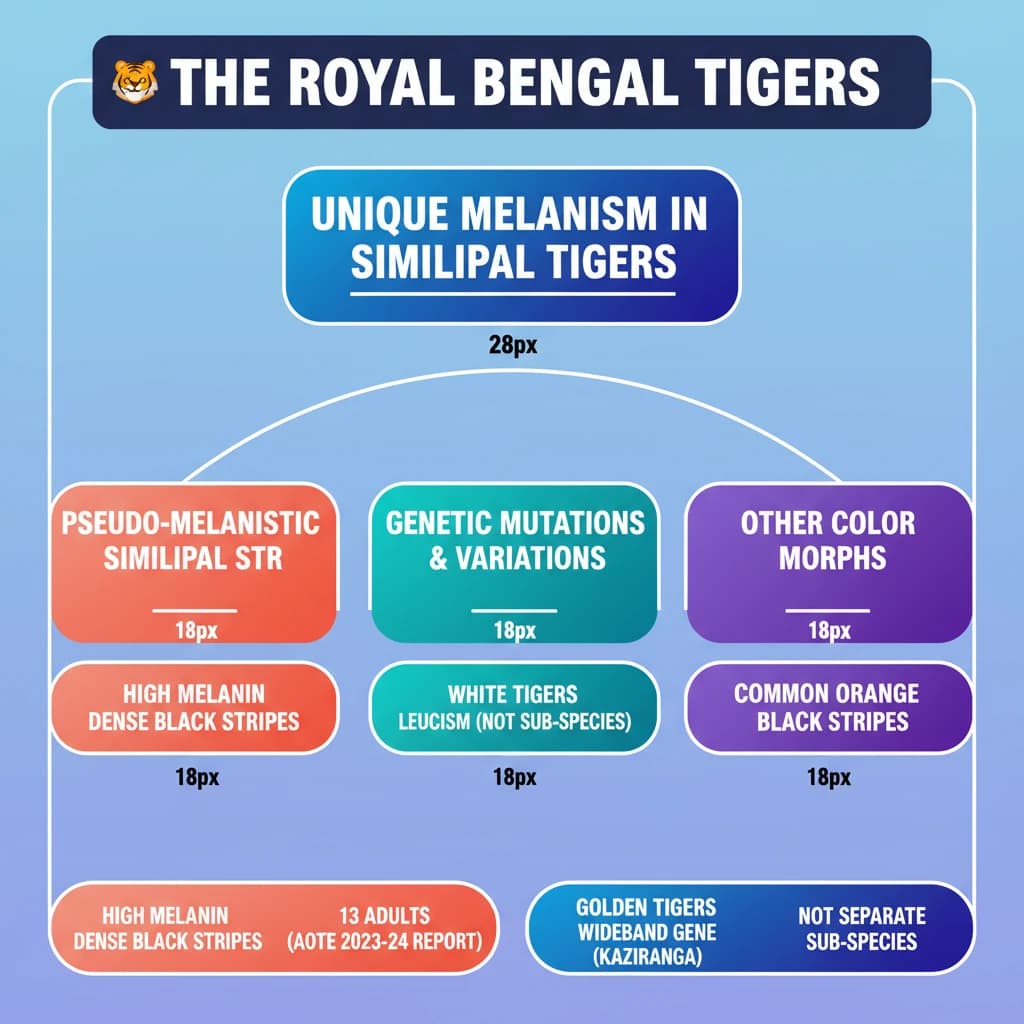
The Royal Bengal Tigers is a key topic under Environment And Ecology for UPSC Civil Services Examination. Key points include: Pseudo-melanistic Royal Bengal Tigers in Similipal STR have unique high melanin levels, resulting in dense black stripes.. AOTE 2023-24 report identified 13 adult pseudo-melanistic tigers in STR, a trait unique to this wild habitat.. Other tiger color variations include common orange with black stripes, white tigers (due to leucism), and golden tigers (due to the wideband gene).. Understanding this topic is essential for both UPSC Prelims and Mains preparation.

Why is The Royal Bengal Tigers important for UPSC exam?

The Royal Bengal Tigers is a Medium-level topic in UPSC Environment And Ecology. It is tested in both Prelims (factual MCQs) and Mains (analytical answer writing). Previous year UPSC questions have frequently covered aspects of The Royal Bengal Tigers, making it essential for comprehensive IAS preparation.

How to prepare The Royal Bengal Tigers for UPSC?

To prepare The Royal Bengal Tigers for UPSC: (1) Study the comprehensive notes covering all key concepts on Vaidra. (2) Practice previous year questions on this topic. (3) Connect it with current affairs using daily updates. (4) Revise using key takeaways and mind maps available for Environment And Ecology. (5) Write practice answers linking The Royal Bengal Tigers to related GS Paper topics.

Key takeaways of The Royal Bengal Tigers for UPSC

  • Pseudo-melanistic Royal Bengal Tigers in Similipal STR have unique high melanin levels, resulting in dense black stripes.
  • AOTE 2023-24 report identified 13 adult pseudo-melanistic tigers in STR, a trait unique to this wild habitat.
  • Other tiger color variations include common orange with black stripes, white tigers (due to leucism), and golden tigers (due to the wideband gene).
  • White tigers are not a separate subspecies but a genetic mutation (leucism) reducing pigmentation.
  • Golden tigers, seen in Kaziranga, are also not a subspecies, caused by a recessive 'wideband' gene affecting melanin.
  • Genetic diversity and unique traits are crucial for long-term species survival and conservation strategies.
The Royal Bengal Tigers

The Royal Bengal Tigers

Medium⏱️ 7 min read✓ 95% Verified
environment and ecology

📖 Introduction

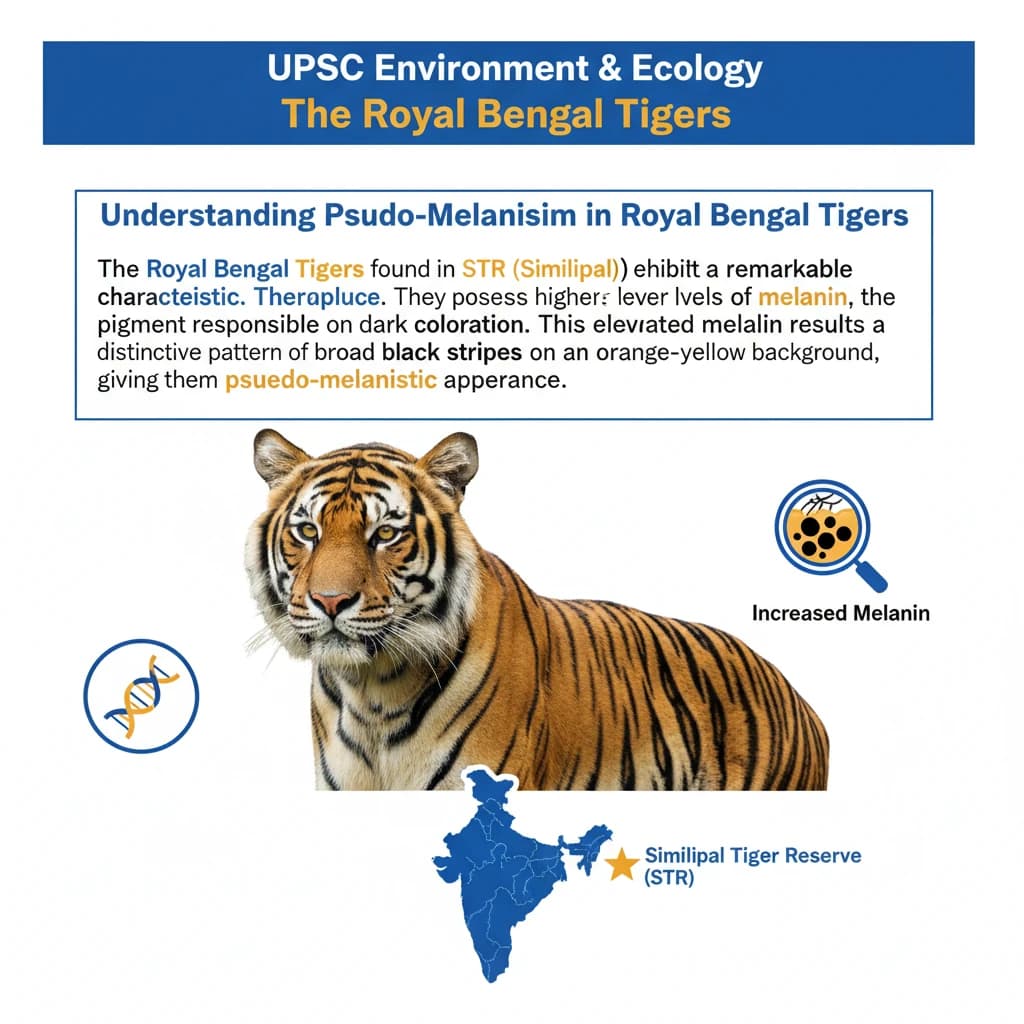
<h4>Understanding Pseudo-Melanism in Royal Bengal Tigers</h4><p>The <strong>Royal Bengal Tigers</strong> found in <strong>STR</strong> (Similipal Tiger Reserve) exhibit a remarkable genetic characteristic. They possess higher levels of <strong>melanin</strong>, the pigment responsible for dark coloration.</p><p>This elevated melanin results in a distinctive pattern of broad black stripes on an orange-yellow background, giving them a <strong>pseudo-melanistic</strong> appearance. This trait makes them visually unique among tiger populations.</p><div class='key-point-box'><p><strong>Pseudo-melanism</strong> is a genetic variation where an animal appears darker than normal due to increased pigmentation, but not fully melanistic (completely black).</p></div><h4>All Odisha Tiger Estimation (AOTE) 2023-24 Findings</h4><p>Recent surveys confirm the presence of these unique tigers. The <strong>All Odisha Tiger Estimation (AOTE) 2023-24 report</strong> provides crucial data on the tiger population in the region.</p><div class='info-box'><p>The <strong>AOTE 2023-24 report</strong> estimates that <strong>Similipal Tiger Reserve (STR)</strong> is home to <strong>27 tigers</strong>. Significantly, <strong>13 adult pseudo-melanistic tigers</strong> were identified within this population.</p></div><p>This particular genetic trait, leading to pseudo-melanism, is currently <strong>not found in any other wild habitat</strong> globally, making STR a critically important site for tiger conservation.</p><div class='exam-tip-box'><p>For <strong>UPSC Prelims</strong>, remember the location (<strong>STR</strong>), the specific trait (<strong>pseudo-melanism</strong>), and its uniqueness. For <strong>Mains</strong>, discuss its implications for biodiversity and conservation strategies.</p></div><h4>Other Notable Color Variations in Tigers</h4><p>While pseudo-melanism is rare, tigers display several other fascinating color variations, each stemming from distinct genetic factors.</p><ul><li><strong>Orange with Black or Brown Stripes:</strong> This is the most prevalent and widely recognized coloration of tigers, including the typical <strong>Royal Bengal Tiger</strong>.</li><li>Each tiger possesses a <strong>unique stripe pattern</strong>, akin to human fingerprints. This intricate patterning provides effective <strong>camouflage</strong> within their natural forest habitats.</li></ul><h4>Understanding White Tigers</h4><p><strong>White tigers</strong> are often mistaken for a separate subspecies, but they are not. Their distinct appearance is due to a specific genetic condition.</p><div class='info-box'><p>The white fur of these tigers is a result of a <strong>genetic mutation</strong> known as <strong>leucism</strong>. This mutation causes a significant reduction in overall pigmentation, leading to pale-colored skin, fur, or scales.</p></div><p>Unlike albinism, leucism affects only pigment cells, not eye color, so white tigers typically have blue eyes.</p><h4>Exploring Golden Tigers</h4><p>Another striking variation is the <strong>Golden Tiger</strong>, which, like white tigers, is not considered a distinct subspecies. Their unique coloration is also genetically determined.</p><div class='info-box'><p>The golden hue in these tigers is caused by a <strong>recessive gene</strong> referred to as <strong>“wideband.”</strong> This gene interferes with <strong>melanin production</strong> during the hair growth phase, resulting in a lighter, golden-orange coat.</p></div><p>This rare variation has been specifically observed in the wild within <strong>Kaziranga National Park</strong> in India, highlighting the genetic diversity present in Indian tiger populations.</p>
Concept Diagram

💡 Key Takeaways

  • •Pseudo-melanistic Royal Bengal Tigers in Similipal STR have unique high melanin levels, resulting in dense black stripes.
  • •AOTE 2023-24 report identified 13 adult pseudo-melanistic tigers in STR, a trait unique to this wild habitat.
  • •Other tiger color variations include common orange with black stripes, white tigers (due to leucism), and golden tigers (due to the wideband gene).
  • •White tigers are not a separate subspecies but a genetic mutation (leucism) reducing pigmentation.
  • •Golden tigers, seen in Kaziranga, are also not a subspecies, caused by a recessive 'wideband' gene affecting melanin.
  • •Genetic diversity and unique traits are crucial for long-term species survival and conservation strategies.

🧠 Memory Techniques

Memory Aid
95% Verified Content

Related Topics

Loading related topics...
Explore:Environment And Ecology Topics·All Subjects·Daily Current Affairs·Editorial Analysis·Previous Year Questions·UPSC GPT
The Royal Bengal Tigers - UPSC Environment And Ecology