Loading page, please wait…
Vaidra Logo
Vaidra

Top 4 items + smart groups

UPSC GPT
New
Current Affairs
Daily Solutions
Daily Puzzle
Mains Evaluator

Version 2.0.0 • Built with ❤️ for UPSC aspirants

Loading...
Loading...
Loading...
Loading...
Loading...
Loading...
Loading...
Loading...
Loading...
Loading...
Loading...
Loading...
Loading...
Back
All Subjects

Topics

0 topics • 0 completed

Loading topics...
Loading...
Loading...
Loading...
Loading...
Loading...
Overall Progress0%

Bhitarkanika National Park: Key Fauna & Nesting Sites - UPSC Environment And Ecology

What is Bhitarkanika National Park: Key Fauna & Nesting Sites in UPSC Environment And Ecology?

Bhitarkanika National Park: Key Fauna & Nesting Sites is a key topic under Environment And Ecology for UPSC Civil Services Examination. Key points include: Bhitarkanika National Park is home to India's largest congregation of saltwater crocodiles.. Gahirmatha Beach within BNP is the world's largest nesting site for Olive Ridley Sea Turtles, famous for 'Arribada'.. Bagagahana (Herony) near Surajpore creek is a significant avian breeding ground.. Understanding this topic is essential for both UPSC Prelims and Mains preparation.

Why is Bhitarkanika National Park: Key Fauna & Nesting Sites important for UPSC exam?

Bhitarkanika National Park: Key Fauna & Nesting Sites is a Medium-level topic in UPSC Environment And Ecology. It is tested in both Prelims (factual MCQs) and Mains (analytical answer writing). Previous year UPSC questions have frequently covered aspects of Bhitarkanika National Park: Key Fauna & Nesting Sites, making it essential for comprehensive IAS preparation.

How to prepare Bhitarkanika National Park: Key Fauna & Nesting Sites for UPSC?

To prepare Bhitarkanika National Park: Key Fauna & Nesting Sites for UPSC: (1) Study the comprehensive notes covering all key concepts on Vaidra. (2) Practice previous year questions on this topic. (3) Connect it with current affairs using daily updates. (4) Revise using key takeaways and mind maps available for Environment And Ecology. (5) Write practice answers linking Bhitarkanika National Park: Key Fauna & Nesting Sites to related GS Paper topics.

Key takeaways of Bhitarkanika National Park: Key Fauna & Nesting Sites for UPSC

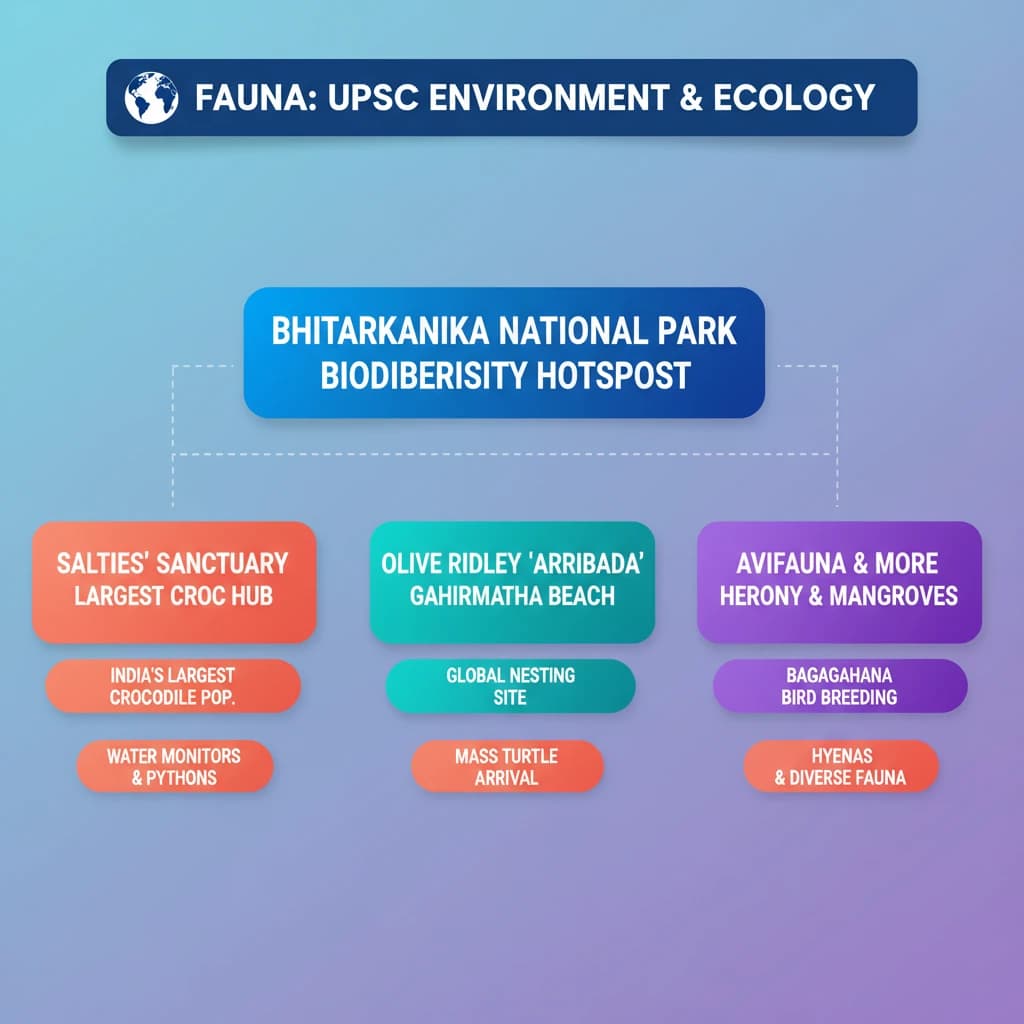
  • Bhitarkanika National Park is home to India's largest congregation of saltwater crocodiles.
  • Gahirmatha Beach within BNP is the world's largest nesting site for Olive Ridley Sea Turtles, famous for 'Arribada'.
  • Bagagahana (Herony) near Surajpore creek is a significant avian breeding ground.
  • Other notable fauna include water monitor lizards, pythons, and hyenas.
  • The park's diverse fauna highlights the importance of mangrove ecosystems and coastal biodiversity conservation.
Bhitarkanika National Park: Key Fauna & Nesting Sites

Bhitarkanika National Park: Key Fauna & Nesting Sites

Medium⏱️ 6 min read✓ 95% Verified
environment and ecology

📖 Introduction

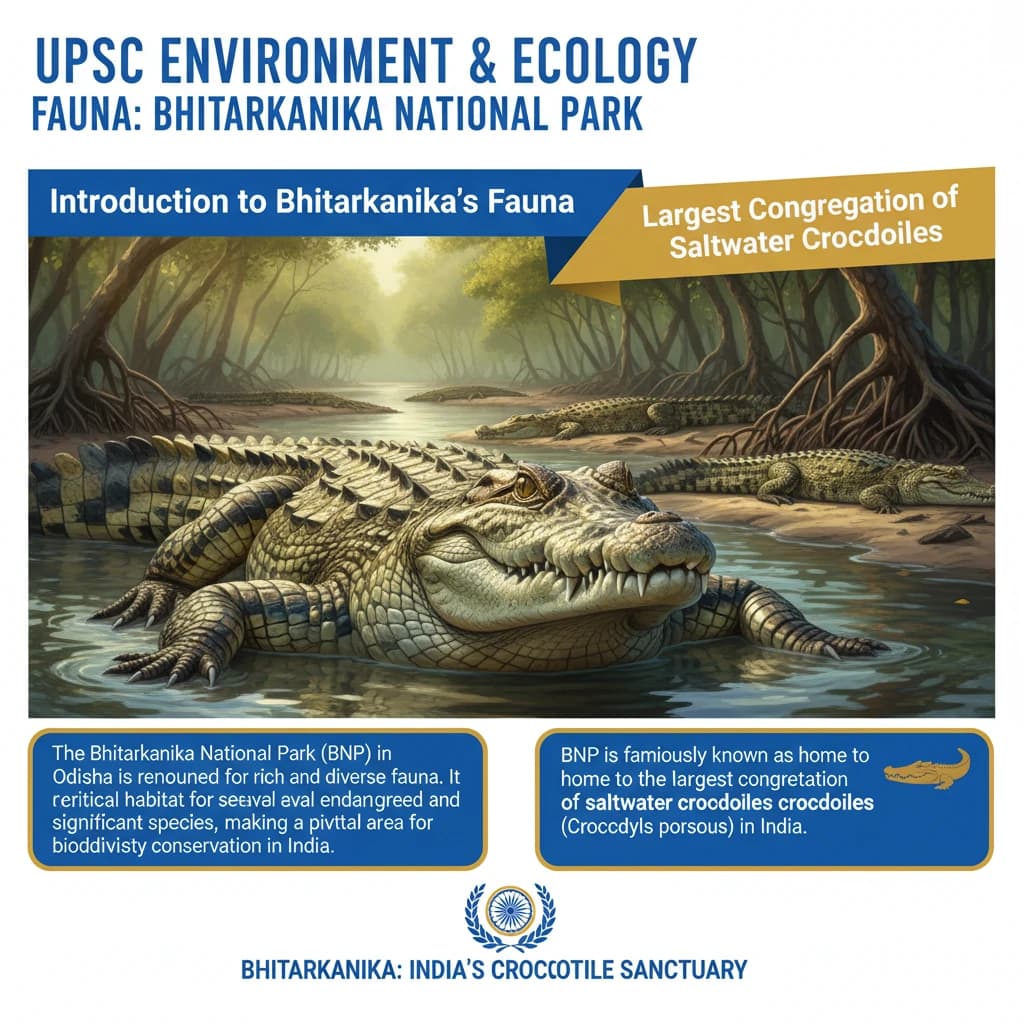
<h4>Introduction to Bhitarkanika's Fauna</h4><p>The <strong>Bhitarkanika National Park (BNP)</strong> in Odisha is renowned for its rich and diverse fauna. It represents a critical habitat for several endangered and significant species, making it a pivotal area for biodiversity conservation in India.</p><h4>Largest Congregation of Saltwater Crocodiles</h4><p>BNP is famously known as home to the <strong>largest congregation of saltwater crocodiles (<em>Crocodylus porosus</em>)</strong> in India. This makes it a prime location for studying and conserving these apex predators.</p><div class='info-box'><p><strong>Saltwater Crocodiles:</strong> These are the largest living reptiles and are found in coastal brackish waters and estuaries. Bhitarkanika's extensive mangrove ecosystem provides an ideal habitat for their breeding and survival.</p></div><h4>Other Notable Species</h4><p>Beyond the crocodiles, Bhitarkanika's ecosystem supports a variety of other fascinating wildlife. These species contribute to the park's rich biodiversity and ecological balance.</p><ul><li><strong>Water Monitor Lizards:</strong> Large, semi-aquatic lizards found in various habitats, including mangrove forests.</li><li><strong>Pythons:</strong> Non-venomous constrictor snakes, often found in dense vegetation.</li><li><strong>Hyenas:</strong> Scavenging carnivores, though their presence in a coastal mangrove ecosystem might refer to specific species adapted to the region's periphery.</li></ul><h4>Gahirmatha Beach: Olive Ridley Sea Turtle Nesting Site</h4><p><strong>Gahirmatha Beach</strong>, located within the <strong>Bhitarkanika National Park</strong>, holds immense ecological significance. It is globally recognized as the <strong>largest nesting site for Olive Ridley Sea Turtles (<em>Lepidochelys olivacea</em>)</strong>.</p><div class='key-point-box'><p><strong>Mass Nesting (Arribada):</strong> Every year, millions of female Olive Ridley turtles arrive at Gahirmatha Beach for mass nesting, a phenomenon known as 'Arribada'. This spectacle is crucial for the species' survival.</p></div><div class='exam-tip-box'><p><strong>UPSC Insight:</strong> Questions on <strong>Gahirmatha Beach</strong> and <strong>Olive Ridley Sea Turtles</strong> are frequent in <strong>UPSC Prelims</strong>, often focusing on their conservation status, location, and unique nesting behavior. It's vital to know about the challenges faced by these turtles.</p></div><h4>Bagagahana (Herony): An Avian Spectacle</h4><p>Near the <strong>Surajpore creek</strong> within the park, an area known as <strong>Bagagahana (Herony)</strong> becomes a vibrant hub for thousands of birds. This site offers a breathtaking natural spectacle.</p><div class='info-box'><p><strong>Avian Activity:</strong> Thousands of birds congregate here to nest and perform intricate aerial acrobatics, particularly before mating. This creates an impressive and noisy display of avian life.</p></div><p>This 'herony' is a testament to the rich avian diversity supported by the mangrove ecosystem, providing safe breeding grounds away from predators.</p>
Concept Diagram

💡 Key Takeaways

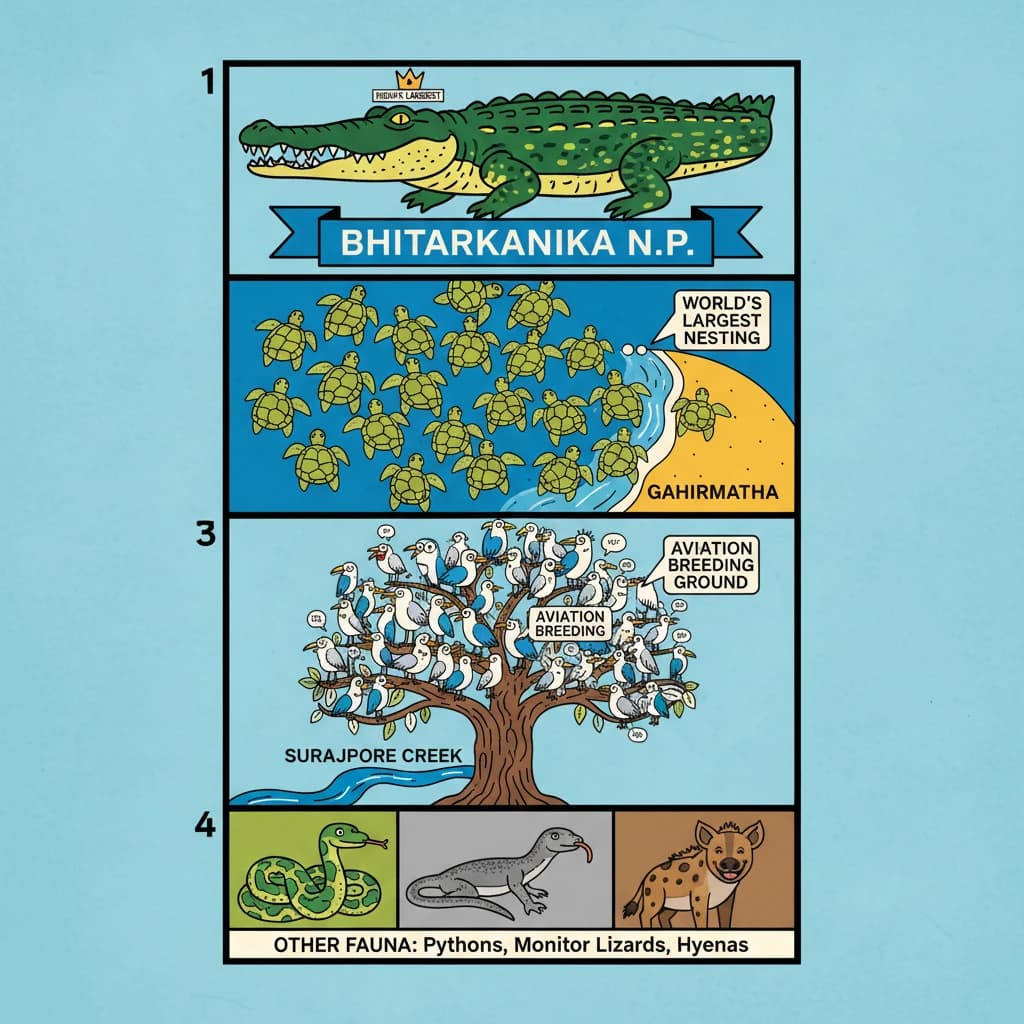
  • •Bhitarkanika National Park is home to India's largest congregation of saltwater crocodiles.
  • •Gahirmatha Beach within BNP is the world's largest nesting site for Olive Ridley Sea Turtles, famous for 'Arribada'.
  • •Bagagahana (Herony) near Surajpore creek is a significant avian breeding ground.
  • •Other notable fauna include water monitor lizards, pythons, and hyenas.
  • •The park's diverse fauna highlights the importance of mangrove ecosystems and coastal biodiversity conservation.

🧠 Memory Techniques
Memory Aid
95% Verified Content

📚 Reference Sources

•Bhitarkanika National Park official information (general knowledge)
•IUCN Red List for species conservation status

Related Topics

Loading related topics...
Explore:Environment And Ecology Topics·All Subjects·Daily Current Affairs·Editorial Analysis·Previous Year Questions·UPSC GPT
Bhitarkanika National Park: Key Fauna & Nesting Sites - UPSC Environment And Ecology