Loading page, please wait…
Vaidra Logo
Vaidra

Top 4 items + smart groups

UPSC GPT
New
Current Affairs
Daily Solutions
Daily Puzzle
Mains Evaluator

Version 2.0.0 • Built with ❤️ for UPSC aspirants

Loading...
Loading...
Loading...
Loading...
Loading...
Loading...
Loading...
Loading...
Loading...
Loading...
Loading...
Loading...
Loading...
Back
All Subjects

Topics

0 topics • 0 completed

Loading topics...
Loading...
Loading...
Loading...
Loading...
Loading...
Overall Progress0%

What are the Trend in Forestry Parameters Between 2013-2023? - UPSC Environment And Ecology

What is What are the Trend in Forestry Parameters Between 2013-2023? in UPSC Environment And Ecology?

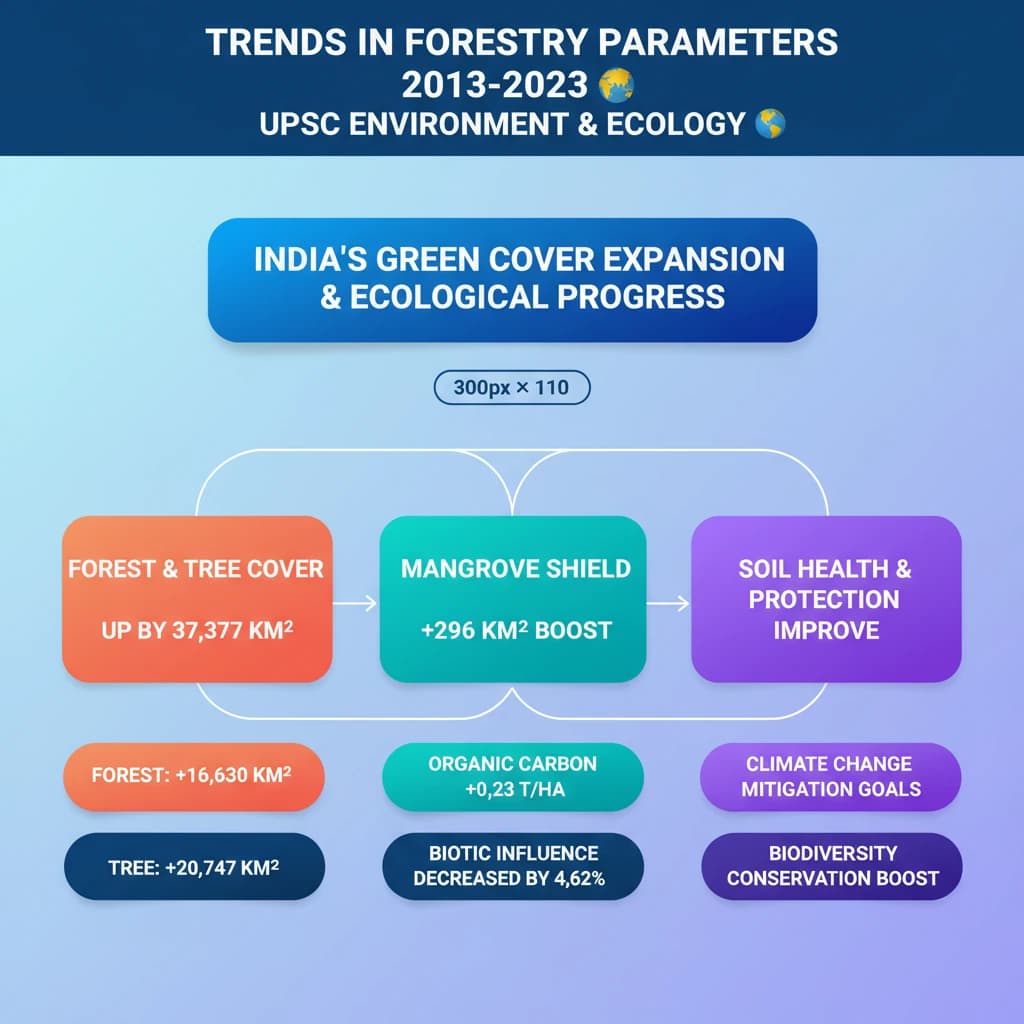
What are the Trend in Forestry Parameters Between 2013-2023? is a key topic under Environment And Ecology for UPSC Civil Services Examination. Key points include: India's forest and tree cover increased by 16,630.25 km² and 20,747.34 km² respectively between 2013-2023.. Mangrove cover saw a significant rise of 296.33 km² in the same period.. Soil health improved, with soil organic carbon increasing from 55.85 to 56.08 tonnes per hectare.. Understanding this topic is essential for both UPSC Prelims and Mains preparation.

Why is What are the Trend in Forestry Parameters Between 2013-2023? important for UPSC exam?

What are the Trend in Forestry Parameters Between 2013-2023? is a Medium-level topic in UPSC Environment And Ecology. It is tested in both Prelims (factual MCQs) and Mains (analytical answer writing). Previous year UPSC questions have frequently covered aspects of What are the Trend in Forestry Parameters Between 2013-2023?, making it essential for comprehensive IAS preparation.

How to prepare What are the Trend in Forestry Parameters Between 2013-2023? for UPSC?

To prepare What are the Trend in Forestry Parameters Between 2013-2023? for UPSC: (1) Study the comprehensive notes covering all key concepts on Vaidra. (2) Practice previous year questions on this topic. (3) Connect it with current affairs using daily updates. (4) Revise using key takeaways and mind maps available for Environment And Ecology. (5) Write practice answers linking What are the Trend in Forestry Parameters Between 2013-2023? to related GS Paper topics.

Key takeaways of What are the Trend in Forestry Parameters Between 2013-2023? for UPSC

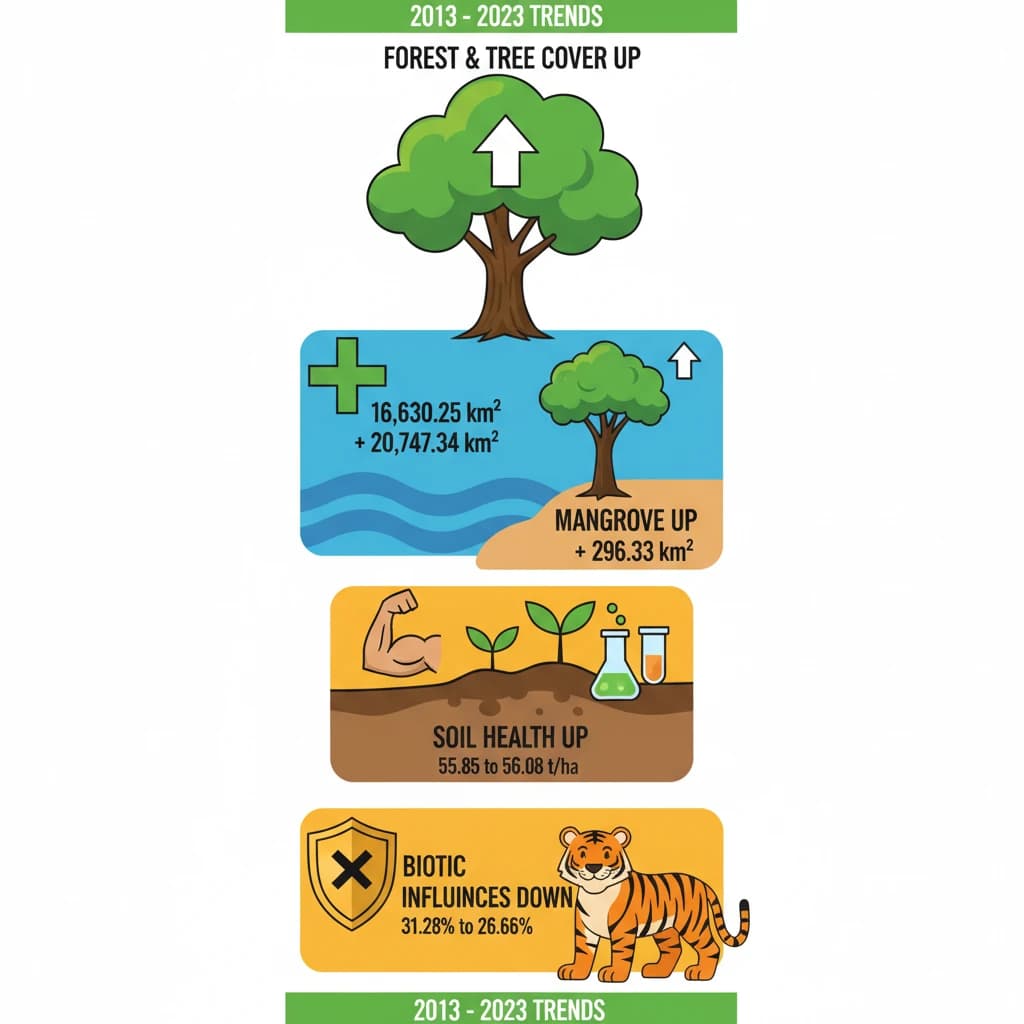
  • India's forest and tree cover increased by 16,630.25 km² and 20,747.34 km² respectively between 2013-2023.
  • Mangrove cover saw a significant rise of 296.33 km² in the same period.
  • Soil health improved, with soil organic carbon increasing from 55.85 to 56.08 tonnes per hectare.
  • Biotic influences on forests decreased from 31.28% to 26.66%, indicating better protection and management.
  • These positive trends contribute significantly to India's climate change goals and biodiversity conservation efforts.
What are the Trend in Forestry Parameters Between 2013-2023?

What are the Trend in Forestry Parameters Between 2013-2023?

Medium⏱️ 10 min read✓ 95% Verified
environment and ecology

📖 Introduction

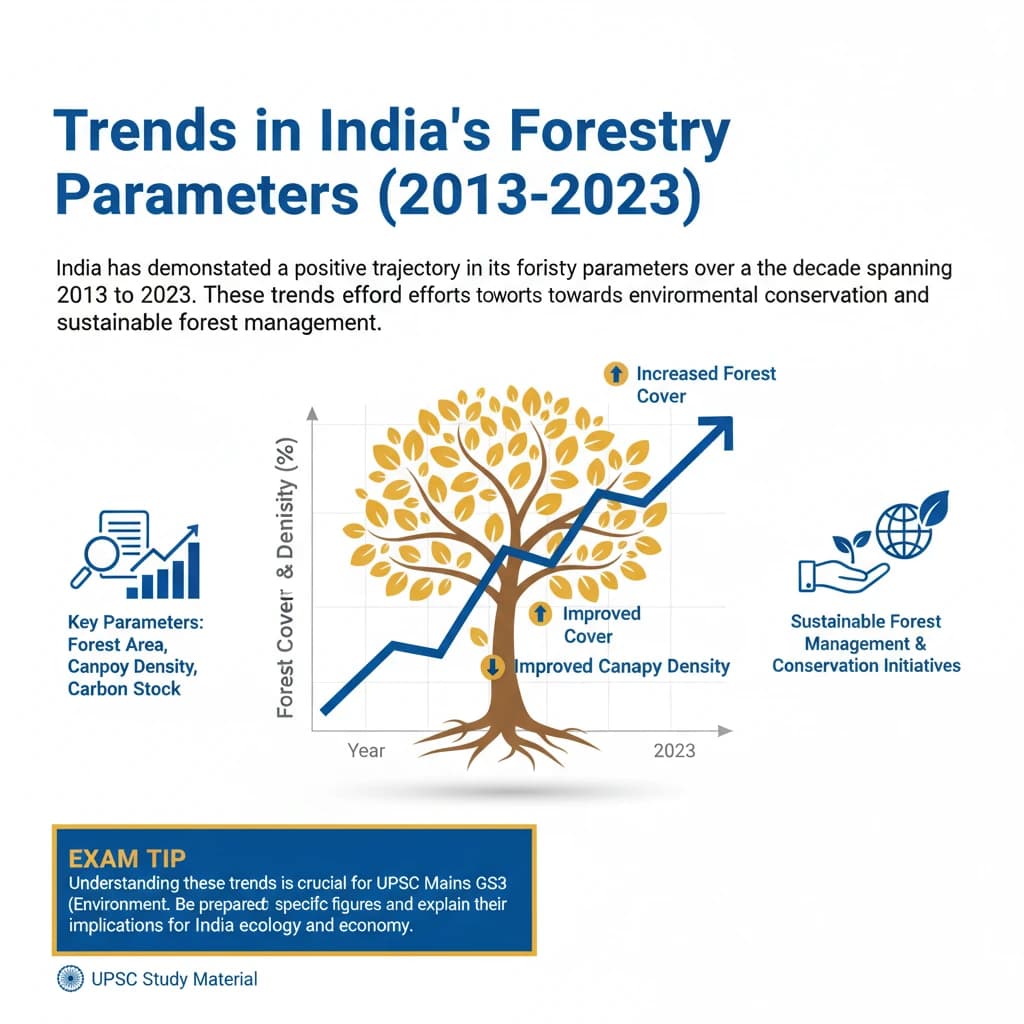
<h4>Trends in India's Forestry Parameters (2013-2023)</h4><p>India has demonstrated a positive trajectory in its forestry parameters over the decade spanning <strong>2013 to 2023</strong>. These trends reflect concerted efforts towards environmental conservation and sustainable forest management.</p><div class='exam-tip-box'><p>Understanding these trends is crucial for <strong>UPSC Mains GS3 (Environment)</strong>. Be prepared to cite specific figures and explain their implications for India's environmental health and climate change commitments.</p></div><h4>Overall Increase in Green Cover</h4><p>A significant highlight of this period is the substantial growth in the country's green cover. Both <strong>forest cover</strong> and <strong>tree cover</strong> have shown impressive increases, contributing to enhanced carbon sequestration and biodiversity.</p><div class='info-box'><p><strong>Forest Cover Increase:</strong> 16,630.25 km²</p><p><strong>Tree Cover Increase:</strong> 20,747.34 km²</p></div><p>Beyond terrestrial forests, India's vital <strong>mangrove ecosystems</strong> have also expanded. Mangroves play a critical role in coastal protection, biodiversity, and carbon storage.</p><div class='info-box'><p><strong>Mangrove Cover Increase:</strong> 296.33 km²</p></div><h4>Improvement in Soil Health</h4><p>The health of forest soils is a fundamental indicator of ecosystem vitality. The period from 2013 to 2023 witnessed a general improvement in <strong>soil health</strong> across various depths.</p><div class='info-box'><p><strong>Improved Soil Health:</strong> From 83.53% in <strong>2013</strong> to 87.16% (shallow to deep soil).</p></div><p>This improvement is largely attributed to an increase in <strong>humus content</strong>, which is vital for soil fertility and structure. A key component contributing to this is <strong>soil organic carbon</strong>.</p><div class='key-point-box'><p><strong>Soil Organic Carbon (SOC):</strong> Carbon contained in <strong>soil organic matter</strong>. It is essential for soil aggregation, enhancing soil structure, and improving stability and water retention capacity.</p></div><div class='info-box'><p><strong>Increase in Soil Organic Carbon:</strong> From 55.85 tonnes per hectare to 56.08 tonnes per hectare.</p></div><h4>Reduction in Biotic Influences</h4><p><strong>Biotic influences</strong> refer to the impact of living organisms, including human activities, on forest ecosystems. A positive trend observed is the reduction in these pressures on India's forests.</p><div class='key-point-box'><p><strong>Biotic Influences:</strong> Any influence from living organisms on forests. This includes activities such as <strong>grazing</strong>, <strong>browsing</strong>, <strong>man-made fires</strong>, <strong>pollarding</strong>, <strong>illicit felling</strong>, and <strong>lopping</strong>.</p></div><div class='info-box'><p><strong>Reduction in Biotic Influences:</strong> From 31.28% in <strong>2013</strong> to 26.66%.</p></div><p>This decline in biotic pressures signifies improved conditions for both <strong>floral biodiversity</strong> and <strong>faunal biodiversity</strong> within forest ecosystems. It indicates more effective protection and management strategies.
Concept Diagram

💡 Key Takeaways

  • •India's forest and tree cover increased by 16,630.25 km² and 20,747.34 km² respectively between 2013-2023.
  • •Mangrove cover saw a significant rise of 296.33 km² in the same period.
  • •Soil health improved, with soil organic carbon increasing from 55.85 to 56.08 tonnes per hectare.
  • •Biotic influences on forests decreased from 31.28% to 26.66%, indicating better protection and management.
  • •These positive trends contribute significantly to India's climate change goals and biodiversity conservation efforts.

🧠 Memory Techniques
Memory Aid
95% Verified Content

📚 Reference Sources

•India State of Forest Report (ISFR) 2021 (Forest Survey of India, MoEF&CC)

Related Topics

Loading related topics...
Explore:Environment And Ecology Topics·All Subjects·Daily Current Affairs·Editorial Analysis·Previous Year Questions·UPSC GPT
What are the Trend in Forestry Parameters Between 2013-2023? - UPSC Environment And Ecology