Loading page, please wait…
Vaidra Logo
Vaidra

Top 4 items + smart groups

UPSC GPT
New
Current Affairs
Daily Solutions
Daily Puzzle
Mains Evaluator

Version 2.0.0 • Built with ❤️ for UPSC aspirants

Loading...
Loading...
Loading...
Loading...
Loading...
Loading...
Loading...
Loading...
Loading...
Loading...
Loading...
Loading...
Loading...
What are Other Important Canals Around the World? - UPSC Environment And Ecology
Back
All Subjects

Topics

0 topics • 0 completed

Loading topics...
Loading...
Loading...
Loading...
Loading...
Loading...
Overall Progress0%

What are Other Important Canals Around the World? - UPSC Environment And Ecology

What is What are Other Important Canals Around the World? in UPSC Environment And Ecology?

What are Other Important Canals Around the World? is a key topic under Environment And Ecology for UPSC Civil Services Examination. Key points include: Suez Canal connects Mediterranean and Red Sea, separating Asia/Africa, shortest route for Europe-Asia trade.. Kiel Canal links Baltic and North Sea, bypassing Denmark, crucial for Northern European shipping.. Corinth Canal (Greece) is world's narrowest, connecting Ionian and Aegean Seas, mainly for smaller vessels.. Understanding this topic is essential for both UPSC Prelims and Mains preparation.

Why is What are Other Important Canals Around the World? important for UPSC exam?

What are Other Important Canals Around the World? is a Medium-level topic in UPSC Environment And Ecology. It is tested in both Prelims (factual MCQs) and Mains (analytical answer writing). Previous year UPSC questions have frequently covered aspects of What are Other Important Canals Around the World?, making it essential for comprehensive IAS preparation.

How to prepare What are Other Important Canals Around the World? for UPSC?

To prepare What are Other Important Canals Around the World? for UPSC: (1) Study the comprehensive notes covering all key concepts on Vaidra. (2) Practice previous year questions on this topic. (3) Connect it with current affairs using daily updates. (4) Revise using key takeaways and mind maps available for Environment And Ecology. (5) Write practice answers linking What are Other Important Canals Around the World? to related GS Paper topics.

Key takeaways of What are Other Important Canals Around the World? for UPSC

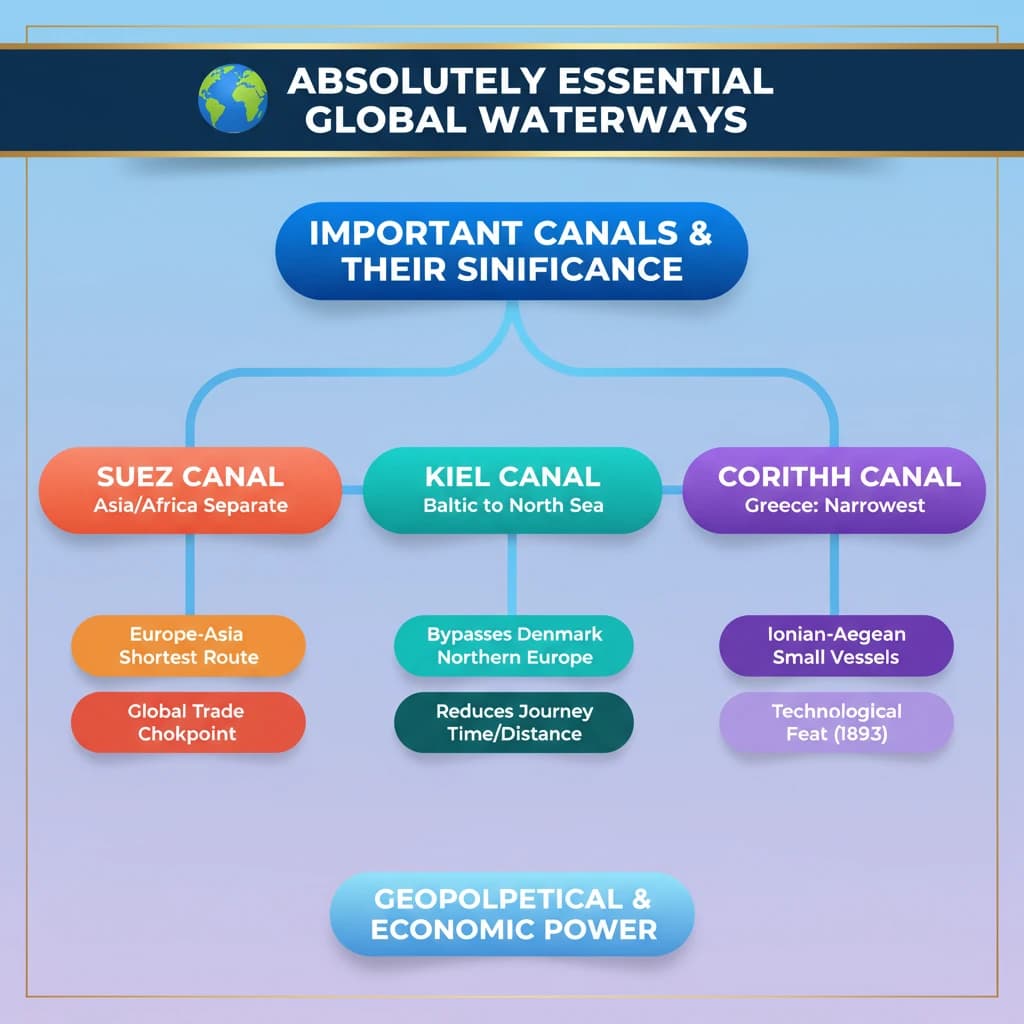
  • Suez Canal connects Mediterranean and Red Sea, separating Asia/Africa, shortest route for Europe-Asia trade.
  • Kiel Canal links Baltic and North Sea, bypassing Denmark, crucial for Northern European shipping.
  • Corinth Canal (Greece) is world's narrowest, connecting Ionian and Aegean Seas, mainly for smaller vessels.
  • Canals are vital for global trade, reducing shipping distances, and hold significant geopolitical importance.
  • Historical development of canals reflects technological advancements and imperial ambitions.
What are Other Important Canals Around the World?

What are Other Important Canals Around the World?

Medium⏱️ 7 min read✓ 95% Verified
environment and ecology

📖 Introduction

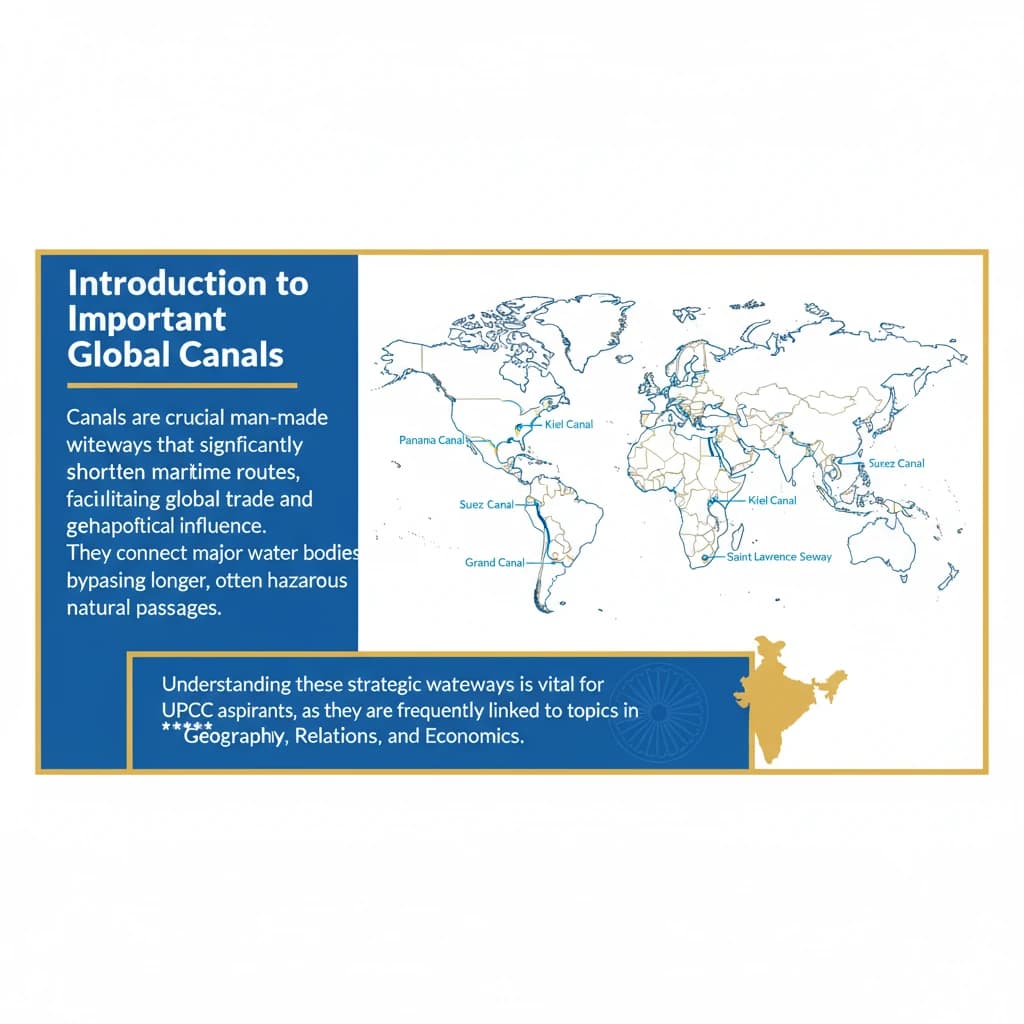
<h4>Introduction to Important Global Canals</h4><p>Canals are crucial man-made waterways that significantly shorten maritime routes, facilitating global trade and enhancing geopolitical influence. They connect major water bodies, bypassing longer, often hazardous natural passages.</p><div class='key-point-box'><p>Understanding these strategic waterways is vital for UPSC aspirants, as they are frequently linked to topics in <strong>Geography</strong>, <strong>International Relations</strong>, and <strong>Economy</strong>.</p></div><h4>The Suez Canal: A Lifeline for Global Trade</h4><p>The <strong>Suez Canal</strong> is an artificial sea-level waterway in <strong>Egypt</strong>, connecting the <strong>Mediterranean Sea</strong> to the <strong>Red Sea</strong> via the <strong>Gulf of Suez</strong>. This strategic link effectively separates the continents of <strong>Asia</strong> and <strong>Africa</strong>.</p><div class='info-box'><p><strong>Key Facts:</strong><ul><li><strong>Connects:</strong> Mediterranean Sea and Red Sea (via Gulf of Suez)</li><li><strong>Location:</strong> Egypt, between Port Said (north) and Suez (south)</li><li><strong>Significance:</strong> Provides the shortest maritime route between <strong>Europe</strong> and the regions around the <strong>Indian Ocean</strong> and the <strong>Western Pacific Ocean</strong>.</li></ul></p></div><p>Its existence dramatically reduces travel time for ships, eliminating the need to navigate around the entire continent of <strong>Africa</strong> (the Cape of Good Hope route).</p><h4>The Kiel Canal: Connecting Northern Europe</h4><p>The <strong>Kiel Canal</strong> is an important freshwater canal in <strong>Germany</strong>. It serves as a vital shortcut for vessels navigating between two major European seas.</p><div class='info-box'><p><strong>Key Facts:</strong><ul><li><strong>Connects:</strong> <strong>Baltic Sea</strong> with the <strong>North Sea</strong></li><li><strong>Opened:</strong> <strong>1895</strong></li><li><strong>Length:</strong> Approximately <strong>98 km</strong> long</li><li><strong>Significance:</strong> Allows ships to bypass the much longer and often more perilous route around the <strong>Jutland Peninsula</strong> (Denmark).</li></ul></p></div><p>This canal significantly boosts maritime efficiency and safety for shipping in Northern Europe, especially for trade with <strong>Scandinavia</strong> and <strong>Russia</strong>.</p><h4>The Corinth Canal: Greece's Engineering Marvel</h4><p>The <strong>Corinth Canal</strong> is a notable canal located in <strong>Greece</strong>. It is renowned for its unique geological and structural characteristics.</p><div class='info-box'><p><strong>Key Facts:</strong><ul><li><strong>Connects:</strong> <strong>Corinthian Gulf</strong> of the <strong>Ionian Sea</strong> and the <strong>Saronic Gulf</strong> of the <strong>Aegean Sea</strong></li><li><strong>Distinction:</strong> Considered the <strong>world’s narrowest canal</strong> for large vessels.</li></ul></p></div><p>While historically significant, its narrowness limits its utility for modern, large cargo ships, making it more of a tourist attraction and a route for smaller vessels today.</p><div class='exam-tip-box'><p>For UPSC, focus on the <strong>geopolitical and economic significance</strong> of these canals. Be prepared to locate them on a map and discuss their impact on global trade routes and international relations.</p></div>
Concept Diagram

💡 Key Takeaways

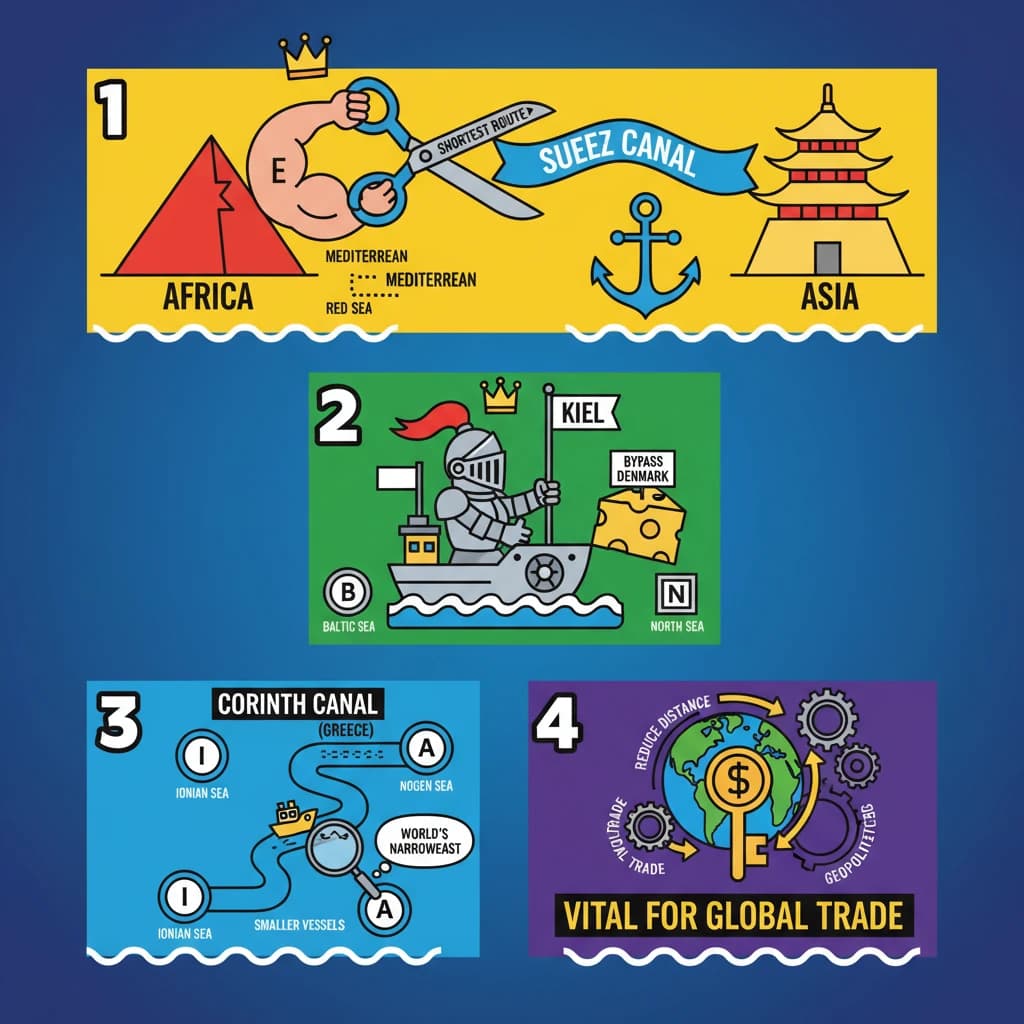
  • •Suez Canal connects Mediterranean and Red Sea, separating Asia/Africa, shortest route for Europe-Asia trade.
  • •Kiel Canal links Baltic and North Sea, bypassing Denmark, crucial for Northern European shipping.
  • •Corinth Canal (Greece) is world's narrowest, connecting Ionian and Aegean Seas, mainly for smaller vessels.
  • •Canals are vital for global trade, reducing shipping distances, and hold significant geopolitical importance.
  • •Historical development of canals reflects technological advancements and imperial ambitions.

🧠 Memory Techniques
Memory Aid
95% Verified Content

📚 Reference Sources

•Encyclopaedia Britannica (for general canal information and historical context)
•Suez Canal Authority official website (for specific Suez Canal details)

Related Topics

Loading related topics...
Explore:Environment And Ecology Topics·All Subjects·Daily Current Affairs·Editorial Analysis·Previous Year Questions·UPSC GPT