Loading page, please wait…
Vaidra Logo
Vaidra

Top 4 items + smart groups

UPSC GPT
New
Current Affairs
Daily Solutions
Daily Puzzle
Mains Evaluator

Version 2.0.0 • Built with ❤️ for UPSC aspirants

Loading...
Loading...
Loading...
Loading...
Loading...
Loading...
Loading...
Loading...
Loading...
Loading...
Loading...
Loading...
Loading...
Back
All Subjects

Topics

0 topics • 0 completed

Loading topics...
Loading...
Loading...
Loading...
Loading...
Loading...
Overall Progress0%

No reason to worry - UPSC Environment And Ecology

What is No reason to worry in UPSC Environment And Ecology?

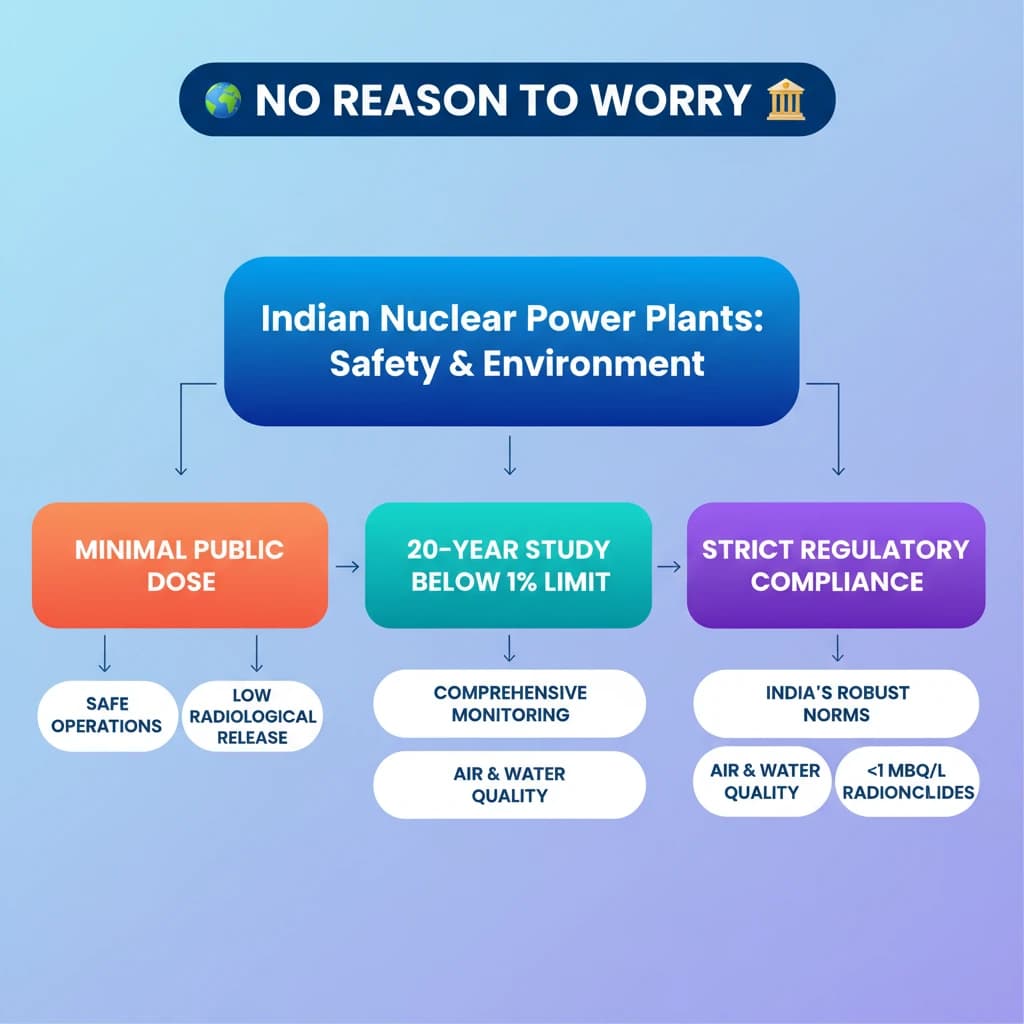
No reason to worry is a key topic under Environment And Ecology for UPSC Civil Services Examination. Key points include: Indian Nuclear Power Plants (NPPs) operate safely with minimal public radiological doses.. A 20-year study (2000-2020) confirms environmental releases are well below 1% of permissible limits.. Comprehensive monitoring covers gaseous and liquid waste, including fission products and activated nuclides.. Understanding this topic is essential for both UPSC Prelims and Mains preparation.

Why is No reason to worry important for UPSC exam?

No reason to worry is a Medium-level topic in UPSC Environment And Ecology. It is tested in both Prelims (factual MCQs) and Mains (analytical answer writing). Previous year UPSC questions have frequently covered aspects of No reason to worry, making it essential for comprehensive IAS preparation.

How to prepare No reason to worry for UPSC?

To prepare No reason to worry for UPSC: (1) Study the comprehensive notes covering all key concepts on Vaidra. (2) Practice previous year questions on this topic. (3) Connect it with current affairs using daily updates. (4) Revise using key takeaways and mind maps available for Environment And Ecology. (5) Write practice answers linking No reason to worry to related GS Paper topics.

Key takeaways of No reason to worry for UPSC

  • Indian Nuclear Power Plants (NPPs) operate safely with minimal public radiological doses.
  • A 20-year study (2000-2020) confirms environmental releases are well below 1% of permissible limits.
  • Comprehensive monitoring covers gaseous and liquid waste, including fission products and activated nuclides.
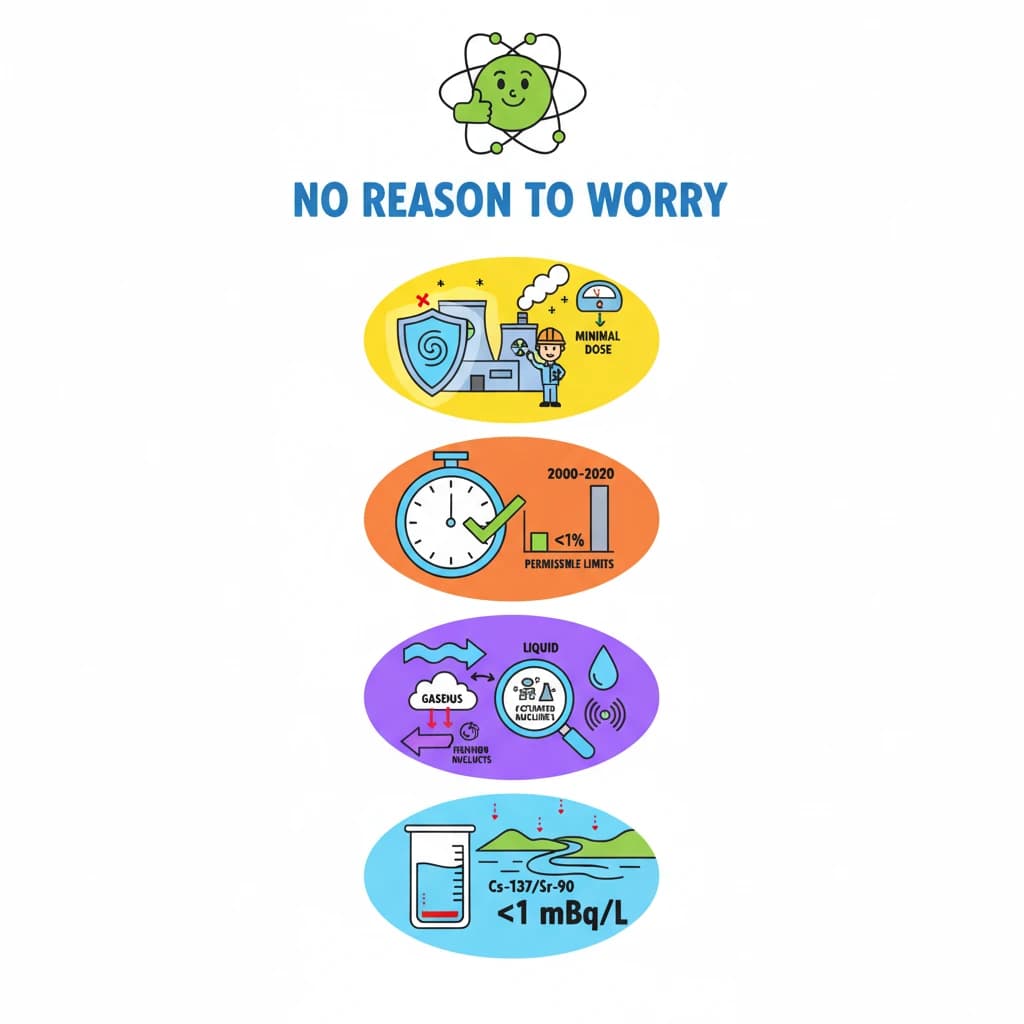
  • Radionuclide concentrations in air, rivers, lakes, and sea water are consistently very low (e.g., <1 mBq/L for Cs-137/Sr-90 in water).
  • Discharges adhere strictly to India's robust radiological and environmental regulatory regimes.
No reason to worry

No reason to worry

Medium⏱️ 7 min read✓ 95% Verified
environment and ecology

📖 Introduction

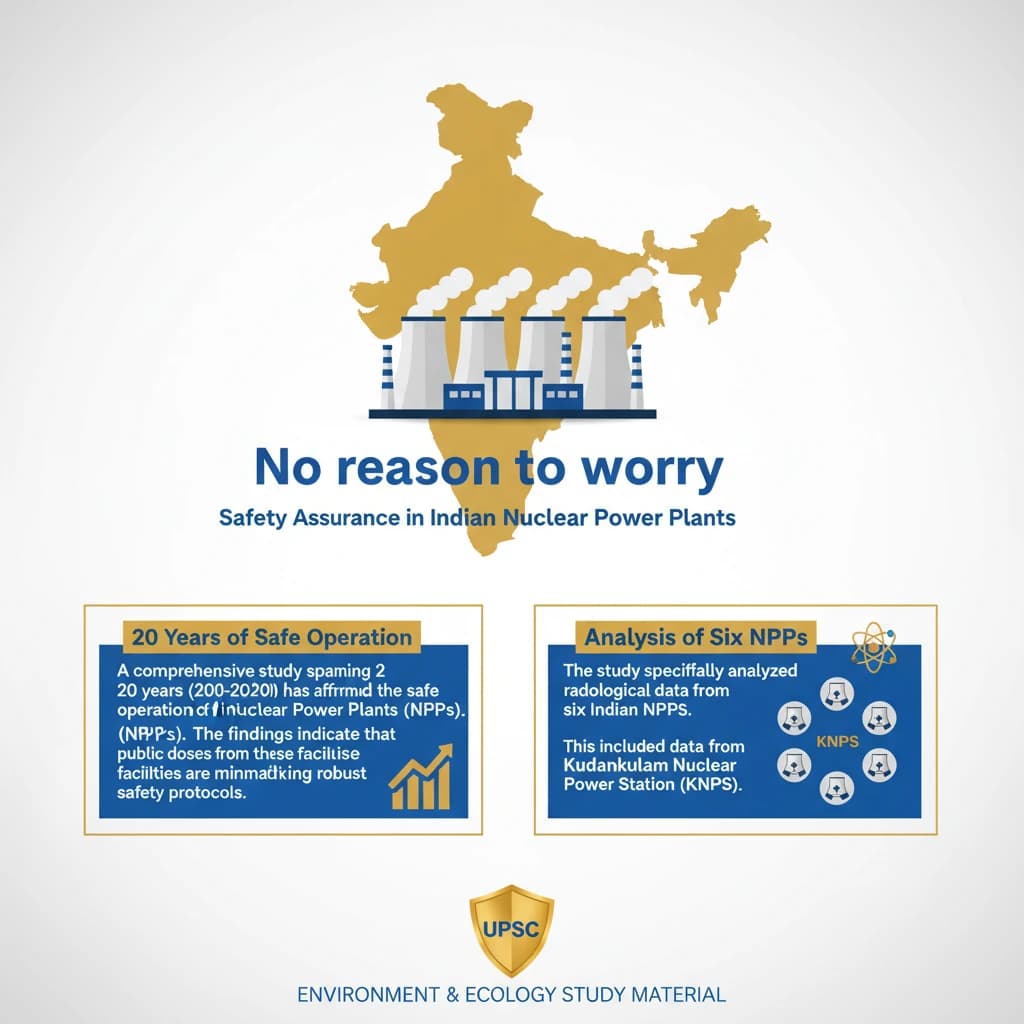
<h4>Safety Assurance in Indian Nuclear Power Plants</h4><p>A comprehensive study spanning <strong>20 years (2000-2020)</strong> has affirmed the safe operation of <strong>Indian Nuclear Power Plants (NPPs)</strong>. The findings indicate that public doses from these facilities are minimal, underscoring robust safety protocols.</p><p>The study specifically analyzed radiological data from <strong>six Indian NPPs</strong>. This included data from the <strong>Kudankulam Nuclear Power Station (KNPS)</strong>, which was covered for the period from <strong>2013 to 2020</strong>.</p><div class='info-box'><p><strong>Study Focus:</strong> Concentrations of <strong>fission products</strong> and <strong>neutron-activated nuclides</strong> within a <strong>5 km radius</strong> of the plants.</p><p><strong>Key Finding:</strong> Monitored values within the 5 km radius were consistently <strong>well below 1%</strong> of the permissible limits. This suggests extremely low environmental impact close to the facilities.</p></div><h4>Monitored Radioactive Substances</h4><p>The study meticulously examined various radioactive substances released as gaseous and liquid waste from the NPPs. These substances are crucial indicators of operational safety and environmental impact.</p><div class='key-point-box'><p><strong>Gaseous Waste Components:</strong></p><ul><li><strong>Fission product noble gases</strong></li><li><strong>Argon 41</strong></li><li><strong>Radioiodine</strong></li><li><strong>Particulate radionuclides:</strong> <strong>cobalt-60</strong>, <strong>strontium-90</strong>, <strong>caesium-137</strong>, and <strong>tritium</strong></li></ul><p><strong>Liquid Discharge Components:</strong></p><ul><li><strong>Fission product radionuclides:</strong> <strong>radioiodine</strong>, <strong>tritium</strong>, <strong>strontium-90</strong>, <strong>caesium-137</strong></li><li><strong>Activation products:</strong> <strong>cobalt-60</strong></li></ul></div><h4>Environmental Concentrations of Radionuclides</h4><p>Monitoring extended to various environmental matrices, including rivers, lakes, sea water, and air particulates. The concentrations observed were remarkably low, often below detection limits or significantly below specified safety thresholds.</p><div class='info-box'><p><strong>In Rivers and Lakes:</strong></p><ul><li><strong>Caesium-137</strong> and <strong>strontium-90</strong> were below <strong>5 mBq per litre</strong>.</li><li>Average concentrations were below <strong>1 mBq per litre</strong> for <strong>caesium-137</strong> and <strong>average iodine-131 activity</strong>.</li></ul><p><strong>In Sea Water:</strong></p><ul><li>Concentrations were below <strong>5 mBq per litre</strong>.</li><li>Near nuclear plants, the concentration was less than <strong>50 mBq per litre</strong>.</li><li>For <strong>caesium-137</strong> and <strong>strontium-90</strong>, average concentrations were below <strong>1 mBq per litre</strong> for both.</li></ul></div><h4>Air Particulates Monitoring</h4><p>Monitoring of air particulates provides crucial data on atmospheric releases. The study reported very low levels of radioactivity in the air around the plants.</p><div class='info-box'><p><strong>Average Gross Alpha Activity:</strong> Less than <strong>0.1 millibecquerel (mBq) per cubic meter</strong> at all seven nuclear plants monitored.</p><p><strong>Specific Marker Concentrations in Air:</strong> Average concentrations of <strong>radioiodine (Iodine-131)</strong>, <strong>caesium-137</strong>, and <strong>strontium-90</strong> across all sites were below <strong>1 mBq per cubic meter</strong>.</p></div><h4>Regional Variations and Regulatory Adherence</h4><p>While overall levels were low, some regional variations were noted, primarily due to environmental factors rather than operational issues.</p><p>The <strong>Narora Atomic Power Station</strong> in <strong>Uttar Pradesh</strong> exhibited slightly higher maximum values for air particulates. This was attributed to a higher <strong>atmospheric dust load</strong> prevalent in the region, rather than increased radioactive emissions.</p><div class='exam-tip-box'><p><strong>UPSC Insight:</strong> When discussing environmental impact, it's crucial to differentiate between plant-specific emissions and ambient environmental factors like dust load. This demonstrates a nuanced understanding for <strong>GS Paper III</strong>.</p></div><p>All <strong>radioactive discharges</strong> are carried out through controlled processes of <strong>dilution and dispersion</strong>. These operations strictly adhere to stringent <strong>radiological and environmental regulatory regimes</strong> established by Indian authorities.</p>
Concept Diagram

💡 Key Takeaways

  • •Indian Nuclear Power Plants (NPPs) operate safely with minimal public radiological doses.
  • •A 20-year study (2000-2020) confirms environmental releases are well below 1% of permissible limits.
  • •Comprehensive monitoring covers gaseous and liquid waste, including fission products and activated nuclides.
  • •Radionuclide concentrations in air, rivers, lakes, and sea water are consistently very low (e.g., <1 mBq/L for Cs-137/Sr-90 in water).
  • •Discharges adhere strictly to India's robust radiological and environmental regulatory regimes.

🧠 Memory Techniques
Memory Aid
95% Verified Content

📚 Reference Sources

•Implicitly: Reports from Indian Nuclear Power Corporation Limited (NPCIL)
•Implicitly: Data from Atomic Energy Regulatory Board (AERB)

Related Topics

Loading related topics...
Explore:Environment And Ecology Topics·All Subjects·Daily Current Affairs·Editorial Analysis·Previous Year Questions·UPSC GPT
No reason to worry - UPSC Environment And Ecology