Loading page, please wait…
Vaidra Logo
Vaidra

Top 4 items + smart groups

UPSC GPT
New
Current Affairs
Daily Solutions
Daily Puzzle
Mains Evaluator

Version 2.0.0 • Built with ❤️ for UPSC aspirants

Loading...
Loading...
Loading...
Loading...
Loading...
Loading...
Loading...
Loading...
Loading...
Loading...
Loading...
Loading...
Loading...
What are the Key Highlights of the Report? - UPSC Environment And Ecology
Back
All Subjects

Topics

0 topics • 0 completed

Loading topics...
Loading...
Loading...
Loading...
Loading...
Loading...
Overall Progress0%

What are the Key Highlights of the Report? - UPSC Environment And Ecology

What is What are the Key Highlights of the Report? in UPSC Environment And Ecology?

What are the Key Highlights of the Report? is a key topic under Environment And Ecology for UPSC Civil Services Examination. Key points include: Livestock is the largest source of human-induced nitrogen emissions.. Nitrogen Use Efficiency (NUE) varies significantly by region and crop type.. Developing countries face dual challenges of limited fertilizer access and soil degradation.. Understanding this topic is essential for both UPSC Prelims and Mains preparation.

Why is What are the Key Highlights of the Report? important for UPSC exam?

What are the Key Highlights of the Report? is a Medium-level topic in UPSC Environment And Ecology. It is tested in both Prelims (factual MCQs) and Mains (analytical answer writing). Previous year UPSC questions have frequently covered aspects of What are the Key Highlights of the Report?, making it essential for comprehensive IAS preparation.

How to prepare What are the Key Highlights of the Report? for UPSC?

To prepare What are the Key Highlights of the Report? for UPSC: (1) Study the comprehensive notes covering all key concepts on Vaidra. (2) Practice previous year questions on this topic. (3) Connect it with current affairs using daily updates. (4) Revise using key takeaways and mind maps available for Environment And Ecology. (5) Write practice answers linking What are the Key Highlights of the Report? to related GS Paper topics.

Key takeaways of What are the Key Highlights of the Report? for UPSC

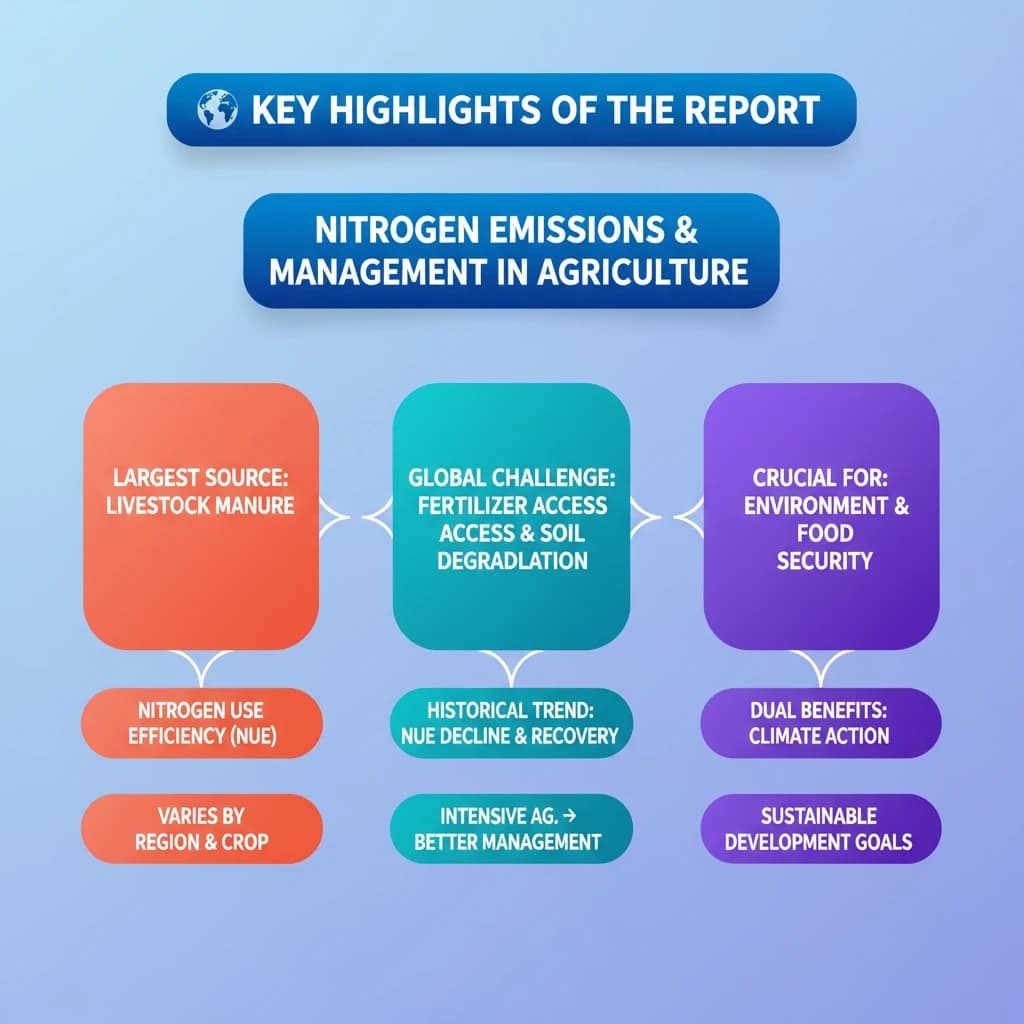
  • Livestock is the largest source of human-induced nitrogen emissions.
  • Nitrogen Use Efficiency (NUE) varies significantly by region and crop type.
  • Developing countries face dual challenges of limited fertilizer access and soil degradation.
  • Historical trends show NUE decline due to intensive agriculture, followed by recovery with better management.
  • Effective nitrogen management is crucial for environmental protection, food security, and climate action.
What are the Key Highlights of the Report?

What are the Key Highlights of the Report?

Medium⏱️ 8 min read✓ 95% Verified
environment and ecology

📖 Introduction

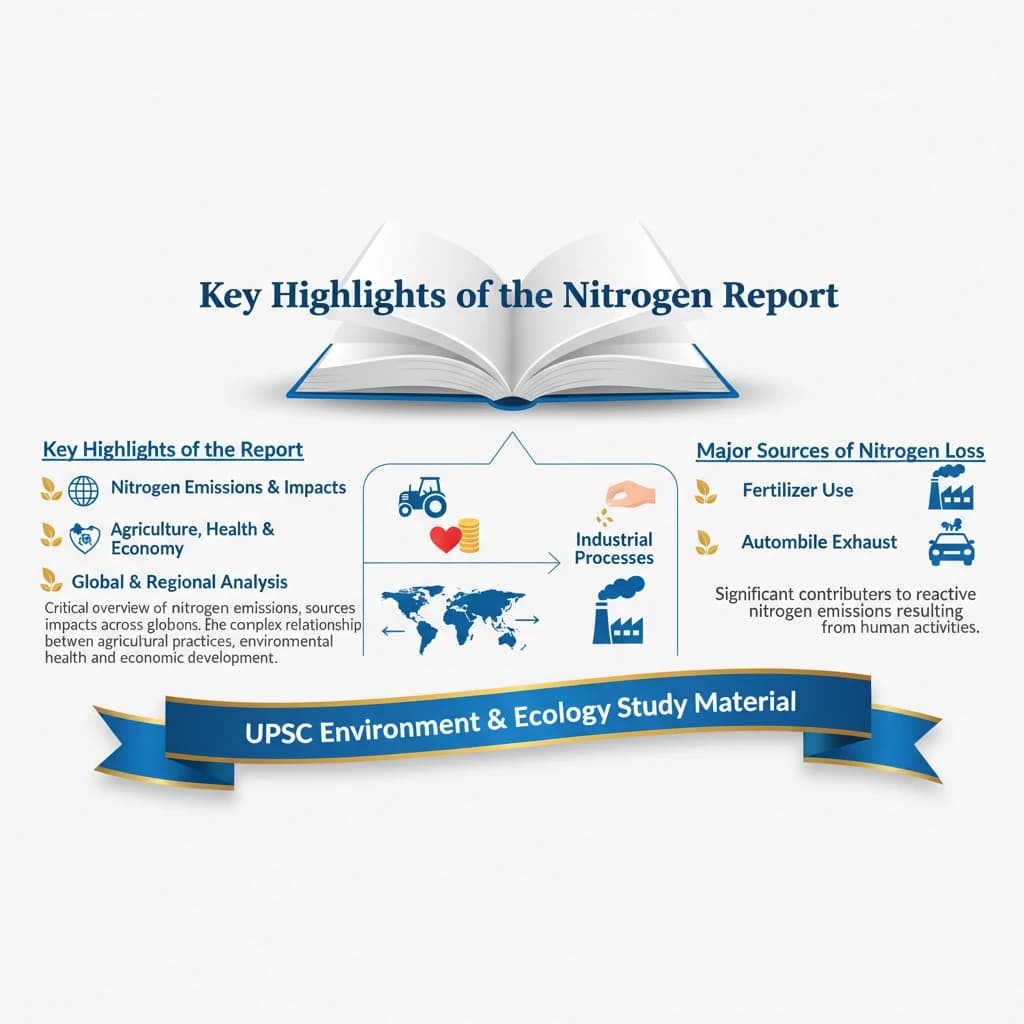
<h4>Key Highlights of the Nitrogen Report</h4><p>The report provides a critical overview of <strong>nitrogen emissions</strong>, their primary sources, and the varied impacts across different global regions. It emphasizes the complex relationship between agricultural practices, environmental health, and economic development.</p><h4>Major Sources of Nitrogen Loss</h4><p>The report identifies several significant contributors to <strong>reactive nitrogen emissions</strong> resulting from human activities.</p><div class='key-point-box'><p><strong>Livestock</strong> stands out as the primary source, accounting for approximately <strong>one-third</strong> of the total nitrogen emissions.</p></div><p>Other substantial contributors include the widespread use of <strong>synthetic fertilizers</strong>, changes in <strong>land-use patterns</strong>, and emissions from inadequate <strong>manure management</strong> practices.</p><h4>Regional Differences in Nitrogen Use Efficiency (NUE)</h4><p>The report highlights considerable variations in <strong>Nitrogen Use Efficiency (NUE)</strong> across different global regions, influenced by distinct agricultural practices and policies.</p><h5>Asia's Nitrogen Trajectory</h5><p>In <strong>Asia</strong>, the implementation of <strong>fertilizer subsidies</strong> during the <strong>Green Revolution</strong> significantly boosted crop yields but concurrently led to substantial <strong>nitrogen pollution</strong>.</p><p><strong>Southeast Asia</strong> experienced a notable decline in <strong>NUE</strong>, dropping from <strong>65% in 1961</strong> to <strong>45% in the 1990s</strong>. However, it showed recovery, reaching <strong>54% by 2022</strong>.</p><div class='info-box'><p><strong>Nitrogen Use Efficiency (NUE)</strong>: A measure of how effectively applied nitrogen is utilized by crops to produce yield, minimizing losses to the environment.</p></div><h5>Challenges in Africa</h5><p><strong>Africa</strong> continues to grapple with persistently <strong>low crop yields</strong> and severe <strong>nutrient depletion</strong> in its soils.</p><p>These issues are largely attributed to inadequate agricultural policies and limited access to essential <strong>nitrogen fertilizers</strong>.</p><h5>Progress in Europe & North America</h5><p>Regions like <strong>Europe</strong> and <strong>North America</strong> have achieved higher <strong>NUE</strong> levels.</p><p>This success is primarily due to the implementation of stringent <strong>nutrient management guidelines</strong> and effective regulatory frameworks.</p><p><strong>North America</strong> initially saw its <strong>NUE drop from 65% in 1961</strong> to below <strong>50% in the 1980s</strong>, but then recorded a significant increase to <strong>69% in 2022</strong>.</p><h5>Latin America's Fertilizer Dependency</h5><p><strong>Latin America</strong> faces unique challenges, including a heavy reliance on <strong>imported fertilizers</strong>.</p><p>Disruptions in <strong>supply chains</strong> severely impact nitrogen management practices in the region.</p><h4>Crop-Level Variation in Nitrogen Use Efficiency</h4><p>The report underscores that <strong>NUE</strong> varies considerably depending on the <strong>crop type</strong>.</p><ul><li><strong>Soybeans</strong> demonstrated a high <strong>NUE of 80% in 2010</strong>, indicating efficient nitrogen utilization.</li><li>In contrast, <strong>fruits and vegetables</strong> exhibited a much lower <strong>NUE, around 14% in 2010</strong>, pointing to substantial nitrogen losses during their production cycle.</li></ul><h4>Challenges for Developing Nations</h4><p><strong>Low- and Middle-Income countries</strong> face a dual challenge regarding nitrogen management.</p><p>They often have <strong>limited access to nitrogen fertilizers</strong>, which impacts food security, alongside widespread <strong>soil health degradation</strong>.</p><p>Without effective strategies to address <strong>nitrogen losses</strong>, these nations experience low crop yields, and poor <strong>manure management</strong> exacerbates nitrogen emissions.</p><div class='exam-tip-box'><p>UPSC often asks about environmental challenges in developing countries. Understanding <strong>nitrogen loss</strong> and its socio-economic impacts is crucial for <strong>GS-III Environment</strong> and <strong>Agriculture</strong> papers.</p></div>
Concept Diagram

💡 Key Takeaways

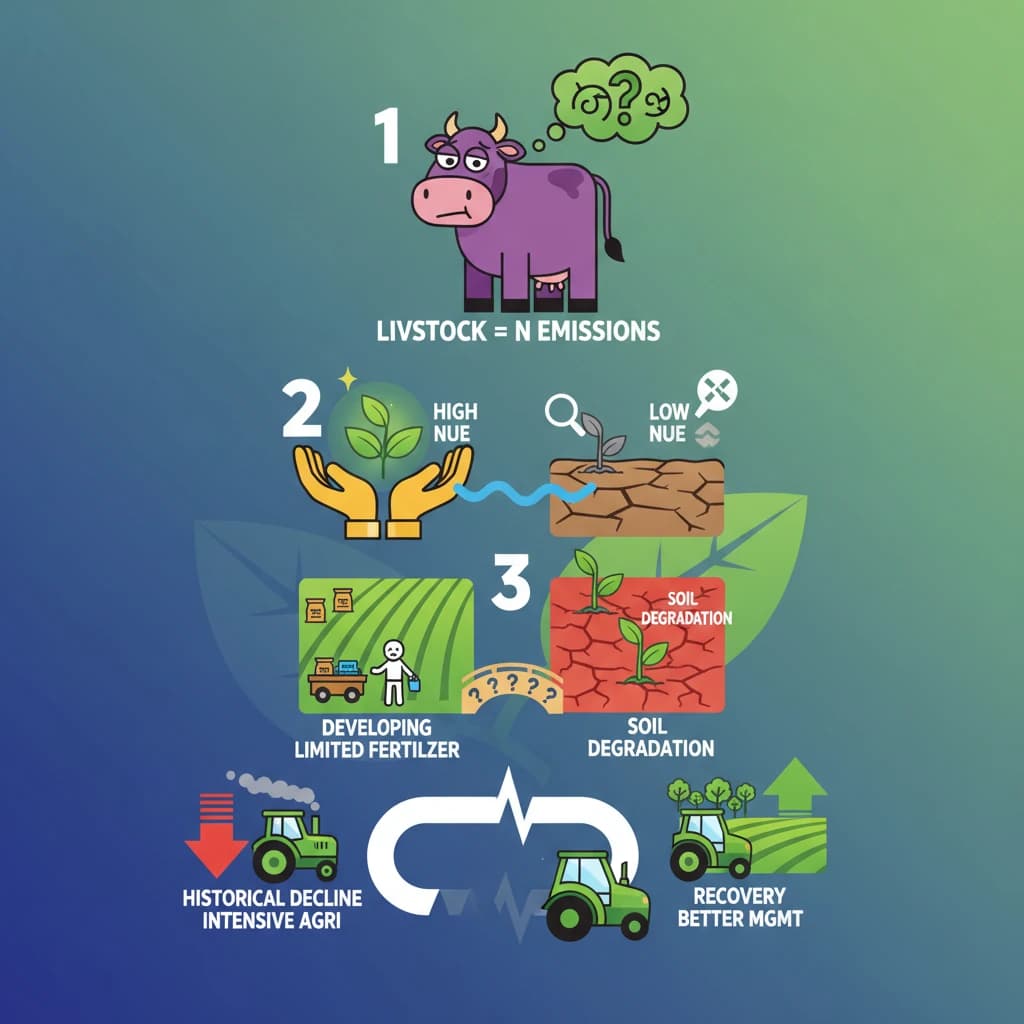
  • •Livestock is the largest source of human-induced nitrogen emissions.
  • •Nitrogen Use Efficiency (NUE) varies significantly by region and crop type.
  • •Developing countries face dual challenges of limited fertilizer access and soil degradation.
  • •Historical trends show NUE decline due to intensive agriculture, followed by recovery with better management.
  • •Effective nitrogen management is crucial for environmental protection, food security, and climate action.

🧠 Memory Techniques
Memory Aid
95% Verified Content

📚 Reference Sources

•General knowledge on Nitrogen Cycle and Green Revolution

Related Topics

Loading related topics...
Explore:Environment And Ecology Topics·All Subjects·Daily Current Affairs·Editorial Analysis·Previous Year Questions·UPSC GPT