Loading page, please wait…
Vaidra Logo
Vaidra

Top 4 items + smart groups

UPSC GPT
New
Current Affairs
Daily Solutions
Daily Puzzle
Mains Evaluator

Version 2.0.0 • Built with ❤️ for UPSC aspirants

Loading...
Loading...
Loading...
Loading...
Loading...
Loading...
Loading...
Loading...
Loading...
Loading...
Loading...
Loading...
Loading...
Back
All Subjects

Topics

0 topics • 0 completed

Loading topics...
Loading...
Loading...
Loading...
Loading...
Loading...
Overall Progress0%
What are the Key Facts About the Exotic Species? - UPSC Environment And Ecology

What are the Key Facts About the Exotic Species? - UPSC Environment And Ecology

What is What are the Key Facts About the Exotic Species? in UPSC Environment And Ecology?

What are the Key Facts About the Exotic Species? is a key topic under Environment And Ecology for UPSC Civil Services Examination. Key points include: Exotic species are non-native plants or animals introduced to new regions, primarily by humans.. India has seen a rise in exotic animal imports and smuggling, posing ecological and health risks.. The Wild Life (Protection) Amendment Act, 2022, introduced Section 49M for registration of exotic species.. Understanding this topic is essential for both UPSC Prelims and Mains preparation.

Why is What are the Key Facts About the Exotic Species? important for UPSC exam?

What are the Key Facts About the Exotic Species? is a Medium-level topic in UPSC Environment And Ecology. It is tested in both Prelims (factual MCQs) and Mains (analytical answer writing). Previous year UPSC questions have frequently covered aspects of What are the Key Facts About the Exotic Species?, making it essential for comprehensive IAS preparation.

How to prepare What are the Key Facts About the Exotic Species? for UPSC?

To prepare What are the Key Facts About the Exotic Species? for UPSC: (1) Study the comprehensive notes covering all key concepts on Vaidra. (2) Practice previous year questions on this topic. (3) Connect it with current affairs using daily updates. (4) Revise using key takeaways and mind maps available for Environment And Ecology. (5) Write practice answers linking What are the Key Facts About the Exotic Species? to related GS Paper topics.

Key takeaways of What are the Key Facts About the Exotic Species? for UPSC

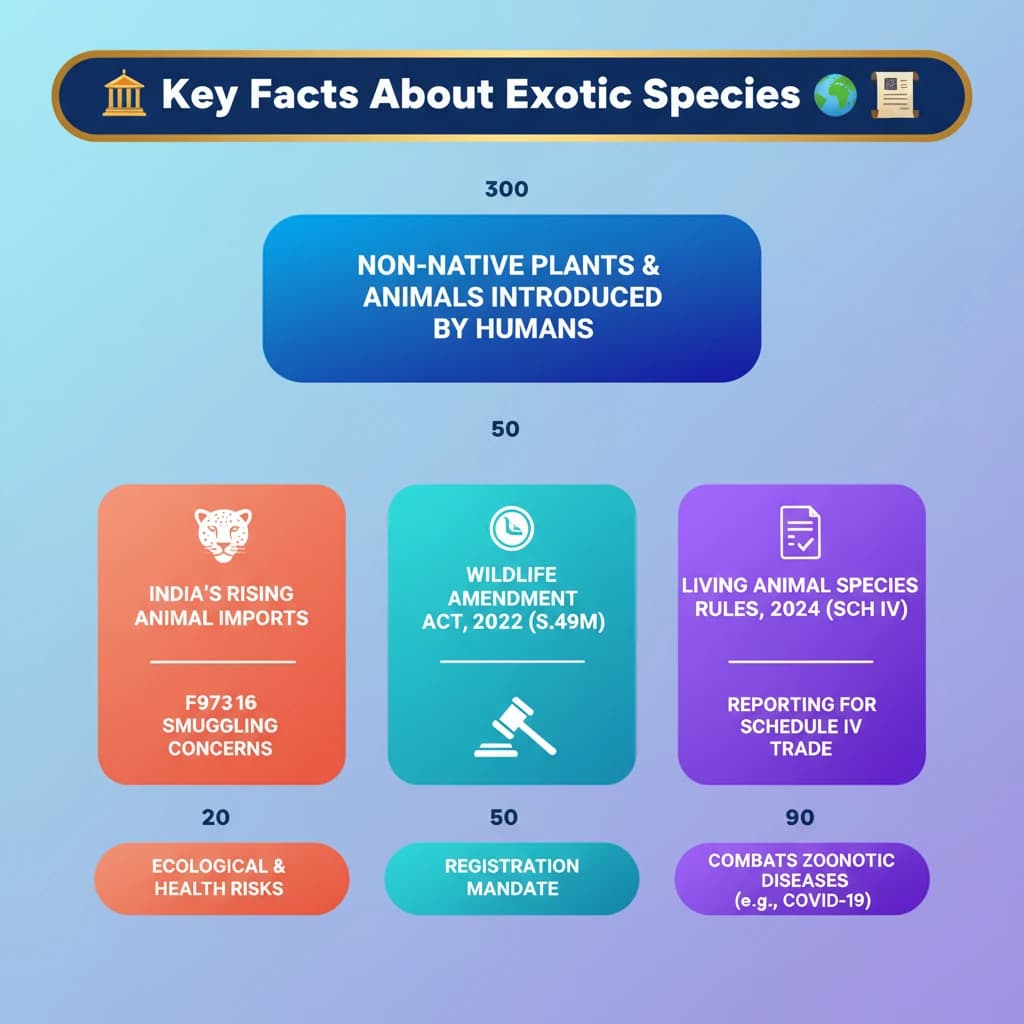
  • Exotic species are non-native plants or animals introduced to new regions, primarily by humans.
  • India has seen a rise in exotic animal imports and smuggling, posing ecological and health risks.
  • The Wild Life (Protection) Amendment Act, 2022, introduced Section 49M for registration of exotic species.
  • The Living Animal Species (Reporting and Registration) Rules, 2024, operationalize this, mandating reporting and registration for Schedule IV species.
  • Unregulated exotic animal trade is a significant source of zoonotic diseases, as highlighted by the COVID-19 pandemic.
  • Increased seizures in states like Assam and Mizoram underscore the scale of illegal exotic animal trafficking from Southeast Asia.
What are the Key Facts About the Exotic Species?

What are the Key Facts About the Exotic Species?

Medium⏱️ 6 min read✓ 98% Verified
environment and ecology

📖 Introduction

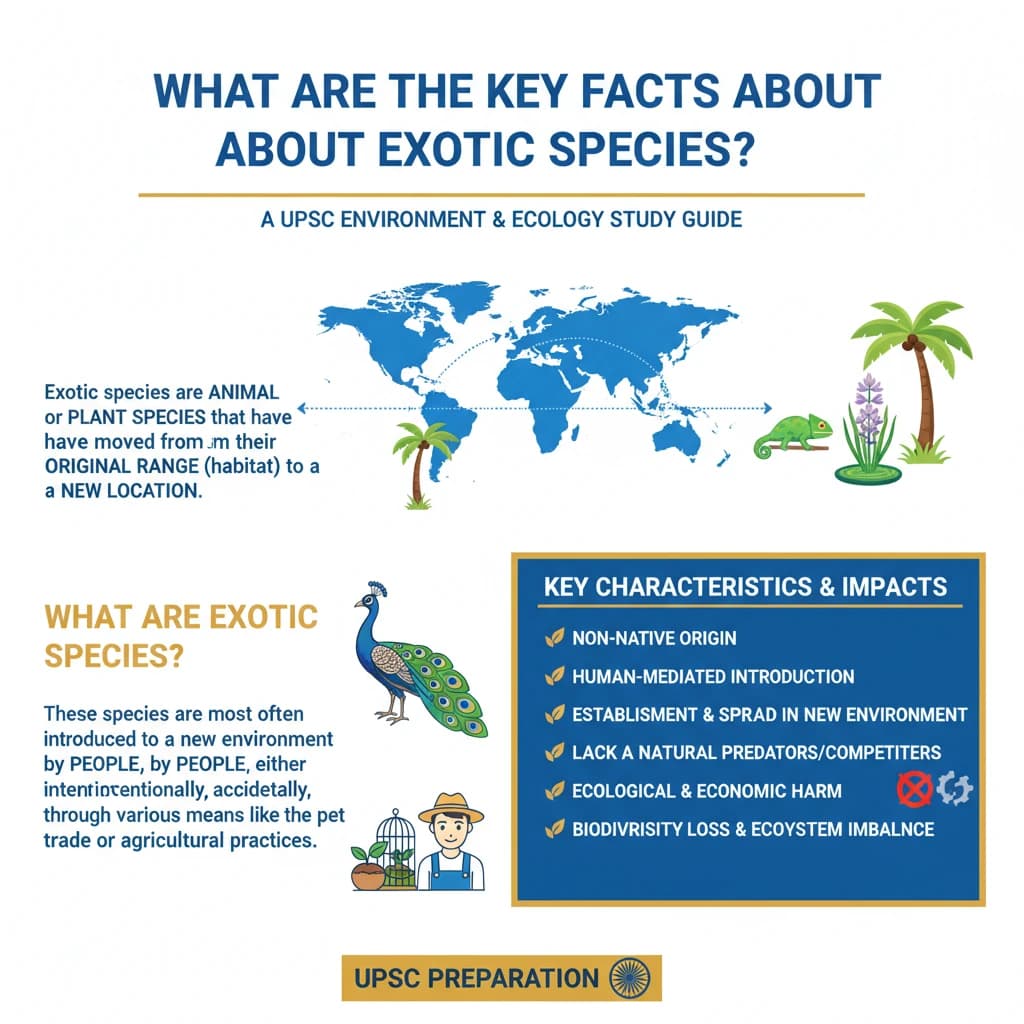
<h4>What are Exotic Species?</h4><p><strong>Exotic species</strong> are <strong>animal</strong> or <strong>plant species</strong> that have been moved from their <strong>original range</strong> (natural habitat) to a <strong>new location</strong>.</p><p>These species are <strong>most often introduced</strong> to a new environment <strong>by people</strong>, either intentionally or accidentally, through various means like the pet trade or agricultural practices.</p><div class="info-box"><p><strong>Definition of Exotic Species:</strong> A species found in an area where it does not naturally occur, having been introduced by human activity.</p></div><h4>Examples of Exotic Animals in India</h4><p>India hosts several examples of exotic animals that have been introduced, often through the pet trade. These species originate from diverse geographical regions.</p><ul><li><p><strong>Ball python</strong> (Western Africa)</p></li><li><p><strong>Iguana</strong> (Central and South America)</p></li><li><p><strong>Cockatiel</strong> (Australia)</p></li><li><p><strong>Red-eared slider Turtle</strong> (USA and Mexico)</p></li><li><p><strong>African grey parrot</strong> (Central Africa)</p></li><li><p><strong>Amazonian parrot</strong> (South and Central America)</p></li></ul><h4>Legal Framework for Exotic Species in India</h4><p>India has recently strengthened its legal provisions to regulate the possession and trade of exotic species, driven by growing concerns.</p><p>The <strong>Wild Life (Protection) Amendment Act, 2022</strong>, introduced a pivotal <strong>Section 49M</strong> to the existing legislation.</p><div class="key-point-box"><p><strong>Section 49M</strong> mandates the <strong>registration of possession, transfer, birth, and death</strong> of species listed in the <strong>CITES Appendices</strong> and <strong>Schedule IV of the Wild Life (Protection) Act, 1972</strong>.</p></div><p>Further operationalizing this amendment, the <strong>Living Animal Species (Reporting and Registration) Rules, 2024</strong>, were enacted.</p><p>These rules require any person possessing a species listed in <strong>Schedule IV of the Wild Life (Protection) Act, 1972</strong>, to <strong>report and register</strong> the species with the authorities.</p><div class="exam-tip-box"><p><strong>UPSC Insight:</strong> Be aware of the recent legislative updates like the <strong>2022 Amendment Act</strong> and the <strong>2024 Rules</strong>, as they reflect the government's current policy stance on exotic species.</p></div><h4>Concerns Associated with Exotic Species</h4><p>The unregulated import and breeding of exotic species in India pose several significant threats, impacting both biodiversity and public health.</p><p>Many exotic species are imported and bred in captivity <strong>without proper registration</strong>, creating a loophole that can be exploited for illegal trade.</p><p>This lack of regulation significantly increases the <strong>threat of zoonotic diseases</strong>, which can jump from animals to humans, potentially causing widespread outbreaks.</p><div class="highlight-box"><p>The <strong>Covid-19 pandemic</strong>, a zoonotic disease, starkly brought attention to the grave dangers of <strong>unregulated trade and ownership</strong> of exotic animals globally.</p></div><p>Activists have raised alarms about the <strong>increased smuggling of endangered exotic animals</strong> into India, particularly from <strong>Southeast Asia</strong> and other regions.</p><p>There has been a notable increase in the <strong>seizure of exotic animals</strong>, especially in states like <strong>Assam</strong> and <strong>Mizoram</strong>, indicating the scale of this illicit trade.</p><div class="info-box"><p><strong>Recent Seizures:</strong> Confiscated species in India include <strong>Kangaroos</strong> (from Australia), <strong>Koalas</strong> (from Australia), and <strong>Lemurs</strong> (from Madagascar), often temporarily housed in zoos.</p></div>
Concept Diagram

💡 Key Takeaways

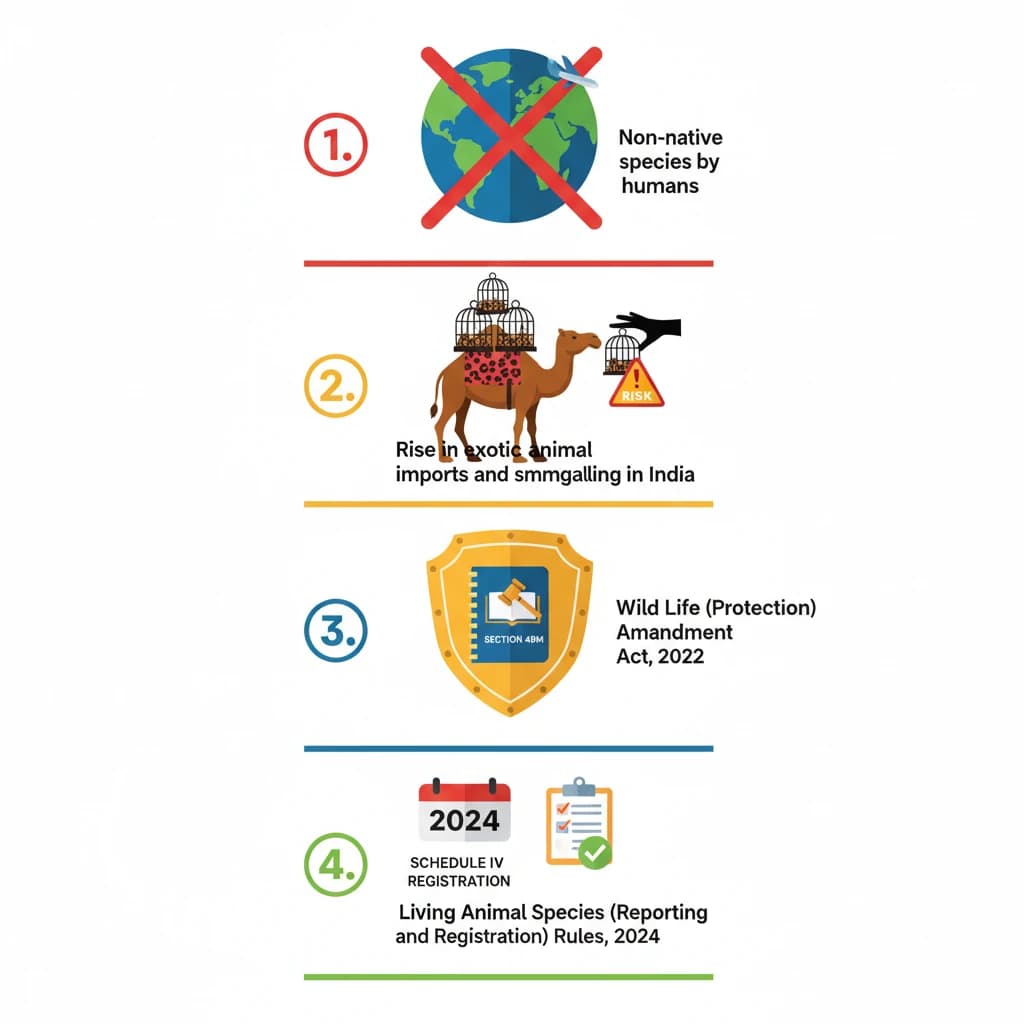
  • •Exotic species are non-native plants or animals introduced to new regions, primarily by humans.
  • •India has seen a rise in exotic animal imports and smuggling, posing ecological and health risks.
  • •The Wild Life (Protection) Amendment Act, 2022, introduced Section 49M for registration of exotic species.
  • •The Living Animal Species (Reporting and Registration) Rules, 2024, operationalize this, mandating reporting and registration for Schedule IV species.
  • •Unregulated exotic animal trade is a significant source of zoonotic diseases, as highlighted by the COVID-19 pandemic.
  • •Increased seizures in states like Assam and Mizoram underscore the scale of illegal exotic animal trafficking from Southeast Asia.

🧠 Memory Techniques
Memory Aid
98% Verified Content

📚 Reference Sources

•The Wild Life (Protection) Act, 1972 (as amended up to 2022)
•Living Animal Species (Reporting and Registration) Rules, 2024
•Convention on International Trade in Endangered Species of Wild Fauna and Flora (CITES) official website

Related Topics

Loading related topics...
Explore:Environment And Ecology Topics·All Subjects·Daily Current Affairs·Editorial Analysis·Previous Year Questions·UPSC GPT