Loading page, please wait…
Vaidra Logo
Vaidra

Top 4 items + smart groups

UPSC GPT
New
Current Affairs
Daily Solutions
Daily Puzzle
Mains Evaluator

Version 2.0.0 • Built with ❤️ for UPSC aspirants

Loading...
Loading...
Loading...
Loading...
Loading...
Loading...
Loading...
Loading...
Loading...
Loading...
Loading...
Loading...
Loading...

What is Black Carbon (BC)? - UPSC Environment And Ecology

What is What is Black Carbon (BC)? in UPSC Environment And Ecology?

What is Black Carbon (BC)? is a key topic under Environment And Ecology for UPSC Civil Services Examination. Key points include: Black Carbon (BC) is a dark, sooty aerosol from incomplete combustion of biomass and fossil fuels.. It is the second-largest contributor to global warming after CO2, despite being a short-lived pollutant.. BC warms the atmosphere and accelerates snow/ice melt by reducing albedo.. Understanding this topic is essential for both UPSC Prelims and Mains preparation.

Why is What is Black Carbon (BC)? important for UPSC exam?

What is Black Carbon (BC)? is a Medium-level topic in UPSC Environment And Ecology. It is tested in both Prelims (factual MCQs) and Mains (analytical answer writing). Previous year UPSC questions have frequently covered aspects of What is Black Carbon (BC)?, making it essential for comprehensive IAS preparation.

How to prepare What is Black Carbon (BC)? for UPSC?

To prepare What is Black Carbon (BC)? for UPSC: (1) Study the comprehensive notes covering all key concepts on Vaidra. (2) Practice previous year questions on this topic. (3) Connect it with current affairs using daily updates. (4) Revise using key takeaways and mind maps available for Environment And Ecology. (5) Write practice answers linking What is Black Carbon (BC)? to related GS Paper topics.

Key takeaways of What is Black Carbon (BC)? for UPSC

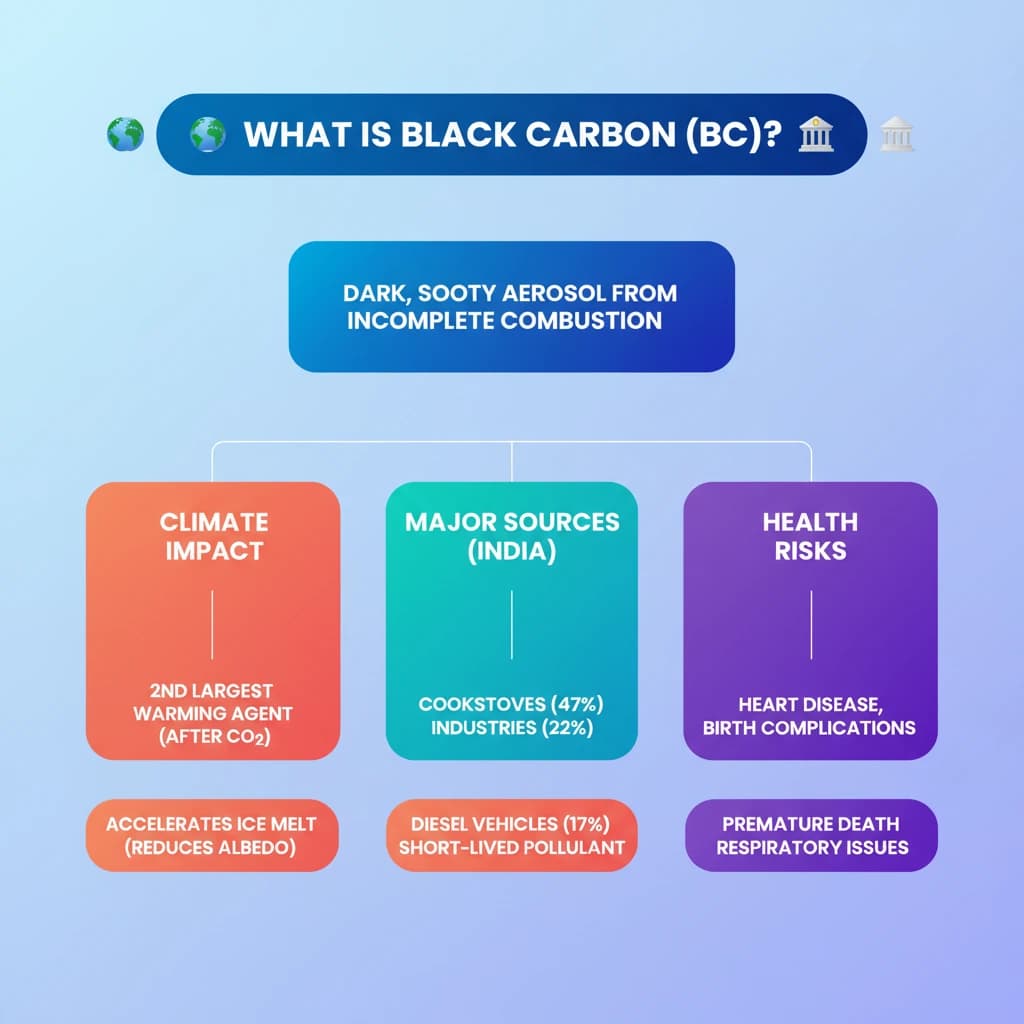
  • Black Carbon (BC) is a dark, sooty aerosol from incomplete combustion of biomass and fossil fuels.
  • It is the second-largest contributor to global warming after CO2, despite being a short-lived pollutant.
  • BC warms the atmosphere and accelerates snow/ice melt by reducing albedo.
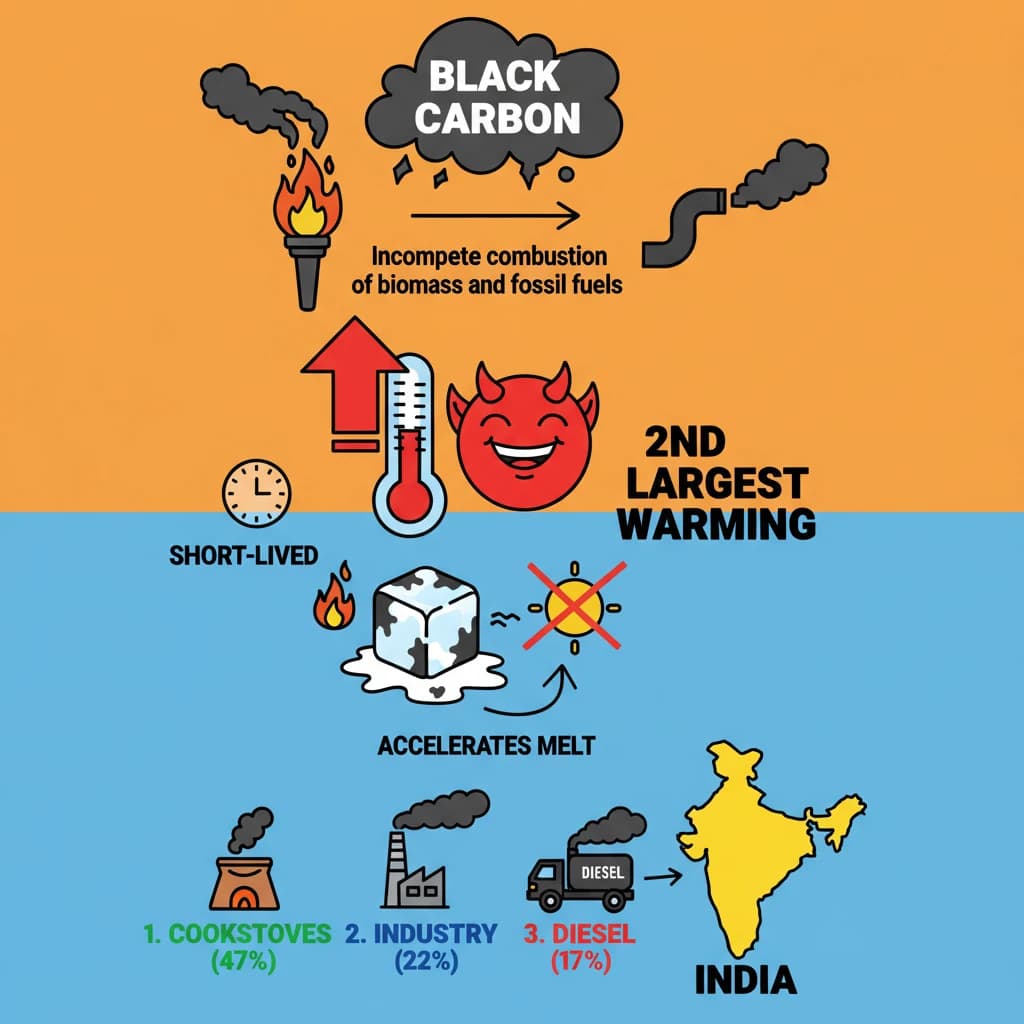
  • Major sources in India are traditional cookstoves (47%), industries (22%), and diesel vehicles (17%).
  • BC poses severe health risks, including heart disease, birth complications, and premature death.
  • Its short atmospheric lifetime offers opportunities for rapid climate benefits through emission reductions.
What is Black Carbon (BC)?

What is Black Carbon (BC)?

Medium⏱️ 7 min read✓ 95% Verified
environment and ecology

📖 Introduction

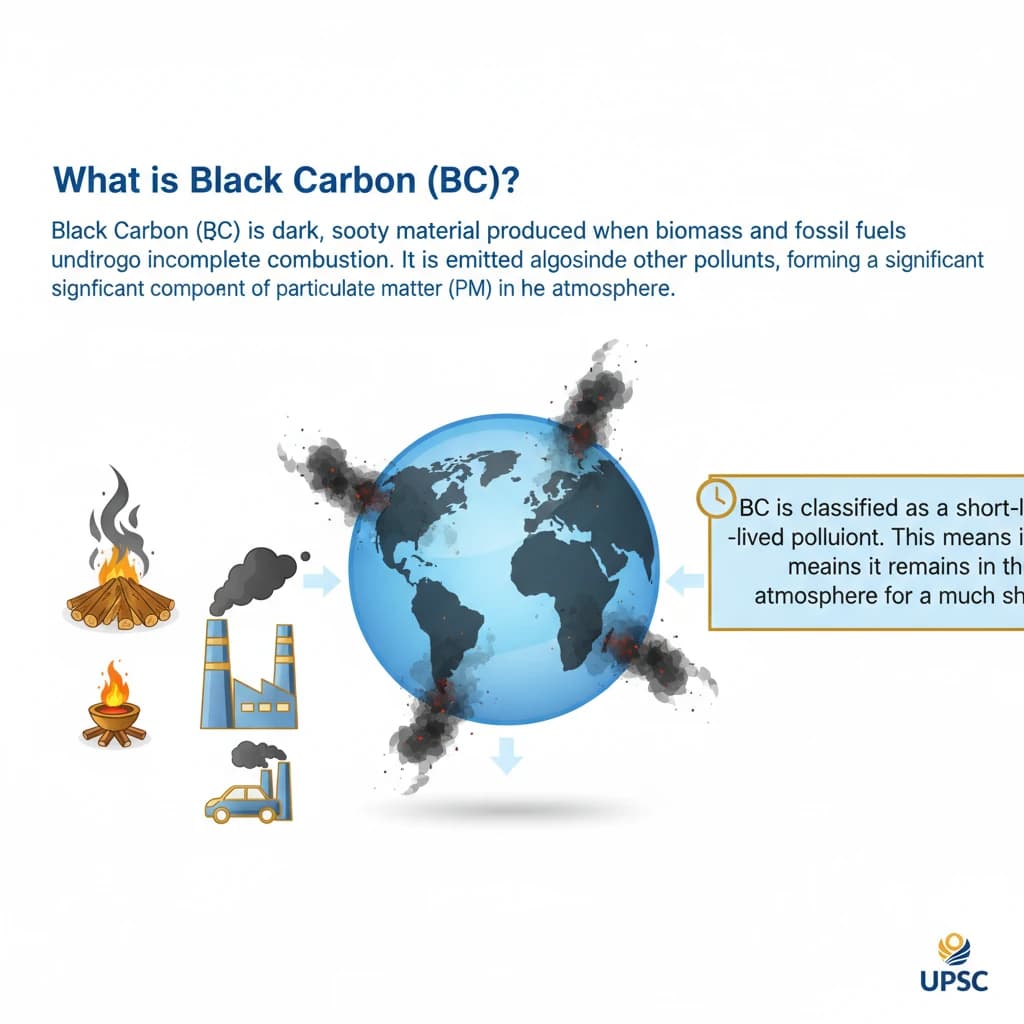
<h4>What is Black Carbon (BC)?</h4><p><strong>Black Carbon (BC)</strong> is a dark, sooty material produced when <strong>biomass</strong> and <strong>fossil fuels</strong> undergo <strong>incomplete combustion</strong>. It is emitted alongside other pollutants, forming a significant component of particulate matter (PM) in the atmosphere.</p><div class='info-box'><p><strong>BC</strong> is classified as a <strong>short-lived pollutant</strong>. This means it remains in the atmosphere for a much shorter duration compared to long-lived greenhouse gases like carbon dioxide (CO2).</p></div><p>Despite its short atmospheric lifespan, <strong>Black Carbon</strong> is recognized as the <strong>second-largest contributor to warming the planet</strong>, trailing only behind <strong>carbon dioxide (CO2)</strong>. Its potent warming effect makes it a critical focus in climate change mitigation.</p><div class='key-point-box'><p>Unlike other greenhouse gas emissions, <strong>BC</strong> is quickly washed out of the atmosphere by precipitation. This characteristic implies that its presence can be significantly reduced or even eliminated if emissions are stopped, offering a more immediate climate benefit.</p></div><p>Furthermore, unlike historical carbon emissions that disperse globally, <strong>Black Carbon</strong> is primarily a <strong>localized source</strong>. This means its impacts are often more pronounced in the regions where it is emitted, leading to greater local environmental and health consequences.</p><p>Scientifically, <strong>Black Carbon</strong> is a type of <strong>aerosol</strong>. Aerosols are tiny solid or liquid particles suspended in the atmosphere, and they play a complex role in Earth's climate system.</p><h4>Impacts of Black Carbon</h4><p>Among various <strong>aerosols</strong>, such as brown carbon and sulphates, <strong>Black Carbon</strong> has been identified as the <strong>second most important anthropogenic agent</strong> for climate change. It also serves as the primary marker for understanding the adverse effects caused by air pollution.</p><p>One of the most significant impacts of <strong>Black Carbon</strong> is its ability to <strong>absorb solar energy</strong>. When suspended in the atmosphere, it directly warms the surrounding air, contributing to atmospheric heating and global warming.</p><div class='info-box'><p>When <strong>BC</strong> eventually falls to Earth with precipitation, it settles on surfaces like snow and ice. This darkens their appearance, significantly <strong>reducing their albedo</strong> (the reflecting power of a surface). The diminished reflectivity causes more solar energy to be absorbed, warming the snow and ice and accelerating their melting.</p></div><p>Beyond its climate effects, <strong>Black Carbon</strong> poses severe risks to human health. Studies have established a <strong>direct link</strong> between exposure to <strong>BC</strong> and a higher risk of serious health conditions.</p><p>These health risks include an increased likelihood of <strong>heart disease</strong>, various <strong>birth complications</strong>, and a higher incidence of <strong>premature death</strong>, highlighting the urgent need for emission control.</p><h4>Sources of Black Carbon in India</h4><p>In India, the majority of <strong>Black Carbon emissions</strong> originate from the burning of <strong>biomass</strong>. This primarily includes materials like <strong>cow dung</strong> and <strong>straw</strong>, which are commonly used in traditional cookstoves in rural households.</p><p>Other significant sources of <strong>BC</strong> include emissions from <strong>gas and diesel engines</strong>, particularly in the transportation sector. <strong>Coal-fired power plants</strong> and various other industrial processes that burn <strong>fossil fuels</strong> also contribute substantially.</p><div class='info-box'><p>According to a <strong>2016 study</strong>, the breakdown of India's total <strong>Black Carbon emissions</strong> by sector is as follows:</p><ul><li><strong>Residential sector</strong>: 47%</li><li><strong>Industries</strong>: 22%</li><li><strong>Diesel vehicles</strong>: 17%</li><li><strong>Open burning</strong> (e.g., agricultural waste): 12%</li><li><strong>Other sources</strong>: 2%</li></ul></div><p>This data underscores the dominant role of the <strong>residential sector</strong>, particularly traditional cooking practices, in India's overall <strong>Black Carbon</strong> emission profile.</p>
Concept Diagram

💡 Key Takeaways

  • •Black Carbon (BC) is a dark, sooty aerosol from incomplete combustion of biomass and fossil fuels.
  • •It is the second-largest contributor to global warming after CO2, despite being a short-lived pollutant.
  • •BC warms the atmosphere and accelerates snow/ice melt by reducing albedo.
  • •Major sources in India are traditional cookstoves (47%), industries (22%), and diesel vehicles (17%).
  • •BC poses severe health risks, including heart disease, birth complications, and premature death.
  • •Its short atmospheric lifetime offers opportunities for rapid climate benefits through emission reductions.

🧠 Memory Techniques
Memory Aid
95% Verified Content

📚 Reference Sources

•UN Environment Programme (UNEP) reports on Short-Lived Climate Pollutants
•Intergovernmental Panel on Climate Change (IPCC) assessment reports
•Studies on Black Carbon emissions in India (e.g., TERI, CSTEP)

Related Topics

Loading related topics...
Explore:Environment And Ecology Topics·All Subjects·Daily Current Affairs·Editorial Analysis·Previous Year Questions·UPSC GPT
Back
All Subjects

Topics

0 topics • 0 completed

Loading topics...
Loading...
Loading...
Loading...
Loading...
Loading...
Overall Progress0%
What is Black Carbon (BC)? - UPSC Environment And Ecology