Loading page, please wait…
Vaidra Logo
Vaidra

Top 4 items + smart groups

UPSC GPT
New
Current Affairs
Daily Solutions
Daily Puzzle
Mains Evaluator

Version 2.0.0 • Built with ❤️ for UPSC aspirants

Loading...
Loading...
Loading...
Loading...
Loading...
Loading...
Loading...
Loading...
Loading...
Loading...
Loading...
Loading...
Loading...
Back
All Subjects

Topics

0 topics • 0 completed

Loading topics...
Loading...
Loading...
Loading...
Loading...
Loading...
Overall Progress0%

Horseshoe Crabs - UPSC Environment And Ecology

What is Horseshoe Crabs in UPSC Environment And Ecology?

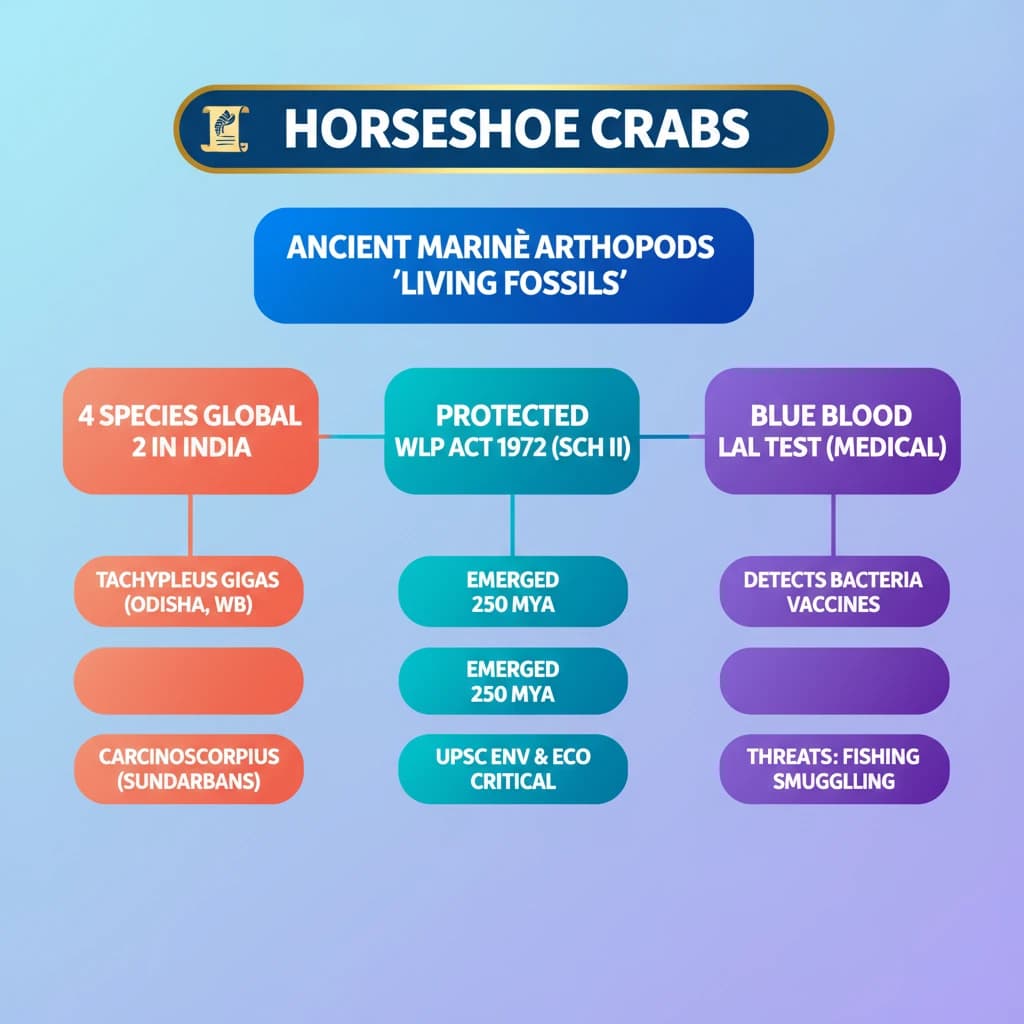
Horseshoe Crabs is a key topic under Environment And Ecology for UPSC Civil Services Examination. Key points include: Horseshoe crabs are ancient marine arthropods, often called 'living fossils' (emerged 250 million years ago).. There are 4 species globally; India has 2: Tachypleus Gigas (Odisha, WB) and Carcinoscorpius rotundicauda (Sundarbans).. Indian species are protected under Schedule II of the Wildlife Protection Act, 1972.. Understanding this topic is essential for both UPSC Prelims and Mains preparation.

Why is Horseshoe Crabs important for UPSC exam?

Horseshoe Crabs is a Medium-level topic in UPSC Environment And Ecology. It is tested in both Prelims (factual MCQs) and Mains (analytical answer writing). Previous year UPSC questions have frequently covered aspects of Horseshoe Crabs, making it essential for comprehensive IAS preparation.

How to prepare Horseshoe Crabs for UPSC?

To prepare Horseshoe Crabs for UPSC: (1) Study the comprehensive notes covering all key concepts on Vaidra. (2) Practice previous year questions on this topic. (3) Connect it with current affairs using daily updates. (4) Revise using key takeaways and mind maps available for Environment And Ecology. (5) Write practice answers linking Horseshoe Crabs to related GS Paper topics.

Key takeaways of Horseshoe Crabs for UPSC

  • Horseshoe crabs are ancient marine arthropods, often called 'living fossils' (emerged 250 million years ago).
  • There are 4 species globally; India has 2: Tachypleus Gigas (Odisha, WB) and Carcinoscorpius rotundicauda (Sundarbans).
  • Indian species are protected under Schedule II of the Wildlife Protection Act, 1972.
  • Their blue blood is used to produce the Limulus Amebocyte Lysate (LAL) test, crucial for detecting bacterial contamination in vaccines and medical devices.
  • Major threats include destructive fishing practices and illegal smuggling.
  • Conservation efforts are ongoing, including a recent tagging exercise by ZSI and Odisha Forest Department.
  • International Horseshoe Crab Day is celebrated on June 20th.
Horseshoe Crabs

Horseshoe Crabs

Medium⏱️ 8 min read✓ 95% Verified
environment and ecology

📖 Introduction

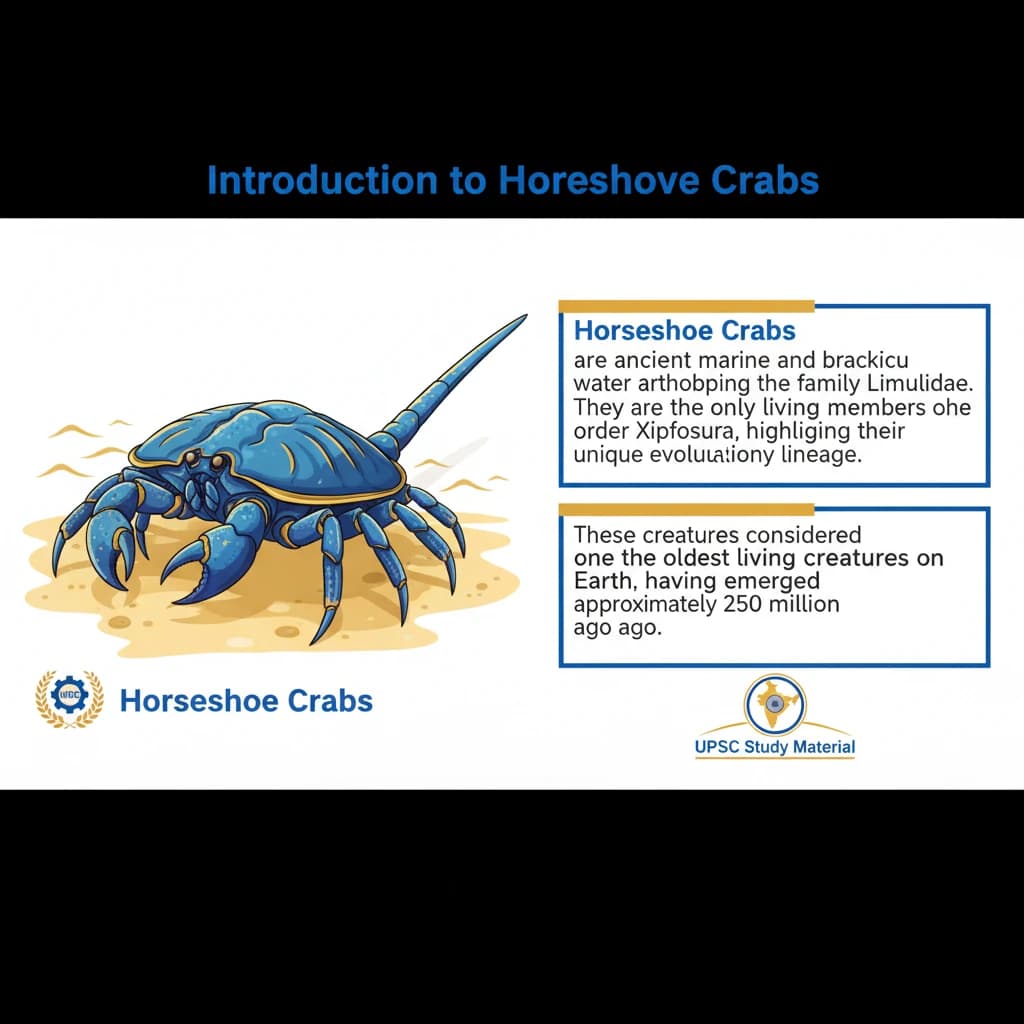
<h4>Introduction to Horseshoe Crabs</h4><p><strong>Horseshoe crabs</strong> are ancient <strong>marine</strong> and <strong>brackish water arthropods</strong> belonging to the family <strong>Limulidae</strong>. They are the only living members of the order <strong>Xiphosura</strong>, highlighting their unique evolutionary lineage.</p><p>These creatures are considered one of the <strong>oldest living creatures on Earth</strong>, having emerged approximately <strong>250 million years ago</strong>. Due to their minimal evolutionary change over vast geological periods, they are often referred to as <strong>living fossils</strong>.</p><div class='key-point-box'><p><strong>Living Fossils:</strong> A term for any living species of organism which appears to be the same as a species otherwise known only from fossils and has no close living relatives.</p></div><h4>Species and Distribution</h4><p>Globally, there are <strong>four existing species</strong> of <strong>horseshoe crabs</strong>. Their distribution spans various coastal regions, reflecting their adaptability to different marine environments.</p><ul><li><strong>India</strong> is home to <strong>two species</strong> of horseshoe crabs:</li><ul><li><strong>Tachypleus Gigas</strong>: Primarily found along the coasts of <strong>Odisha</strong> and <strong>West Bengal</strong>.</li><li><strong>Carcinoscorpius rotundicauda</strong>: Predominantly located in the <strong>Sundarbans mangroves</strong> of <strong>West Bengal</strong>.</li></ul><li><strong>American Horseshoe Crab (Limulus polyphemus)</strong>: Inhabits the <strong>eastern coast of the USA</strong> and the <strong>Gulf of Mexico</strong>.</li><li><strong>Tri-spine Horseshoe Crab (Tachypleus tridentatus)</strong>: Distributed across the <strong>Indo-Pacific region</strong>.</li></ul><h4>Threats to Horseshoe Crabs</h4><p>Despite their ancient lineage and resilience, <strong>horseshoe crabs</strong> face significant threats in modern times. These pressures endanger their populations and ecological stability.</p><ul><li><strong>Destructive fishing practices</strong>: Non-selective fishing methods often result in the accidental capture and mortality of horseshoe crabs.</li><li><strong>Illegal smuggling</strong>: Demand for their parts, especially for medicinal purposes, drives illicit trade.</li></ul><h4>Conservation Status</h4><p>Recognizing their ecological and scientific importance, various measures have been taken for their protection. Their conservation status varies by species and region.</p><div class='info-box'><ul><li><strong>Wildlife Protection Act (WPA), 1972</strong>: The <strong>Indian species</strong> of horseshoe crabs are protected under <strong>Schedule II</strong> of this Act, providing them with high legal protection.</li><li><strong>IUCN Status</strong>:</li><ul><li><strong>American horseshoe crab</strong> (Limulus polyphemus): Listed as <strong>Vulnerable</strong>.</li><li><strong>Tri-spine horseshoe crab</strong> (Tachypleus tridentatus): Listed as <strong>Endangered</strong>.</li><li>The other two species are currently <strong>not listed</strong> on the IUCN Red List.</li></ul></ul></div><h4>Medicinal Significance</h4><p>The unique biological properties of <strong>horseshoe crabs</strong> have made them invaluable in medical science, particularly their blood, which possesses remarkable characteristics.</p><ul><li>Their <strong>carapace</strong> (hard upper shell) has traditional applications, such as being applied onto scars for healing.</li><li><strong>Horseshoe crab blood</strong> is distinctively <strong>bright blue</strong>. It contains specialized immune cells called <strong>amebocytes</strong>.</li><li>These <strong>amebocytes</strong> are highly sensitive to <strong>toxic bacteria</strong> and clot around invading pathogens, effectively protecting the crab's body from infection.</li></ul><div class='key-point-box'><p><strong>Limulus Amebocyte Lysate (LAL) Test</strong>: Scientists developed this crucial test using the immune cells from horseshoe crab blood. The <strong>LAL test</strong> is vital for checking new vaccines, injectable drugs, and medical devices for <strong>bacterial contamination</strong>, preventing the distribution of harmful products.</p></div><h4>International Horseshoe Crab Day</h4><p>To raise awareness and foster collective conservation efforts, <strong>International Horseshoe Crab Day</strong> is celebrated annually on <strong>June 20th</strong>. This day highlights their importance and the need for their protection.</p>
Concept Diagram

💡 Key Takeaways

  • •Horseshoe crabs are ancient marine arthropods, often called 'living fossils' (emerged 250 million years ago).
  • •There are 4 species globally; India has 2: Tachypleus Gigas (Odisha, WB) and Carcinoscorpius rotundicauda (Sundarbans).
  • •Indian species are protected under Schedule II of the Wildlife Protection Act, 1972.
  • •Their blue blood is used to produce the Limulus Amebocyte Lysate (LAL) test, crucial for detecting bacterial contamination in vaccines and medical devices.
  • •Major threats include destructive fishing practices and illegal smuggling.
  • •Conservation efforts are ongoing, including a recent tagging exercise by ZSI and Odisha Forest Department.
  • •International Horseshoe Crab Day is celebrated on June 20th.

🧠 Memory Techniques
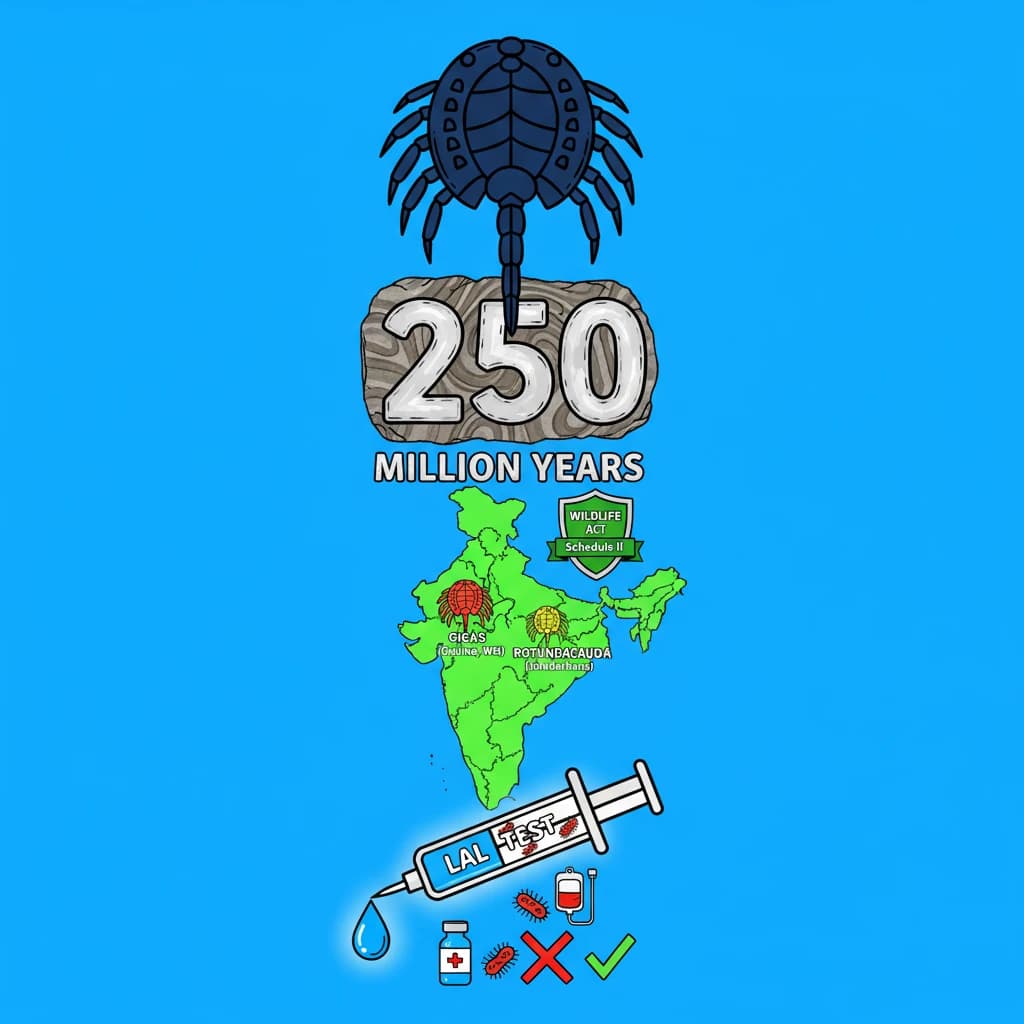
Memory Aid
95% Verified Content

Related Topics

Loading related topics...
Explore:Environment And Ecology Topics·All Subjects·Daily Current Affairs·Editorial Analysis·Previous Year Questions·UPSC GPT
Horseshoe Crabs - UPSC Environment And Ecology