📖 Introduction
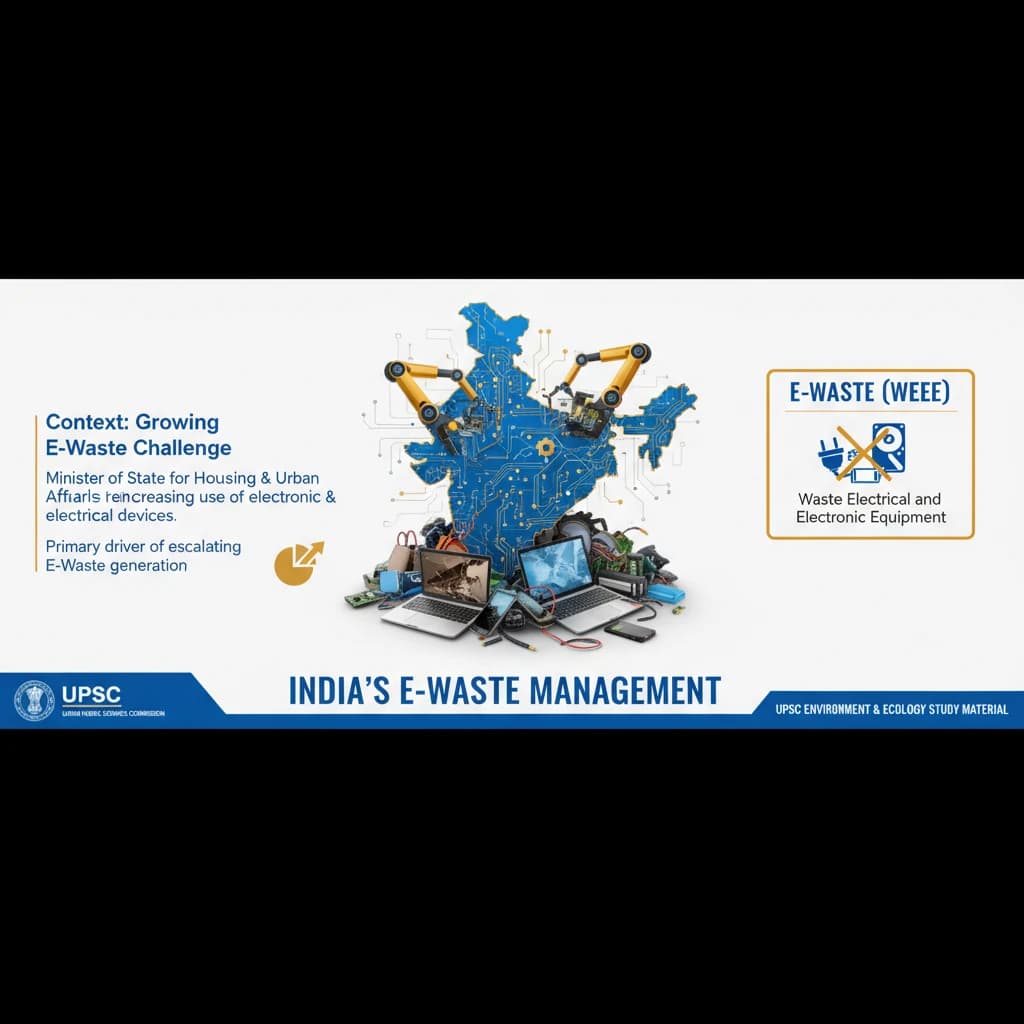
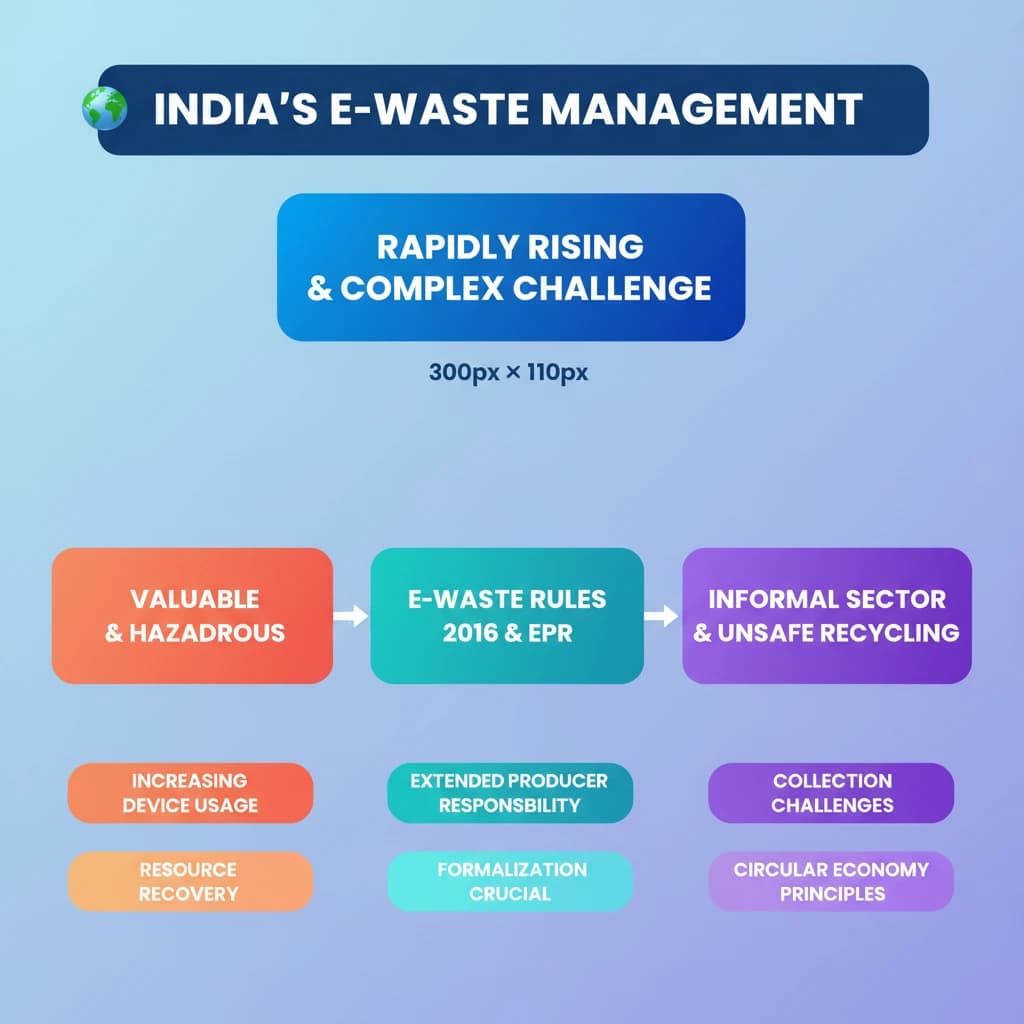
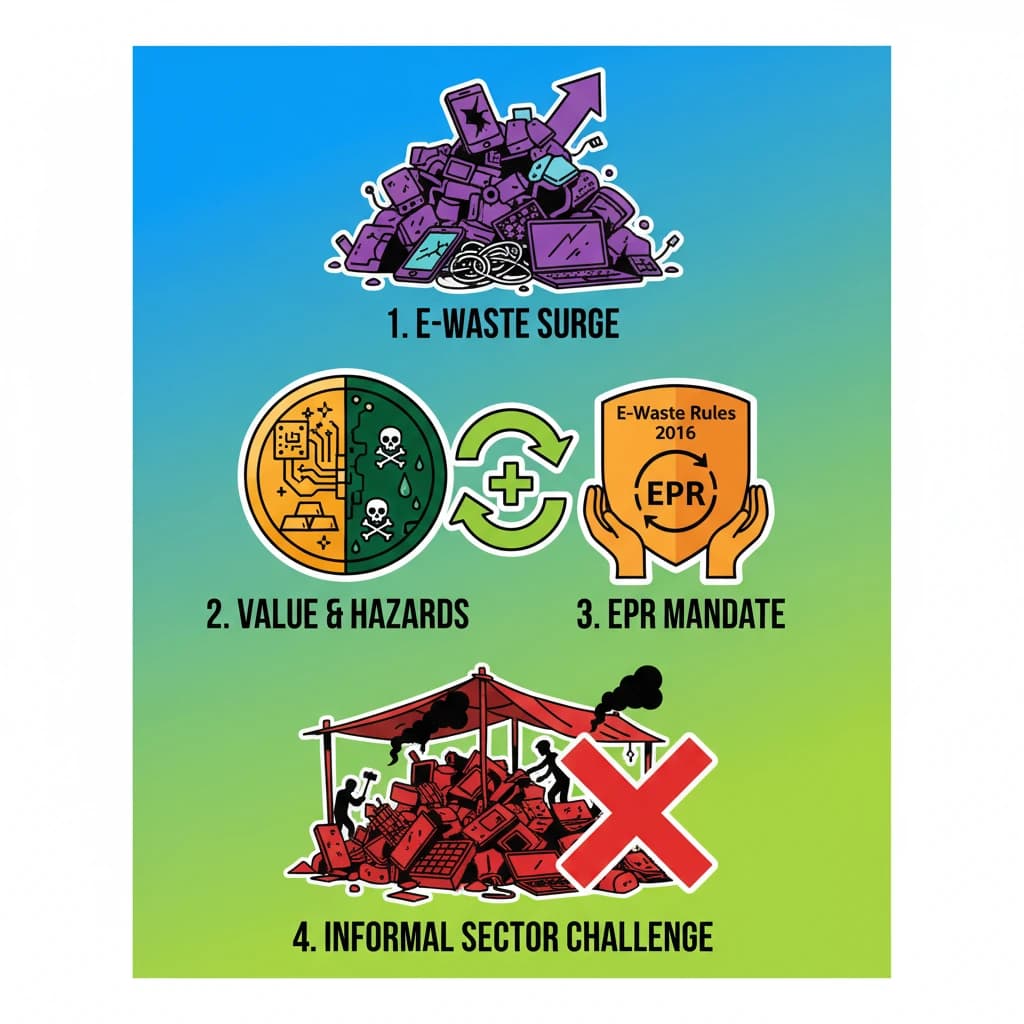
<h4>Understanding E-Waste</h4><p><strong>Electronic waste (e-waste)</strong> refers to discarded electrical and electronic equipment (EEE) that is old or has reached its end-of-life. This category encompasses a wide range of devices, from household appliances to complex office equipment.</p><div class='info-box'><p><strong>Toxic Components:</strong> E-waste contains numerous hazardous chemicals and heavy metals. Key examples include <strong>lead</strong>, <strong>cadmium</strong>, <strong>mercury</strong>, and <strong>nickel</strong>, which pose significant environmental and health risks if not managed properly.</p></div><h4>The State of E-Waste in India</h4><p>India is experiencing a substantial increase in e-waste generation, reflecting the growing use of electronic and electrical devices across the country.</p><div class='info-box'><p><strong>Volume Growth:</strong> India witnessed a <strong>72.54% rise</strong> in e-waste generation over five years, from <strong>1.01 million metric tonnes (MT)</strong> in <strong>2019-20</strong> to <strong>1.751 million MT</strong> in <strong>2023-24</strong>.</p><p><strong>Untreated Waste:</strong> Approximately <strong>57%</strong> of the total e-waste generated annually, equivalent to <strong>990,000 MT</strong>, remains untreated.</p><p><strong>Concentrated Generation:</strong> The top <strong>65 cities</strong> in India generate over <strong>60%</strong> of the total e-waste, with <strong>10 states</strong> accounting for <strong>70%</strong> of the total.</p></div><p>Despite the growing volume, the recycling rate has shown some improvement.</p><div class='info-box'><p><strong>Recycling Rate:</strong> Only <strong>22.7%</strong> of e-waste was recycled in <strong>2020-21</strong>, a notable increase from <strong>12%</strong> in <strong>2019-20</strong>.</p></div><div class='key-point-box'><p><strong>Informal Sector Dominance:</strong> A significant challenge in India is the dominance of the <strong>informal sector</strong> in handling e-waste. This sector often operates without adequate environmental safeguards, leading to hazardous practices and pollution.</p></div><p>Globally, India holds a prominent position in e-waste generation.</p><div class='info-box'><p><strong>Global Context:</strong> India is the <strong>third-largest e-waste generator globally</strong>, following only <strong>China</strong> and the <strong>United States</strong>. Worldwide, approximately <strong>53.6 MT</strong> of e-waste was generated in <strong>2019</strong>, according to <strong>UN estimates</strong>.</p></div><h4>E-Waste (Management) Rules, 2022</h4><p>The <strong>E-Waste (Management) Rules, 2022</strong>, represent a significant step in India's efforts to manage electronic waste effectively. These rules introduced several key provisions:</p><ul><li><strong>Extended Producer Responsibility (EPR):</strong> Producers are legally mandated to achieve specific annual recycling targets. Compliance is ensured through the procurement of <strong>EPR certificates</strong> from registered recyclers.</li><li><strong>Expanded Product Coverage:</strong> The scope of regulated items was significantly broadened to include <strong>106 Electrical and Electronic Equipment (EEE) items</strong> from <strong>FY 2023-24</strong>, a substantial increase from the previous <strong>21 items</strong>.</li><li><strong>Integration of Bulk Consumers:</strong> Public institutions and offices, classified as <strong>bulk consumers</strong>, are now required to dispose of their e-waste exclusively through <strong>registered recyclers or refurbishers</strong>.</li></ul><h4>Key Amendments to E-Waste Rules</h4><p>India's e-waste management framework is continuously evolving with recent amendments.</p><ul><li><strong>E-Waste (Management) Second Amendment Rules, 2023:</strong> These rules added <strong>Clause 4 to Rule 5</strong> of the <strong>2022 Rules</strong>. Its primary aim is to ensure <strong>safe, accountable, and sustainable refrigerant management</strong> in the manufacturing of refrigeration and air-conditioning equipment.</li><li><strong>E-Waste (Management) Amendment Rules, 2024:</strong> This amendment empowers the <strong>Central Government</strong> to establish platforms for the <strong>trading of Extended Producer Responsibility (EPR) certificates</strong>. These platforms will operate under guidelines issued by the <strong>Central Pollution Control Board (CPCB)</strong>.</li></ul><div class='info-box'><p><strong>CPCB Role in EPR Certificates:</strong> The <strong>Central Pollution Control Board</strong> is tasked with setting the price range for <strong>EPR certificates</strong>. The maximum price will be <strong>100%</strong> and the minimum <strong>30%</strong> of the environmental compensation applicable for non-compliance.</p></div><h4>International Conventions on E-Waste</h4><p>India is a signatory to several international agreements addressing hazardous waste, including e-waste.</p><ul><li><strong>Basel Convention on the Control of Transboundary Movements of Hazardous Wastes and Their Disposal (1989):</strong> This convention aims to reduce the movement of hazardous waste between nations and prevent its transfer from developed to less developed countries. <strong>India is a party</strong> to this convention.</li><li><strong>Bamako Convention (1991):</strong> This regional convention specifically prohibits the import of hazardous waste (including e-waste) into Africa and controls its transboundary movement within the continent.</li><li><strong>Minamata Convention on Mercury (2013):</strong> This global treaty aims to protect human health and the environment from the adverse effects of mercury. <strong>India ratified</strong> the Minamata Convention in <strong>2018</strong>.</li><li><strong>Stockholm Convention on Persistent Organic Pollutants (POPs) (2001):</strong> This convention seeks to eliminate or restrict the production and use of persistent organic pollutants. <strong>India ratified</strong> the Stockholm Convention and implements its provisions through domestic laws.</li></ul><h4>National Framework for Waste Management</h4><p>Beyond the specific e-waste rules, India has broader national policies and regulations for waste management.</p><ul><li><strong>Hazardous and Other Wastes (Management and Transboundary Movement) Rules, 2016:</strong> These rules provide a comprehensive framework for the management of various hazardous wastes, complementing the e-waste specific regulations.</li><li><strong>National Action Plan for Chemical and Waste Management:</strong> This plan reflects India's commitments to international conventions like the <strong>Stockholm</strong> and <strong>Rotterdam Conventions</strong>, promoting sound management of chemicals and waste.</li></ul><h4>Common E-Waste Disposal Methods in India</h4><p>Various methods are employed for e-waste disposal, each with its own implications.</p><ul><li><strong>Landfilling:</strong> This involves burying e-waste in excavated pits, which are then sealed with layers of earth.</li></ul><div class='info-box'><p><strong>Concern with Landfilling:</strong> A major environmental risk is the potential for <strong>hazardous substances</strong> to leach into the soil and groundwater, causing significant contamination.</p></div><ul><li><strong>Incineration:</strong> This method involves the controlled burning of e-waste at very high temperatures, typically between <strong>900–10,000°C</strong>.</li></ul><div class='info-box'><p><strong>Benefits of Incineration:</strong> It effectively reduces the volume of waste and can neutralize some hazardous substances present in the e-waste.</p></div><ul><li><strong>Recycling:</strong> This is the most environmentally sound method, involving the dismantling of e-waste to recover valuable materials and safely dispose of toxic components.</li></ul><div class='info-box'><p><strong>Benefits of Recycling:</strong> It significantly reduces the release of hazardous substances like <strong>mercury</strong>, <strong>cadmium</strong>, and <strong>lead</strong>, thereby minimizing environmental pollution and health risks.</p><p><strong>Examples of Recycled Items:</strong> Common items recycled include <strong>printed circuit boards</strong>, <strong>CRTs (Cathode Ray Tubes)</strong>, <strong>mobile phones</strong>, and various types of <strong>wires</strong>.</p></div>