Loading page, please wait…
Vaidra Logo
Vaidra

Top 4 items + smart groups

UPSC GPT
New
Current Affairs
Daily Solutions
Daily Puzzle
Mains Evaluator

Version 2.0.0 • Built with ❤️ for UPSC aspirants

Loading...
Loading...
Loading...
Loading...
Loading...
Loading...
Loading...
Loading...
Loading...
Loading...
Loading...
Loading...
Loading...
18th India State of Forest Report 2023 - UPSC Environment And Ecology
Back
All Subjects

Topics

0 topics • 0 completed

Loading topics...
Loading...
Loading...
Loading...
Loading...
Loading...
Overall Progress0%

18th India State of Forest Report 2023 - UPSC Environment And Ecology

What is 18th India State of Forest Report 2023 in UPSC Environment And Ecology?

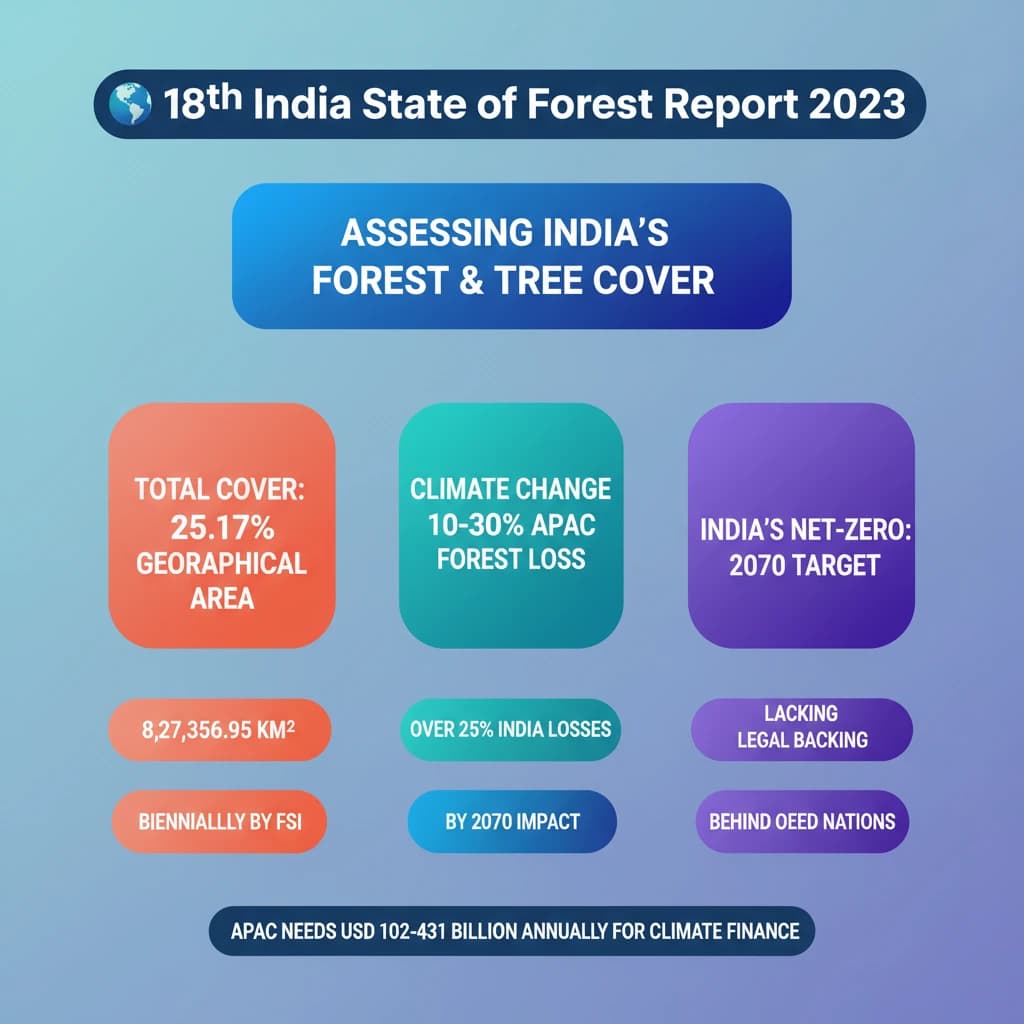
18th India State of Forest Report 2023 is a key topic under Environment And Ecology for UPSC Civil Services Examination. Key points include: The 18th ISFR 2023, released biennially by FSI, assesses India's forest and tree cover.. Total forest and tree cover is 8,27,356.95 km², representing 25.17% of India's geographical area.. Climate change could reduce APAC forest output by 10-30% by 2070, with India facing over 25% losses.. Understanding this topic is essential for both UPSC Prelims and Mains preparation.

Why is 18th India State of Forest Report 2023 important for UPSC exam?

18th India State of Forest Report 2023 is a Medium-level topic in UPSC Environment And Ecology. It is tested in both Prelims (factual MCQs) and Mains (analytical answer writing). Previous year UPSC questions have frequently covered aspects of 18th India State of Forest Report 2023, making it essential for comprehensive IAS preparation.

How to prepare 18th India State of Forest Report 2023 for UPSC?

To prepare 18th India State of Forest Report 2023 for UPSC: (1) Study the comprehensive notes covering all key concepts on Vaidra. (2) Practice previous year questions on this topic. (3) Connect it with current affairs using daily updates. (4) Revise using key takeaways and mind maps available for Environment And Ecology. (5) Write practice answers linking 18th India State of Forest Report 2023 to related GS Paper topics.

Key takeaways of 18th India State of Forest Report 2023 for UPSC

  • The 18th ISFR 2023, released biennially by FSI, assesses India's forest and tree cover.
  • Total forest and tree cover is 8,27,356.95 km², representing 25.17% of India's geographical area.
  • Climate change could reduce APAC forest output by 10-30% by 2070, with India facing over 25% losses.
  • Most Asian net-zero targets lack legal backing; India's target is 2070, behind OECD nations.
  • APAC needs USD 102-431 billion annually for climate finance, requiring private investment and regulatory reforms.
  • Scaling up renewable energy and leveraging carbon markets are critical for cost-effective climate action.
18th India State of Forest Report 2023

18th India State of Forest Report 2023

Medium⏱️ 7 min read✓ 95% Verified
environment and ecology

📖 Introduction

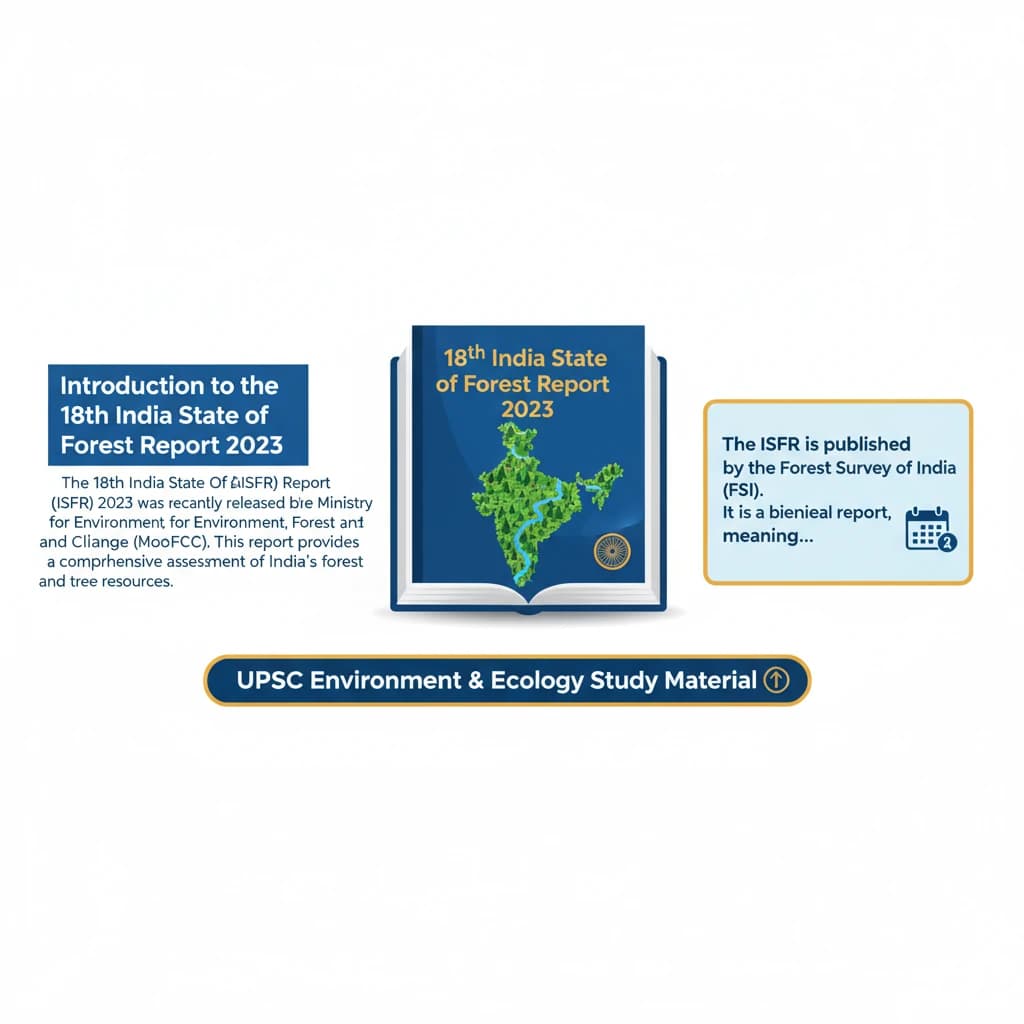
<h4>Introduction to the 18th India State of Forest Report 2023</h4><p>The <strong>18th India State of Forest Report (ISFR) 2023</strong> was recently released by the <strong>Ministry for Environment, Forest and Climate Change (MoEFCC)</strong>. This report provides a comprehensive assessment of India's forest and tree resources.</p><div class='info-box'><p>The <strong>ISFR</strong> is published by the <strong>Forest Survey of India (FSI)</strong>. It is a <strong>biennial</strong> report, meaning it is released every two years, a practice that began in <strong>1987</strong>.</p></div><h4>Key Findings: Forest and Tree Cover</h4><p>The report highlights the current status of <strong>forest and tree cover</strong> across the country. This data is crucial for understanding India's progress in achieving its environmental goals.</p><div class='key-point-box'><p>The <strong>total forest and tree cover</strong> of India stands at <strong>8,27,356.95 km²</strong>. This constitutes <strong>25.17%</strong> of the country's total <strong>geographical area (GA)</strong>.</p></div><p>The report further breaks down this total into distinct categories:</p><table class='info-table'><tr><th>Class</th><th>Area (km²)</th><th>Percentage of GA</th></tr><tr><td><strong>Forest Cover</strong></td><td><strong>7,15,342.61 km²</strong></td><td><strong>21.76%</strong></td></tr><tr><td><strong>Tree Cover</strong></td><td><strong>1,12,014.34 km²</strong></td><td><strong>3.41%</strong></td></tr><tr><td><strong>Total Forest and Tree Cover</strong></td><td><strong>8,27,356.95 km²</strong></td><td><strong>25.17%</strong></td></tr></table><h4>Environmental Impact Projections</h4><p>The <strong>ISFR 2023</strong> also delves into the potential environmental impacts, particularly concerning <strong>forest productivity</strong> under changing climatic conditions. These projections are vital for long-term planning.</p><div class='info-box'><p><strong>Climate change</strong> is projected to significantly reduce <strong>forest output</strong> in the <strong>Asia-Pacific (APAC)</strong> region. Estimates suggest a <strong>10–30% reduction</strong> by <strong>2070</strong>.</p></div><p>Specific regions within <strong>APAC</strong> are expected to face varying degrees of impact:</p><ul><li><strong>India</strong>, <strong>Vietnam</strong>, and <strong>Southeast Asia</strong> could experience losses exceeding <strong>25%</strong>.</li><li>In contrast, <strong>China</strong> and <strong>Central Asia</strong> might see modest increases, typically under <strong>5%</strong>.</li></ul><h4>Required Actions: Addressing Climate Change</h4><p>The report emphasizes several critical actions needed to mitigate climate change and its impacts on forests. These actions involve policy, finance, and technological shifts.</p><h5>Net-Zero Commitments and Targets</h5><p>Achieving <strong>net-zero emissions</strong> is a global imperative. The report assesses the commitments made by Asian economies in this regard.</p><div class='key-point-box'><p>Out of <strong>44 Asian economies</strong>, <strong>36</strong> have announced <strong>net-zero targets</strong>. However, only <strong>four</strong> of these commitments currently possess <strong>legal backing</strong>.</p></div><p>Comparison with developed nations reveals a lag:</p><ul><li><strong>India's net-zero target</strong> is set for <strong>2070</strong>.</li><li><strong>China's target</strong> is for <strong>2060</strong>.</li><li>Most <strong>OECD nations</strong> aim for <strong>2050</strong>, indicating a more ambitious timeline.</li></ul><h5>Climate Finance Needs</h5><p>Adequate financial resources are indispensable for effective climate action. The report quantifies the substantial funding gap in the region.</p><div class='info-box'><p>The <strong>APAC region</strong> requires an estimated <strong>USD 102–431 billion annually</strong> for climate action. This significantly exceeds the <strong>USD 50 billion</strong> recorded in <strong>2021-22</strong>.</p></div><p>To bridge this gap, crucial reforms are needed:</p><ul><li>Greater mobilization of <strong>private investment</strong>.</li><li>Implementation of robust <strong>regulatory reforms</strong> to facilitate climate-friendly investments.</li></ul><h5>Renewable Energy and Carbon Markets</h5><p>The report identifies key strategies for cost-effective climate mitigation. Scaling up clean energy and utilizing market mechanisms are central to these strategies.</p><div class='exam-tip-box'><p>For <strong>UPSC Mains (GS-III Environment)</strong>, understanding the interplay between <strong>renewable energy expansion</strong> and <strong>carbon markets</strong> is crucial. These are practical tools for achieving climate goals efficiently.</p></div><p>The <strong>ISFR 2023</strong> underscores the necessity for:</p><ul><li>Rapidly <strong>scaling up renewable energy</strong> infrastructure and adoption.</li><li>Effectively <strong>leveraging carbon markets</strong> to drive cost-effective climate action and incentivize emission reductions.</li></ul>
Concept Diagram

💡 Key Takeaways

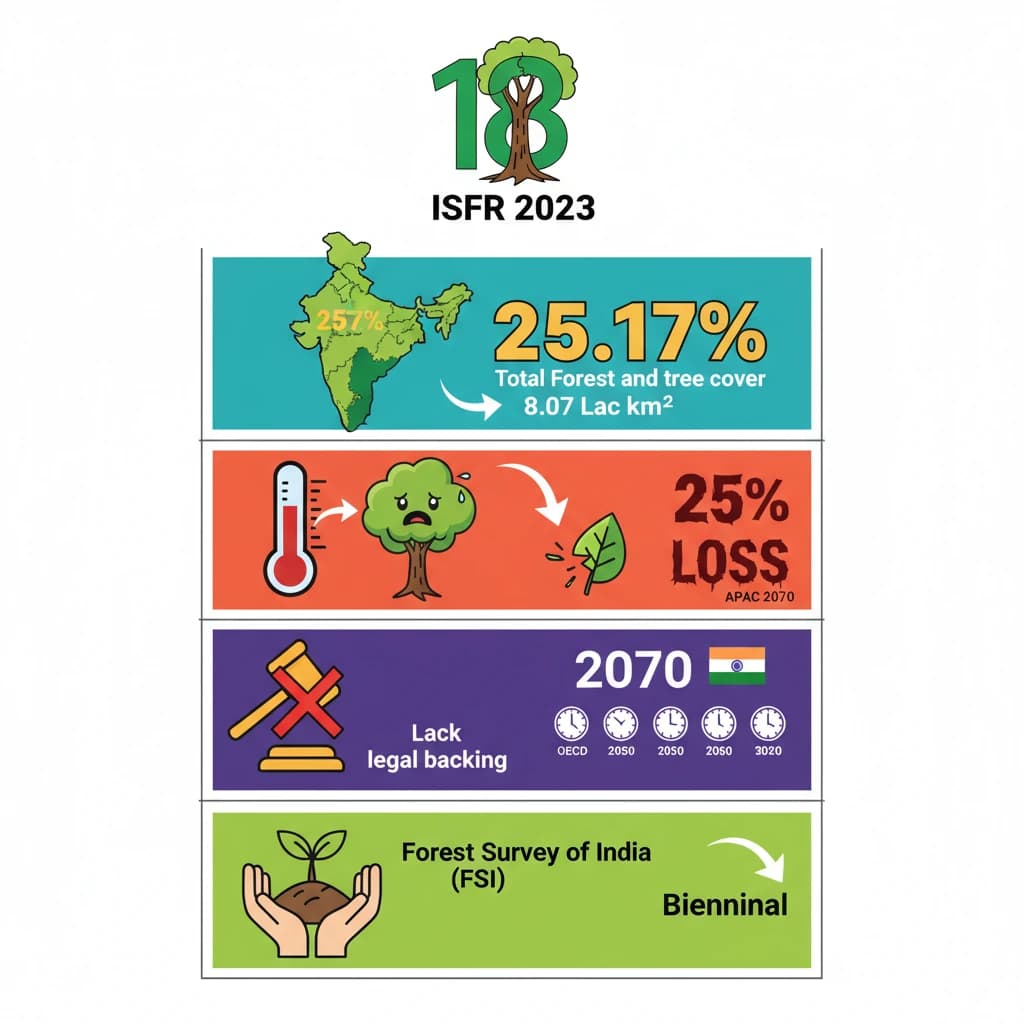
  • •The 18th ISFR 2023, released biennially by FSI, assesses India's forest and tree cover.
  • •Total forest and tree cover is 8,27,356.95 km², representing 25.17% of India's geographical area.
  • •Climate change could reduce APAC forest output by 10-30% by 2070, with India facing over 25% losses.
  • •Most Asian net-zero targets lack legal backing; India's target is 2070, behind OECD nations.
  • •APAC needs USD 102-431 billion annually for climate finance, requiring private investment and regulatory reforms.
  • •Scaling up renewable energy and leveraging carbon markets are critical for cost-effective climate action.

🧠 Memory Techniques
Memory Aid
95% Verified Content

📚 Reference Sources

•Ministry for Environment, Forest and Climate Change (MoEFCC)
•Forest Survey of India (FSI) official reports (implied by source content)

Related Topics

Loading related topics...
Explore:Environment And Ecology Topics·All Subjects·Daily Current Affairs·Editorial Analysis·Previous Year Questions·UPSC GPT