Loading page, please wait…
Vaidra Logo
Vaidra

Top 4 items + smart groups

UPSC GPT
New
Current Affairs
Daily Solutions
Daily Puzzle
Mains Evaluator

Version 2.0.0 • Built with ❤️ for UPSC aspirants

Loading...
Loading...
Loading...
Loading...
Loading...
Loading...
Loading...
Loading...
Loading...
Loading...
Loading...
Loading...
Loading...

Crocodile Conservation Project: Objectives, Implementation & Sanctuaries - UPSC Environment And Ecology

What is Crocodile Conservation Project: Objectives, Implementation & Sanctuaries in UPSC Environment And Ecology?

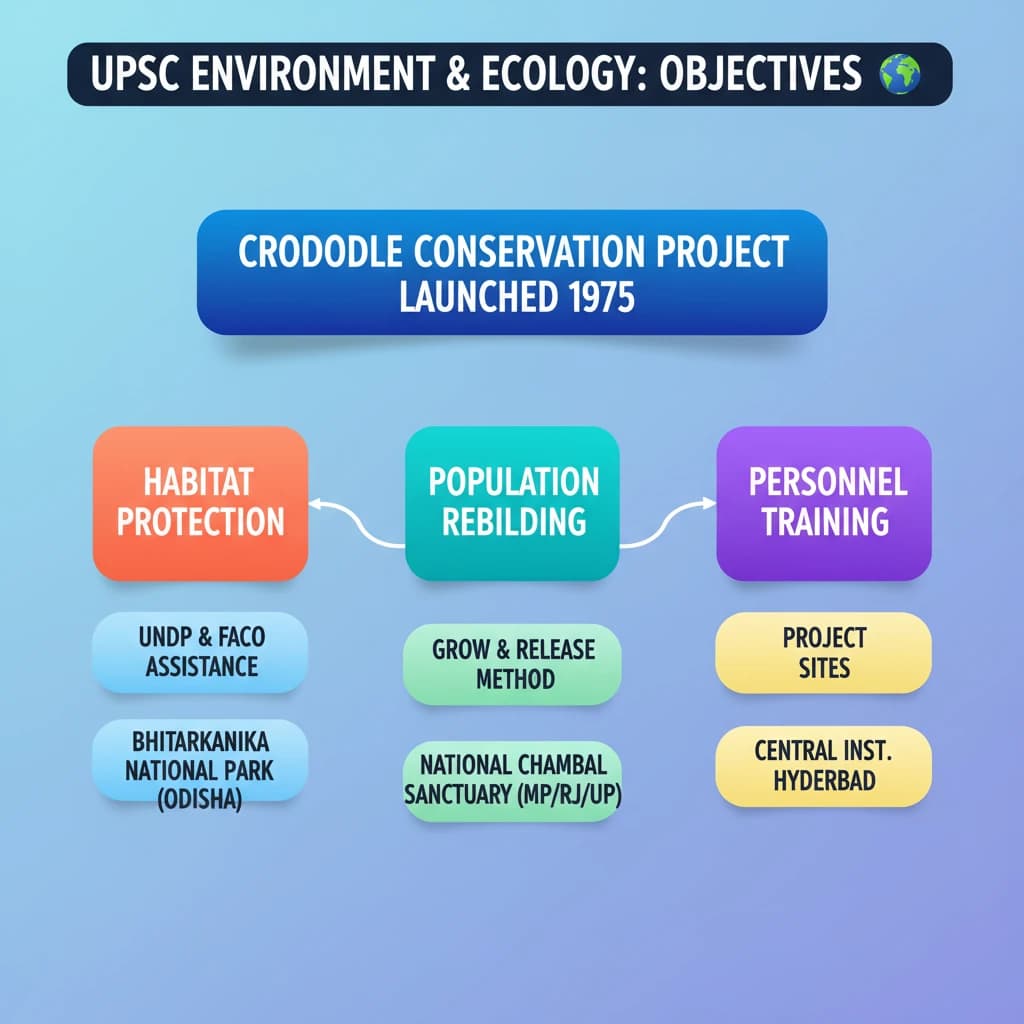
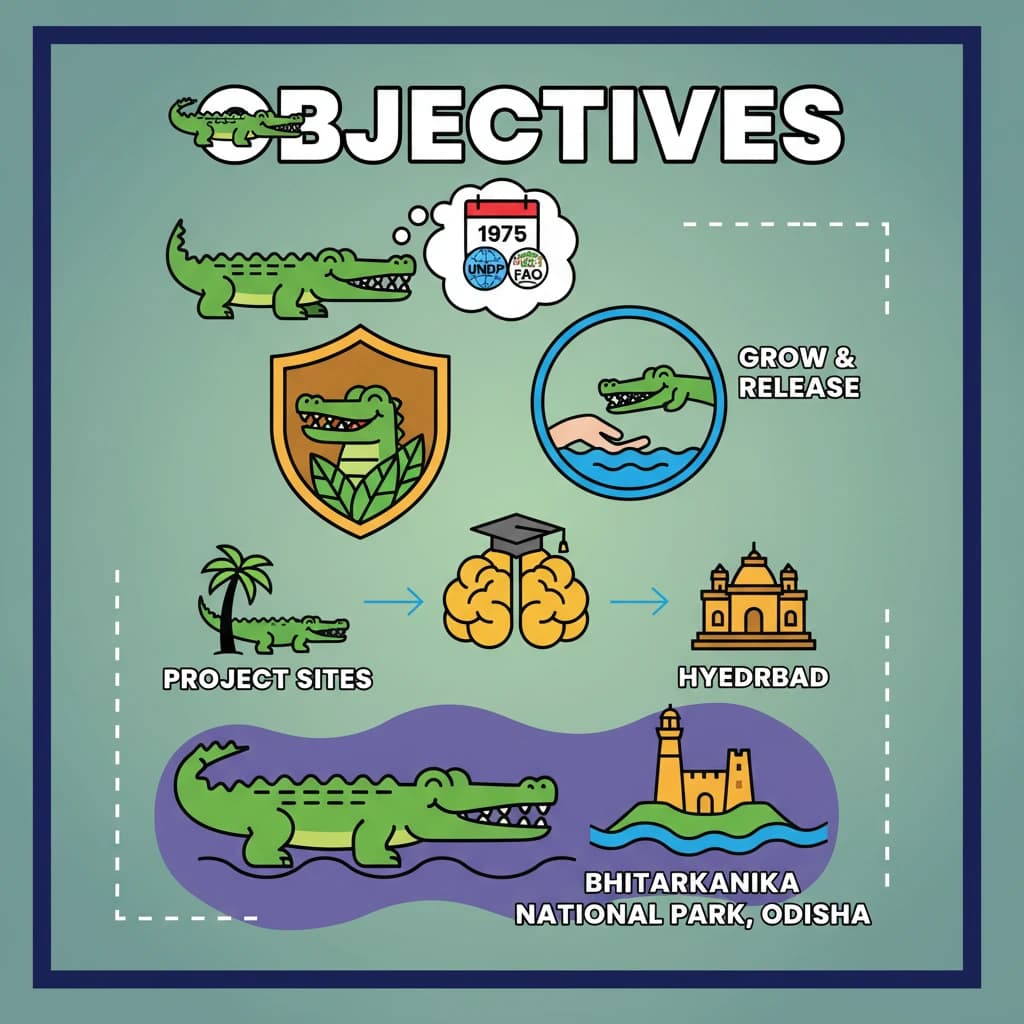
Crocodile Conservation Project: Objectives, Implementation & Sanctuaries is a key topic under Environment And Ecology for UPSC Civil Services Examination. Key points include: Crocodile Conservation Project launched in 1975 with UNDP and FAO assistance.. Key objectives: Protection of natural habitats and rebuilding populations via 'grow and release' method.. Personnel training conducted at project sites and Central Crocodile Breeding Institute, Hyderabad.. Understanding this topic is essential for both UPSC Prelims and Mains preparation.

Why is Crocodile Conservation Project: Objectives, Implementation & Sanctuaries important for UPSC exam?

Crocodile Conservation Project: Objectives, Implementation & Sanctuaries is a Medium-level topic in UPSC Environment And Ecology. It is tested in both Prelims (factual MCQs) and Mains (analytical answer writing). Previous year UPSC questions have frequently covered aspects of Crocodile Conservation Project: Objectives, Implementation & Sanctuaries, making it essential for comprehensive IAS preparation.

How to prepare Crocodile Conservation Project: Objectives, Implementation & Sanctuaries for UPSC?

To prepare Crocodile Conservation Project: Objectives, Implementation & Sanctuaries for UPSC: (1) Study the comprehensive notes covering all key concepts on Vaidra. (2) Practice previous year questions on this topic. (3) Connect it with current affairs using daily updates. (4) Revise using key takeaways and mind maps available for Environment And Ecology. (5) Write practice answers linking Crocodile Conservation Project: Objectives, Implementation & Sanctuaries to related GS Paper topics.

Key takeaways of Crocodile Conservation Project: Objectives, Implementation & Sanctuaries for UPSC

  • Crocodile Conservation Project launched in 1975 with UNDP and FAO assistance.
  • Key objectives: Protection of natural habitats and rebuilding populations via 'grow and release' method.
  • Personnel training conducted at project sites and Central Crocodile Breeding Institute, Hyderabad.
  • Bhitarkanika National Park (Odisha) is crucial for saltwater crocodiles.
  • National Chambal Sanctuary (MP, Rajasthan, UP) is vital for gharials.
  • Saltwater crocodile population has significantly risen since 1975.
  • Bhitarkanika's breeding program stopped in 2024 due to population saturation; eggs now bred for tourism.
Crocodile Conservation Project: Objectives, Implementation & Sanctuaries

Crocodile Conservation Project: Objectives, Implementation & Sanctuaries

Medium⏱️ 6 min read✓ 95% Verified
environment and ecology

📖 Introduction

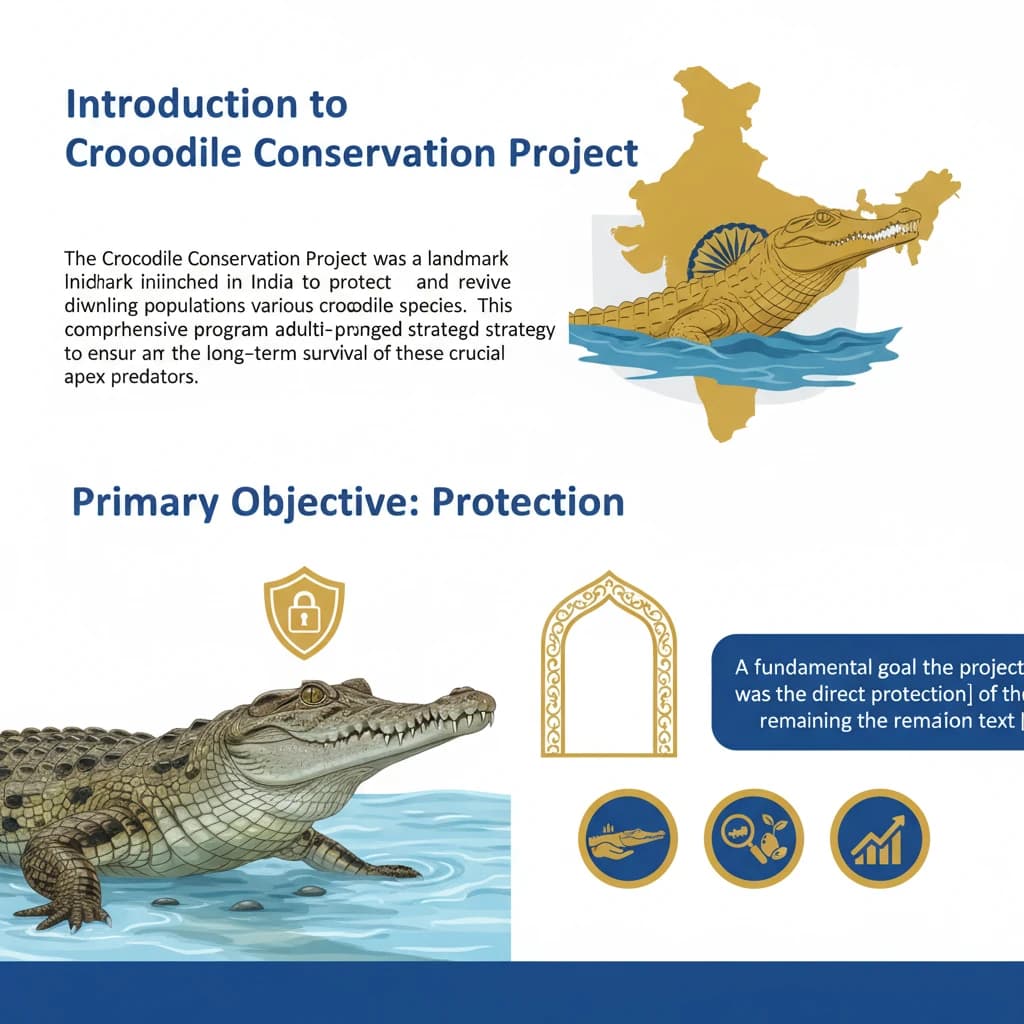
<h4>Introduction to Crocodile Conservation Project</h4><p>The <strong>Crocodile Conservation Project</strong> was a landmark initiative launched in India to protect and revive the dwindling populations of various crocodile species. This comprehensive program adopted a multi-pronged strategy to ensure the long-term survival of these crucial apex predators.</p><h4>Primary Objective: Protection</h4><p>A fundamental goal of the project was the direct <strong>protection</strong> of the remaining <strong>crocodile populations</strong>. This involved safeguarding them in their <strong>natural habitats</strong>, primarily through the establishment and effective management of dedicated sanctuaries.</p><div class='info-box'><p><strong>Habitat Protection:</strong> Establishing and managing <strong>sanctuaries</strong> and <strong>protected areas</strong> is critical for providing safe breeding grounds and foraging areas, free from human interference and poaching.</p></div><h4>Secondary Objective: Population Rebuilding ('Grow and Release')</h4><p>A core strategy for population recovery was the '<strong>grow and release</strong>' or '<strong>rear and release</strong>' approach. This involved a systematic process designed to significantly increase the survival rates of young crocodiles.</p><div class='key-point-box'><p><strong>'Grow and Release' Process:</strong><ul><li><strong>Egg Collection:</strong> Gathering crocodile eggs from natural nests.</li><li><strong>Incubation:</strong> Controlled incubation of eggs in protected environments.</li><li><strong>Rearing:</strong> Raising hatchlings in captivity until they reach a suitable size, reducing vulnerability to predators.</li><li><strong>Release:</strong> Releasing the sub-adult crocodiles into designated natural habitats.</li><li><strong>Monitoring:</strong> Post-release tracking and observation to assess survival and adaptation.</li></ul></p></div><h4>Capacity Building: Personnel Training</h4><p>To ensure the project's success, a strong emphasis was placed on developing skilled human resources. This involved intensive <strong>training for personnel</strong> involved in crocodile conservation activities.</p><div class='info-box'><p><strong>Training Locations:</strong> Training was provided at various <strong>project sites</strong> across the country, as well as at the specialized <strong>Central Crocodile Breeding and Management Institute</strong> located in <strong>Hyderabad</strong>.</p></div><h4>International Collaboration and Implementation</h4><p>The initiation and successful implementation of the <strong>Crocodile Conservation Project</strong> benefited significantly from international support. This collaboration underscored the global importance of wildlife conservation efforts.</p><div class='info-box'><p><strong>International Assistance:</strong> The project was launched with crucial assistance from the <strong>United Nations Development Programme (UNDP)</strong> and the <strong>Food and Agriculture Organization (FAO)</strong>.</p></div><h4>Key Crocodile Conservation Sanctuaries in India</h4><p>Several protected areas became vital centers for crocodile conservation, each specializing in different species. These sanctuaries played a pivotal role in the project's achievements.</p><ul><li><strong>Bhitarkanika National Park (Odisha):</strong> Renowned for its successful conservation of <strong>saltwater crocodiles</strong>.</li><li><strong>National Chambal Sanctuary (Madhya Pradesh, Rajasthan, Uttar Pradesh):</strong> A critical habitat for the endangered <strong>gharials</strong>, spanning three Indian states.</li></ul><h4>Project Achievements and Recent Developments</h4><p>The long-term commitment to the <strong>Crocodile Conservation Project</strong> has yielded significant positive outcomes, particularly for certain species.</p><div class='highlight-box'><p><strong>Major Achievement:</strong> Since its launch in <strong>1975</strong>, the project has led to a steady and substantial rise in the population of <strong>saltwater crocodiles</strong> in India, marking a notable conservation success story.</p></div><p>However, successful conservation also brings new challenges and management decisions. A recent development highlights this evolution in strategy.</p><div class='exam-tip-box'><p><strong>Important Update (2024):</strong> The intensive <strong>crocodile breeding program</strong> within <strong>Bhitarkanika National Park</strong> was officially stopped in <strong>2024</strong>. This decision was made due to the achievement of <strong>population saturation</strong> for saltwater crocodiles within the park. Despite this, <strong>egg collection</strong> continues annually, with eggs being bred for <strong>tourism purposes</strong> rather than for release into the wild.</p></div>
Concept Diagram

💡 Key Takeaways

  • •Crocodile Conservation Project launched in 1975 with UNDP and FAO assistance.
  • •Key objectives: Protection of natural habitats and rebuilding populations via 'grow and release' method.
  • •Personnel training conducted at project sites and Central Crocodile Breeding Institute, Hyderabad.
  • •Bhitarkanika National Park (Odisha) is crucial for saltwater crocodiles.
  • •National Chambal Sanctuary (MP, Rajasthan, UP) is vital for gharials.
  • •Saltwater crocodile population has significantly risen since 1975.
  • •Bhitarkanika's breeding program stopped in 2024 due to population saturation; eggs now bred for tourism.

🧠 Memory Techniques
Memory Aid
95% Verified Content

📚 Reference Sources

•Ministry of Environment, Forest and Climate Change (MoEFCC) reports on wildlife conservation
•IUCN Red List for crocodile species status
•National Park and Wildlife Sanctuary official websites (Bhitarkanika, Chambal)

Related Topics

Loading related topics...
Explore:Environment And Ecology Topics·All Subjects·Daily Current Affairs·Editorial Analysis·Previous Year Questions·UPSC GPT
Back
All Subjects

Topics

0 topics • 0 completed

Loading topics...
Loading...
Loading...
Loading...
Loading...
Loading...
Overall Progress0%
Crocodile Conservation Project: Objectives, Implementation & Sanctuaries - UPSC Environment And Ecology