Loading page, please wait…
Vaidra Logo
Vaidra

Top 4 items + smart groups

UPSC GPT
New
Current Affairs
Daily Solutions
Daily Puzzle
Mains Evaluator

Version 2.0.0 • Built with ❤️ for UPSC aspirants

Loading...
Loading...
Loading...
Loading...
Loading...
Loading...
Loading...
Loading...
Loading...
Loading...
Loading...
Loading...
Loading...
Back
All Subjects

Topics

0 topics • 0 completed

Loading topics...
Loading...
Loading...
Loading...
Loading...
Loading...
Overall Progress0%

Gases, Rainfall and Climate Change - UPSC Environment And Ecology

What is Gases, Rainfall and Climate Change in UPSC Environment And Ecology?

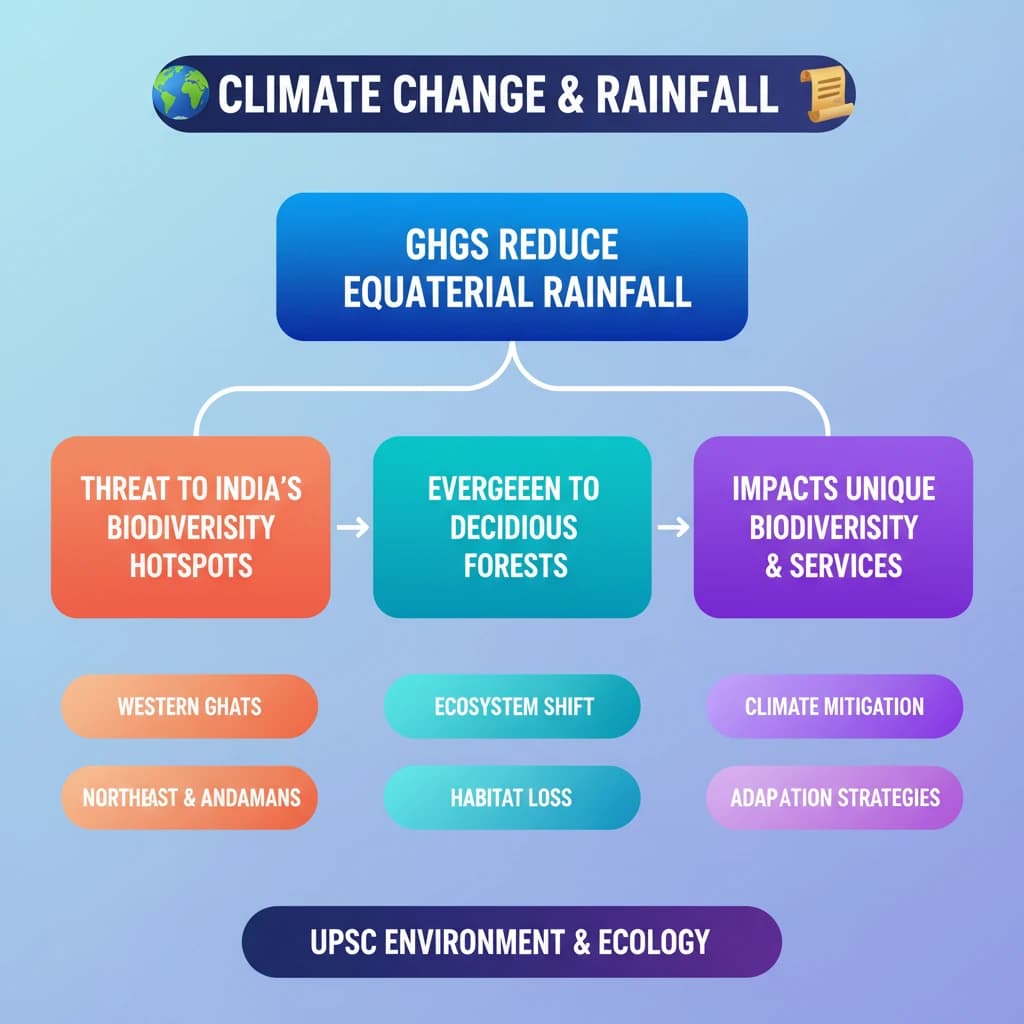
Gases, Rainfall and Climate Change is a key topic under Environment And Ecology for UPSC Civil Services Examination. Key points include: Increased GHGs can decrease rainfall in equatorial regions.. This poses a threat to India's biodiversity hotspots (Western Ghats, Northeast, Andamans).. Evergreen forests in these regions could transform into deciduous forests.. Understanding this topic is essential for both UPSC Prelims and Mains preparation.

Why is Gases, Rainfall and Climate Change important for UPSC exam?

Gases, Rainfall and Climate Change is a Medium-level topic in UPSC Environment And Ecology. It is tested in both Prelims (factual MCQs) and Mains (analytical answer writing). Previous year UPSC questions have frequently covered aspects of Gases, Rainfall and Climate Change, making it essential for comprehensive IAS preparation.

How to prepare Gases, Rainfall and Climate Change for UPSC?

To prepare Gases, Rainfall and Climate Change for UPSC: (1) Study the comprehensive notes covering all key concepts on Vaidra. (2) Practice previous year questions on this topic. (3) Connect it with current affairs using daily updates. (4) Revise using key takeaways and mind maps available for Environment And Ecology. (5) Write practice answers linking Gases, Rainfall and Climate Change to related GS Paper topics.

Key takeaways of Gases, Rainfall and Climate Change for UPSC

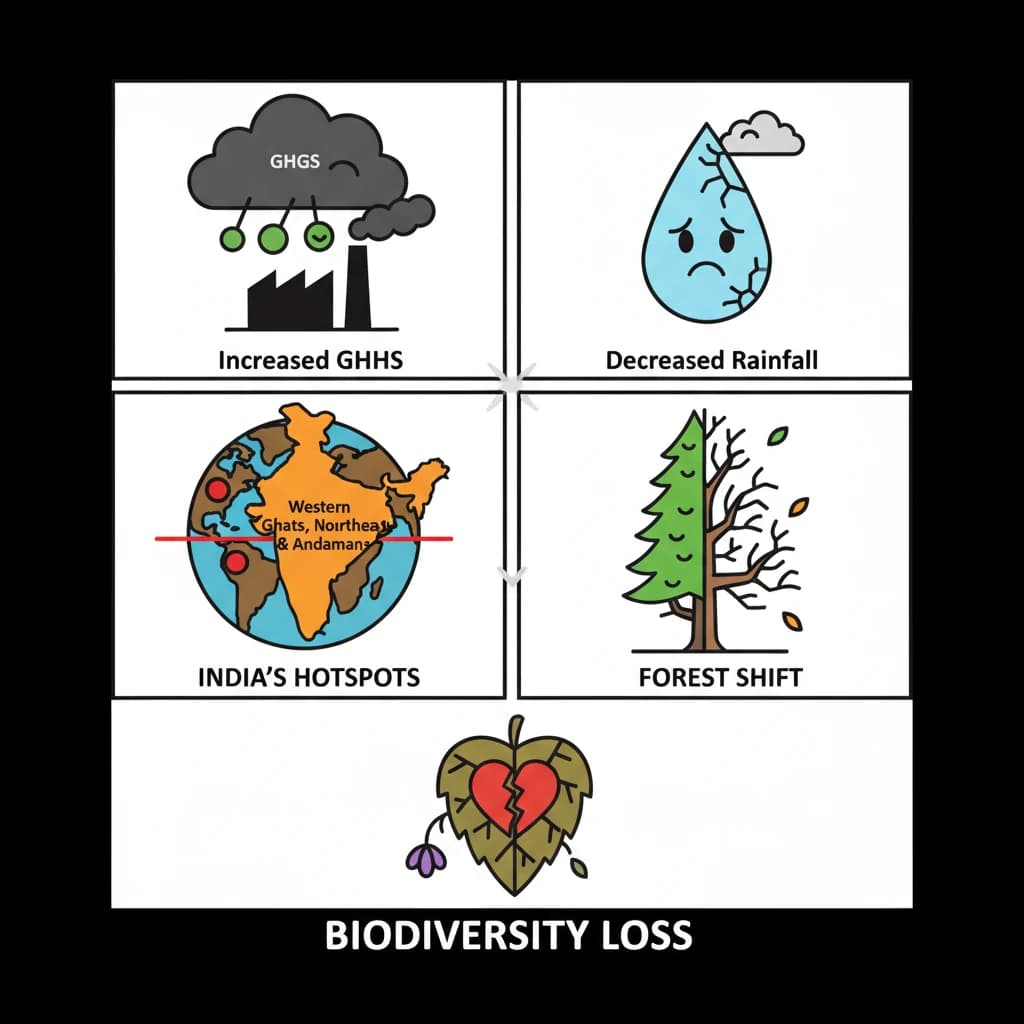
  • Increased GHGs can decrease rainfall in equatorial regions.
  • This poses a threat to India's biodiversity hotspots (Western Ghats, Northeast, Andamans).
  • Evergreen forests in these regions could transform into deciduous forests.
  • Such a shift would severely impact unique biodiversity and ecosystem services.
  • Proactive climate mitigation and adaptation strategies are crucial for conservation.
Gases, Rainfall and Climate Change

Gases, Rainfall and Climate Change

Medium⏱️ 5 min read✓ 95% Verified
environment and ecology

📖 Introduction

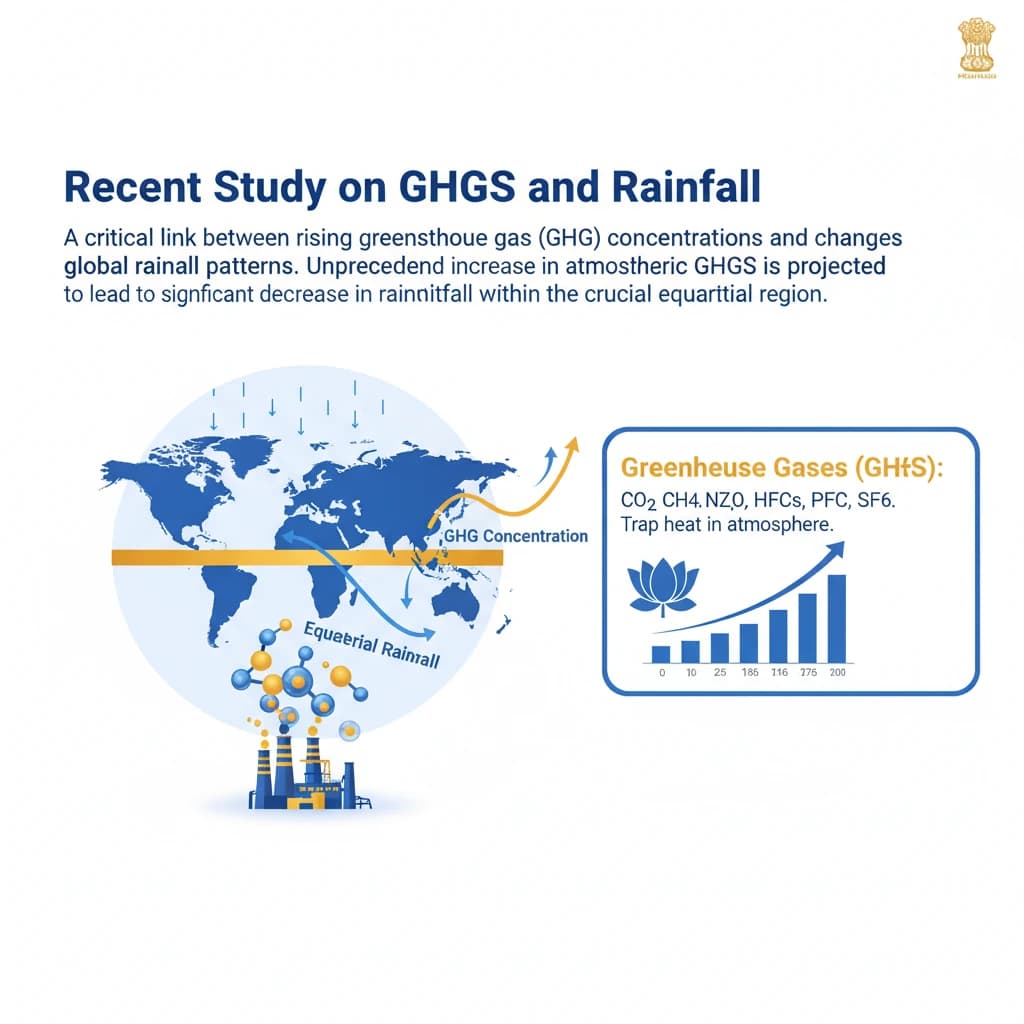
<h4>Recent Study on GHGs and Rainfall</h4><p>A <strong>recent study</strong> has highlighted a critical link between rising <strong>greenhouse gas (GHG)</strong> concentrations and changes in global rainfall patterns.</p><p>The research indicates that an <strong>unprecedented increase</strong> in atmospheric GHGs is projected to lead to a significant <strong>decrease in rainfall</strong> within the crucial <strong>equatorial region</strong>.</p><div class='info-box'><p><strong>Greenhouse Gases (GHGs):</strong> Atmospheric gases that absorb and emit radiant energy within the thermal infrared range, causing the greenhouse effect. Key GHGs include <strong>carbon dioxide (CO2)</strong>, <strong>methane (CH4)</strong>, and <strong>nitrous oxide (N2O)</strong>.</p></div><h4>Impact on India's Biodiversity Hotspots</h4><p>This projected decline in equatorial rainfall has severe implications, particularly for <strong>India’s biodiversity hotspots</strong>.</p><p>The study warns of a potential ecological transformation: the existing <strong>evergreen forests</strong> in these regions could be replaced by <strong>deciduous forests</strong>.</p><div class='key-point-box'><p>The shift from <strong>evergreen to deciduous forests</strong> signifies a major ecological change, impacting species composition, water cycles, and overall ecosystem resilience.</p></div><h4>Affected Indian Regions</h4><p>The biodiversity hotspots identified as vulnerable to this transformation include:</p><ul><li>The <strong>Western Ghats</strong>: Known for its high endemism and rich biodiversity.</li><li><strong>Northeast India</strong>: A region characterized by diverse forest types and unique flora and fauna.</li><li>The <strong>Andaman and Nicobar Islands</strong>: Home to pristine rainforests and marine ecosystems.</li></ul><div class='exam-tip-box'><p>Understanding the specific regions affected (<strong>Western Ghats, Northeast India, Andamans</strong>) is crucial for UPSC. Questions often focus on geographical impacts of climate change.</p></div>
Concept Diagram

💡 Key Takeaways

  • •Increased GHGs can decrease rainfall in equatorial regions.
  • •This poses a threat to India's biodiversity hotspots (Western Ghats, Northeast, Andamans).
  • •Evergreen forests in these regions could transform into deciduous forests.
  • •Such a shift would severely impact unique biodiversity and ecosystem services.
  • •Proactive climate mitigation and adaptation strategies are crucial for conservation.

🧠 Memory Techniques
Memory Aid
95% Verified Content

Related Topics

Loading related topics...
Explore:Environment And Ecology Topics·All Subjects·Daily Current Affairs·Editorial Analysis·Previous Year Questions·UPSC GPT
Gases, Rainfall and Climate Change - UPSC Environment And Ecology