Loading page, please wait…
Vaidra Logo
Vaidra

Top 4 items + smart groups

UPSC GPT
New
Current Affairs
Daily Solutions
Daily Puzzle
Mains Evaluator

Version 2.0.0 • Built with ❤️ for UPSC aspirants

Loading...
Loading...
Loading...
Loading...
Loading...
Loading...
Loading...
Loading...
Loading...
Loading...
Loading...
Loading...
Loading...
Dicliptra Polymorpha - UPSC Environment And Ecology
Back
All Subjects

Topics

0 topics • 0 completed

Loading topics...
Loading...
Loading...
Loading...
Loading...
Loading...
Overall Progress0%

Dicliptra Polymorpha - UPSC Environment And Ecology

What is Dicliptra Polymorpha in UPSC Environment And Ecology?

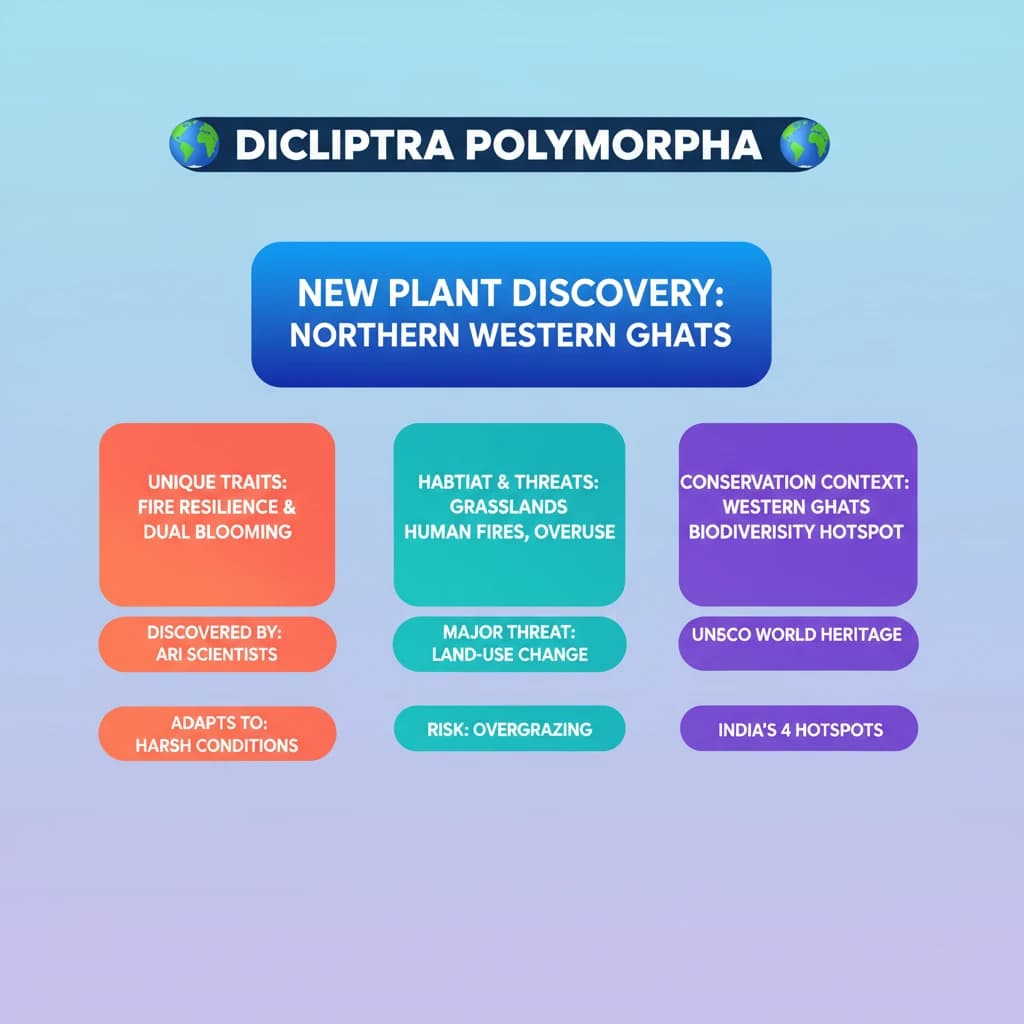
Dicliptra Polymorpha is a key topic under Environment And Ecology for UPSC Civil Services Examination. Key points include: <strong>Dicliptra Polymorpha</strong> is a new plant species discovered in the <strong>Northern Western Ghats</strong> by <strong>ARI</strong> scientists.. It exhibits unique traits like <strong>fire resilience</strong> and a <strong>dual blooming pattern</strong>, adapting to harsh grassland conditions.. Major threats include <strong>human-induced fires</strong> and <strong>habitat overuse</strong> (overgrazing, land-use changes).. Understanding this topic is essential for both UPSC Prelims and Mains preparation.

Why is Dicliptra Polymorpha important for UPSC exam?

Dicliptra Polymorpha is a Medium-level topic in UPSC Environment And Ecology. It is tested in both Prelims (factual MCQs) and Mains (analytical answer writing). Previous year UPSC questions have frequently covered aspects of Dicliptra Polymorpha, making it essential for comprehensive IAS preparation.

How to prepare Dicliptra Polymorpha for UPSC?

To prepare Dicliptra Polymorpha for UPSC: (1) Study the comprehensive notes covering all key concepts on Vaidra. (2) Practice previous year questions on this topic. (3) Connect it with current affairs using daily updates. (4) Revise using key takeaways and mind maps available for Environment And Ecology. (5) Write practice answers linking Dicliptra Polymorpha to related GS Paper topics.

Key takeaways of Dicliptra Polymorpha for UPSC

  • <strong>Dicliptra Polymorpha</strong> is a new plant species discovered in the <strong>Northern Western Ghats</strong> by <strong>ARI</strong> scientists.
  • It exhibits unique traits like <strong>fire resilience</strong> and a <strong>dual blooming pattern</strong>, adapting to harsh grassland conditions.
  • Major threats include <strong>human-induced fires</strong> and <strong>habitat overuse</strong> (overgrazing, land-use changes).
  • The <strong>Western Ghats</strong> is a <strong>UNESCO World Heritage Site</strong> and one of India's four <strong>biodiversity hotspots</strong>, rich in endemic flora and fauna.
  • The <strong>Central Zoo Authority (CZA)</strong>, established in <strong>1992</strong> under the <strong>Wildlife (Protection) Act, 1972</strong>, is a statutory body for biodiversity conservation.
  • The <strong>Gadgil Committee (2011)</strong> focused on the ecological protection of the <strong>Western Ghats</strong>.
Dicliptra Polymorpha

Dicliptra Polymorpha

Medium⏱️ 8 min read✓ 95% Verified
environment and ecology

📖 Introduction

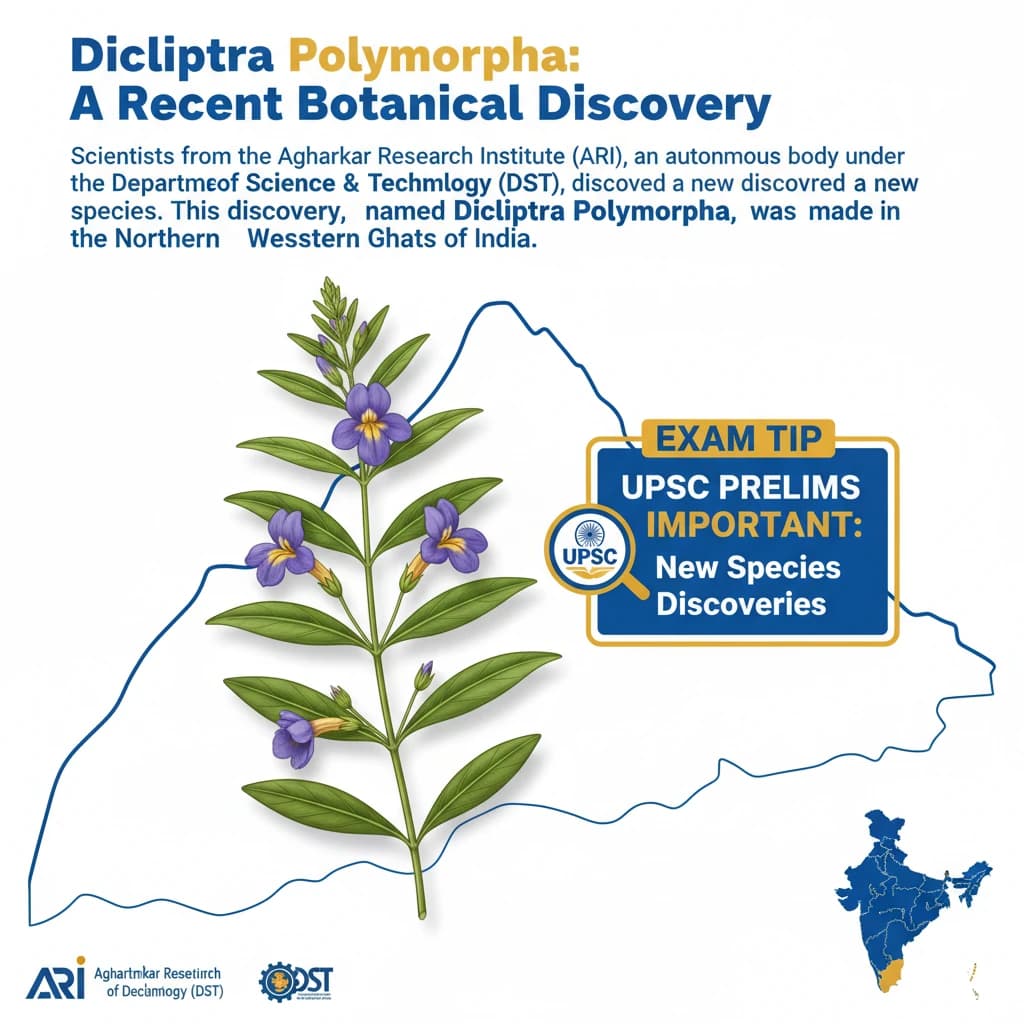
<h4>Dicliptra Polymorpha: A Recent Botanical Discovery</h4><p>Scientists from the <strong>Agharkar Research Institute (ARI)</strong>, an autonomous body under the <strong>Department of Science & Technology (DST)</strong>, recently discovered a new plant species. This discovery, named <strong>Dicliptra Polymorpha</strong>, was made in the <strong>Northern Western Ghats of India</strong>.</p><div class='exam-tip-box'><p>New species discoveries are important for <strong>UPSC Prelims</strong>, often appearing as direct questions. Understanding the associated geographical location and unique traits is crucial.</p></div><h4>Key Characteristics of Dicliptra Polymorpha</h4><p>The newly identified <strong>Dicliptra Polymorpha</strong> exhibits several distinctive traits, allowing it to thrive in challenging environments. These adaptations highlight its resilience within its natural habitat.</p><ul><li><strong>Fire Resilience</strong>: This species can successfully survive both prolonged <strong>summer droughts</strong> and frequent <strong>grassland fires</strong>, demonstrating remarkable hardiness.</li><li><strong>Dual Blooming Pattern</strong>: It displays an unusual flowering cycle, blooming twice a year. The first phase occurs <strong>post-monsoon (November–April)</strong>, and a second phase emerges in <strong>May–June</strong>, specifically after fires.</li><li><strong>Morphological Distinction</strong>: Its <strong>inflorescence flower structures</strong> are unique among Indian species of Dicliptra. Interestingly, these structures bear similarities to those found in certain <strong>African species</strong>.</li></ul><div class='info-box'><p><strong>Adaptations to Harsh Conditions</strong>: <strong>Dicliptra Polymorpha</strong> thrives on open grassland slopes. It develops <strong>woody rootstocks</strong> that produce dwarf flowering shoots during its second, post-fire blooming phase, aiding its survival.</p></div><h4>Threats to Dicliptra Polymorpha</h4><p>Despite its resilience, <strong>Dicliptra Polymorpha</strong> faces significant threats, primarily from anthropogenic activities and environmental pressures within its habitat.</p><ul><li><strong>Human-Induced Fires</strong>: While fires can trigger a second blooming, uncontrolled or excessive fires can severely degrade the species' habitat and impact its long-term survival.</li><li><strong>Habitat Overuse</strong>: Practices such as <strong>overgrazing</strong> by livestock and extensive <strong>land-use changes</strong> pose a considerable threat. These activities directly impact the delicate balance of grassland biodiversity where the species resides.</li></ul><h4>The Western Ghats: A Global Biodiversity Hotspot</h4><p>The <strong>Western Ghats</strong>, also known as the <strong>Sahyadri Hills</strong>, are renowned globally for their exceptionally rich and unique assemblage of <strong>flora and fauna</strong>. This mountain range is a critical ecological zone in India.</p><div class='info-box'><p><strong>Geographical Nomenclature</strong>: The range is called <strong>Sahyadri</strong> in northern Maharashtra, <strong>Nilgiri Hills</strong> in Karnataka and Tamil Nadu, and <strong>Anaimalai Hills</strong> and <strong>Cardamom Hills</strong> in Kerala.</p></div><p>Recognized as a <strong>UNESCO World Heritage Site</strong>, the Western Ghats are a cornerstone of India's natural heritage. They are one of <strong>India’s four recognized biodiversity hotspots</strong>, harboring numerous endemic and yet-to-be-discovered species.</p><p>This region is home to <strong>two biosphere reserves</strong>, <strong>13 National Parks</strong>, numerous <strong>wildlife sanctuaries</strong>, and many <strong>Reserve Forests</strong>. It encompasses diverse ecosystems, from the evergreen forests of <strong>Nagarahole</strong> to the deciduous forests of <strong>Bandipur National Park</strong>.</p><h4>Central Zoo Authority (CZA): A Statutory Body for Conservation</h4><p>The <strong>Central Zoo Authority (CZA)</strong> plays a pivotal role in strengthening national efforts for biodiversity conservation. It is a <strong>statutory body</strong> operating under the <strong>Ministry of Environment, Forest and Climate Change</strong>.</p><div class='info-box'><p><strong>Establishment & Structure</strong>: The <strong>CZA</strong> was established in <strong>1992</strong> under the provisions of the <strong>Wildlife (Protection) Act, 1972</strong>. It is chaired by the <strong>Environment Minister</strong> and comprises <strong>10 members</strong> and a <strong>member-secretary</strong>.</p></div><p>The primary objective of the <strong>CZA</strong> is to complement and reinforce national initiatives aimed at the conservation of India's rich biodiversity, particularly through the regulation and oversight of zoos.</p><h4>Conservation Efforts in the Western Ghats</h4><p>Given its immense ecological value, the <strong>Western Ghats</strong> have been the focus of various conservation initiatives. One notable effort was the formation of the <strong>Gadgil Committee</strong>.</p><div class='key-point-box'><p>The <strong>Gadgil Committee (2011)</strong>, also known as the <strong>Western Ghats Ecology Expert Panel (WGEEP)</strong>, was established to assess the ecological status of the Western Ghats and recommend measures for its protection and sustainable management.</p></div>
Concept Diagram

💡 Key Takeaways

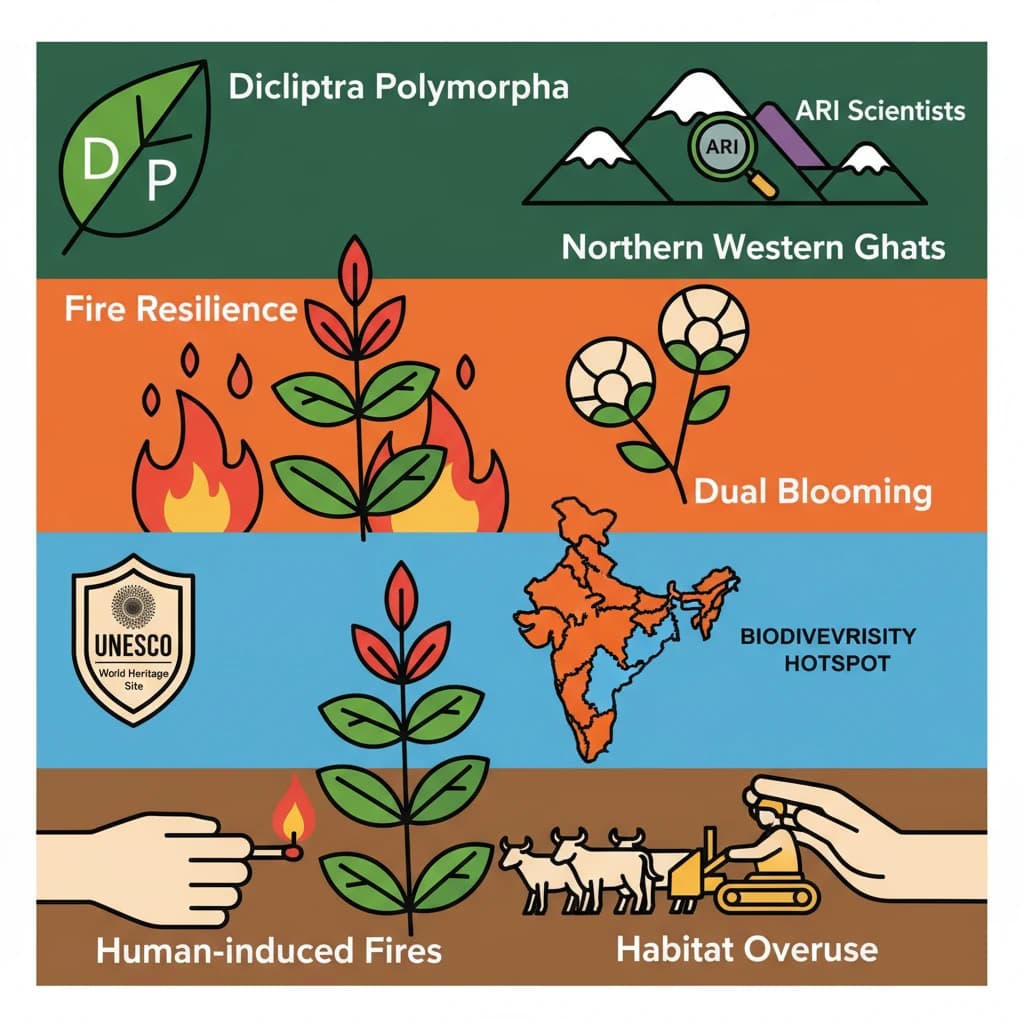
  • •<strong>Dicliptra Polymorpha</strong> is a new plant species discovered in the <strong>Northern Western Ghats</strong> by <strong>ARI</strong> scientists.
  • •It exhibits unique traits like <strong>fire resilience</strong> and a <strong>dual blooming pattern</strong>, adapting to harsh grassland conditions.
  • •Major threats include <strong>human-induced fires</strong> and <strong>habitat overuse</strong> (overgrazing, land-use changes).
  • •The <strong>Western Ghats</strong> is a <strong>UNESCO World Heritage Site</strong> and one of India's four <strong>biodiversity hotspots</strong>, rich in endemic flora and fauna.
  • •The <strong>Central Zoo Authority (CZA)</strong>, established in <strong>1992</strong> under the <strong>Wildlife (Protection) Act, 1972</strong>, is a statutory body for biodiversity conservation.
  • •The <strong>Gadgil Committee (2011)</strong> focused on the ecological protection of the <strong>Western Ghats</strong>.

🧠 Memory Techniques
Memory Aid
95% Verified Content

Related Topics

Loading related topics...
Explore:Environment And Ecology Topics·All Subjects·Daily Current Affairs·Editorial Analysis·Previous Year Questions·UPSC GPT