Loading page, please wait…
Vaidra Logo
Vaidra

Top 4 items + smart groups

UPSC GPT
New
Current Affairs
Daily Solutions
Daily Puzzle
Mains Evaluator

Version 2.0.0 • Built with ❤️ for UPSC aspirants

Loading...
Loading...
Loading...
Loading...
Loading...
Loading...
Loading...
Loading...
Loading...
Loading...
Loading...
Loading...
Loading...
Back
All Subjects

Topics

0 topics • 0 completed

Loading topics...
Loading...
Loading...
Loading...
Loading...
Loading...
Overall Progress0%
Balancing Climate Goals and Biodiversity Protection - UPSC Environment And Ecology

Balancing Climate Goals and Biodiversity Protection - UPSC Environment And Ecology

What is Balancing Climate Goals and Biodiversity Protection in UPSC Environment And Ecology?

Balancing Climate Goals and Biodiversity Protection is a key topic under Environment And Ecology for UPSC Civil Services Examination. Key points include: Land availability is a major constraint for simultaneously achieving climate goals (CDR) and biodiversity protection (30x30 target).. The 30x30 target aims to protect 30% of land and marine areas by 2030, but current coverage is significantly lower.. Land-based Carbon Dioxide Removal (CDR) strategies can conflict with establishing new protected areas and may lead to further biodiversity loss.. Understanding this topic is essential for both UPSC Prelims and Mains preparation.

Why is Balancing Climate Goals and Biodiversity Protection important for UPSC exam?

Balancing Climate Goals and Biodiversity Protection is a Medium-level topic in UPSC Environment And Ecology. It is tested in both Prelims (factual MCQs) and Mains (analytical answer writing). Previous year UPSC questions have frequently covered aspects of Balancing Climate Goals and Biodiversity Protection, making it essential for comprehensive IAS preparation.

How to prepare Balancing Climate Goals and Biodiversity Protection for UPSC?

To prepare Balancing Climate Goals and Biodiversity Protection for UPSC: (1) Study the comprehensive notes covering all key concepts on Vaidra. (2) Practice previous year questions on this topic. (3) Connect it with current affairs using daily updates. (4) Revise using key takeaways and mind maps available for Environment And Ecology. (5) Write practice answers linking Balancing Climate Goals and Biodiversity Protection to related GS Paper topics.

Key takeaways of Balancing Climate Goals and Biodiversity Protection for UPSC

  • Land availability is a major constraint for simultaneously achieving climate goals (CDR) and biodiversity protection (30x30 target).
  • The 30x30 target aims to protect 30% of land and marine areas by 2030, but current coverage is significantly lower.
  • Land-based Carbon Dioxide Removal (CDR) strategies can conflict with establishing new protected areas and may lead to further biodiversity loss.
  • Large-scale CDR deployment could compete with land used for food crop production, posing food security challenges.
  • International environmental law faces challenges in reconciling these conflicting land-use demands.
  • Integrated policy frameworks and sustainable land-use planning are crucial to find synergistic solutions.
Balancing Climate Goals and Biodiversity Protection

Balancing Climate Goals and Biodiversity Protection

Medium⏱️ 10 min read✓ 98% Verified
environment and ecology

📖 Introduction

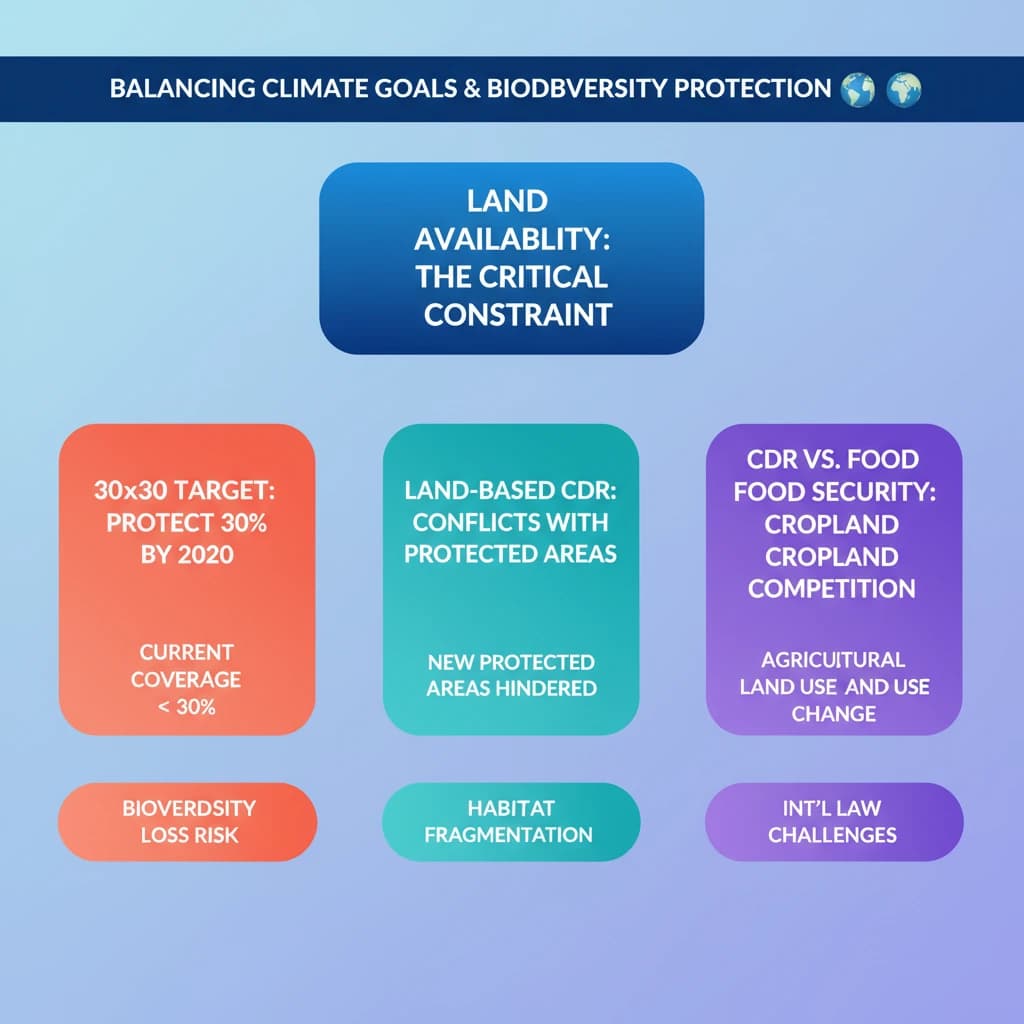
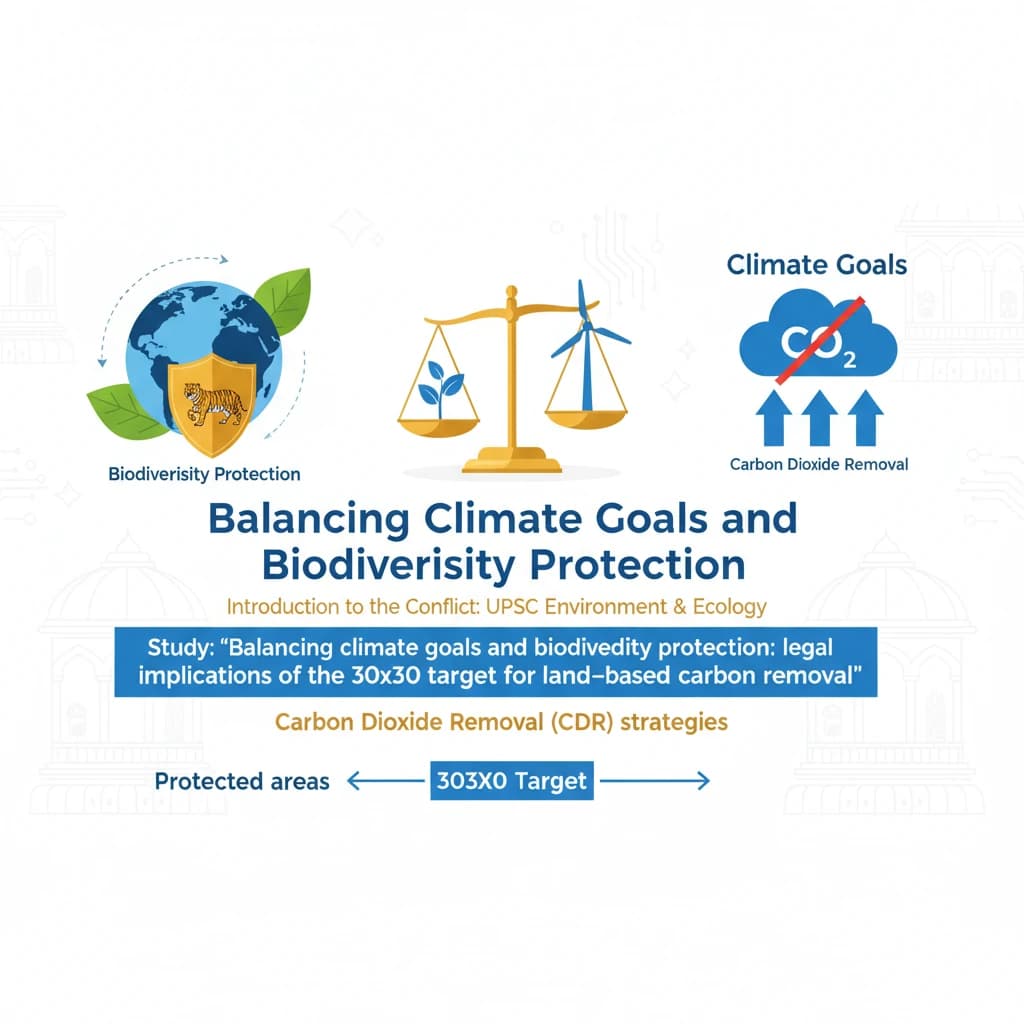
<h4>Introduction to the Conflict</h4><p>A recent study, titled <strong>“Balancing climate goals and biodiversity protection: legal implications of the 30x30 target for land-based carbon removal,”</strong> has brought to light a significant conflict. This research focuses on the tensions between land-based <strong>Carbon Dioxide Removal (CDR) strategies</strong> and the establishment of <strong>protected areas</strong>.</p><p>The study specifically examines this conflict within the framework of <strong>international environmental law</strong>. It highlights how efforts to achieve climate targets can inadvertently pose challenges to biodiversity conservation.</p><div class='exam-tip-box'><p><strong>UPSC Insight:</strong> Understanding such conflicts is crucial for <strong>GS Paper 3 (Environment)</strong>. Questions often revolve around the trade-offs and synergistic approaches required for sustainable development.</p></div><h4>Limited Land Availability: A Critical Challenge</h4><p>One of the primary issues identified is the <strong>limited availability of land</strong>. This constraint poses a critical challenge for simultaneously implementing both ambitious <strong>biodiversity targets</strong> and large-scale <strong>land-based climate mitigation strategies</strong>.</p><div class='key-point-box'><p>Many countries are pledging significant portions of their land for <strong>CDR activities</strong>. This creates direct competition for the land needed to establish and expand <strong>protected areas</strong>, which are vital for biodiversity.</p></div><h4>Global Targets and Current Status: The 30x30 Goal</h4><p>Nations worldwide have committed to the ambitious <strong>“30x30” biodiversity target</strong>. This goal aims to safeguard <strong>30% of the world’s terrestrial and marine areas by 2030</strong>.</p><div class='info-box'><p><strong>What is the 30x30 Target?</strong> It is a global initiative aiming to limit the accelerating loss of species and protect vital ecosystems. These ecosystems are crucial for economic security and ecological balance.</p></div><p>Despite this commitment, the current status shows a significant shortfall. As of <strong>2023</strong>, protected areas cover only approximately <strong>16% of terrestrial areas</strong> and a mere <strong>8% of marine areas</strong>.</p><p>This means that global efforts are currently falling considerably short of the ambitious <strong>30x30 goal</strong>, necessitating accelerated action and integrated planning.</p><h4>Land Use and Conflict: Biodiversity vs. Climate Mitigation</h4><p>The study underscores that certain <strong>land-based climate mitigation strategies</strong> inherently conflict with the urgent need to establish more <strong>protected areas</strong>. This is primarily due to existing <strong>land use constraints</strong>.</p><p>The large-scale deployment of <strong>Carbon Dioxide Removal (CDR) techniques</strong> could have severe consequences. It risks resulting in further <strong>biodiversity loss</strong> and intensified <strong>competition for land</strong> that is currently used for essential <strong>food crop production</strong>.</p><div class='exam-tip-box'><p><strong>UPSC Connection:</strong> This highlights the complex interlinkages between <strong>climate change mitigation</strong>, <strong>biodiversity conservation</strong>, and <strong>food security</strong>, all critical themes for essay and general studies papers.</p></div>
Concept Diagram

💡 Key Takeaways

  • •Land availability is a major constraint for simultaneously achieving climate goals (CDR) and biodiversity protection (30x30 target).
  • •The 30x30 target aims to protect 30% of land and marine areas by 2030, but current coverage is significantly lower.
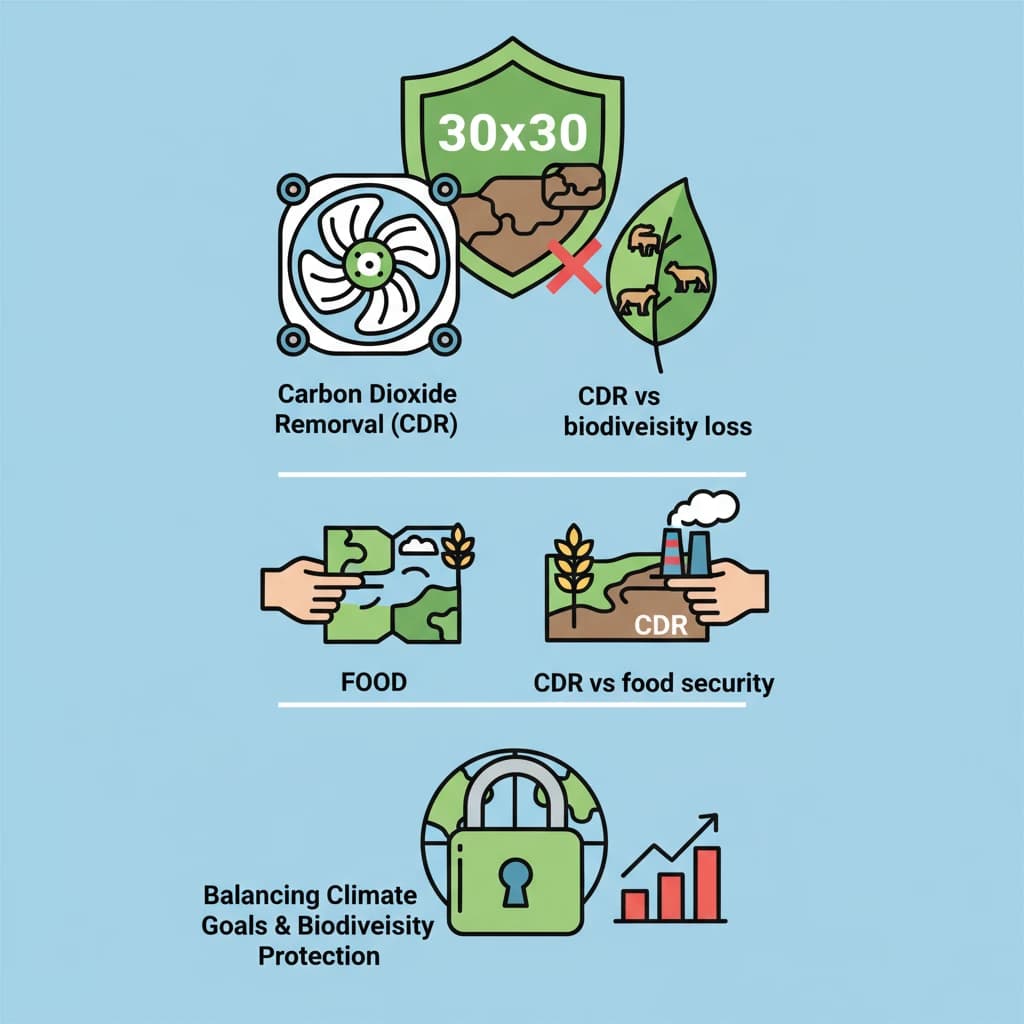
  • •Land-based Carbon Dioxide Removal (CDR) strategies can conflict with establishing new protected areas and may lead to further biodiversity loss.
  • •Large-scale CDR deployment could compete with land used for food crop production, posing food security challenges.
  • •International environmental law faces challenges in reconciling these conflicting land-use demands.
  • •Integrated policy frameworks and sustainable land-use planning are crucial to find synergistic solutions.

🧠 Memory Techniques
Memory Aid
98% Verified Content

📚 Reference Sources

•Study: Balancing climate goals and biodiversity protection: legal implications of the 30x30 target for land-based carbon removal (Referenced by Drishti IAS)

Related Topics

Loading related topics...
Explore:Environment And Ecology Topics·All Subjects·Daily Current Affairs·Editorial Analysis·Previous Year Questions·UPSC GPT