Loading page, please wait…
Vaidra Logo
Vaidra

Top 4 items + smart groups

UPSC GPT
New
Current Affairs
Daily Solutions
Daily Puzzle
Mains Evaluator

Version 2.0.0 • Built with ❤️ for UPSC aspirants

Loading...
Loading...
Loading...
Loading...
Loading...
Loading...
Loading...
Loading...
Loading...
Loading...
Loading...
Loading...
Loading...
Back
All Subjects

Topics

0 topics • 0 completed

Loading topics...
Loading...
Loading...
Loading...
Loading...
Loading...
Overall Progress0%

What are the Government Initiatives and Policies on Biofuels? - UPSC Environment And Ecology

What is What are the Government Initiatives and Policies on Biofuels? in UPSC Environment And Ecology?

What are the Government Initiatives and Policies on Biofuels? is a key topic under Environment And Ecology for UPSC Civil Services Examination. Key points include: National Policy on Biofuel, 2018 aims to reduce import dependence via bioethanol, biodiesel, and bio-CNG blending.. The 20% ethanol blending target was advanced from 2030 to 2025-26 in May 2022.. GST on ethanol for blending was reduced from 18% to 5% to encourage adoption.. Understanding this topic is essential for both UPSC Prelims and Mains preparation.

Why is What are the Government Initiatives and Policies on Biofuels? important for UPSC exam?

What are the Government Initiatives and Policies on Biofuels? is a Medium-level topic in UPSC Environment And Ecology. It is tested in both Prelims (factual MCQs) and Mains (analytical answer writing). Previous year UPSC questions have frequently covered aspects of What are the Government Initiatives and Policies on Biofuels?, making it essential for comprehensive IAS preparation.

How to prepare What are the Government Initiatives and Policies on Biofuels? for UPSC?

To prepare What are the Government Initiatives and Policies on Biofuels? for UPSC: (1) Study the comprehensive notes covering all key concepts on Vaidra. (2) Practice previous year questions on this topic. (3) Connect it with current affairs using daily updates. (4) Revise using key takeaways and mind maps available for Environment And Ecology. (5) Write practice answers linking What are the Government Initiatives and Policies on Biofuels? to related GS Paper topics.

Key takeaways of What are the Government Initiatives and Policies on Biofuels? for UPSC

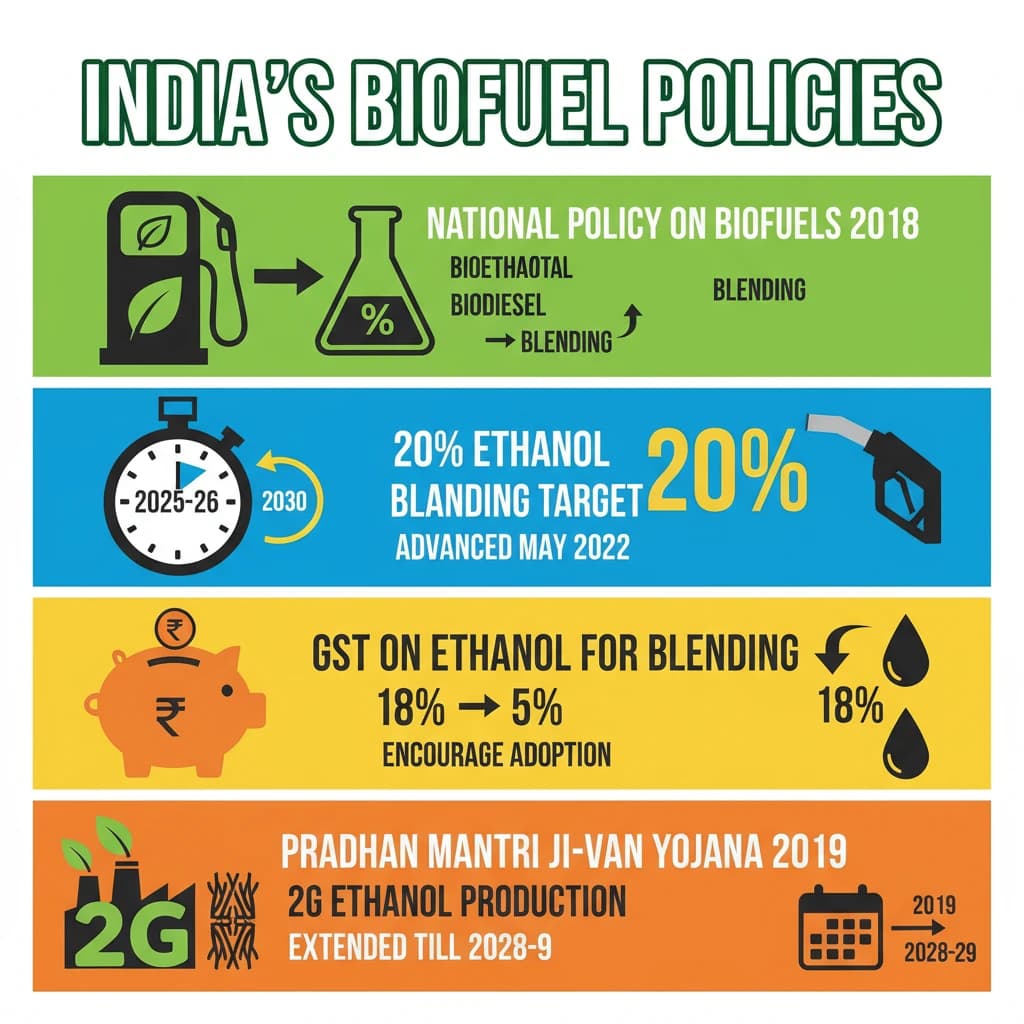
  • National Policy on Biofuel, 2018 aims to reduce import dependence via bioethanol, biodiesel, and bio-CNG blending.
  • The 20% ethanol blending target was advanced from 2030 to 2025-26 in May 2022.
  • GST on ethanol for blending was reduced from 18% to 5% to encourage adoption.
  • Pradhan Mantri JI-VAN Yojana, 2019 supports 2G ethanol production from lignocellulosic biomass, extended till 2028-29.
  • GOBAR DHAN Scheme, 2018 converts cattle dung and farm waste into compost, biogas, and bio-CNG, boosting rural income and cleanliness.
What are the Government Initiatives and Policies on Biofuels?

What are the Government Initiatives and Policies on Biofuels?

Medium⏱️ 8 min read✓ 98% Verified
environment and ecology

📖 Introduction

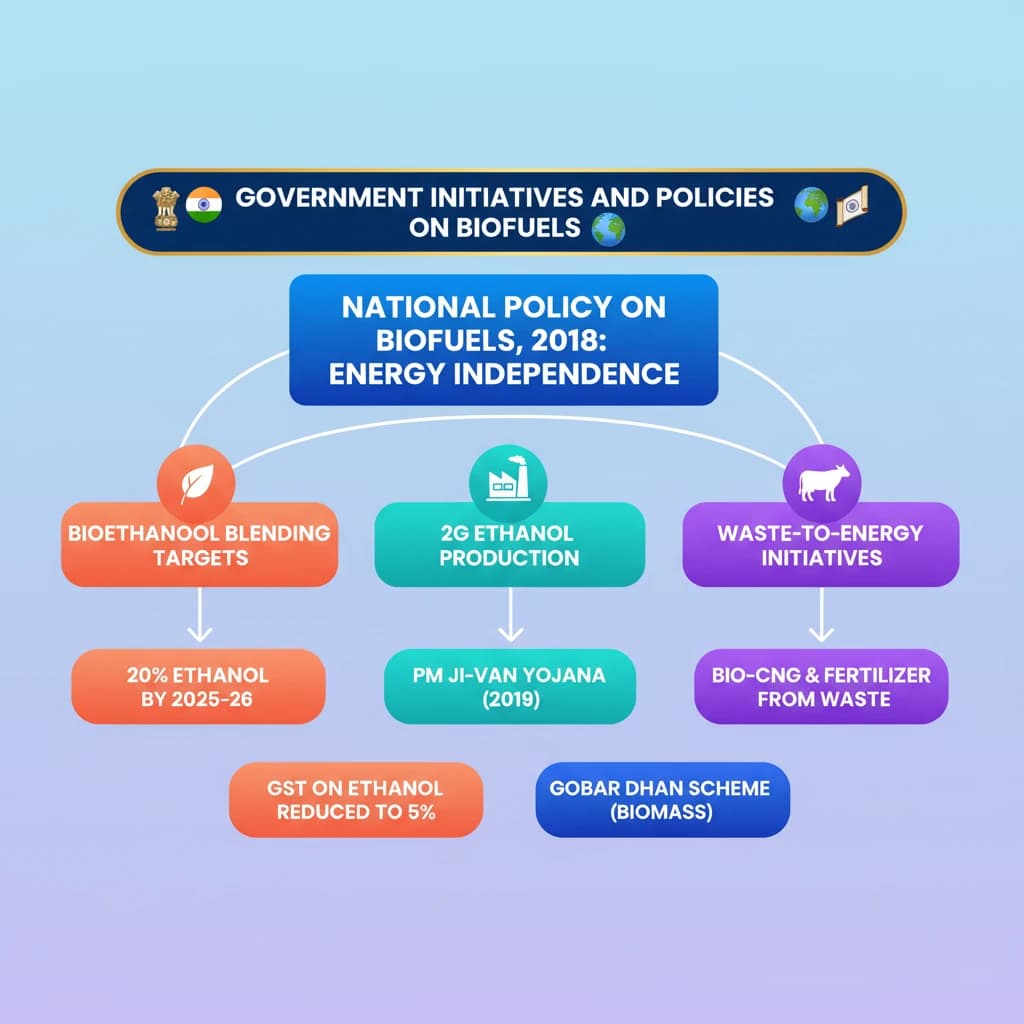
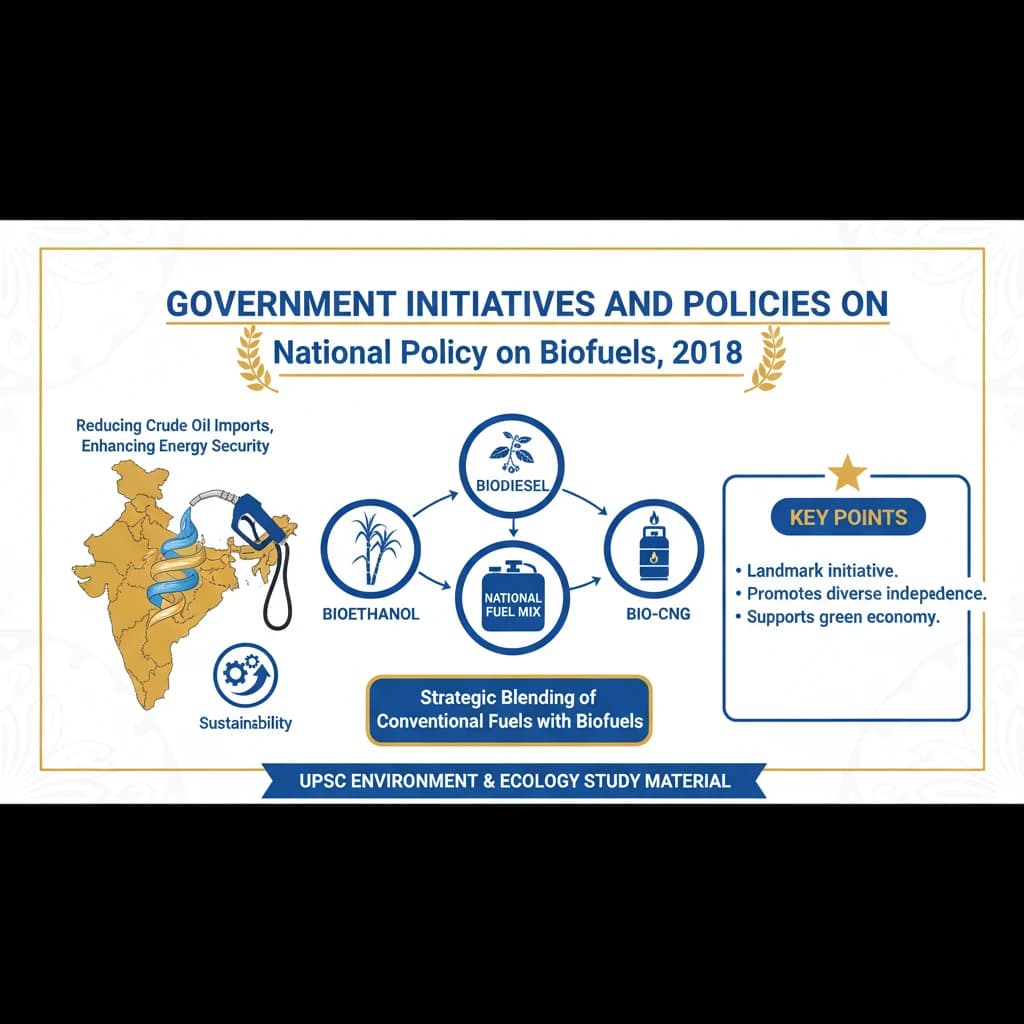
<h4>National Policy on Biofuel, 2018</h4><p>The <strong>National Policy on Biofuel, 2018</strong>, is a landmark initiative aimed at reducing India's reliance on crude oil imports. It strategically promotes the blending of conventional fuels with various biofuels.</p><p>This policy focuses on integrating <strong>bioethanol</strong>, <strong>biodiesel</strong>, and <strong>bio-CNG</strong> into the national fuel mix, thereby enhancing energy security and sustainability.</p><div class='key-point-box'><p><strong>Key Elements of the Policy:</strong></p><ul><li>Promotion of the <strong>Ethanol Blending Programme (EBP)</strong>.</li><li>Support for the production of <strong>second-generation ethanol</strong> from agricultural and forest residues.</li><li>Boosting local production of fuel additives under the <strong>“Make in India”</strong> initiative.</li><li>Emphasis on <strong>Research and Development (R&amp;D)</strong> in feedstock for biofuels.</li></ul></div><div class='exam-tip-box'><p><strong>Important Amendment:</strong> In <strong>May 2022</strong>, the policy was amended to advance the <strong>20% ethanol blending target</strong> from <strong>2030</strong> to <strong>2025-26</strong>, highlighting the government's accelerated commitment.</p></div><h4>Reduced GST on Ethanol</h4><p>To further incentivize the use of ethanol for blending, the government significantly reduced the <strong>Goods and Services Tax (GST)</strong> rate on ethanol. This reduction applies specifically to ethanol used under the <strong>Ethanol Blended Petrol (EBP) Programme</strong>.</p><div class='info-box'><p>The <strong>GST rate</strong> on ethanol for blending was lowered from <strong>18% to 5%</strong>, making ethanol blending more economically viable for producers and distributors.</p></div><h4>Pradhan Mantri JI-VAN Yojana, 2019</h4><p>The <strong>Pradhan Mantri JI-VAN Yojana, 2019</strong> (JAI-VIGYAN, JAI-ANUSANDHAN) is a crucial scheme designed to bolster the production of <strong>Second Generation (2G) ethanol</strong>. It provides financial support for setting up commercial projects.</p><p>This scheme targets ethanol production from diverse <strong>cellulosic and lignocellulosic sources</strong>, including those derived from petrochemical routes.</p><div class='info-box'><p><strong>What is Lignocellulosic Biomass?</strong></p><p><strong>Lignocellulosic biomass</strong> refers to plant biomass composed primarily of <strong>cellulose</strong>, <strong>hemicellulose</strong>, and <strong>lignin</strong>. Examples include <strong>cereal straw</strong>, <strong>bagasse</strong>, <strong>forest residues</strong>, and purpose-grown energy crops like <strong>vegetative grasses</strong>.</p></div><div class='exam-tip-box'><p><strong>Scheme Extension:</strong> The government has approved an extension of the scheme's implementation timeline. It will now run until <strong>2028-29</strong>, indicating sustained focus on 2G ethanol production.</p></div><h4>GOBAR (Galvanizing Organic Bio-Agro Resources) DHAN Scheme, 2018</h4><p>The <strong>GOBAR DHAN Scheme, 2018</strong>, is an innovative initiative focused on sustainable waste management and resource generation in rural areas. It aims to convert organic waste into valuable resources.</p><p>The scheme primarily targets the management and conversion of <strong>cattle dung</strong> and other <strong>solid waste</strong> from farms into useful products such as <strong>compost</strong>, <strong>biogas</strong>, and <strong>bio-CNG</strong>.</p><div class='key-point-box'><p><strong>Dual Objectives:</strong> The <strong>GOBAR DHAN Scheme</strong> contributes to keeping villages clean by managing waste effectively and simultaneously enhances the income of rural households through value-added products.</p></div>
Concept Diagram

💡 Key Takeaways

  • •National Policy on Biofuel, 2018 aims to reduce import dependence via bioethanol, biodiesel, and bio-CNG blending.
  • •The 20% ethanol blending target was advanced from 2030 to 2025-26 in May 2022.
  • •GST on ethanol for blending was reduced from 18% to 5% to encourage adoption.
  • •Pradhan Mantri JI-VAN Yojana, 2019 supports 2G ethanol production from lignocellulosic biomass, extended till 2028-29.
  • •GOBAR DHAN Scheme, 2018 converts cattle dung and farm waste into compost, biogas, and bio-CNG, boosting rural income and cleanliness.

🧠 Memory Techniques
Memory Aid
98% Verified Content

Related Topics

Loading related topics...
Explore:Environment And Ecology Topics·All Subjects·Daily Current Affairs·Editorial Analysis·Previous Year Questions·UPSC GPT
What are the Government Initiatives and Policies on Biofuels? - UPSC Environment And Ecology