Loading page, please wait…
Vaidra Logo
Vaidra

Top 4 items + smart groups

UPSC GPT
New
Current Affairs
Daily Solutions
Daily Puzzle
Mains Evaluator

Version 2.0.0 • Built with ❤️ for UPSC aspirants

Loading...
Loading...
Loading...
Loading...
Loading...
Loading...
Loading...
Loading...
Loading...
Loading...
Loading...
Loading...
Loading...

What is the Crocodile Conservation Project? - UPSC Environment And Ecology

What is What is the Crocodile Conservation Project? in UPSC Environment And Ecology?

What is the Crocodile Conservation Project? is a key topic under Environment And Ecology for UPSC Civil Services Examination. Key points include: Crocodile Conservation Project started in 1975 at Bhitarkanika National Park, Odisha.. Aimed to protect Mugger, Gharial, and Saltwater Crocodile species.. Goal: Increase population to 5-6 crocodiles per km of water.. Understanding this topic is essential for both UPSC Prelims and Mains preparation.

Why is What is the Crocodile Conservation Project? important for UPSC exam?

What is the Crocodile Conservation Project? is a Medium-level topic in UPSC Environment And Ecology. It is tested in both Prelims (factual MCQs) and Mains (analytical answer writing). Previous year UPSC questions have frequently covered aspects of What is the Crocodile Conservation Project?, making it essential for comprehensive IAS preparation.

How to prepare What is the Crocodile Conservation Project? for UPSC?

To prepare What is the Crocodile Conservation Project? for UPSC: (1) Study the comprehensive notes covering all key concepts on Vaidra. (2) Practice previous year questions on this topic. (3) Connect it with current affairs using daily updates. (4) Revise using key takeaways and mind maps available for Environment And Ecology. (5) Write practice answers linking What is the Crocodile Conservation Project? to related GS Paper topics.

Key takeaways of What is the Crocodile Conservation Project? for UPSC

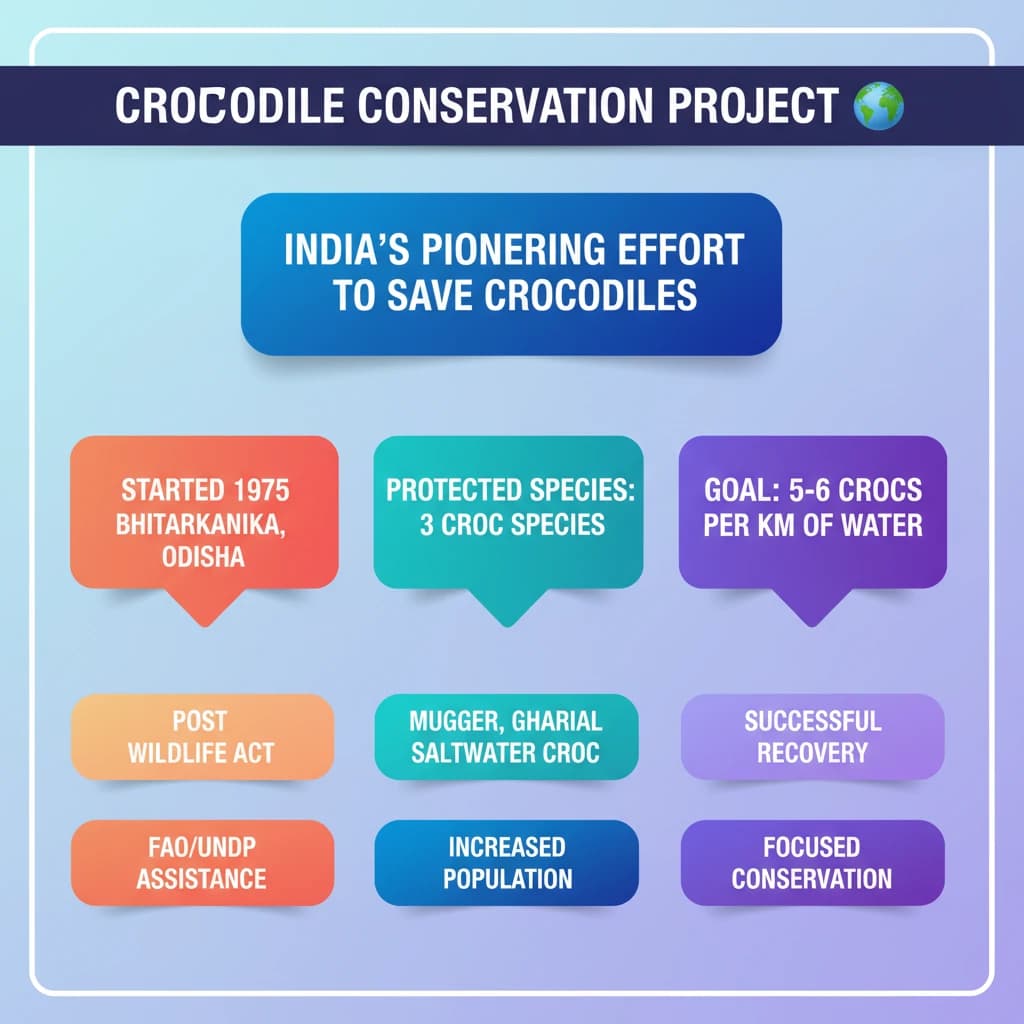
  • Crocodile Conservation Project started in 1975 at Bhitarkanika National Park, Odisha.
  • Aimed to protect Mugger, Gharial, and Saltwater Crocodile species.
  • Goal: Increase population to 5-6 crocodiles per km of water.
  • Initiated with FAO/UNDP assistance, post-Wildlife Protection Act, 1972.
  • Demonstrates successful species recovery through focused conservation efforts.
What is the Crocodile Conservation Project?

What is the Crocodile Conservation Project?

Medium⏱️ 8 min read✓ 95% Verified
environment and ecology

📖 Introduction

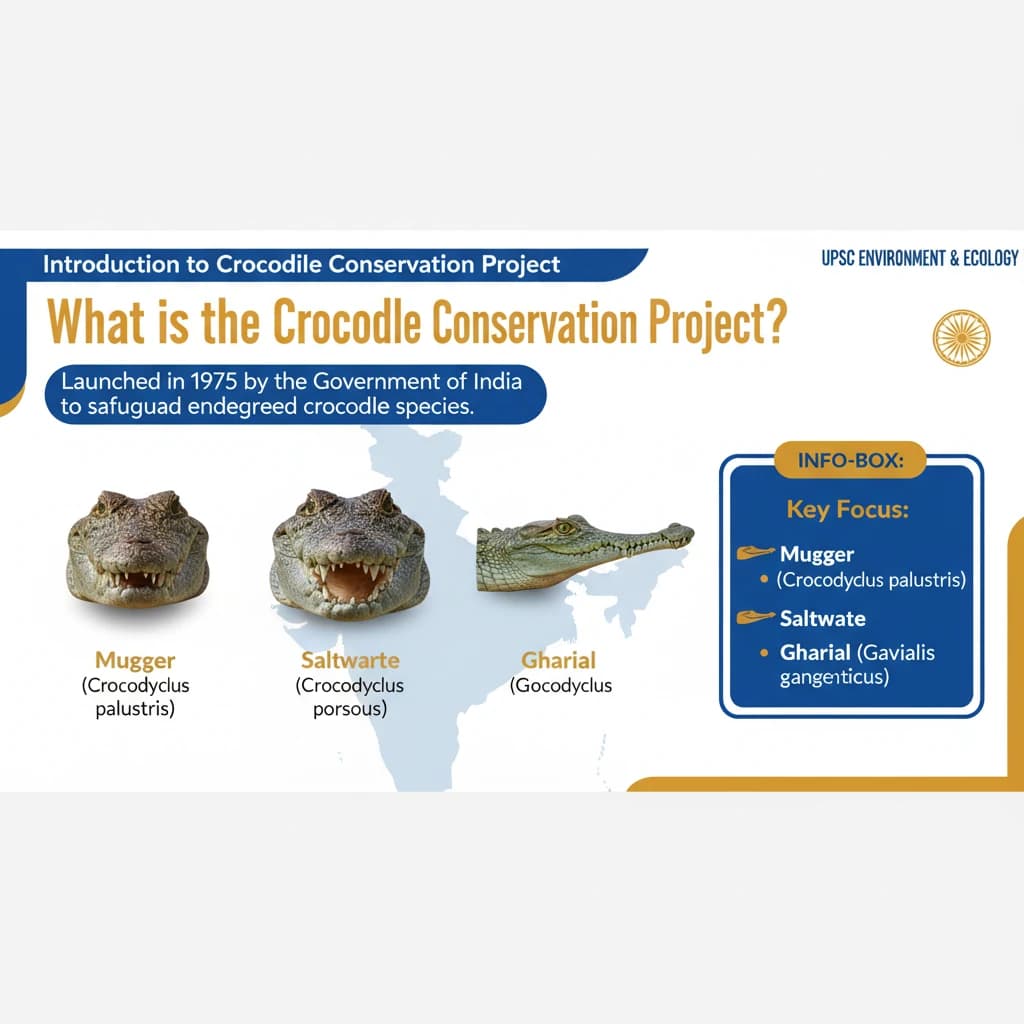
<h4>Introduction to Crocodile Conservation Project</h4><p>The <strong>Crocodile Conservation Project</strong> was a pioneering initiative launched in <strong>1975</strong> by the Government of India. Its primary objective was to safeguard and enhance the populations of three critically important and endangered crocodile species found in India.</p><div class='info-box'><p><strong>Key Focus:</strong> The project specifically targeted the conservation of <strong>Mugger</strong> (<em>Crocodylus palustris</em>), <strong>Gharial</strong> (<em>Gavialis gangeticus</em>), and <strong>Saltwater Crocodile</strong> (<em>Crocodylus porosus</em>).</p></div><h4>Project Launch and Location</h4><p>The project was strategically initiated at <strong>Bhitarkanika National Park</strong> in <strong>Odisha</strong>. This location was chosen due to its rich biodiversity and as a significant habitat for these crocodile species, providing an ideal environment for conservation efforts.</p><h4>Primary Conservation Goals</h4><p>The overarching goal of the project was to reverse the decline in crocodile populations. This involved comprehensive measures to protect their habitats, reduce threats, and facilitate breeding programs.</p><div class='key-point-box'><p><strong>Specific Population Target:</strong> A quantitative goal was set to increase the population density to a level where <strong>5 to 6 crocodiles</strong> could be sighted per kilometer of water stretch. This benchmark aimed to ensure a healthy and sustainable population.</p></div><h4>Species Under Protection</h4><p>The three species — <strong>Mugger</strong>, <strong>Gharial</strong>, and <strong>Saltwater Crocodile</strong> — represent distinct ecological roles and face unique threats. Protecting them was crucial for maintaining the ecological balance of their respective aquatic ecosystems.</p><div class='exam-tip-box'><p><strong>UPSC Insight:</strong> Understanding the specific species targeted by conservation projects is vital for questions on biodiversity and endangered species. Remember their scientific names if possible, and their IUCN status.</p></div>
Concept Diagram

💡 Key Takeaways

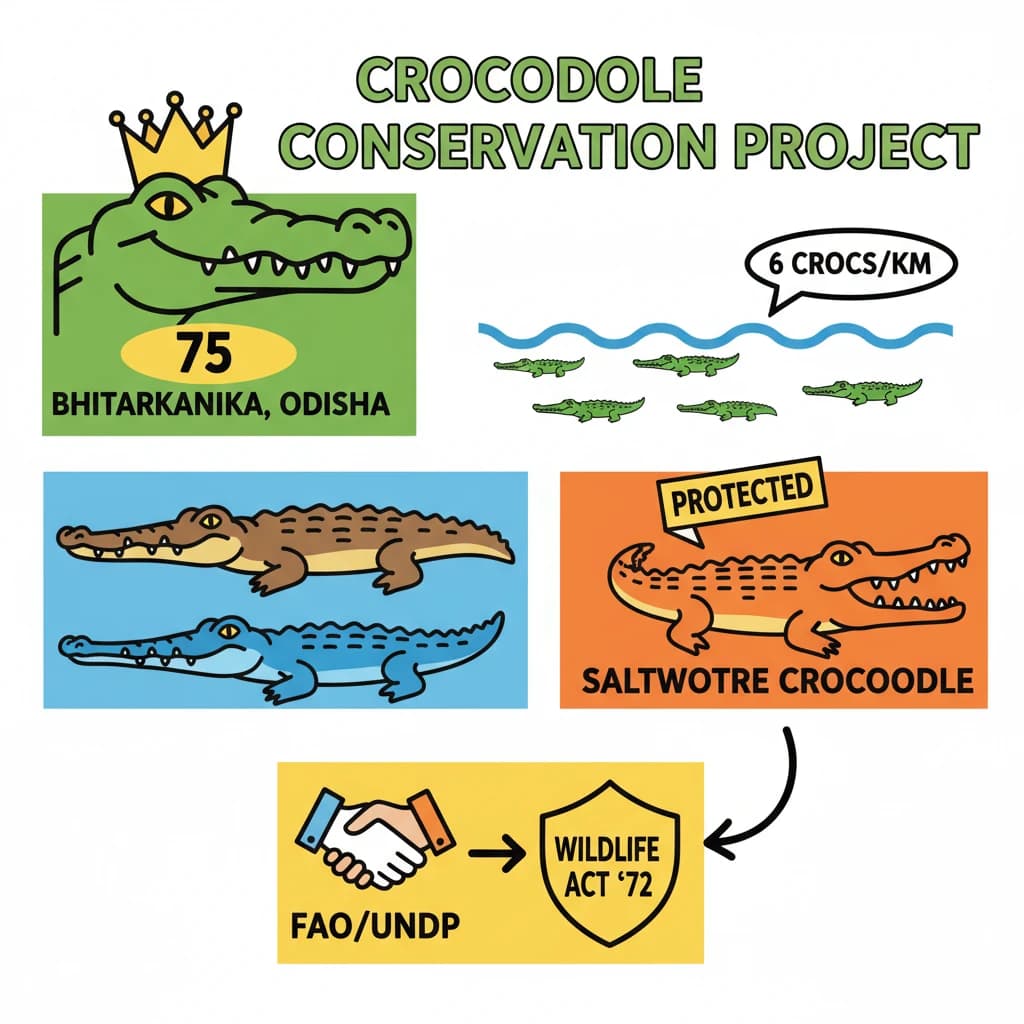
  • •Crocodile Conservation Project started in 1975 at Bhitarkanika National Park, Odisha.
  • •Aimed to protect Mugger, Gharial, and Saltwater Crocodile species.
  • •Goal: Increase population to 5-6 crocodiles per km of water.
  • •Initiated with FAO/UNDP assistance, post-Wildlife Protection Act, 1972.
  • •Demonstrates successful species recovery through focused conservation efforts.

🧠 Memory Techniques
Memory Aid
95% Verified Content

📚 Reference Sources

•Wildlife Protection Act, 1972 documentation
•IUCN Red List for crocodilian species
•Government of India, Ministry of Environment, Forest and Climate Change reports

Related Topics

Loading related topics...
Explore:Environment And Ecology Topics·All Subjects·Daily Current Affairs·Editorial Analysis·Previous Year Questions·UPSC GPT
Back
All Subjects

Topics

0 topics • 0 completed

Loading topics...
Loading...
Loading...
Loading...
Loading...
Loading...
Overall Progress0%
What is the Crocodile Conservation Project? - UPSC Environment And Ecology