Loading page, please wait…
Air Quality Life Index (AQLI) 2024 - UPSC Environment And Ecology
What is Air Quality Life Index (AQLI) 2024 in UPSC Environment And Ecology?
Air Quality Life Index (AQLI) 2024 is a key topic under Environment And Ecology for UPSC Civil Services Examination. Key points include: AQLI 2024 reveals air pollution could reduce global average life expectancy by 1.9 years, totaling 14.9 billion life years lost.. South Asia is the most polluted region, accounting for 45% of global life years lost, with Bangladesh, India, Nepal, and Pakistan being highly affected.. Countries like China (41% reduction, 2 years life gain since 2014) and the US (67.2% reduction, 1.5 years life gain since 1970) demonstrate effective policy impacts.. Understanding this topic is essential for both UPSC Prelims and Mains preparation.
Why is Air Quality Life Index (AQLI) 2024 important for UPSC exam?
Air Quality Life Index (AQLI) 2024 is a Medium-level topic in UPSC Environment And Ecology. It is tested in both Prelims (factual MCQs) and Mains (analytical answer writing). Previous year UPSC questions have frequently covered aspects of Air Quality Life Index (AQLI) 2024, making it essential for comprehensive IAS preparation.
How to prepare Air Quality Life Index (AQLI) 2024 for UPSC?
To prepare Air Quality Life Index (AQLI) 2024 for UPSC: (1) Study the comprehensive notes covering all key concepts on Vaidra. (2) Practice previous year questions on this topic. (3) Connect it with current affairs using daily updates. (4) Revise using key takeaways and mind maps available for Environment And Ecology. (5) Write practice answers linking Air Quality Life Index (AQLI) 2024 to related GS Paper topics.
Key takeaways of Air Quality Life Index (AQLI) 2024 for UPSC
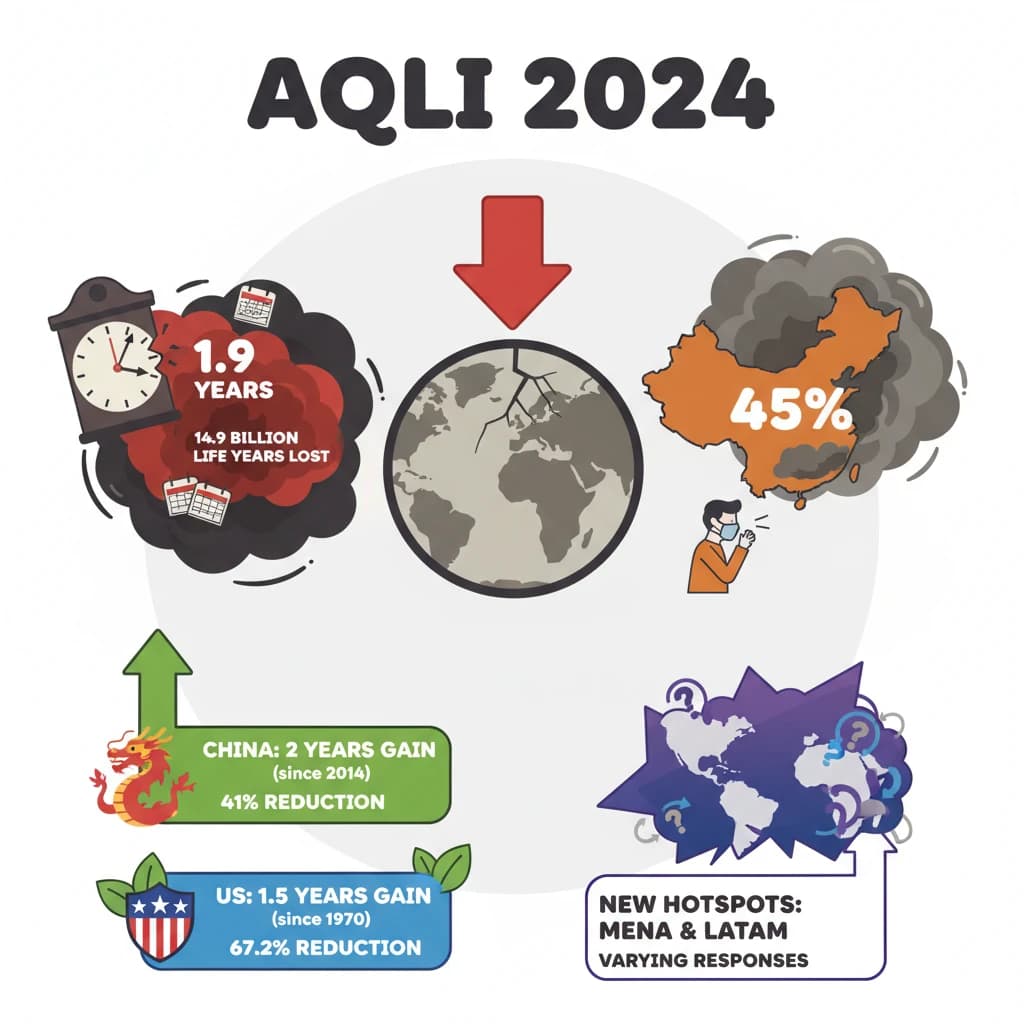
- AQLI 2024 reveals air pollution could reduce global average life expectancy by 1.9 years, totaling 14.9 billion life years lost.
- South Asia is the most polluted region, accounting for 45% of global life years lost, with Bangladesh, India, Nepal, and Pakistan being highly affected.
- Countries like China (41% reduction, 2 years life gain since 2014) and the US (67.2% reduction, 1.5 years life gain since 1970) demonstrate effective policy impacts.
- New pollution hotspots are emerging in MENA and Latin America, with varying regional responses.
- The report emphasizes the critical need for stringent air quality policies and their direct link to public health and longevity.
Air Quality Life Index (AQLI) 2024
Medium⏱️ 7 min read
environment and ecology
📖 Introduction
Introduction to Air Quality Life Index (AQLI) 2024
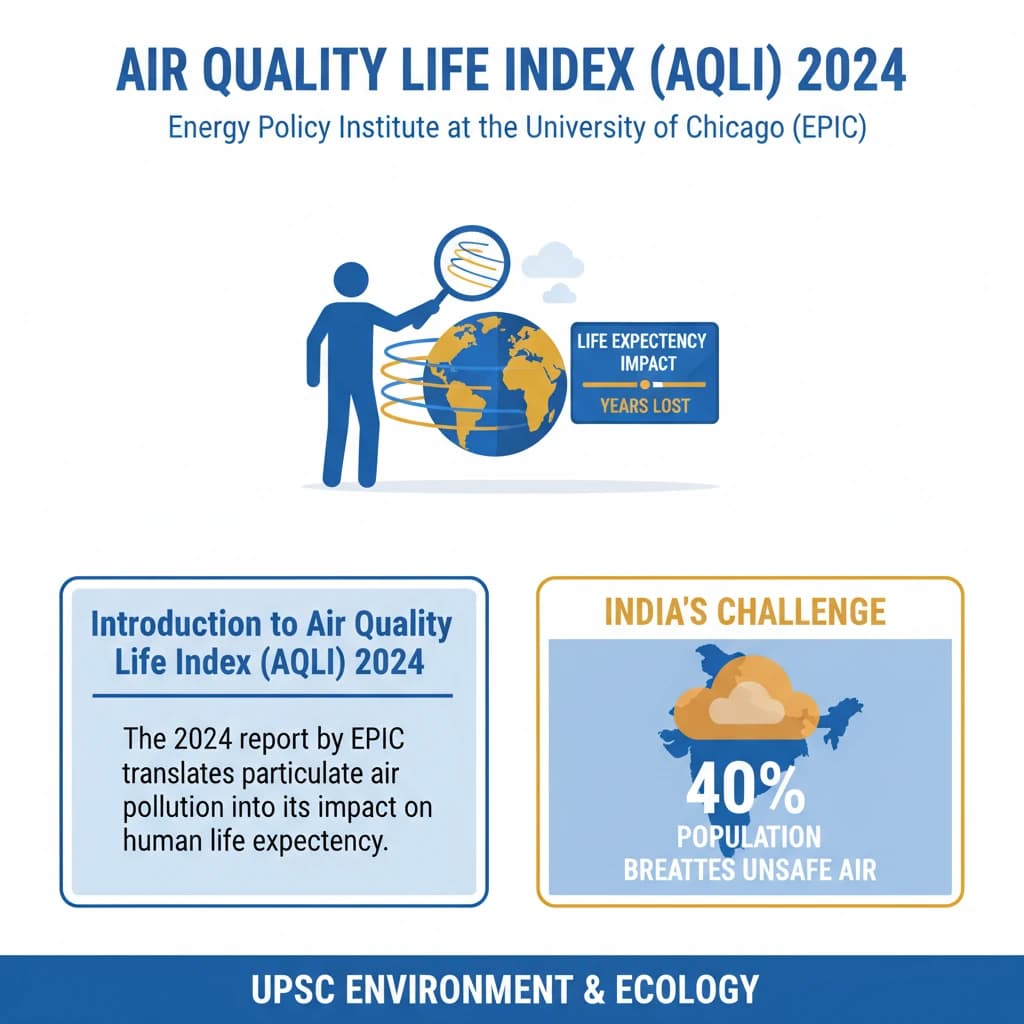
The Air Quality Life Index (AQLI) 2024 report was recently released by the Energy Policy Institute at the University of Chicago (EPIC). This index translates particulate air pollution into its impact on human life expectancy, making the invisible threat tangible.
In India, a significant challenge persists: over 40% of the population breathes air exceeding the national annual PM2.5 standard of 40 µg/m³. This highlights the urgent need for robust air quality management.
What is PM2.5?
PM2.5 refers to particulate matter that is 2.5 micrometres or less in diameter. These fine particles are small enough to penetrate deep into the lungs and even enter the bloodstream, posing severe health risks.
Key Findings: Impact on Life Expectancy
The AQLI 2024 report underscores the profound impact of air pollution on global life expectancy. It reveals that achieving the World Health Organization (WHO) guidelines for PM2.5 could significantly extend human lives.
Global Life Expectancy Gain: If PM2.5 pollution were reduced to meet WHO guidelines, the average person could live 1.9 years longer, collectively adding a staggering 14.9 billion life years globally.
Global Scenario: Pollution Reduction and Life Gains
Several regions have demonstrated the effectiveness of stringent environmental policies in combating air pollution and improving public health.
- United States (US): Has achieved a substantial 67.2% reduction in pollution levels since 1970, leading to an average lifespan extension of 1.5 years for its citizens.
- China: Implemented rigorous policies since 2014, resulting in a remarkable 41% decrease in air pollution. This improvement has added 2 years to the life expectancy of the average Chinese person.
- Europe: Has seen a 30.2% reduction in pollution since 1998, contributing an additional 5.6 months to the average life expectancy across the continent.
These examples of successful policy implementation in the US, China, and Europe can be used in UPSC Mains GS-III answers to illustrate effective strategies for environmental governance and public health improvement.
Regional Analysis: South and Southeast Asia
Despite some improvements, South and Southeast Asia continue to face severe air quality challenges, remaining the most polluted region globally.
- Recent Trends: The region observed a 4% decline in PM2.5 levels in 2022 compared to 2012, indicating some progress.
- Persistent Challenge: Despite this, South Asia alone accounts for 45% of global life years lost due to high pollution, highlighting the immense health burden.
- Most Polluted Countries: Bangladesh, India, Nepal, and Pakistan are consistently ranked among the most polluted nations worldwide.
- Myanmar's Impact: In Myanmar, air pollution is currently reducing life expectancy by an average of 2.9 years.
Regional Analysis: Africa
Air pollution levels in Central and West Africa largely remained unchanged in 2022, posing a significant public health threat.
- Average PM2.5 Concentration: The region's average PM2.5 concentration stands at 22.2 µg/m³, which is 4.4 times higher than the WHO guideline.
- Life Expectancy Reduction: This level of pollution is reducing life expectancy by an average of 1.7 years across the region.
- Emerging Policies: Encouragingly, countries like Nigeria, Rwanda, and Ghana have recently initiated and implemented their own air quality regulations and standards.
Regional Analysis: West Asia (MENA)
The Middle East and North Africa (MENA) region has emerged as a new hotspot for air pollution, with growing concerns about its impact on public health.
- Life Expectancy Reduction: Air pollution in the MENA region is reducing life expectancy by an average of 1.3 years.
- Most Polluted Nations: Qatar and Iraq are identified as the most polluted countries within this region.
Regional Analysis: Latin America
Latin America has experienced a concerning increase in PM2.5 levels in recent years, indicating a deteriorating air quality situation.
- Rising Pollution: PM2.5 levels increased by 4.8% from 2021 and 3% from 1998 in the region.
- Most Polluted: Bolivia is the most polluted country in Latin America.
- Guatemala's Impact: In Guatemala, air pollution is reducing life expectancy by 2.1 years.
- Urban Initiatives: Major cities such as Bogotá, Mexico City, and Quito are actively implementing measures like driving restrictions and improvements in public transport to combat urban air pollution.
💡 Key Takeaways
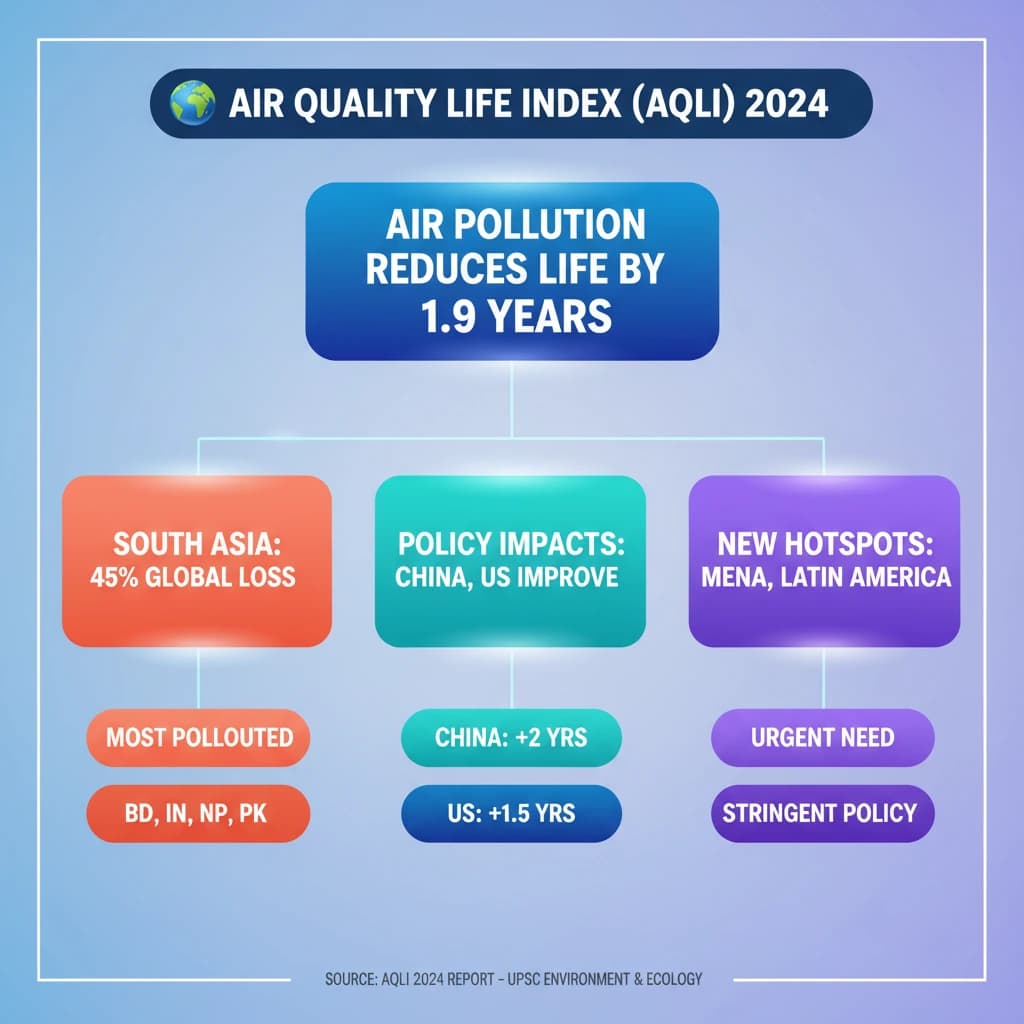
- •AQLI 2024 reveals air pollution could reduce global average life expectancy by 1.9 years, totaling 14.9 billion life years lost.
- •South Asia is the most polluted region, accounting for 45% of global life years lost, with Bangladesh, India, Nepal, and Pakistan being highly affected.
- •Countries like China (41% reduction, 2 years life gain since 2014) and the US (67.2% reduction, 1.5 years life gain since 1970) demonstrate effective policy impacts.
- •New pollution hotspots are emerging in MENA and Latin America, with varying regional responses.
- •The report emphasizes the critical need for stringent air quality policies and their direct link to public health and longevity.
🧠 Memory Techniques
95% Verified Content
📚 Reference Sources
•Drishti IAS Summary on AQLI 2024 (secondary source for content structure)
•World Health Organization (WHO) Air Quality Guidelines (contextual reference)