Loading page, please wait…
Vaidra Logo
Vaidra

Top 4 items + smart groups

UPSC GPT
New
Current Affairs
Daily Solutions
Daily Puzzle
Mains Evaluator

Version 2.0.0 • Built with ❤️ for UPSC aspirants

Loading...
Loading...
Loading...
Loading...
Loading...
Loading...
Loading...
Loading...
Loading...
Loading...
Loading...
Loading...
Loading...
OECMs vs. PAs: Key Differences for Environment & Ecology - UPSC Environment And Ecology
Back
All Subjects

Topics

0 topics • 0 completed

Loading topics...
Loading...
Loading...
Loading...
Loading...
Loading...
Overall Progress0%

OECMs vs. PAs: Key Differences for Environment & Ecology - UPSC Environment And Ecology

What is OECMs vs. PAs: Key Differences for Environment & Ecology in UPSC Environment And Ecology?

OECMs vs. PAs: Key Differences for Environment & Ecology is a key topic under Environment And Ecology for UPSC Civil Services Examination. Key points include: Protected Areas (PAs) are explicitly dedicated to long-term nature conservation with formal legal protection.. Other Effective Area-based Conservation Measures (OECMs) achieve biodiversity conservation as a secondary outcome of other management practices, often lacking formal conservation-specific legal recognition.. PAs form the core of conservation networks, while OECMs complement them by enhancing ecological connectivity and representation.. Understanding this topic is essential for both UPSC Prelims and Mains preparation.

Why is OECMs vs. PAs: Key Differences for Environment & Ecology important for UPSC exam?

OECMs vs. PAs: Key Differences for Environment & Ecology is a Medium-level topic in UPSC Environment And Ecology. It is tested in both Prelims (factual MCQs) and Mains (analytical answer writing). Previous year UPSC questions have frequently covered aspects of OECMs vs. PAs: Key Differences for Environment & Ecology, making it essential for comprehensive IAS preparation.

How to prepare OECMs vs. PAs: Key Differences for Environment & Ecology for UPSC?

To prepare OECMs vs. PAs: Key Differences for Environment & Ecology for UPSC: (1) Study the comprehensive notes covering all key concepts on Vaidra. (2) Practice previous year questions on this topic. (3) Connect it with current affairs using daily updates. (4) Revise using key takeaways and mind maps available for Environment And Ecology. (5) Write practice answers linking OECMs vs. PAs: Key Differences for Environment & Ecology to related GS Paper topics.

Key takeaways of OECMs vs. PAs: Key Differences for Environment & Ecology for UPSC

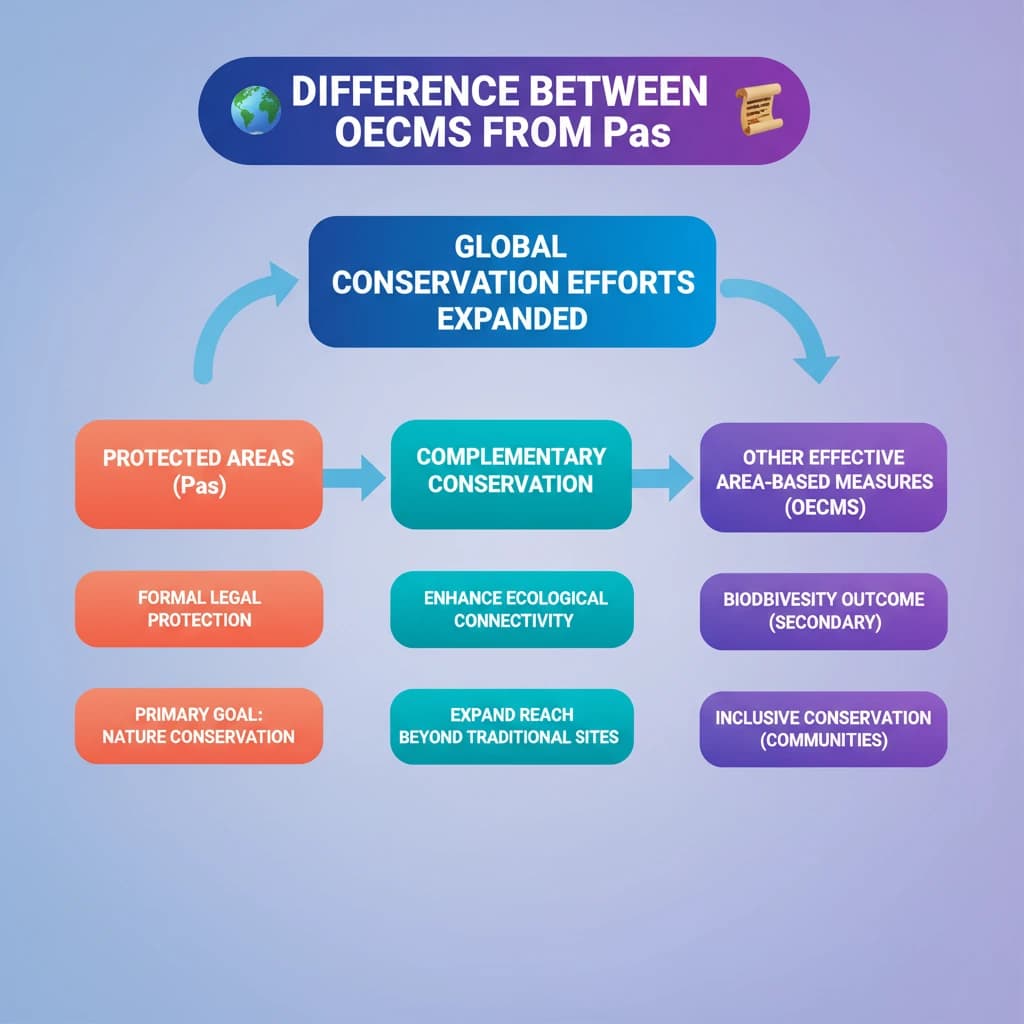
  • Protected Areas (PAs) are explicitly dedicated to long-term nature conservation with formal legal protection.
  • Other Effective Area-based Conservation Measures (OECMs) achieve biodiversity conservation as a secondary outcome of other management practices, often lacking formal conservation-specific legal recognition.
  • PAs form the core of conservation networks, while OECMs complement them by enhancing ecological connectivity and representation.
  • OECMs are crucial for achieving global targets like the 30x30 target, expanding the reach of conservation beyond traditional PAs.
  • The recognition of OECMs promotes inclusive conservation, acknowledging diverse stakeholders including local communities and indigenous peoples.
OECMs vs. PAs: Key Differences for Environment & Ecology

OECMs vs. PAs: Key Differences for Environment & Ecology

Medium⏱️ 8 min read✓ 98% Verified
environment and ecology

📖 Introduction

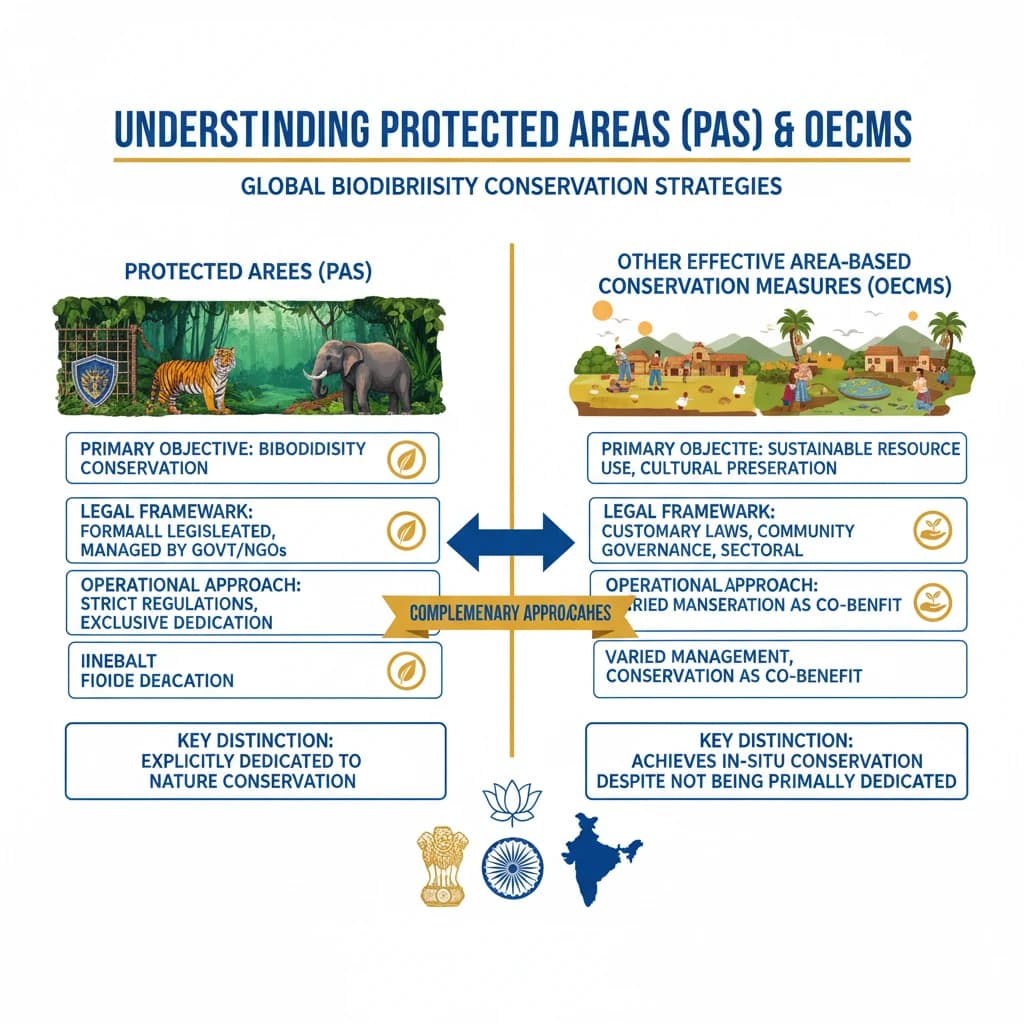
<h4>Understanding Protected Areas (PAs) and OECMs</h4><p>The distinction between <strong>Protected Areas (PAs)</strong> and <strong>Other Effective Area-based Conservation Measures (OECMs)</strong> is crucial for understanding global biodiversity conservation strategies. While both aim to safeguard nature, their primary objectives, legal frameworks, and operational approaches differ significantly.</p><div class='key-point-box'><p><strong>Key Distinction:</strong> PAs are explicitly dedicated to conservation, whereas OECMs achieve conservation outcomes as a secondary or incidental result of other management practices.</p></div><h4>Core Differences: A Comparative Overview</h4><p>The table below outlines the fundamental differences between <strong>Protected Areas</strong> and <strong>Other Effective Area-based Conservation Measures</strong> across various aspects:</p><table class='info-table'><tr><th>Aspect</th><th>Protected Areas (PAs)</th><th>Other Effective Area-based Conservation Measures (OECMs)</th></tr><tr><td><strong>Definition</strong></td><td>Area dedicated to <strong>long-term conservation</strong> of nature, with biodiversity protection as a primary goal.</td><td>Site conserving biodiversity, but not necessarily as the <strong>primary goal</strong>. Conservation is often a co-benefit.</td></tr><tr><td><strong>Primary Objective</strong></td><td>Focus on <strong>biodiversity</strong>, <strong>ecosystem services</strong>, and <strong>cultural values</strong>. Conservation is the explicit and main purpose.</td><td>Biodiversity conservation is a <strong>secondary</strong> or <strong>incidental outcome</strong> of other management activities.</td></tr><tr><td><strong>Legal Recognition</strong></td><td>Formally recognized and <strong>legally protected</strong> under national or international frameworks.</td><td>Voluntary, may <strong>lack formal protection</strong> under specific conservation laws. Recognition often comes from other sectors or communities.</td></tr><tr><td><strong>Role in Conservation Networks</strong></td><td>Form the <strong>core</strong> of conservation networks, vital for long-term, direct protection of ecosystems.</td><td><strong>Complements PAs</strong>, enhancing ecological representation and connectivity across broader landscapes.</td></tr><tr><td><strong>Conservation Outcome</strong></td><td>Characterized by <strong>strict regulations</strong> specifically for biodiversity protection and management.</td><td>May support biodiversity, but their management is <strong>not solely focused on conservation</strong>; it's a positive externality.</td></tr><tr><td><strong>Complementary Role</strong></td><td>Central to achieving global conservation targets, such as the <strong>30% by 2030</strong> goal (often referred to as 30x30).</td><td>Enhances <strong>ecological representation</strong> and <strong>connectivity</strong>, contributing significantly to overall conservation efforts beyond traditional PAs.</td></tr></table><h4>Protected Areas Explained</h4><p><strong>Protected Areas</strong> are geographically defined spaces that are recognized, dedicated, and managed through legal or other effective means. Their explicit purpose is to achieve the <strong>long-term conservation of nature</strong> with associated ecosystem services and cultural values.</p><p>These areas often involve <strong>strict regulations</strong> to prevent human activities that could harm biodiversity. Examples include <strong>National Parks</strong>, <strong>Wildlife Sanctuaries</strong>, and <strong>Biosphere Reserves</strong>.</p><h4>Other Effective Area-based Conservation Measures (OECMs) Explained</h4><p><strong>OECMs</strong> are geographically defined areas, other than Protected Areas, which are governed and managed in ways that achieve positive and sustained <strong>long-term outcomes for the in-situ conservation of biodiversity</strong>. This conservation outcome occurs irrespective of their primary objectives.</p><p>The conservation of biodiversity in OECMs is often a co-benefit of activities like sustainable resource management, traditional land use, or military training areas. They represent a broader approach to conservation beyond strictly designated PAs.</p><div class='exam-tip-box'><p><strong>UPSC Insight:</strong> Understanding the nuanced differences between PAs and OECMs is crucial for questions on <strong>biodiversity conservation strategies</strong>, <strong>global targets (e.g., 30x30)</strong>, and <strong>inclusive conservation models</strong>. Focus on the <strong>'primary objective'</strong> and <strong>'legal recognition'</strong> aspects as key differentiators.</p></div>
Concept Diagram

💡 Key Takeaways

  • •Protected Areas (PAs) are explicitly dedicated to long-term nature conservation with formal legal protection.
  • •Other Effective Area-based Conservation Measures (OECMs) achieve biodiversity conservation as a secondary outcome of other management practices, often lacking formal conservation-specific legal recognition.
  • •PAs form the core of conservation networks, while OECMs complement them by enhancing ecological connectivity and representation.
  • •OECMs are crucial for achieving global targets like the 30x30 target, expanding the reach of conservation beyond traditional PAs.
  • •The recognition of OECMs promotes inclusive conservation, acknowledging diverse stakeholders including local communities and indigenous peoples.

🧠 Memory Techniques

Memory Aid
98% Verified Content

📚 Reference Sources

•IUCN Guidelines for OECMs
•Convention on Biological Diversity (CBD) documents (COP 14 and COP 15)
•Ministry of Environment, Forest and Climate Change (MoEFCC), Government of India reports

Related Topics

Loading related topics...
Explore:Environment And Ecology Topics·All Subjects·Daily Current Affairs·Editorial Analysis·Previous Year Questions·UPSC GPT