Loading page, please wait…
Vaidra Logo
Vaidra

Top 4 items + smart groups

UPSC GPT
New
Current Affairs
Daily Solutions
Daily Puzzle
Mains Evaluator

Version 2.0.0 • Built with ❤️ for UPSC aspirants

Loading...
Loading...
Loading...
Loading...
Loading...
Loading...
Loading...
Loading...
Loading...
Loading...
Loading...
Loading...
Loading...
Back
All Subjects

Topics

0 topics • 0 completed

Loading topics...
Loading...
Loading...
Loading...
Loading...
Loading...
Overall Progress0%

Causes of Acid Rain - UPSC Environment And Ecology

What is Causes of Acid Rain in UPSC Environment And Ecology?

Causes of Acid Rain is a key topic under Environment And Ecology for UPSC Civil Services Examination. Key points include: Acid rain is precipitation with high levels of sulfuric and nitric acids, primarily caused by atmospheric pollutants.. The main anthropogenic causes are emissions of Sulfur Dioxide (SO2) and Nitrogen Oxides (NOx) from fossil fuel combustion.. Key sources include coal-fired power plants, industrial processes, and vehicle exhaust.. Understanding this topic is essential for both UPSC Prelims and Mains preparation.

Why is Causes of Acid Rain important for UPSC exam?

Causes of Acid Rain is a Medium-level topic in UPSC Environment And Ecology. It is tested in both Prelims (factual MCQs) and Mains (analytical answer writing). Previous year UPSC questions have frequently covered aspects of Causes of Acid Rain, making it essential for comprehensive IAS preparation.

How to prepare Causes of Acid Rain for UPSC?

To prepare Causes of Acid Rain for UPSC: (1) Study the comprehensive notes covering all key concepts on Vaidra. (2) Practice previous year questions on this topic. (3) Connect it with current affairs using daily updates. (4) Revise using key takeaways and mind maps available for Environment And Ecology. (5) Write practice answers linking Causes of Acid Rain to related GS Paper topics.

Key takeaways of Causes of Acid Rain for UPSC

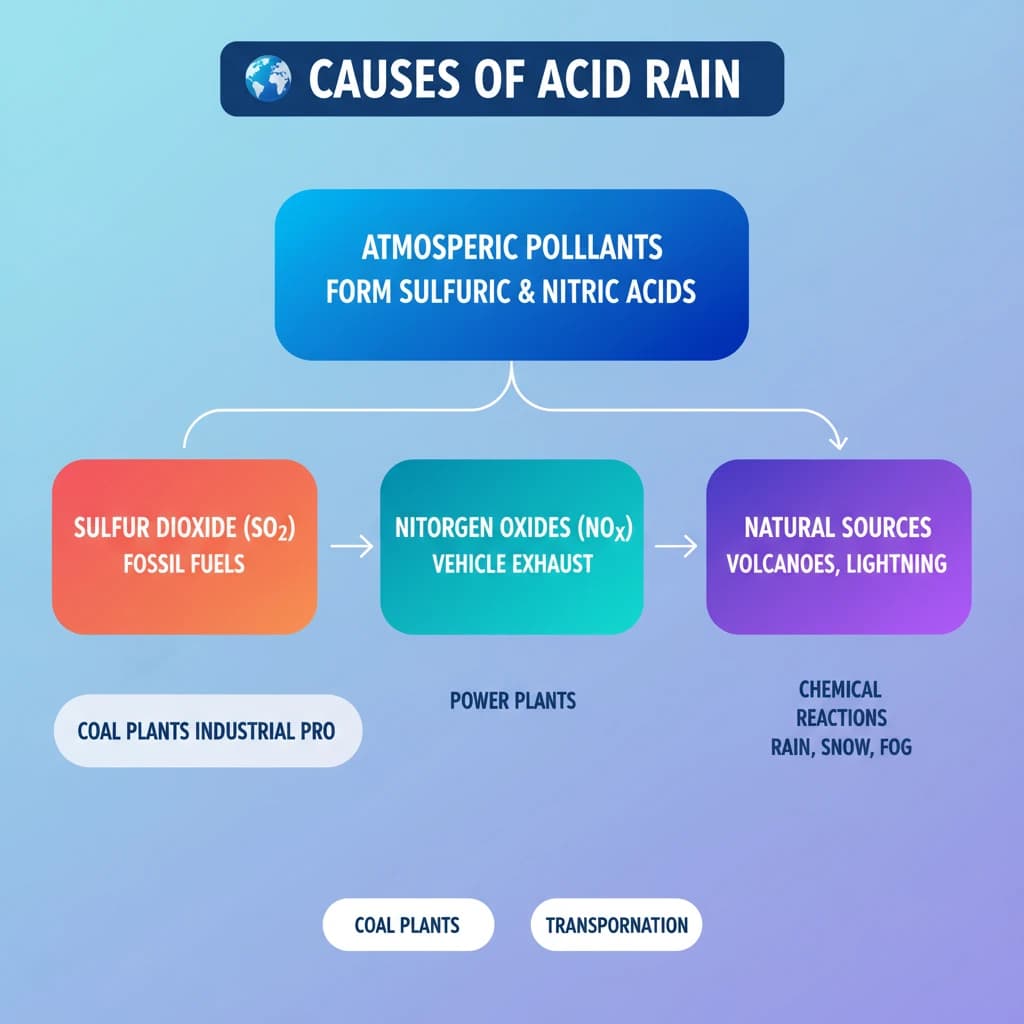
  • Acid rain is precipitation with high levels of sulfuric and nitric acids, primarily caused by atmospheric pollutants.
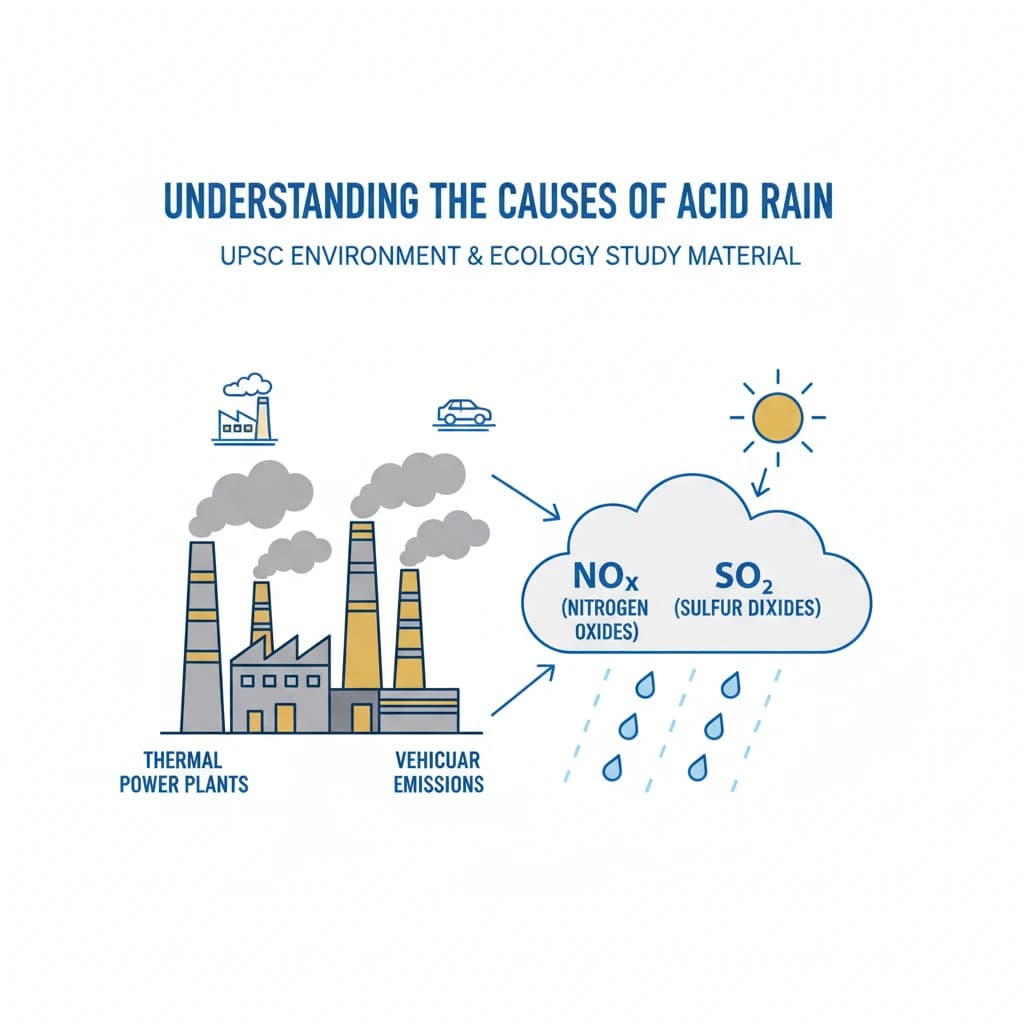
  • The main anthropogenic causes are emissions of Sulfur Dioxide (SO2) and Nitrogen Oxides (NOx) from fossil fuel combustion.
  • Key sources include coal-fired power plants, industrial processes, and vehicle exhaust.
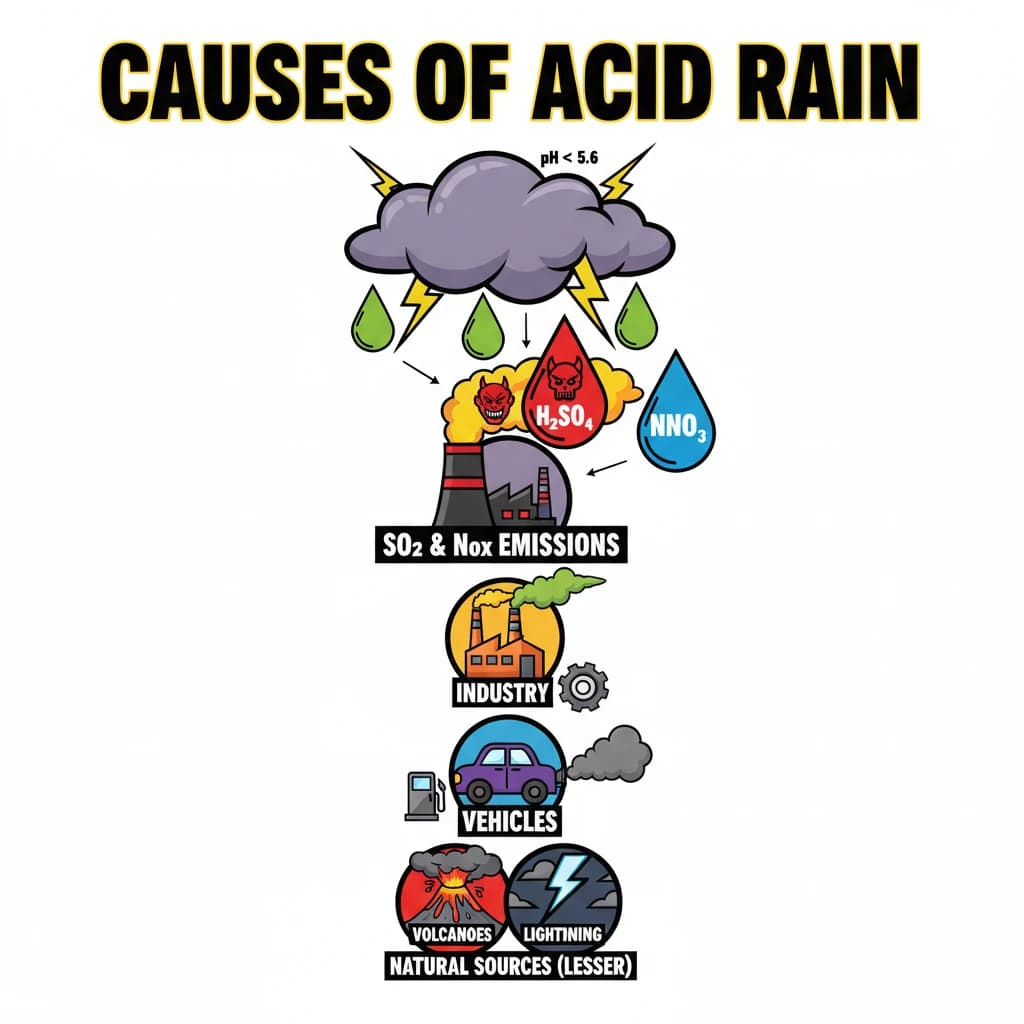
  • Natural sources like volcanic eruptions and lightning also contribute, but to a lesser extent.
  • SO2 and NOx undergo chemical reactions in the atmosphere to form sulfuric and nitric acids, which then fall as acid rain.
  • Acid rain has severe impacts on ecosystems, infrastructure, and human health, necessitating global and local mitigation efforts.
Causes of Acid Rain

Causes of Acid Rain

Medium⏱️ 8 min read✓ 95% Verified
environment and ecology

📖 Introduction

<h4>Understanding the Causes of Acid Rain</h4><p><strong>Acid rain</strong> refers to any form of precipitation with high levels of <strong>nitric</strong> and <strong>sulfuric acids</strong>. It can also include other forms of acidic deposition such as fog, snow, and dry particulate matter. Understanding its causes is crucial for environmental management.</p><div class='info-box'><p><strong>Definition:</strong> <strong>Acid rain</strong> is precipitation (rain, snow, fog, dry particles) that is more acidic than normal, typically with a <strong>pH less than 5.6</strong>, due to atmospheric pollution.</p></div><h4>Primary Anthropogenic Cause: Fossil Fuel Combustion</h4><p>The burning of <strong>fossil fuels</strong> is the leading human-induced cause of acid rain. These fuels, particularly <strong>coal</strong> and <strong>oil</strong>, contain impurities like <strong>sulfur</strong> and <strong>nitrogen compounds</strong>.</p><p>When these fuels are combusted, they release significant amounts of <strong>sulfur dioxide (SO2)</strong> and <strong>nitrogen oxides (NOx)</strong> into the atmosphere. These are the primary precursor gases for acid rain.</p><div class='key-point-box'><p><strong>Key Pollutants:</strong> The two main gaseous pollutants responsible for acid rain are <strong>Sulfur Dioxide (SO2)</strong> and <strong>Nitrogen Oxides (NOx)</strong>.</p></div><h4>Sources of Sulfur Dioxide (SO2) Emissions</h4><p>A major contributor to <strong>SO2</strong> emissions is the combustion of <strong>coal</strong> in <strong>thermal power plants</strong>. Industrial processes, such as <strong>metal smelting</strong> and <strong>manufacturing facilities</strong>, also release substantial amounts of this gas.</p><div class='info-box'><p><strong>Major SO2 Sources:</strong></p><ul><li><strong>Coal-fired power plants</strong></li><li><strong>Industrial boilers</strong> and furnaces</li><li><strong>Smelters</strong> and other industrial processes</li></ul></div><h4>Sources of Nitrogen Oxide (NOx) Emissions</h4><p><strong>Nitrogen oxides (NOx)</strong> are primarily formed during high-temperature combustion processes. This includes emissions from <strong>motor vehicles</strong>, such as cars, trucks, and buses, due to the burning of petrol and diesel.</p><p>Additionally, <strong>industrial combustion processes</strong> and <strong>power generation</strong> also contribute to NOx emissions, especially when operating at very high temperatures.</p><div class='info-box'><p><strong>Major NOx Sources:</strong></p><ul><li><strong>Automobile exhaust</strong> (vehicles)</li><li><strong>Thermal power plants</strong></li><li><strong>Industrial furnaces</strong> and boilers</li></ul></div><h4>Natural Sources Contributing to Acid Rain Precursors</h4><p>While human activities are the dominant cause, natural phenomena also contribute to the presence of <strong>SO2</strong> and <strong>NOx</strong> in the atmosphere. These natural sources are generally less significant globally compared to anthropogenic ones.</p><ul><li><strong>Volcanic Eruptions:</strong> Volcanoes release large quantities of <strong>sulfur dioxide</strong> and hydrogen sulfide, which can be converted to SO2 in the atmosphere.</li><li><strong>Lightning:</strong> High-energy electrical discharges during lightning strikes cause atmospheric nitrogen and oxygen to react, forming various <strong>nitrogen oxides</strong>.</li></ul><h4>Atmospheric Chemical Reactions Leading to Acid Formation</h4><p>Once released into the atmosphere, <strong>SO2</strong> and <strong>NOx</strong> do not immediately form acid rain. They undergo a series of complex <strong>chemical reactions</strong> with water vapor, oxygen, and other chemicals present in the air.</p><p>These reactions transform the gaseous pollutants into droplets of <strong>sulfuric acid (H2SO4)</strong> and <strong>nitric acid (HNO3)</strong>. These acidic droplets then combine with water vapor in the clouds.</p><div class='key-point-box'><p><strong>Chemical Transformation:</strong></p><ul><li><strong>SO2</strong> oxidizes to form <strong>sulfuric acid (H2SO4)</strong>.</li><li><strong>NOx</strong> oxidizes and reacts with water to form <strong>nitric acid (HNO3)</strong>.</li></ul></div><p>When this acidic cloud moisture precipitates as rain, snow, or fog, it is termed <strong>acid rain</strong>. The acids can also deposit as dry particles, known as <strong>dry deposition</strong>.</p><div class='exam-tip-box'><p><strong>UPSC Insight:</strong> While natural sources exist, <strong>anthropogenic emissions</strong> from <strong>fossil fuel combustion</strong> are the primary focus for policy and mitigation strategies related to acid rain. Questions often revolve around these human-induced factors and their impacts.</p></div>
Concept Diagram

💡 Key Takeaways

  • •Acid rain is precipitation with high levels of sulfuric and nitric acids, primarily caused by atmospheric pollutants.
  • •The main anthropogenic causes are emissions of Sulfur Dioxide (SO2) and Nitrogen Oxides (NOx) from fossil fuel combustion.
  • •Key sources include coal-fired power plants, industrial processes, and vehicle exhaust.
  • •Natural sources like volcanic eruptions and lightning also contribute, but to a lesser extent.
  • •SO2 and NOx undergo chemical reactions in the atmosphere to form sulfuric and nitric acids, which then fall as acid rain.
  • •Acid rain has severe impacts on ecosystems, infrastructure, and human health, necessitating global and local mitigation efforts.

🧠 Memory Techniques
Memory Aid
95% Verified Content

📚 Reference Sources

•United States Environmental Protection Agency (EPA) - Acid Rain Program
•National Geographic - Acid Rain Explained
•European Environment Agency (EEA) - Acidification
•NCERT Class 11/12 Environmental Chemistry (general knowledge)

Related Topics

Loading related topics...
Explore:Environment And Ecology Topics·All Subjects·Daily Current Affairs·Editorial Analysis·Previous Year Questions·UPSC GPT
Causes of Acid Rain - UPSC Environment And Ecology