Loading page, please wait…
Vaidra Logo
Vaidra

Top 4 items + smart groups

UPSC GPT
New
Current Affairs
Daily Solutions
Daily Puzzle
Mains Evaluator

Version 2.0.0 • Built with ❤️ for UPSC aspirants

Loading...
Loading...
Loading...
Loading...
Loading...
Loading...
Loading...
Loading...
Loading...
Loading...
Loading...
Loading...
Loading...
Biofilms: Formation, Significance, and Role in Infections - UPSC Environment And Ecology
Back
All Subjects

Topics

0 topics • 0 completed

Loading topics...
Loading...
Loading...
Loading...
Loading...
Loading...
Overall Progress0%

Biofilms: Formation, Significance, and Role in Infections - UPSC Environment And Ecology

What is Biofilms: Formation, Significance, and Role in Infections in UPSC Environment And Ecology?

Biofilms: Formation, Significance, and Role in Infections is a key topic under Environment And Ecology for UPSC Civil Services Examination. Key points include: Biofilms are bacterial communities encased in a self-produced protective matrix (EPS) on surfaces.. They offer significant protection to bacteria from immune responses and antibiotics.. Biofilms are a major cause of chronic bacterial infections and contribute to antibiotic resistance.. Understanding this topic is essential for both UPSC Prelims and Mains preparation.

Why is Biofilms: Formation, Significance, and Role in Infections important for UPSC exam?

Biofilms: Formation, Significance, and Role in Infections is a Medium-level topic in UPSC Environment And Ecology. It is tested in both Prelims (factual MCQs) and Mains (analytical answer writing). Previous year UPSC questions have frequently covered aspects of Biofilms: Formation, Significance, and Role in Infections, making it essential for comprehensive IAS preparation.

How to prepare Biofilms: Formation, Significance, and Role in Infections for UPSC?

To prepare Biofilms: Formation, Significance, and Role in Infections for UPSC: (1) Study the comprehensive notes covering all key concepts on Vaidra. (2) Practice previous year questions on this topic. (3) Connect it with current affairs using daily updates. (4) Revise using key takeaways and mind maps available for Environment And Ecology. (5) Write practice answers linking Biofilms: Formation, Significance, and Role in Infections to related GS Paper topics.

Key takeaways of Biofilms: Formation, Significance, and Role in Infections for UPSC

  • Biofilms are bacterial communities encased in a self-produced protective matrix (EPS) on surfaces.
  • They offer significant protection to bacteria from immune responses and antibiotics.
  • Biofilms are a major cause of chronic bacterial infections and contribute to antibiotic resistance.
  • They are prevalent in nature, medical settings (implants), and industrial systems (biofouling).
  • Understanding biofilms is crucial for public health, environmental management, and industrial sustainability.
Biofilms: Formation, Significance, and Role in Infections

Biofilms: Formation, Significance, and Role in Infections

Medium⏱️ 8 min read✓ 98% Verified
environment and ecology

📖 Introduction

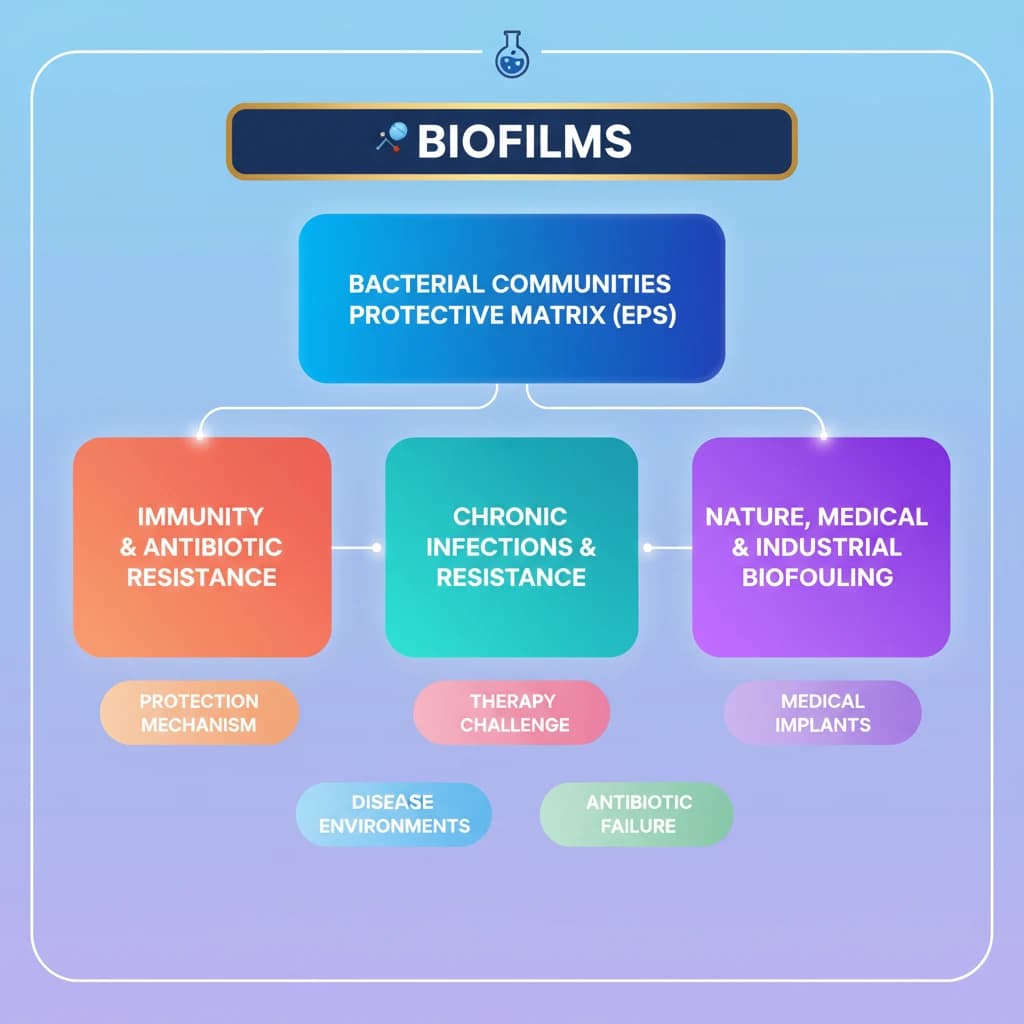
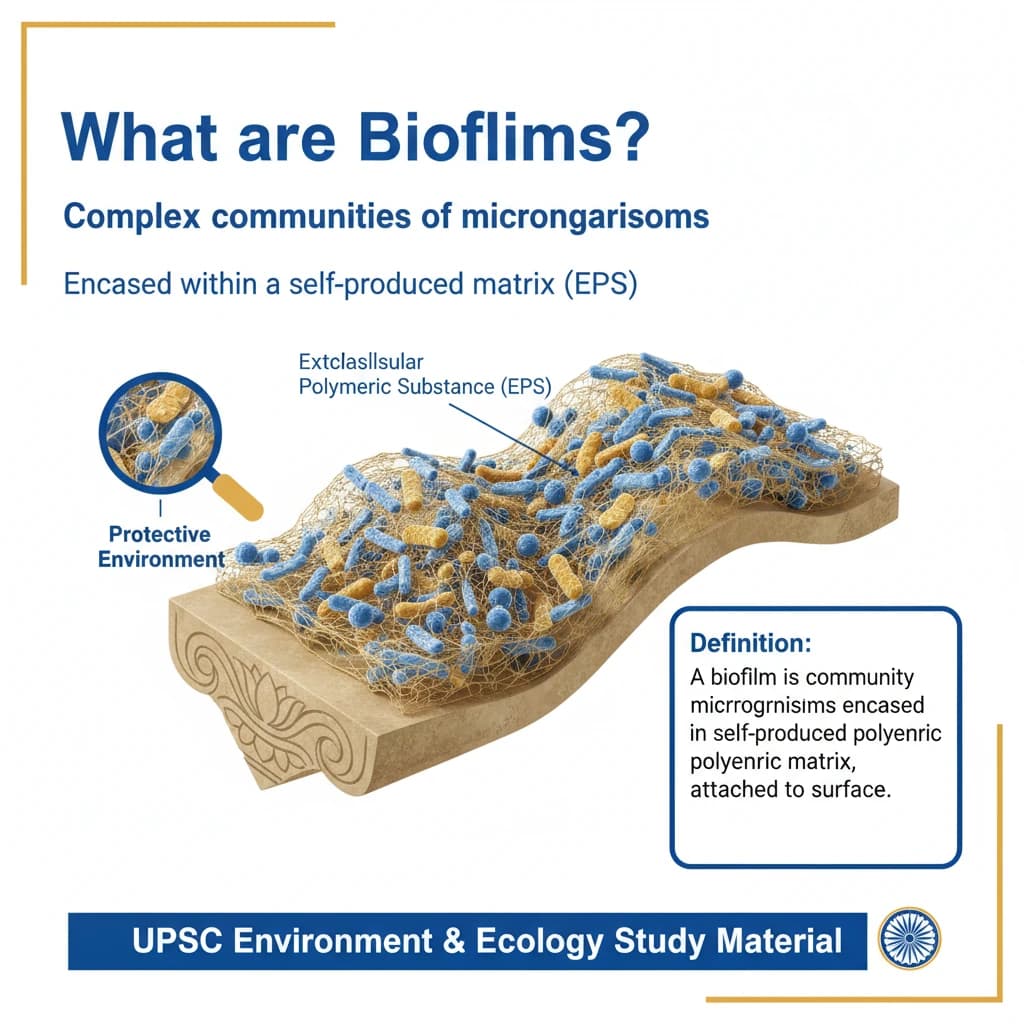
<h4>What are Biofilms?</h4><p><strong>Biofilms</strong> are complex communities of microorganisms, primarily bacteria, that adhere to surfaces. They are encased within a self-produced matrix, often referred to as the <strong>Extracellular Polymeric Substance (EPS)</strong>.</p><p>This unique structure provides a protective environment for the bacterial cells within, allowing them to thrive in various conditions.</p><div class='info-box'><p><strong>Definition:</strong> A <strong>biofilm</strong> is a structured consortium of microbial cells encased in a self-produced polymeric matrix and adherent to a surface.</p></div><h4>Structure of Biofilms</h4><p>The architecture of a biofilm is highly organized, comprising bacterial cells and the <strong>EPS matrix</strong>. The EPS is a complex mixture of polysaccharides, proteins, lipids, and nucleic acids.</p><p>This matrix acts as a scaffold, holding the cells together and mediating their attachment to surfaces. It also facilitates communication among the bacterial cells.</p><div class='key-point-box'><p><strong>Key Components:</strong></p><ul><li><strong>Microbial Cells:</strong> Predominantly bacteria, but can include fungi, algae, and protozoa.</li><li><strong>Extracellular Polymeric Substance (EPS):</strong> The self-produced matrix providing structural integrity and protection.</li></ul></div><h4>Formation Process</h4><p>Biofilm formation is a multi-step process, beginning with the initial attachment of planktonic (free-floating) cells to a surface. This is followed by irreversible attachment and the production of EPS.</p><p>The cells then proliferate and differentiate within the matrix, leading to the maturation of the biofilm. Finally, some cells may disperse from the biofilm to colonize new surfaces.</p><h4>Protective Mechanisms of Biofilms</h4><p>One of the most critical aspects of biofilms is their ability to shield bacteria from external threats. The EPS matrix acts as a physical barrier, preventing harmful substances from reaching the cells.</p><p>This protection makes biofilm-dwelling bacteria significantly more resistant to antibiotics and host immune responses compared to their planktonic counterparts.</p><div class='exam-tip-box'><p><strong>UPSC Insight:</strong> Understanding the protective mechanisms of <strong>biofilms</strong> is crucial for topics related to <strong>antibiotic resistance</strong> and <strong>public health challenges</strong> in microbiology and environmental science. Questions may focus on their role in persistent infections.</p></div><h4>Involvement in Bacterial Infections</h4><p>Biofilms are implicated in nearly all chronic and recurrent bacterial infections in humans. Their resistance to treatment makes these infections particularly difficult to eradicate.</p><p>Examples include infections on medical implants, chronic wound infections, and dental plaque, which is a common biofilm.</p>
Concept Diagram

💡 Key Takeaways

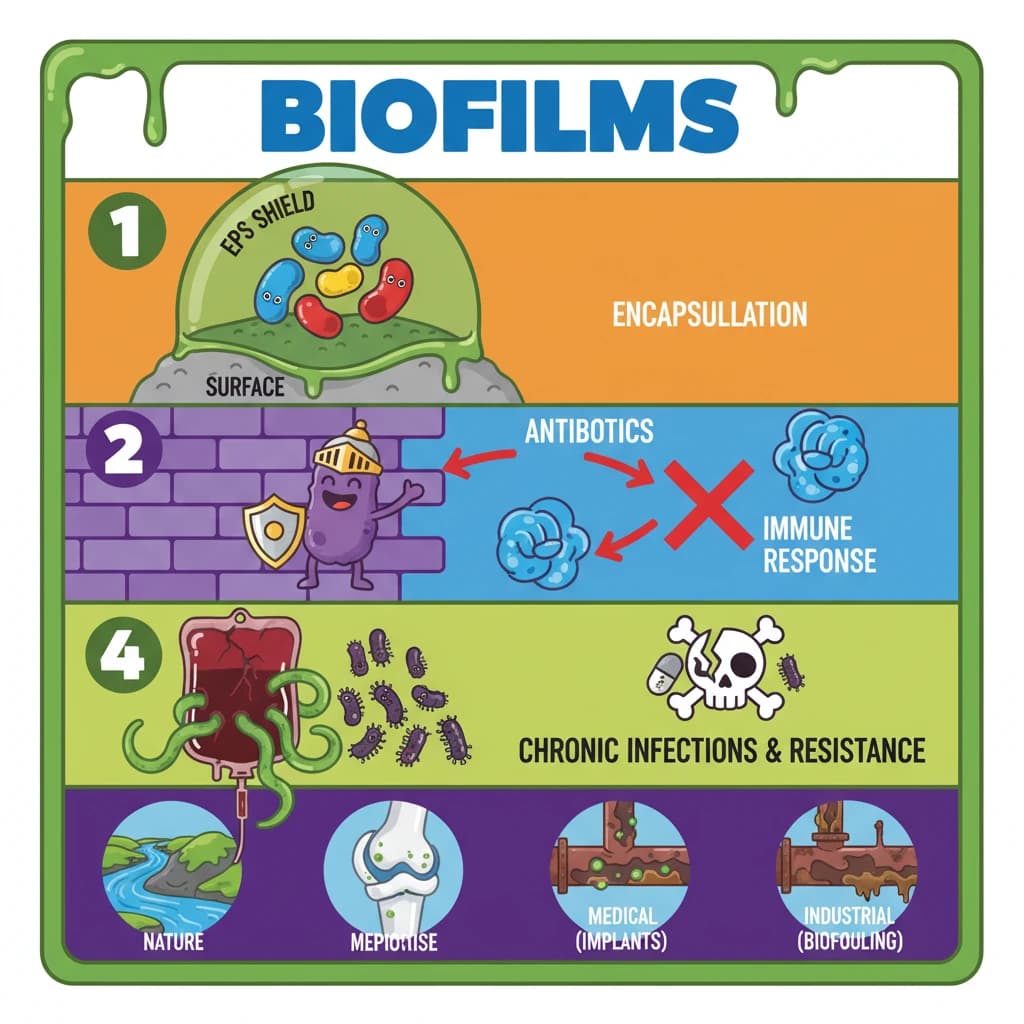
  • •Biofilms are bacterial communities encased in a self-produced protective matrix (EPS) on surfaces.
  • •They offer significant protection to bacteria from immune responses and antibiotics.
  • •Biofilms are a major cause of chronic bacterial infections and contribute to antibiotic resistance.
  • •They are prevalent in nature, medical settings (implants), and industrial systems (biofouling).
  • •Understanding biofilms is crucial for public health, environmental management, and industrial sustainability.

🧠 Memory Techniques
Memory Aid
98% Verified Content

📚 Reference Sources

•Costerton, J. W., Stewart, P. S., & Greenberg, E. P. (1999). Bacterial biofilms: a common cause of persistent infections. Science, 284(5418), 1318-1322.
•Donlan, R. M. (2001). Biofilm formation: a clinical perspective. Clinical Infectious Diseases, 33(8), 1387-1392.
•Flemming, H. C., & Wingender, J. (2010). The biofilm matrix. Nature Reviews Microbiology, 8(9), 623-633.

Related Topics

Loading related topics...
Explore:Environment And Ecology Topics·All Subjects·Daily Current Affairs·Editorial Analysis·Previous Year Questions·UPSC GPT