Loading page, please wait…
Vaidra Logo
Vaidra

Top 4 items + smart groups

UPSC GPT
New
Current Affairs
Daily Solutions
Daily Puzzle
Mains Evaluator

Version 2.0.0 • Built with ❤️ for UPSC aspirants

Loading...
Loading...
Loading...
Loading...
Loading...
Loading...
Loading...
Loading...
Loading...
Loading...
Loading...
Loading...
Loading...

FRA 2006: Aims, Provisions, and Rights (MFP, Community, Habitat) - UPSC Environment And Ecology

What is FRA 2006: Aims, Provisions, and Rights (MFP, Community, Habitat) in UPSC Environment And Ecology?

FRA 2006: Aims, Provisions, and Rights (MFP, Community, Habitat) is a key topic under Environment And Ecology for UPSC Civil Services Examination. Key points include: FRA 2006 aims to rectify historical injustices against forest-dwelling communities.. It grants ownership over Minor Forest Produce (MFP) and secures traditional Community Rights.. Habitat Rights protect Primitive Tribal Groups (PTGs) and pre-agricultural communities.. Understanding this topic is essential for both UPSC Prelims and Mains preparation.

Why is FRA 2006: Aims, Provisions, and Rights (MFP, Community, Habitat) important for UPSC exam?

FRA 2006: Aims, Provisions, and Rights (MFP, Community, Habitat) is a Medium-level topic in UPSC Environment And Ecology. It is tested in both Prelims (factual MCQs) and Mains (analytical answer writing). Previous year UPSC questions have frequently covered aspects of FRA 2006: Aims, Provisions, and Rights (MFP, Community, Habitat), making it essential for comprehensive IAS preparation.

How to prepare FRA 2006: Aims, Provisions, and Rights (MFP, Community, Habitat) for UPSC?

To prepare FRA 2006: Aims, Provisions, and Rights (MFP, Community, Habitat) for UPSC: (1) Study the comprehensive notes covering all key concepts on Vaidra. (2) Practice previous year questions on this topic. (3) Connect it with current affairs using daily updates. (4) Revise using key takeaways and mind maps available for Environment And Ecology. (5) Write practice answers linking FRA 2006: Aims, Provisions, and Rights (MFP, Community, Habitat) to related GS Paper topics.

Key takeaways of FRA 2006: Aims, Provisions, and Rights (MFP, Community, Habitat) for UPSC

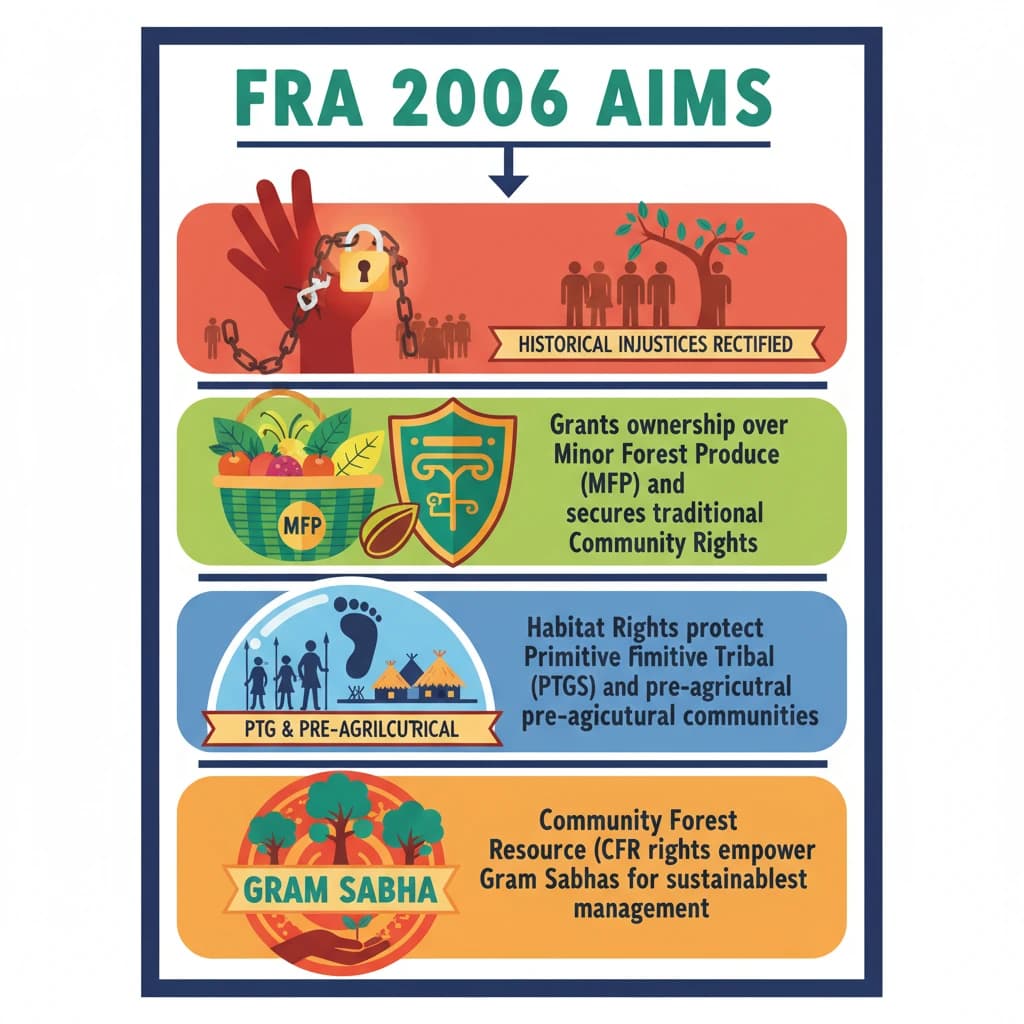
  • FRA 2006 aims to rectify historical injustices against forest-dwelling communities.
  • It grants ownership over Minor Forest Produce (MFP) and secures traditional Community Rights.
  • Habitat Rights protect Primitive Tribal Groups (PTGs) and pre-agricultural communities.
  • Community Forest Resource (CFR) rights empower Gram Sabhas for sustainable forest management.
  • Gram Sabha approval is mandatory for forest land diversion for public projects.
  • The Act promotes community-led conservation and decentralized governance.
FRA 2006: Aims, Provisions, and Rights (MFP, Community, Habitat)

FRA 2006: Aims, Provisions, and Rights (MFP, Community, Habitat)

Medium⏱️ 7 min read✓ 98% Verified
environment and ecology

📖 Introduction

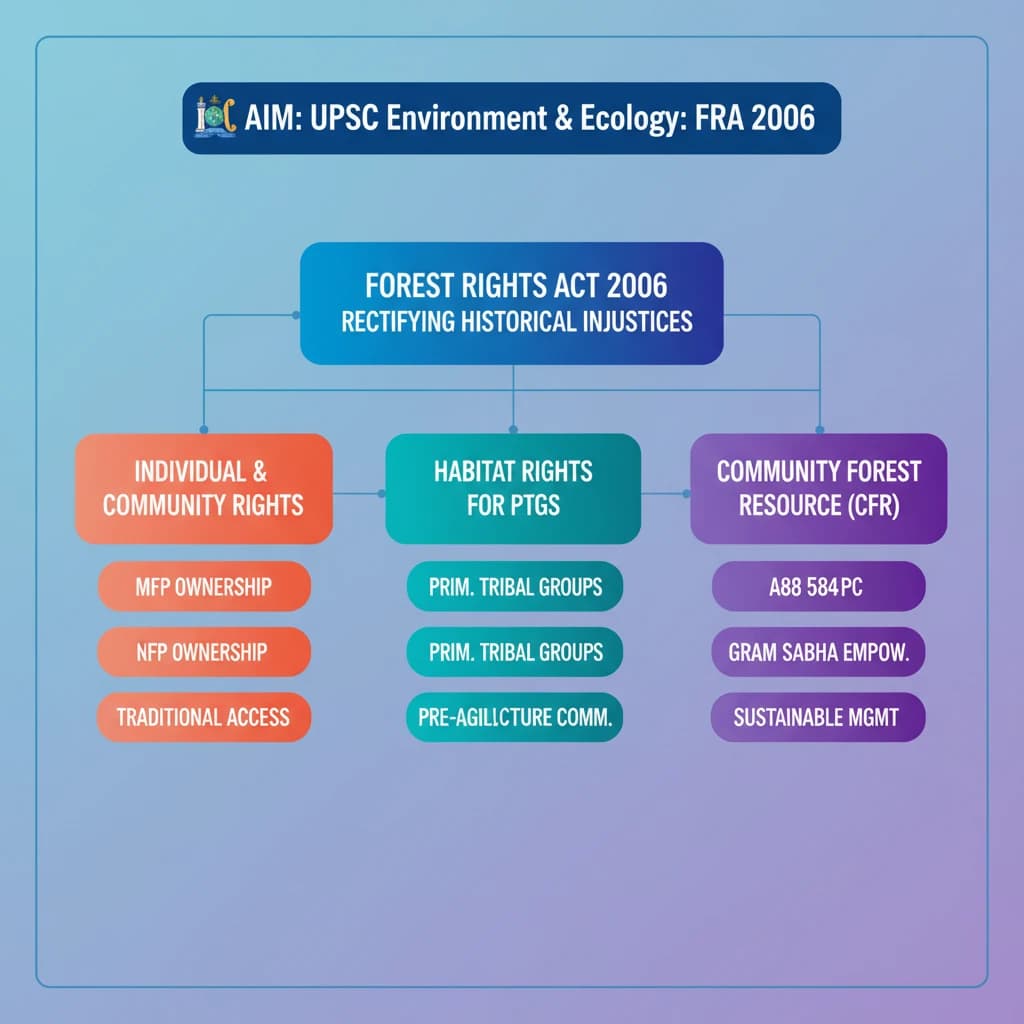
<h4>Overall Aim of the Forest Rights Act (FRA), 2006</h4><p>The <strong>Forest Rights Act (FRA)</strong> of <strong>2006</strong> primarily aims to rectify the <strong>historical injustices</strong> faced by <strong>forest-dwelling communities</strong>. These injustices arose from colonial and post-colonial forest management policies.</p><p>These past policies often disregarded the <strong>deep, symbiotic relationship</strong> that indigenous communities shared with their land and forest resources.</p><h4>Rectifying Historical Injustices</h4><p>The Act seeks to correct wrongs where traditional rights were overlooked or denied. This led to significant marginalization and displacement of forest dwellers.</p><div class='key-point-box'><p>The <strong>FRA</strong> recognizes and vests forest rights and occupation in <strong>Forest Dwelling Scheduled Tribes (FDSTs)</strong> and <strong>Other Traditional Forest Dwellers (OTFDs)</strong> who have been residing in such forests for generations.</p></div><h4>Empowerment and Sustainable Development</h4><p>A core objective is to <strong>empower these communities</strong>. It enables them to gain sustainable access to land and effectively utilize forest resources.</p><p>This empowerment is crucial for promoting <strong>biodiversity</strong> and maintaining <strong>ecological balance</strong>. It also provides essential protection against illegal evictions and displacement, securing their livelihoods.</p><h4>Key Provisions of the Act</h4><p>The <strong>FRA, 2006</strong>, outlines several critical provisions that grant various rights to eligible forest dwellers. These provisions ensure their land tenure, resource access, and traditional practices are legally recognized.</p><ul><li><strong>Ownership Rights</strong> over Minor Forest Produce (MFP).</li><li>Recognition of <strong>Community Rights</strong>, including traditional usage.</li><li>Protection of <strong>Habitat Rights</strong> for vulnerable groups.</li><li>Empowerment for <strong>Community Forest Resource (CFR)</strong> management.</li></ul><h4>Ownership Rights over Minor Forest Produce (MFP)</h4><p>The Act grants <strong>ownership rights</strong> over <strong>Minor Forest Produce (MFP)</strong> to forest-dwelling communities. This empowers them to collect, use, and dispose of these products.</p><div class='info-box'><p><strong>Minor Forest Produce (MFP)</strong> refers to all <strong>non-timber forest products</strong> of plant origin. This includes items such as <strong>bamboo, brushwood, stumps, canes, Tendu leaves, medicinal plants, lac, and honey</strong>.</p></div><h4>Community Rights and Traditional Usage</h4><p>The Act recognizes and secures various <strong>Community Rights</strong>. These include traditional usage rights that communities have exercised over generations within forest areas.</p><p>An important example of such a right is <strong>Nistar</strong>, which refers to traditional concessions or rights of local people to extract forest produce for their domestic use, often without payment.</p><h4>Habitat Rights for Vulnerable Communities</h4><p>The <strong>FRA</strong> specifically protects the <strong>Habitat Rights</strong> of <strong>Primitive Tribal Groups (PTGs)</strong> and <strong>pre-agricultural communities</strong>. This provision safeguards their traditional habitats and ensures their cultural and physical survival.</p><div class='exam-tip-box'><p>Understanding <strong>Habitat Rights</strong> is crucial for questions on tribal welfare and conservation. It highlights the Act's focus on the most vulnerable sections of forest dwellers, often linked to <strong>Particularly Vulnerable Tribal Groups (PVTGs)</strong>.</p></div><h4>Community Forest Resource (CFR) Rights</h4><p>The Act enables communities to protect, regenerate, conserve, and sustainably manage the <strong>forest resources</strong> they have traditionally conserved. This is done through the recognition of <strong>Community Forest Resource (CFR) rights</strong>.</p><p>These rights empower the <strong>Gram Sabha</strong> to manage their traditional forest lands, ensuring local governance and conservation.</p><h4>Diversion of Forest Land for Public Welfare</h4><p>While protecting community rights, the Act also facilitates the <strong>diversion of forest land</strong> for public welfare projects. These projects must be managed by the government.</p><p>Crucially, any such diversion is subject to the mandatory approval of the affected <strong>Gram Sabha</strong>, ensuring community consent in development decisions.</p>
Concept Diagram

💡 Key Takeaways

  • •FRA 2006 aims to rectify historical injustices against forest-dwelling communities.
  • •It grants ownership over Minor Forest Produce (MFP) and secures traditional Community Rights.
  • •Habitat Rights protect Primitive Tribal Groups (PTGs) and pre-agricultural communities.
  • •Community Forest Resource (CFR) rights empower Gram Sabhas for sustainable forest management.
  • •Gram Sabha approval is mandatory for forest land diversion for public projects.
  • •The Act promotes community-led conservation and decentralized governance.

🧠 Memory Techniques
Memory Aid
98% Verified Content

📚 Reference Sources

•The Scheduled Tribes and Other Traditional Forest Dwellers (Recognition of Forest Rights) Act, 2006
•Ministry of Tribal Affairs, Government of India reports and guidelines on FRA implementation

Related Topics

Loading related topics...
Explore:Environment And Ecology Topics·All Subjects·Daily Current Affairs·Editorial Analysis·Previous Year Questions·UPSC GPT
Back
All Subjects

Topics

0 topics • 0 completed

Loading topics...
Loading...
Loading...
Loading...
Loading...
Loading...
Overall Progress0%
FRA 2006: Aims, Provisions, and Rights (MFP, Community, Habitat) - UPSC Environment And Ecology