Loading page, please wait…
Vaidra Logo
Vaidra

Top 4 items + smart groups

UPSC GPT
New
Current Affairs
Daily Solutions
Daily Puzzle
Mains Evaluator

Version 2.0.0 • Built with ❤️ for UPSC aspirants

Loading...
Loading...
Loading...
Loading...
Loading...
Loading...
Loading...
Loading...
Loading...
Loading...
Loading...
Loading...
Loading...
Coastal Regulation Zone (CRZ) - UPSC Environment And Ecology
Back
All Subjects

Topics

0 topics • 0 completed

Loading topics...
Loading...
Loading...
Loading...
Loading...
Loading...
Overall Progress0%

Coastal Regulation Zone (CRZ) - UPSC Environment And Ecology

What is Coastal Regulation Zone (CRZ) in UPSC Environment And Ecology?

Coastal Regulation Zone (CRZ) is a key topic under Environment And Ecology for UPSC Civil Services Examination. Key points include: CRZ was first notified in 1991 by MoEF under the Environment Protection Act, 1986.. It categorizes coastal areas into zones (CRZ-I, II, III, IV) with specific regulations.. CRZ-I protects ecologically sensitive areas like mangroves and coral reefs.. Understanding this topic is essential for both UPSC Prelims and Mains preparation.

Why is Coastal Regulation Zone (CRZ) important for UPSC exam?

Coastal Regulation Zone (CRZ) is a Easy-level topic in UPSC Environment And Ecology. It is tested in both Prelims (factual MCQs) and Mains (analytical answer writing). Previous year UPSC questions have frequently covered aspects of Coastal Regulation Zone (CRZ), making it essential for comprehensive IAS preparation.

How to prepare Coastal Regulation Zone (CRZ) for UPSC?

To prepare Coastal Regulation Zone (CRZ) for UPSC: (1) Study the comprehensive notes covering all key concepts on Vaidra. (2) Practice previous year questions on this topic. (3) Connect it with current affairs using daily updates. (4) Revise using key takeaways and mind maps available for Environment And Ecology. (5) Write practice answers linking Coastal Regulation Zone (CRZ) to related GS Paper topics.

Key takeaways of Coastal Regulation Zone (CRZ) for UPSC

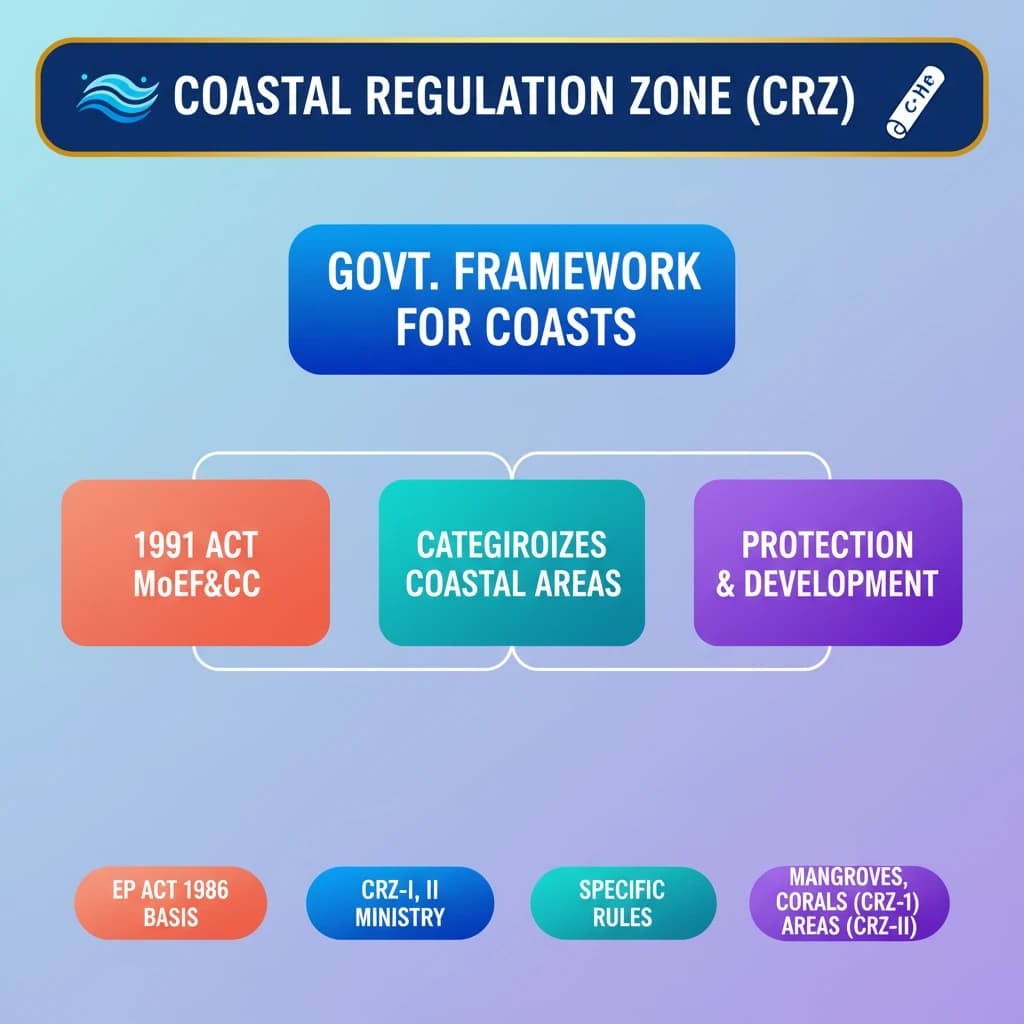
  • CRZ was first notified in 1991 by MoEF under the Environment Protection Act, 1986.
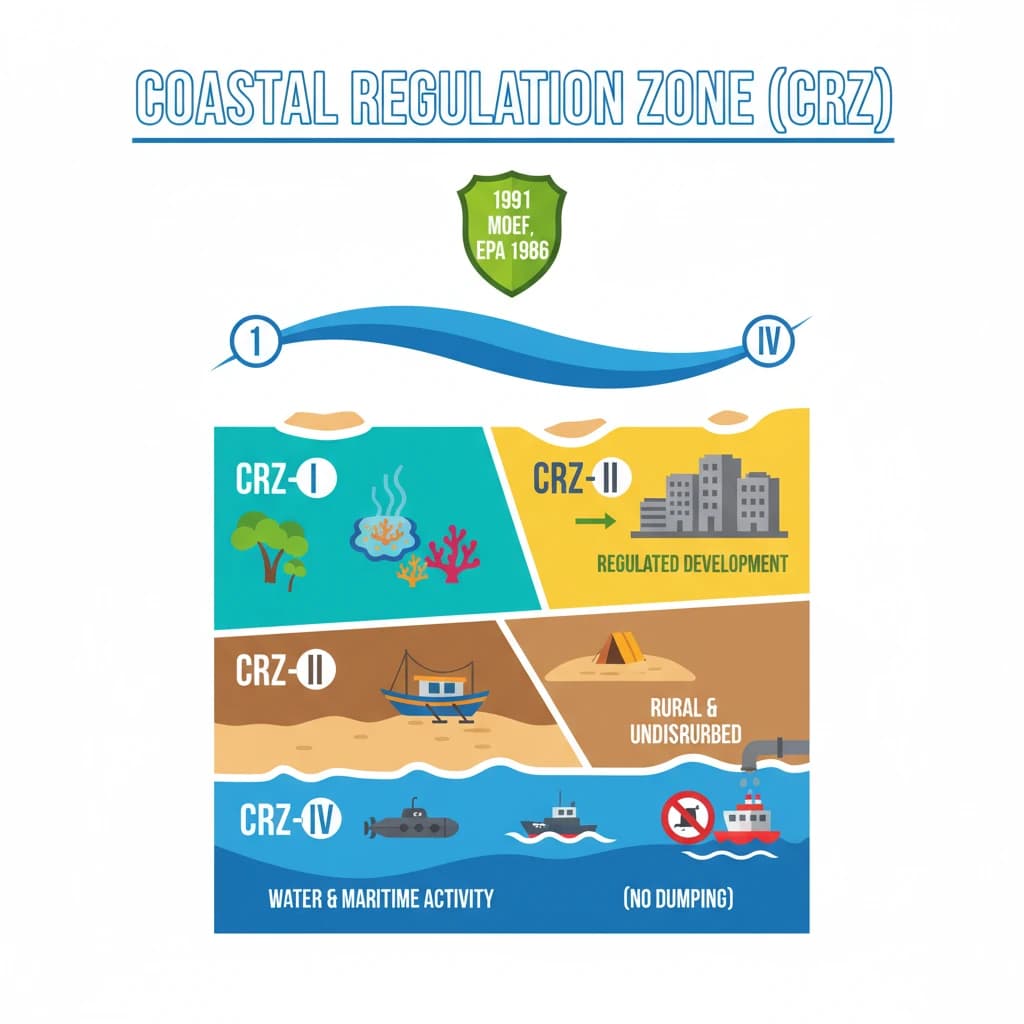
  • It categorizes coastal areas into zones (CRZ-I, II, III, IV) with specific regulations.
  • CRZ-I protects ecologically sensitive areas like mangroves and coral reefs.
  • CRZ-II covers already built-up areas, allowing regulated development.
  • CRZ-III includes undisturbed rural coastal areas, with restrictions on new construction.
  • CRZ-IV is the aquatic area from the low tide line up to territorial limits.
  • The framework aims to balance coastal development with environmental conservation and livelihood protection.
Coastal Regulation Zone (CRZ)

Coastal Regulation Zone (CRZ)

Easy⏱️ 6 min read✓ 95% Verified
environment and ecology

📖 Introduction

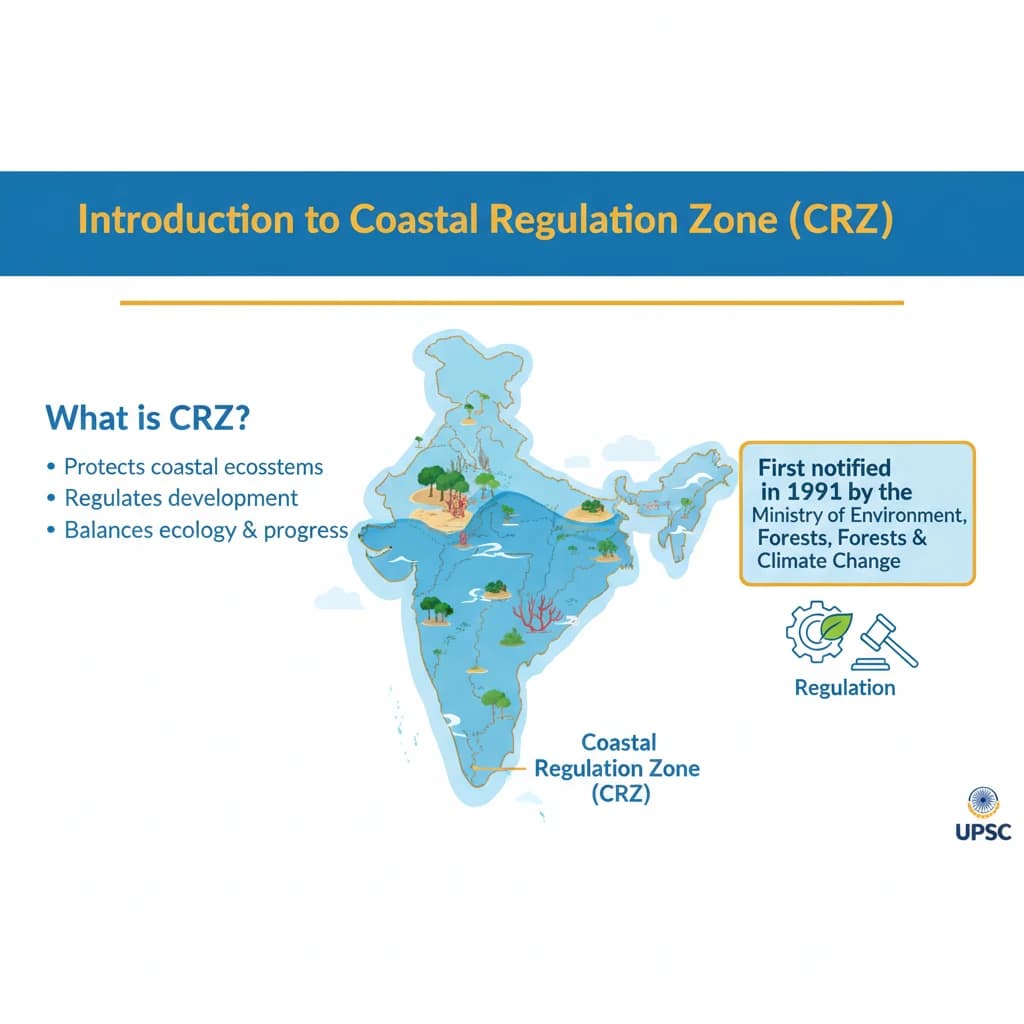
<h4>Introduction to Coastal Regulation Zone (CRZ)</h4><p>The <strong>Coastal Regulation Zone (CRZ)</strong> framework is a critical environmental regulation in India. It aims to protect coastal ecosystems and regulate developmental activities along the country's vast coastline. The regulations are implemented to balance development needs with ecological preservation.</p><div class='info-box'><p>The <strong>CRZ</strong> was first notified in <strong>1991</strong> by the <strong>Ministry of Environment and Forests (MoEF)</strong>. This notification was issued under the overarching provisions of the <strong>Environment Protection Act of 1986</strong>, providing it with strong legal backing.</p></div><div class='key-point-box'><p>The primary objective of <strong>CRZ</strong> notification is to conserve and protect the unique coastal environment, including its flora and fauna, while also regulating human activities to prevent degradation and ensure sustainable use of coastal resources.</p></div><h4>CRZ Categories Explained</h4><p>The <strong>CRZ</strong> framework categorizes coastal areas into distinct zones, each with specific regulations governing permissible and prohibited activities. The initial notification established five zones, though the source content specifically details four of them.</p><ul><li><strong>CRZ-I: Ecologically Sensitive Areas</strong><p>These are regions identified for their significant ecological importance. They include vital habitats such as <strong>mangroves</strong>, <strong>coral reefs</strong>, <strong>sand dunes</strong>, and areas within <strong>biosphere reserves</strong>. Activities here are highly restricted to ensure the preservation of fragile ecosystems.</p></li><li><strong>CRZ-II: Built-up Areas</strong><p>This category encompasses areas that are already substantially developed. These are existing <strong>villages</strong> and <strong>towns</strong> that are well-established. Development in these zones is generally allowed on the landward side of existing structures, adhering to strict environmental norms.</p></li><li><strong>CRZ-III: Undisturbed Areas</strong><p><strong>CRZ-III</strong> includes areas that are relatively undisturbed and do not fall under either <strong>CRZ-I</strong> or <strong>CRZ-II</strong>. These are often rural coastal stretches. Development here is regulated to protect the natural character of the coast and the livelihoods of traditional coastal communities.</p></li><li><strong>CRZ-IV: Aquatic Area</strong><p>This zone covers the <strong>aquatic area</strong> from the <strong>low tide line (LTL)</strong> up to the <strong>territorial limits</strong> (typically 12 nautical miles into the sea). It includes the water column, the seabed, and the sub-soil. Activities such as fishing, dredging, and waste disposal are regulated in this zone.</p></li></ul><div class='exam-tip-box'><p>Understanding the distinctions between each <strong>CRZ category</strong> is crucial for UPSC. Questions often test your knowledge of permissible activities in different zones and their ecological significance. Pay attention to the specific examples provided for <strong>CRZ-I</strong>.</p></div>
Concept Diagram

💡 Key Takeaways

  • •CRZ was first notified in 1991 by MoEF under the Environment Protection Act, 1986.
  • •It categorizes coastal areas into zones (CRZ-I, II, III, IV) with specific regulations.
  • •CRZ-I protects ecologically sensitive areas like mangroves and coral reefs.
  • •CRZ-II covers already built-up areas, allowing regulated development.
  • •CRZ-III includes undisturbed rural coastal areas, with restrictions on new construction.
  • •CRZ-IV is the aquatic area from the low tide line up to territorial limits.
  • •The framework aims to balance coastal development with environmental conservation and livelihood protection.

🧠 Memory Techniques
Memory Aid
95% Verified Content

Related Topics

Loading related topics...
Explore:Environment And Ecology Topics·All Subjects·Daily Current Affairs·Editorial Analysis·Previous Year Questions·UPSC GPT