Loading page, please wait…
Vaidra Logo
Vaidra

Top 4 items + smart groups

UPSC GPT
New
Current Affairs
Daily Solutions
Daily Puzzle
Mains Evaluator

Version 2.0.0 • Built with ❤️ for UPSC aspirants

Loading...
Loading...
Loading...
Loading...
Loading...
Loading...
Loading...
Loading...
Loading...
Loading...
Loading...
Loading...
Loading...
Back
All Subjects

Topics

0 topics • 0 completed

Loading topics...
Loading...
Loading...
Loading...
Loading...
Loading...
Overall Progress0%

What are the Key Facts about Lithium? - UPSC Environment And Ecology

What is What are the Key Facts about Lithium? in UPSC Environment And Ecology?

What are the Key Facts about Lithium? is a key topic under Environment And Ecology for UPSC Civil Services Examination. Key points include: Lithium is a soft, silvery metal with the lowest density and high reactivity.. Key ores include Petalite, Lepidolite, and Spodumene, often called 'white gold'.. Primarily used in rechargeable batteries for EVs, phones, and laptops.. Understanding this topic is essential for both UPSC Prelims and Mains preparation.

Why is What are the Key Facts about Lithium? important for UPSC exam?

What are the Key Facts about Lithium? is a Medium-level topic in UPSC Environment And Ecology. It is tested in both Prelims (factual MCQs) and Mains (analytical answer writing). Previous year UPSC questions have frequently covered aspects of What are the Key Facts about Lithium?, making it essential for comprehensive IAS preparation.

How to prepare What are the Key Facts about Lithium? for UPSC?

To prepare What are the Key Facts about Lithium? for UPSC: (1) Study the comprehensive notes covering all key concepts on Vaidra. (2) Practice previous year questions on this topic. (3) Connect it with current affairs using daily updates. (4) Revise using key takeaways and mind maps available for Environment And Ecology. (5) Write practice answers linking What are the Key Facts about Lithium? to related GS Paper topics.

Key takeaways of What are the Key Facts about Lithium? for UPSC

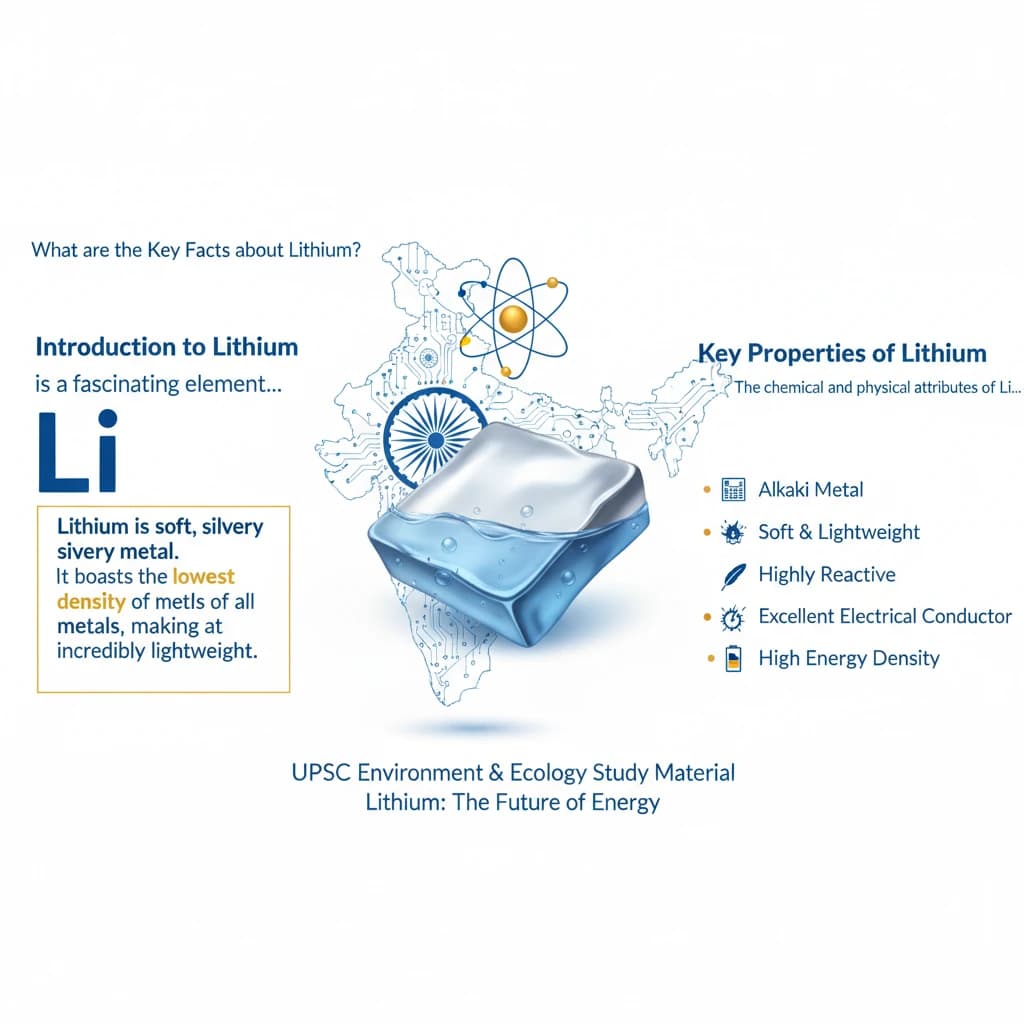
  • Lithium is a soft, silvery metal with the lowest density and high reactivity.
  • Key ores include Petalite, Lepidolite, and Spodumene, often called 'white gold'.
  • Primarily used in rechargeable batteries for EVs, phones, and laptops.
  • Also used in non-rechargeable batteries for pacemakers and in lightweight alloys for armor plating.
  • A critical mineral vital for global energy transition, EVs, and renewable energy storage.
  • India's domestic Lithium discoveries are strategically important for self-reliance.
What are the Key Facts about Lithium?

What are the Key Facts about Lithium?

Medium⏱️ 8 min read✓ 95% Verified
environment and ecology

📖 Introduction

<h4>Introduction to Lithium</h4><p><strong>Lithium</strong> (Li) is a fascinating element known for its unique properties. It is classified as an alkali metal and holds a significant position in modern technology.</p><div class='info-box'><p><strong>Lithium</strong> is a <strong>soft, silvery metal</strong>. It boasts the <strong>lowest density</strong> of all metals, making it incredibly lightweight.</p></div><h4>Key Properties of Lithium</h4><p>The chemical and physical attributes of <strong>Lithium</strong> make it highly valuable across various industries. Its distinct characteristics contribute to its widespread applications.</p><ul><li><strong>High Reactivity:</strong> Lithium readily reacts with other elements, especially non-metals.</li><li><strong>Low Density:</strong> As the lightest metal, it is ideal for applications requiring minimal weight.</li><li><strong>Excellent Electrochemical Properties:</strong> These properties are crucial for its use in energy storage devices.</li></ul><h4>Important Ores of Lithium</h4><p><strong>Lithium</strong> is not found freely in nature due to its high reactivity. Instead, it is extracted from various mineral ores and brines.</p><div class='info-box'><p>Key mineral ores from which <strong>Lithium</strong> is commercially extracted include <strong>Petalite</strong>, <strong>Lepidolite</strong>, and <strong>Spodumene</strong>. These minerals are typically found in pegmatite deposits.</p></div><div class='key-point-box'><p>Due to its strategic importance and high value, <strong>Lithium</strong> is often referred to as <strong>“white gold”</strong>, especially in the context of the global energy transition.</p></div><h4>Diverse Applications of Lithium</h4><p>The versatility of <strong>Lithium</strong> extends to numerous critical applications, primarily driven by its unique electrochemical properties and lightweight nature.</p><h5>Batteries: The Primary Application</h5><p>The most significant use of <strong>Lithium</strong> is in the production of <strong>rechargeable batteries</strong>. These batteries power a vast array of portable electronic devices and electric vehicles.</p><ul><li><strong>Mobile Phones:</strong> Essential for powering smartphones and tablets.</li><li><strong>Laptops:</strong> Provides long-lasting energy for portable computing.</li><li><strong>Digital Cameras:</strong> Enables compact and efficient power sources.</li><li><strong>Electric Vehicles (EVs):</strong> Forms the core of high-capacity batteries driving the global shift towards sustainable transportation.</li></ul><p>Beyond rechargeable variants, <strong>Lithium</strong> is also used in certain <strong>non-rechargeable batteries</strong> for specialized purposes where reliability and longevity are paramount.</p><ul><li><strong>Heart Pacemakers:</strong> Critical for life-sustaining medical devices due to stable power output.</li><li><strong>Toys and Clocks:</strong> Provides compact and long-lasting power for small electronic items.</li></ul><h5>Alloys: Enhancing Material Properties</h5><p><strong>Lithium</strong> is alloyed with other metals to create materials with enhanced strength-to-weight ratios and other desirable properties.</p><div class='info-box'><p>A notable example is the <strong>magnesium-lithium alloy</strong>, which is specifically utilized for <strong>armour plating</strong>. This alloy offers superior protection while keeping the overall weight of the structure low, crucial for aerospace and defense applications.</p></div><div class='exam-tip-box'><p>Understanding <strong>Lithium's applications</strong> is vital for questions on <strong>critical minerals</strong>, <strong>energy security</strong>, and <strong>India's EV policy</strong> in <strong>GS Paper III</strong>. Focus on its role in the green economy.</p></div>
Concept Diagram

💡 Key Takeaways

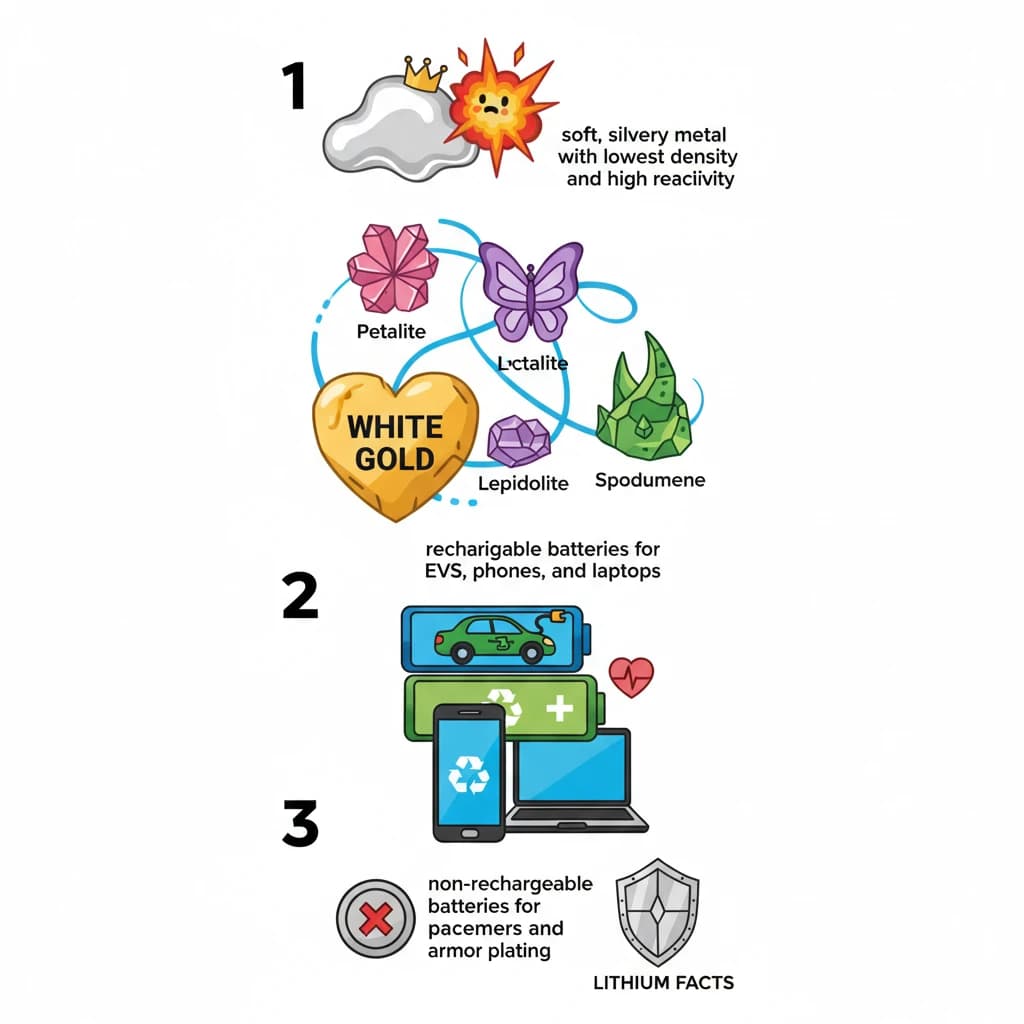
  • •Lithium is a soft, silvery metal with the lowest density and high reactivity.
  • •Key ores include Petalite, Lepidolite, and Spodumene, often called 'white gold'.
  • •Primarily used in rechargeable batteries for EVs, phones, and laptops.
  • •Also used in non-rechargeable batteries for pacemakers and in lightweight alloys for armor plating.
  • •A critical mineral vital for global energy transition, EVs, and renewable energy storage.
  • •India's domestic Lithium discoveries are strategically important for self-reliance.

🧠 Memory Techniques
Memory Aid
95% Verified Content

📚 Reference Sources

•Geological Survey of India (GSI) reports on Lithium discoveries
•International Energy Agency (IEA) reports on Critical Minerals
•General scientific literature on Lithium properties and applications

Related Topics

Loading related topics...
Explore:Environment And Ecology Topics·All Subjects·Daily Current Affairs·Editorial Analysis·Previous Year Questions·UPSC GPT
What are the Key Facts about Lithium? - UPSC Environment And Ecology