Loading page, please wait…
Central Ground Water Board (CGWB) - UPSC Environment And Ecology
What is Central Ground Water Board (CGWB) in UPSC Environment And Ecology?
Central Ground Water Board (CGWB) is a key topic under Environment And Ecology for UPSC Civil Services Examination. Key points include: CGWB is the apex body for scientific groundwater management in India, under the Ministry of Jal Shakti.. Established in 1970, it evolved from the Exploratory Tube Wells Organization and merged with GSI's Ground Water Wing in 1972.. Its key functions include exploration, monitoring, assessment, water quality analysis, and implementing artificial recharge schemes.. Understanding this topic is essential for both UPSC Prelims and Mains preparation.
Why is Central Ground Water Board (CGWB) important for UPSC exam?
Central Ground Water Board (CGWB) is a Medium-level topic in UPSC Environment And Ecology. It is tested in both Prelims (factual MCQs) and Mains (analytical answer writing). Previous year UPSC questions have frequently covered aspects of Central Ground Water Board (CGWB), making it essential for comprehensive IAS preparation.
How to prepare Central Ground Water Board (CGWB) for UPSC?
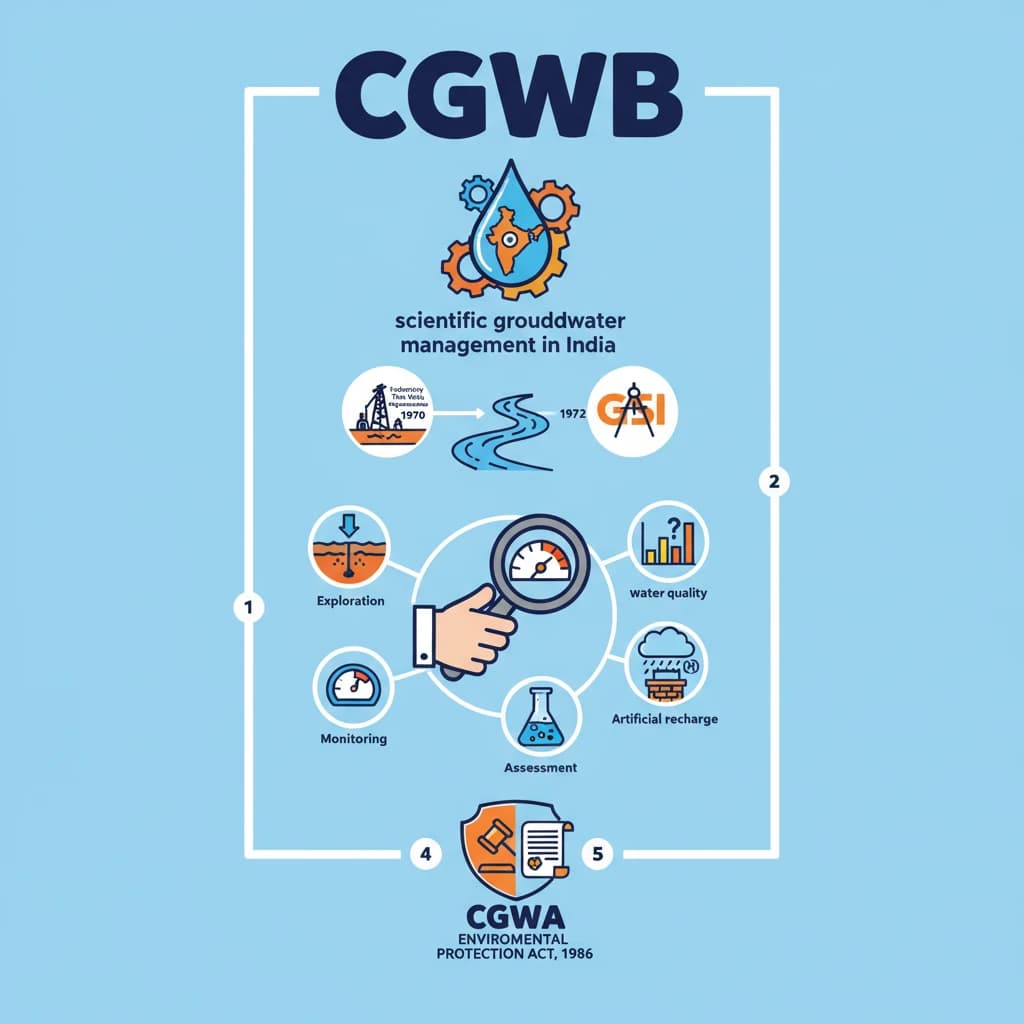
To prepare Central Ground Water Board (CGWB) for UPSC: (1) Study the comprehensive notes covering all key concepts on Vaidra. (2) Practice previous year questions on this topic. (3) Connect it with current affairs using daily updates. (4) Revise using key takeaways and mind maps available for Environment And Ecology. (5) Write practice answers linking Central Ground Water Board (CGWB) to related GS Paper topics.
Key takeaways of Central Ground Water Board (CGWB) for UPSC
- CGWB is the apex body for scientific groundwater management in India, under the Ministry of Jal Shakti.
- Established in 1970, it evolved from the Exploratory Tube Wells Organization and merged with GSI's Ground Water Wing in 1972.
- Its key functions include exploration, monitoring, assessment, water quality analysis, and implementing artificial recharge schemes.
- The Central Ground Water Authority (CGWA) regulates groundwater development under the Environmental Protection Act, 1986.
- Recent data shows 73% of blocks are in the 'safe' groundwater zone, an improvement from 67.4% in 2022.
- CGWB publishes vital scientific reports like Hydrogeological Reports and Ground Water Year Books.
Central Ground Water Board (CGWB)
Medium⏱️ 6 min read
environment and ecology
📖 Introduction
Introduction to Central Ground Water Board (CGWB)
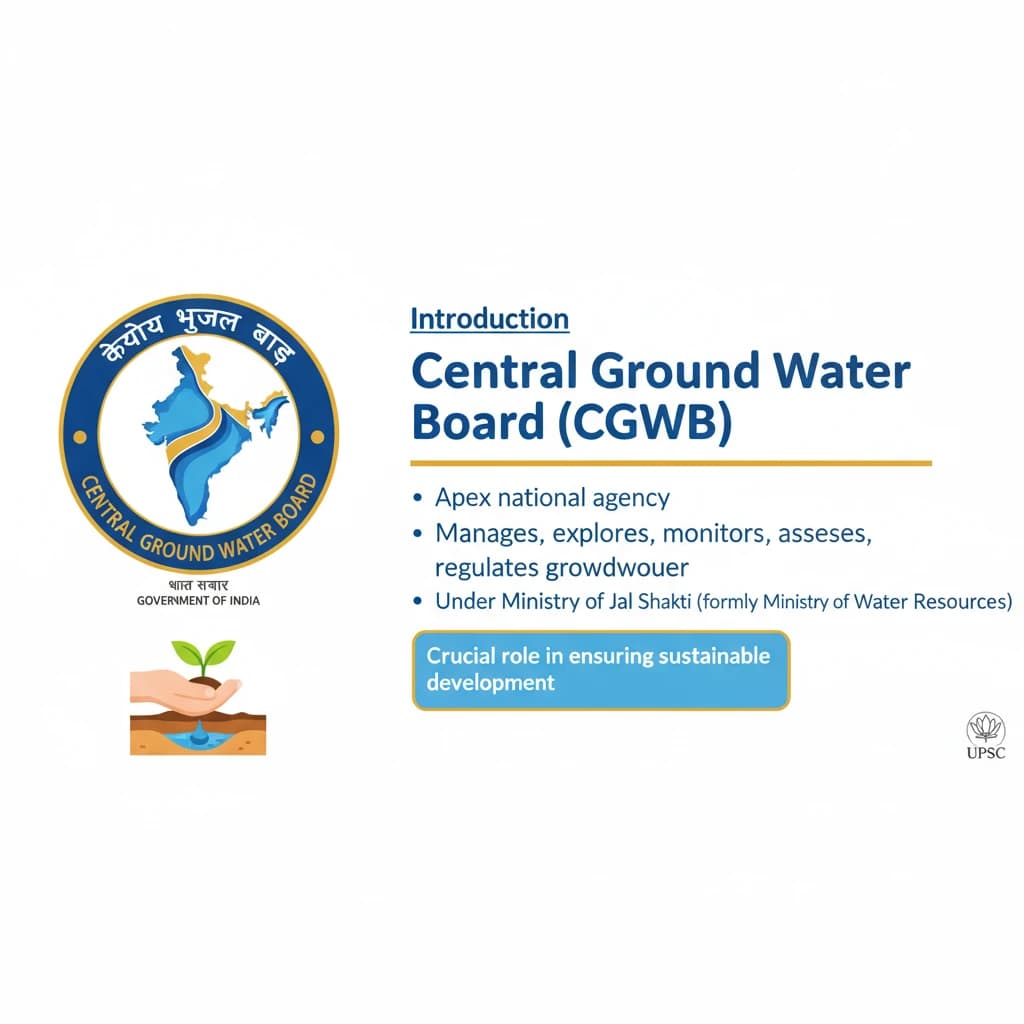
The Central Ground Water Board (CGWB) is the apex national agency responsible for managing, exploring, monitoring, assessing, and regulating groundwater resources across India. It operates under the Ministry of Jal Shakti, formerly known as the Ministry of Water Resources.
The CGWB plays a crucial role in ensuring the sustainable development and management of the nation's vital groundwater reserves.
Establishment and Evolution
The CGWB was initially established in 1970. It began its journey by renaming the existing Exploratory Tube Wells Organization.
Later, in 1972, the organization underwent a significant merger. It was combined with the Ground Water Wing of the Geological Survey of India, forming the comprehensive body known today.
Key Functions and Responsibilities
The primary mandate of CGWB is to provide scientific expertise for effective groundwater management. This includes a wide range of activities aimed at understanding and preserving groundwater.
- Exploration: Conducting surveys to identify new groundwater sources and assess their potential.
- Monitoring: Regularly tracking groundwater levels, quality, and extraction rates across the country.
- Assessment: Evaluating the overall health and sustainability of groundwater aquifers.
- Water Quality Assessments: Analyzing groundwater for various parameters to ensure it is safe for consumption and other uses.
Beyond assessment, CGWB is also actively involved in implementing practical solutions to augment groundwater levels. This includes promoting and executing schemes for artificial recharge and rainwater harvesting.
Groundwater Regulation: Role of CGWA
While CGWB focuses on scientific management and exploration, the regulatory aspect of groundwater development is handled by a distinct body.
The Central Ground Water Authority (CGWA) is constituted under the Environmental Protection Act, 1986. Its main function is to regulate groundwater development to ensure its long-term sustainability and prevent over-exploitation.
Scientific Reports and Data Dissemination
The CGWB is a key source of hydrogeological information for the nation. It regularly releases a variety of scientific reports and publications.
- State and District Hydrogeological Reports: Detailed analyses of groundwater conditions specific to different regions.
- Ground Water Year Books: Annual compilations of groundwater data and trends.
- Atlases: Visual representations of groundwater resources and related information.
Current Groundwater Status
Recent data indicates an improvement in groundwater availability across India. This positive trend highlights the impact of various management and conservation efforts.
Currently, 73% of the blocks in India are classified as being in the 'safe' zone for groundwater. This represents a significant increase from 67.4% reported in 2022, indicating progress in groundwater management.
💡 Key Takeaways
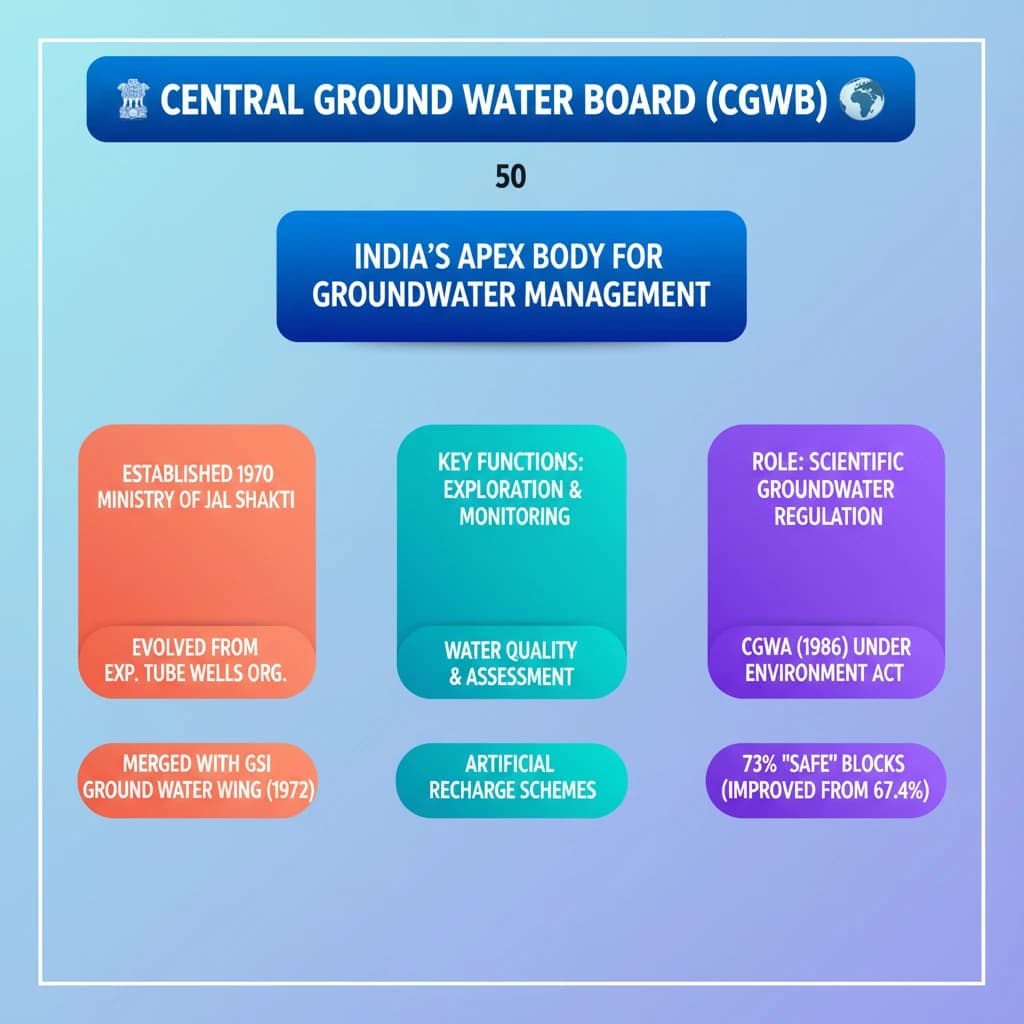
- •CGWB is the apex body for scientific groundwater management in India, under the Ministry of Jal Shakti.
- •Established in 1970, it evolved from the Exploratory Tube Wells Organization and merged with GSI's Ground Water Wing in 1972.
- •Its key functions include exploration, monitoring, assessment, water quality analysis, and implementing artificial recharge schemes.
- •The Central Ground Water Authority (CGWA) regulates groundwater development under the Environmental Protection Act, 1986.
- •Recent data shows 73% of blocks are in the 'safe' groundwater zone, an improvement from 67.4% in 2022.
- •CGWB publishes vital scientific reports like Hydrogeological Reports and Ground Water Year Books.
🧠 Memory Techniques
98% Verified Content
📚 Reference Sources
•Ministry of Jal Shakti (Department of Water Resources, River Development & Ganga Rejuvenation) - CGWB Website
•Press Information Bureau (PIB) releases regarding groundwater assessment