Loading page, please wait…
Vaidra Logo
Vaidra

Top 4 items + smart groups

UPSC GPT
New
Current Affairs
Daily Solutions
Daily Puzzle
Mains Evaluator

Version 2.0.0 • Built with ❤️ for UPSC aspirants

Loading...
Loading...
Loading...
Loading...
Loading...
Loading...
Loading...
Loading...
Loading...
Loading...
Loading...
Loading...
Loading...
Back
All Subjects

Topics

0 topics • 0 completed

Loading topics...
Loading...
Loading...
Loading...
Loading...
Loading...
Overall Progress0%

What are the Key Facts About Himalayan Magpies? - UPSC Environment And Ecology

What is What are the Key Facts About Himalayan Magpies? in UPSC Environment And Ecology?

What are the Key Facts About Himalayan Magpies? is a key topic under Environment And Ecology for UPSC Civil Services Examination. Key points include: Himalayan Magpies belong to the intelligent Corvidae family, along with crows and jays.. They are classified as "Least Concern" on the IUCN Red List.. Key species include Gold-billed (yellow-billed) and Red-billed Magpies, found at different altitudes in the Himalayas.. Understanding this topic is essential for both UPSC Prelims and Mains preparation.

Why is What are the Key Facts About Himalayan Magpies? important for UPSC exam?

What are the Key Facts About Himalayan Magpies? is a Easy-level topic in UPSC Environment And Ecology. It is tested in both Prelims (factual MCQs) and Mains (analytical answer writing). Previous year UPSC questions have frequently covered aspects of What are the Key Facts About Himalayan Magpies?, making it essential for comprehensive IAS preparation.

How to prepare What are the Key Facts About Himalayan Magpies? for UPSC?

To prepare What are the Key Facts About Himalayan Magpies? for UPSC: (1) Study the comprehensive notes covering all key concepts on Vaidra. (2) Practice previous year questions on this topic. (3) Connect it with current affairs using daily updates. (4) Revise using key takeaways and mind maps available for Environment And Ecology. (5) Write practice answers linking What are the Key Facts About Himalayan Magpies? to related GS Paper topics.

Key takeaways of What are the Key Facts About Himalayan Magpies? for UPSC

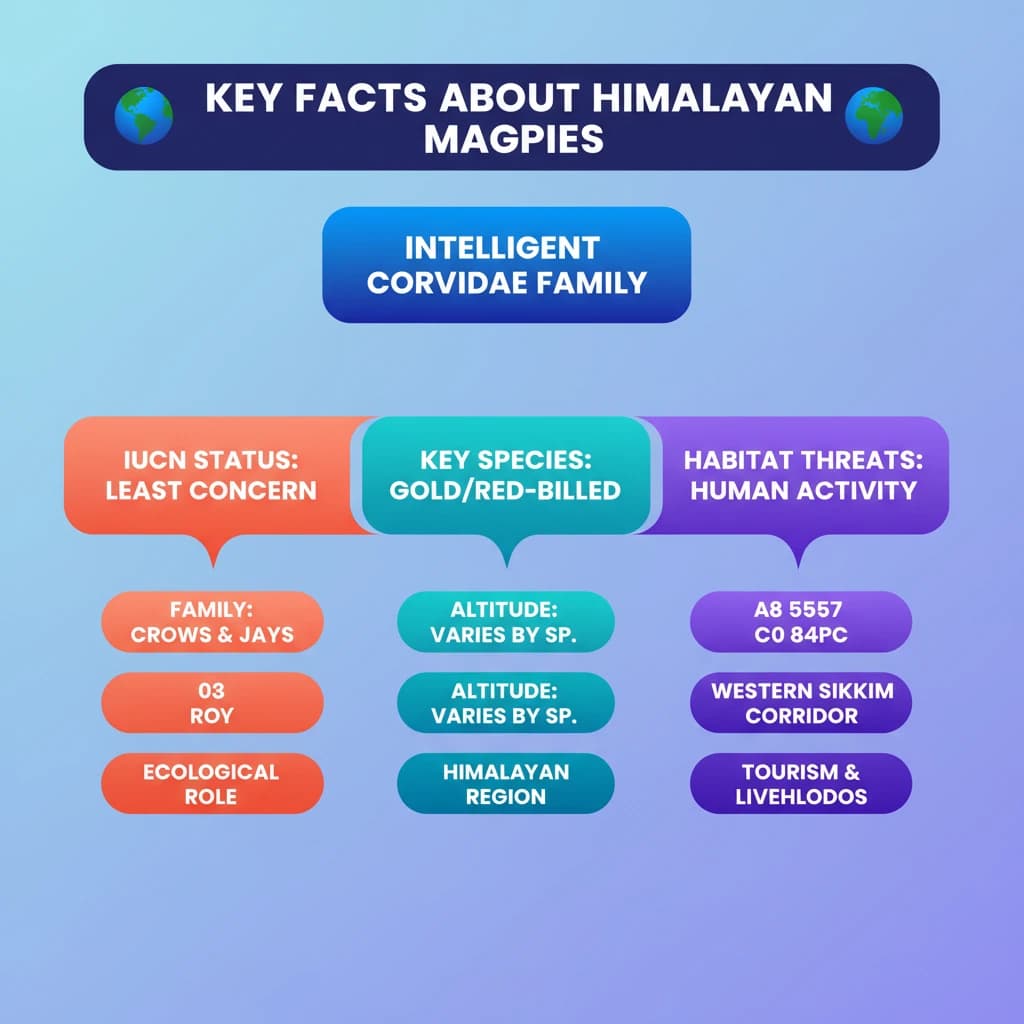
  • Himalayan Magpies belong to the intelligent Corvidae family, along with crows and jays.
  • They are classified as "Least Concern" on the IUCN Red List.
  • Key species include Gold-billed (yellow-billed) and Red-billed Magpies, found at different altitudes in the Himalayas.
  • Their habitats, like the Western Sikkim trekking corridor, face threats from increasing human activity and unsustainable tourism.
  • Conservation efforts must balance local livelihoods with habitat protection.
What are the Key Facts About Himalayan Magpies?

What are the Key Facts About Himalayan Magpies?

Easy⏱️ 7 min read✓ 95% Verified
environment and ecology

📖 Introduction

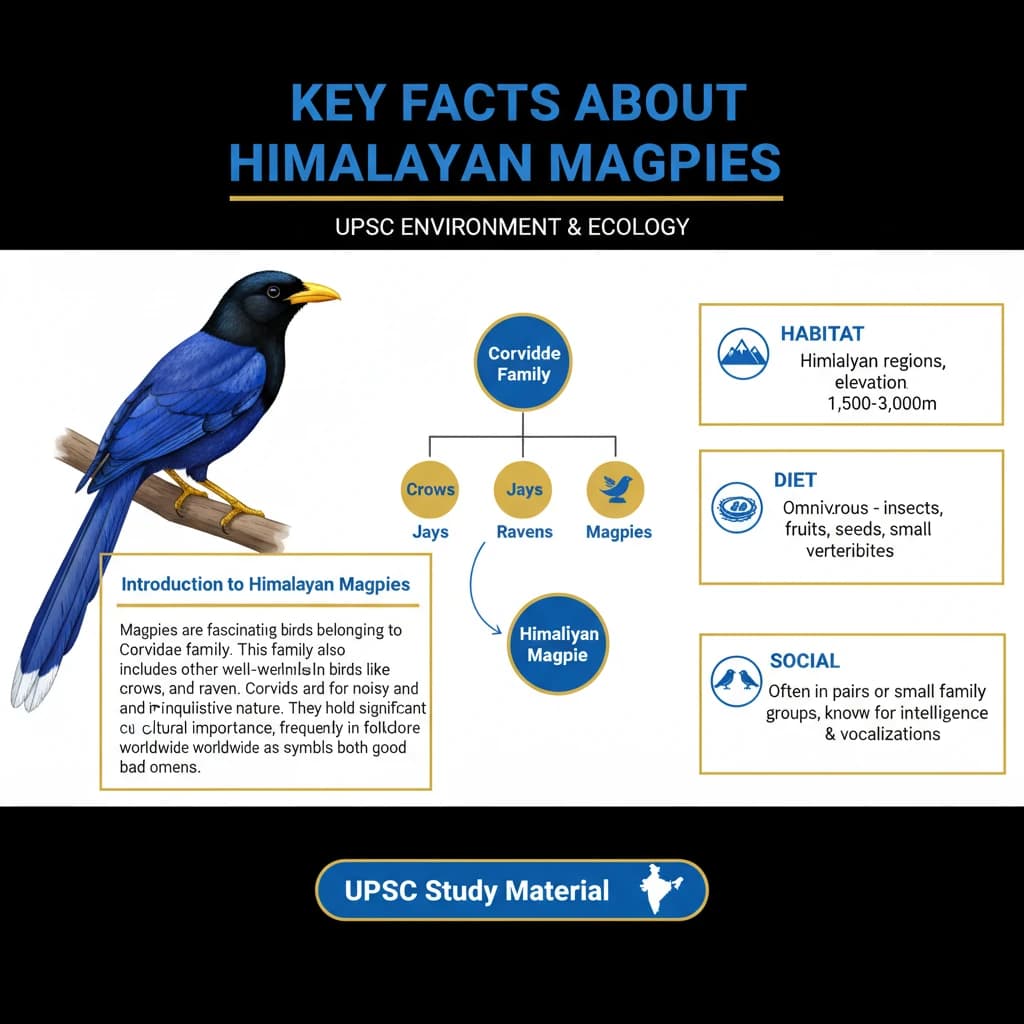
<h4>Introduction to Himalayan Magpies</h4><p><strong>Magpies</strong> are fascinating birds belonging to the <strong>Corvidae family</strong>. This family also includes other well-known birds like <strong>crows</strong>, <strong>jays</strong>, and <strong>ravens</strong>.</p><p><strong>Corvids</strong> are often recognized for their noisy and inquisitive nature. They hold significant cultural importance, frequently appearing in folklore worldwide as symbols of both good and bad omens.</p><p>Among the many striking species of magpies, some of the most noticeable are found in the majestic <strong>Himalayan region</strong>.</p><div class='info-box'><p><strong>IUCN Status:</strong> Himalayan magpies are currently classified as <strong>“Least Concern”</strong> on the <strong>IUCN Red List of Threatened Species</strong>, indicating a relatively stable population.</p></div><h4>Key Himalayan Magpie Species</h4><p>Across the vast stretch from <strong>Kashmir to Myanmar</strong>, several closely related <strong>blue magpie species</strong> are commonly sighted in the Himalayas.</p><div class='key-point-box'><p>There are distinct species inhabiting different altitudinal zones:</p><ul><li><strong>Gold-billed Magpie (Urocissa flavirostris):</strong> Also known as the <strong>yellow-billed blue magpie</strong>, this species thrives in high-altitude zones. It is typically found between <strong>2,000 and 3,000 meters above sea level</strong>.</li><li><strong>Red-billed Magpie (Urocissa erythroryncha):</strong> This species prefers slightly lower elevations compared to its gold-billed counterpart.</li><li><strong>Blue Magpie:</strong> Found at even lower altitudes, often in areas with larger <strong>human populations</strong>.</li></ul></div><h4>Habitat and Sighting Corridors</h4><p>The <strong>Himalayan ecosystem</strong> provides diverse habitats for these magpies. Specific regions offer excellent opportunities for birdwatching.</p><p>One of the prime locations for spotting both the <strong>yellow-billed</strong> and <strong>red-billed magpies</strong> is the <strong>trekking corridor in Western Sikkim</strong>.</p><div class='info-box'><p>This corridor extends from the town of <strong>Yuksom (1,780 meters)</strong> up to the <strong>Goche La pass (around 4,700 meters)</strong>, offering a range of altitudinal zones.</p></div><h4>Nesting Habits and Behavior</h4><p>The nesting and social behaviors of <strong>Himalayan magpies</strong> vary slightly among species.</p><p><strong>Yellow-billed blue magpies</strong> are known to construct their nests primarily in <strong>rhododendron trees</strong>. These nests are typically built hastily using <strong>twigs and grass</strong>.</p><p>In terms of appearance, the <strong>blue magpie</strong> and <strong>red-billed magpie</strong> share similarities, though they are generally a little smaller than the <strong>yellow-billed variety</strong>.</p><p>Magpies can be observed in various social configurations: as <strong>solitary birds</strong>, in <strong>pairs</strong>, or in noisy <strong>flocks of 8-10 individuals</strong>.</p><h4>Threats and Conservation Challenges</h4><p>Despite their "Least Concern" status, <strong>Himalayan magpies</strong> face emerging threats due to increasing anthropogenic pressures.</p><p>The rising level of <strong>human activity in forested areas</strong> is a significant concern. This activity raises questions about the magpies' ability to adapt to rapid <strong>habitat changes</strong>.</p><div class='exam-tip-box'><p>The popularity of <strong>rhododendron flowers</strong> as a tourist attraction, while economically beneficial, poses <strong>sustainability challenges</strong>. Local villagers may increasingly rely on <strong>forest resources</strong> to support the burgeoning tourism industry, impacting magpie habitats.</p></div>
Concept Diagram

💡 Key Takeaways

  • •Himalayan Magpies belong to the intelligent Corvidae family, along with crows and jays.
  • •They are classified as "Least Concern" on the IUCN Red List.
  • •Key species include Gold-billed (yellow-billed) and Red-billed Magpies, found at different altitudes in the Himalayas.
  • •Their habitats, like the Western Sikkim trekking corridor, face threats from increasing human activity and unsustainable tourism.
  • •Conservation efforts must balance local livelihoods with habitat protection.

🧠 Memory Techniques

Memory Aid
95% Verified Content

Related Topics

Loading related topics...
Explore:Environment And Ecology Topics·All Subjects·Daily Current Affairs·Editorial Analysis·Previous Year Questions·UPSC GPT
What are the Key Facts About Himalayan Magpies? - UPSC Environment And Ecology