Loading page, please wait…
CGWB Report on Groundwater Contamination - UPSC Environment And Ecology
What is CGWB Report on Groundwater Contamination in UPSC Environment And Ecology?
CGWB Report on Groundwater Contamination is a key topic under Environment And Ecology for UPSC Civil Services Examination. Key points include: CGWB report reveals a significant rise in groundwater contamination across India.. Nitrate contamination is a major concern, affecting 440 districts in 2023, up from 359 in 2017.. 56% of India's districts exceed the safe nitrate limit of 45 mg/L.. Understanding this topic is essential for both UPSC Prelims and Mains preparation.
Why is CGWB Report on Groundwater Contamination important for UPSC exam?
CGWB Report on Groundwater Contamination is a Medium-level topic in UPSC Environment And Ecology. It is tested in both Prelims (factual MCQs) and Mains (analytical answer writing). Previous year UPSC questions have frequently covered aspects of CGWB Report on Groundwater Contamination, making it essential for comprehensive IAS preparation.
How to prepare CGWB Report on Groundwater Contamination for UPSC?
To prepare CGWB Report on Groundwater Contamination for UPSC: (1) Study the comprehensive notes covering all key concepts on Vaidra. (2) Practice previous year questions on this topic. (3) Connect it with current affairs using daily updates. (4) Revise using key takeaways and mind maps available for Environment And Ecology. (5) Write practice answers linking CGWB Report on Groundwater Contamination to related GS Paper topics.
Key takeaways of CGWB Report on Groundwater Contamination for UPSC
- CGWB report reveals a significant rise in groundwater contamination across India.
- Nitrate contamination is a major concern, affecting 440 districts in 2023, up from 359 in 2017.
- 56% of India's districts exceed the safe nitrate limit of 45 mg/L.
- Rajasthan, Karnataka, and Tamil Nadu are primary hotspots for nitrate contamination.
- Monsoon season leads to an increase in nitrate levels (32.66% post-monsoon vs. 30.77% pre-monsoon).
- Fluoride and Uranium are other persistent contaminants, particularly in over-exploited groundwater zones.
- Groundwater extraction remains high at 60.4%, steady since 2009.
CGWB Report on Groundwater Contamination
Medium⏱️ 6 min read
environment and ecology
📖 Introduction
Introduction: Groundwater Contamination Crisis
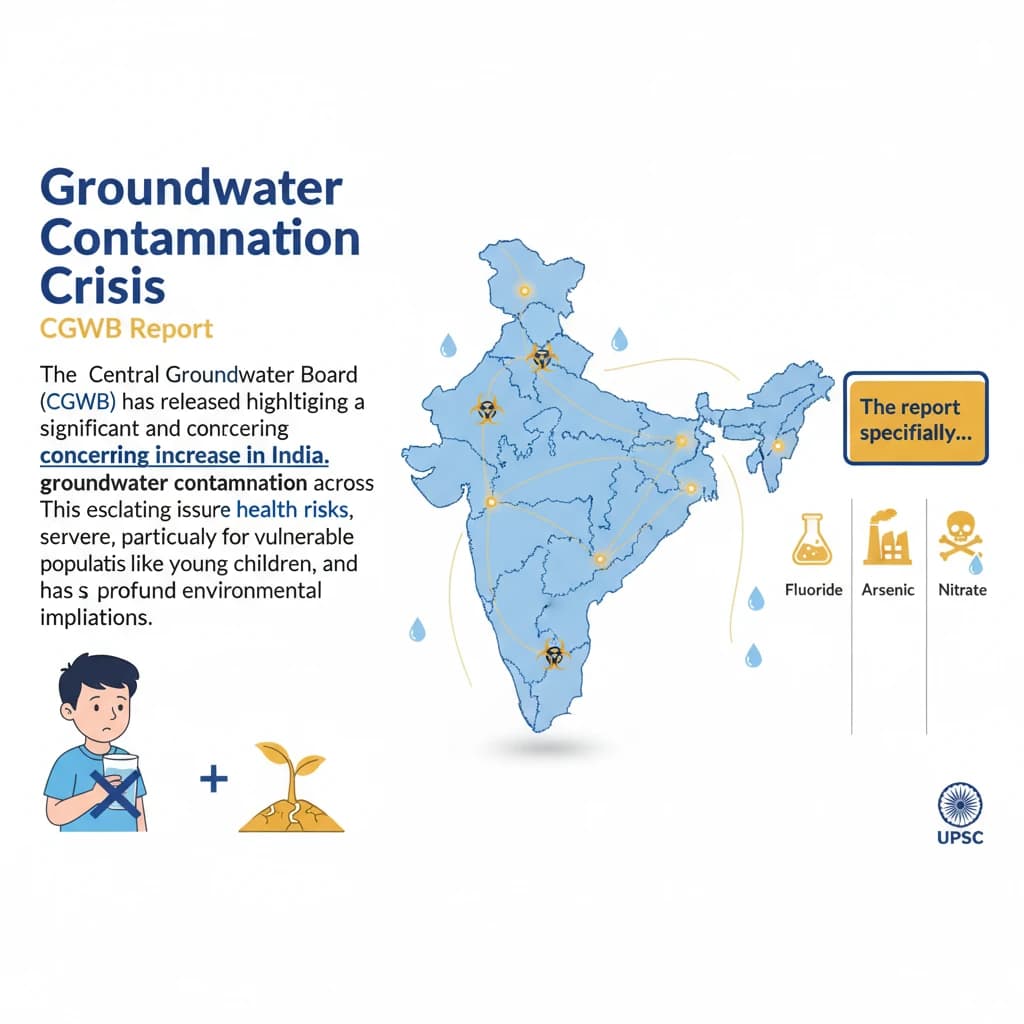
The Central Groundwater Board (CGWB) has released a report highlighting a significant and concerning increase in groundwater contamination across India. This escalating issue poses severe health risks, particularly for vulnerable populations like young children, and has profound environmental implications.
The report specifically identifies a troubling rise in districts reporting excessive levels of nitrate, a chemical contaminant, in their groundwater resources.
Key Findings: Nitrate Contamination Escalation
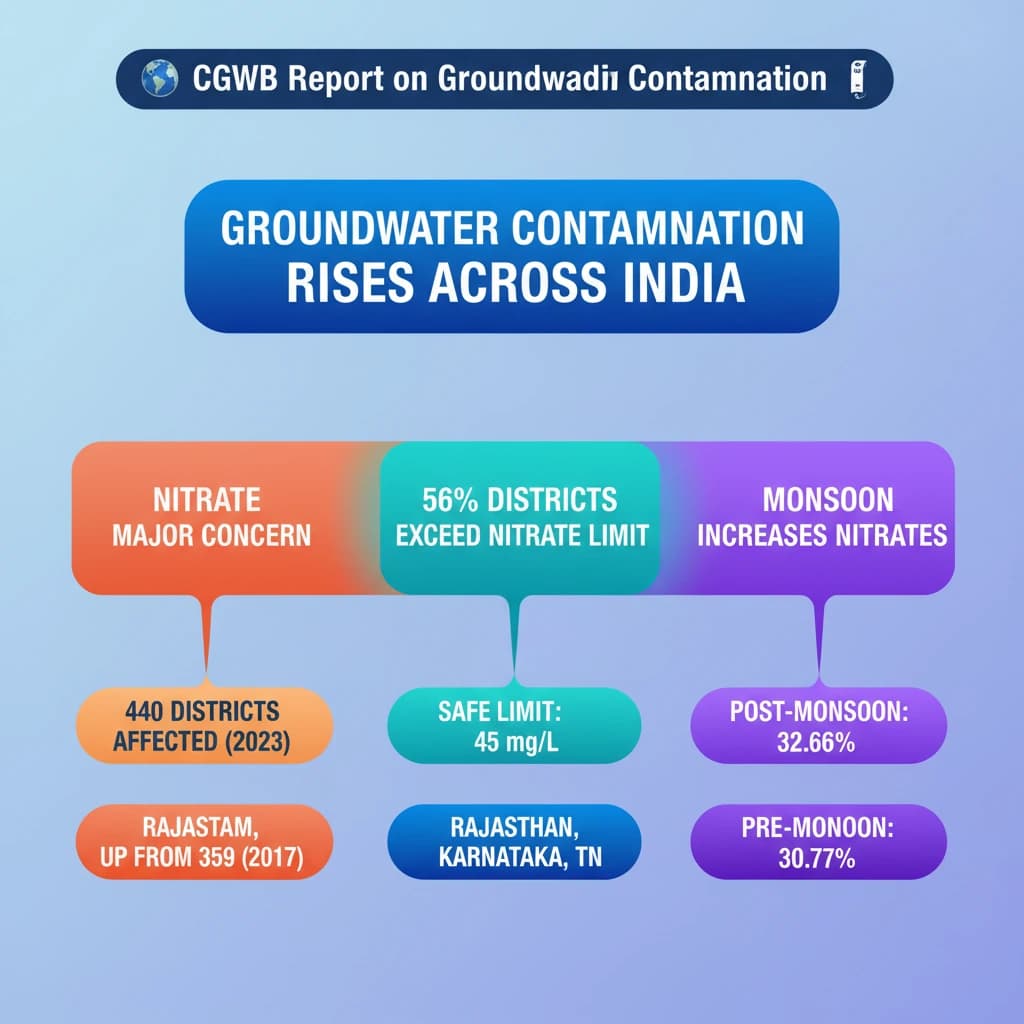
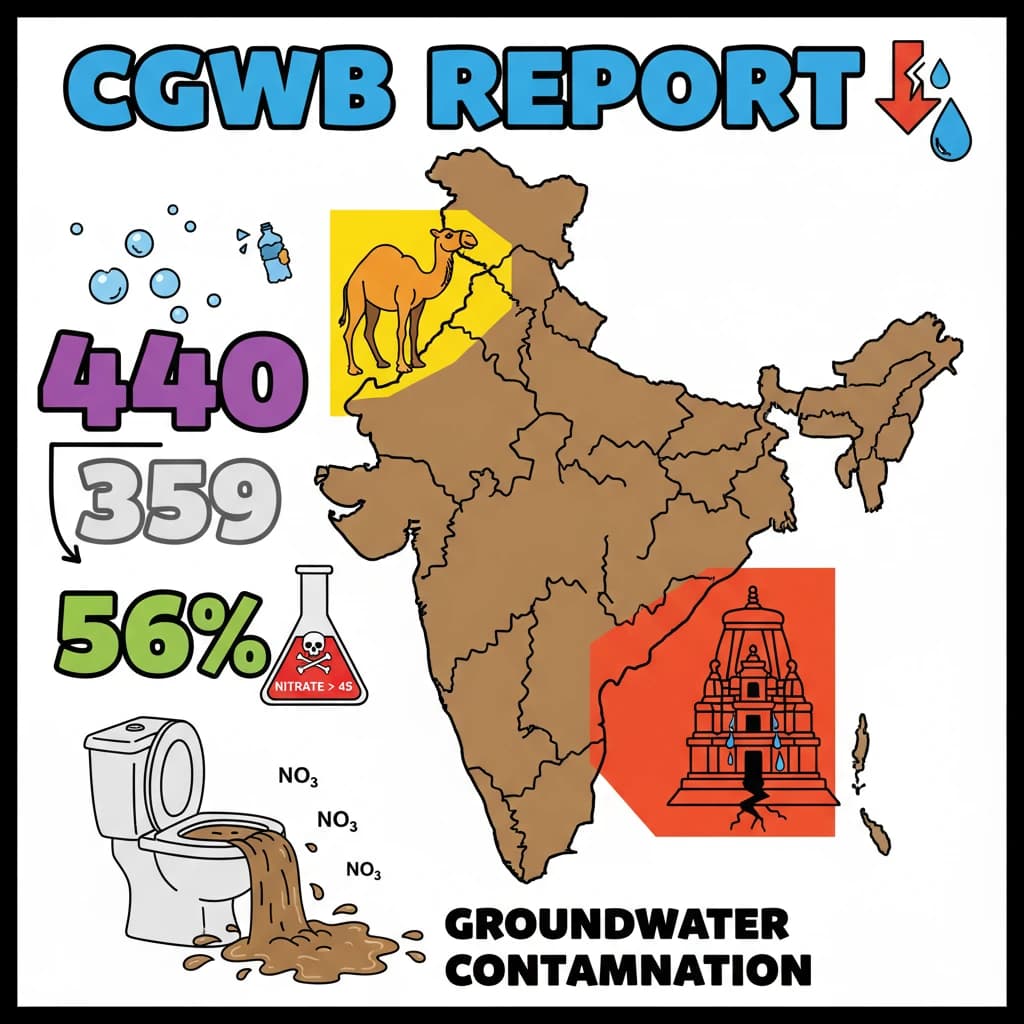
The CGWB report reveals a stark increase in nitrate contamination. As of 2023, a total of 440 districts across India reported groundwater with excessive nitrate levels. This marks a substantial rise from 359 districts reported in 2017.
A significant proportion of India's districts are now affected. Approximately 56% of all districts in India have nitrate concentrations that exceed the prescribed safe limit of 45 mg per litre.
Safe Limit: The permissible limit for nitrate in drinking water, as per Indian standards, is 45 mg per litre.
Regional Hotspots for Nitrate Contamination
Certain regions in India are disproportionately affected by high levels of nitrate contamination. The states reporting the highest percentages of nitrate contamination include Rajasthan (49%), Karnataka (48%), and Tamil Nadu (37%).
Beyond these primary hotspots, other states are also experiencing notable and growing concerns regarding nitrate contamination. These include Maharashtra, Telangana, Andhra Pradesh, and Madhya Pradesh, with particular attention on central and southern India.
Monsoon's Impact on Nitrate Levels
The report indicates a clear correlation between the monsoon season and increased nitrate contamination. Levels of nitrate in groundwater tend to rise significantly after the monsoon period.
Specifically, 32.66% of groundwater samples tested exceeded safe limits during the rainy season. This is notably higher compared to the 30.77% of samples that exceeded safe limits in the pre-monsoon period.
Other Significant Groundwater Contaminants
While nitrate is a major concern, the CGWB report also highlights the persistence of other critical contaminants in India's groundwater.
- Fluoride Contamination: This remains a significant problem, particularly in states such as Rajasthan, Haryana, Karnataka, Andhra Pradesh, and Telangana.
- Uranium Contamination: Levels of uranium exceeding safe limits have been detected in groundwater across several states. These include Rajasthan, Punjab, Haryana, Gujarat, Tamil Nadu, Andhra Pradesh, and Karnataka. This issue is particularly prevalent in over-exploited groundwater zones.
Groundwater Extraction Status
The report also provides an overview of groundwater extraction rates across the country. Currently, approximately 60.4% of the total groundwater resources are being extracted across India.
Extraction Rate: The rate of groundwater extraction has remained relatively steady since 2009, indicating consistent pressure on these vital resources.
UPSC Insight: Understanding the regional distribution and types of contamination is crucial for questions on Environmental Geography (GS-I) and Environmental Pollution & Degradation (GS-III).
💡 Key Takeaways
- •CGWB report reveals a significant rise in groundwater contamination across India.
- •Nitrate contamination is a major concern, affecting 440 districts in 2023, up from 359 in 2017.
- •56% of India's districts exceed the safe nitrate limit of 45 mg/L.
- •Rajasthan, Karnataka, and Tamil Nadu are primary hotspots for nitrate contamination.
- •Monsoon season leads to an increase in nitrate levels (32.66% post-monsoon vs. 30.77% pre-monsoon).
- •Fluoride and Uranium are other persistent contaminants, particularly in over-exploited groundwater zones.
- •Groundwater extraction remains high at 60.4%, steady since 2009.
🧠 Memory Techniques
95% Verified Content
📚 Reference Sources
•Central Groundwater Board (CGWB) Report (implied from summary)