Loading page, please wait…
Climate Change Impact on Small Island Developing States - UPSC Environment And Ecology
What is Climate Change Impact on Small Island Developing States in UPSC Environment And Ecology?
Climate Change Impact on Small Island Developing States is a key topic under Environment And Ecology for UPSC Civil Services Examination. Key points include: SIDS are 39 small island nations facing severe environmental, social, and economic vulnerabilities, particularly to climate change.. They are located primarily in the Caribbean, Pacific, and Atlantic, Indian Ocean & South China Sea regions.. SIDS were formally recognized as a 'special case' at the 1992 UN Conference on Environment and Development.. Understanding this topic is essential for both UPSC Prelims and Mains preparation.
Why is Climate Change Impact on Small Island Developing States important for UPSC exam?
Climate Change Impact on Small Island Developing States is a Medium-level topic in UPSC Environment And Ecology. It is tested in both Prelims (factual MCQs) and Mains (analytical answer writing). Previous year UPSC questions have frequently covered aspects of Climate Change Impact on Small Island Developing States, making it essential for comprehensive IAS preparation.
How to prepare Climate Change Impact on Small Island Developing States for UPSC?
To prepare Climate Change Impact on Small Island Developing States for UPSC: (1) Study the comprehensive notes covering all key concepts on Vaidra. (2) Practice previous year questions on this topic. (3) Connect it with current affairs using daily updates. (4) Revise using key takeaways and mind maps available for Environment And Ecology. (5) Write practice answers linking Climate Change Impact on Small Island Developing States to related GS Paper topics.
Key takeaways of Climate Change Impact on Small Island Developing States for UPSC
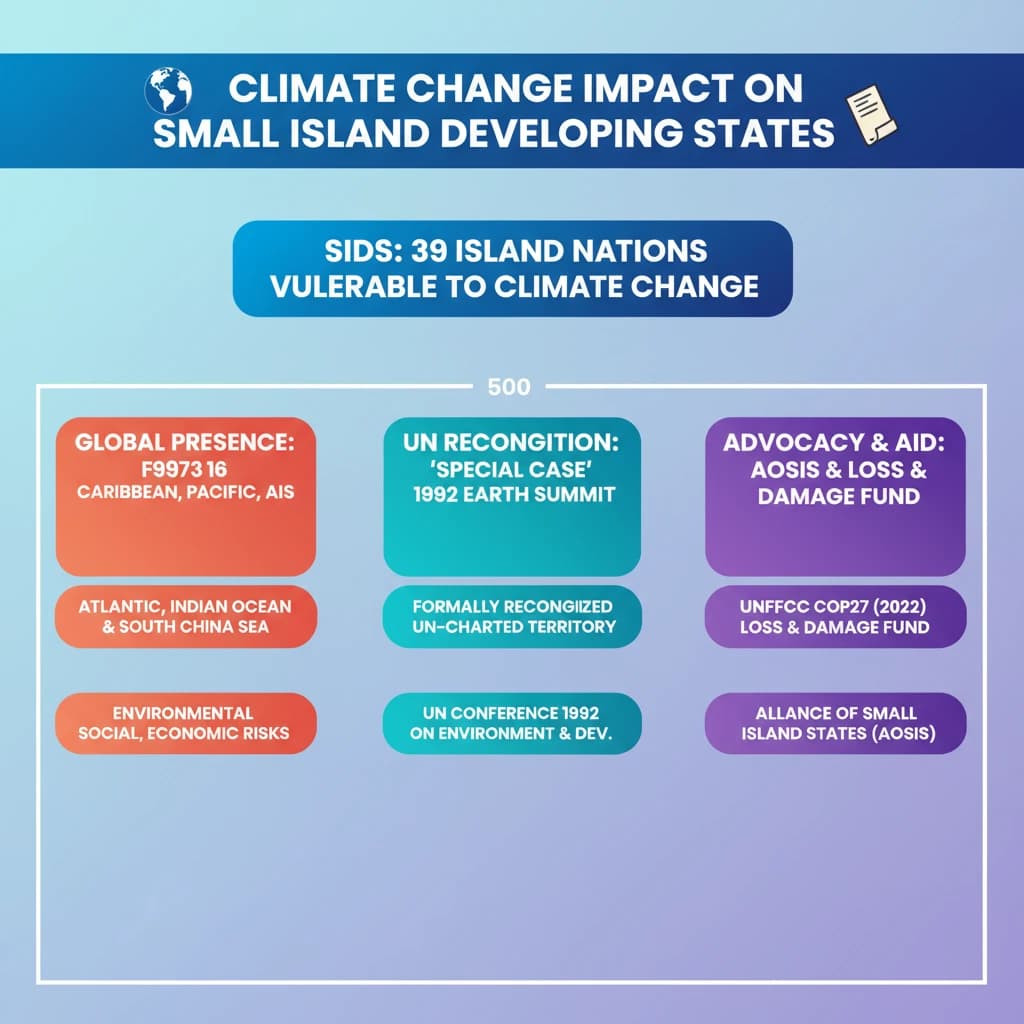
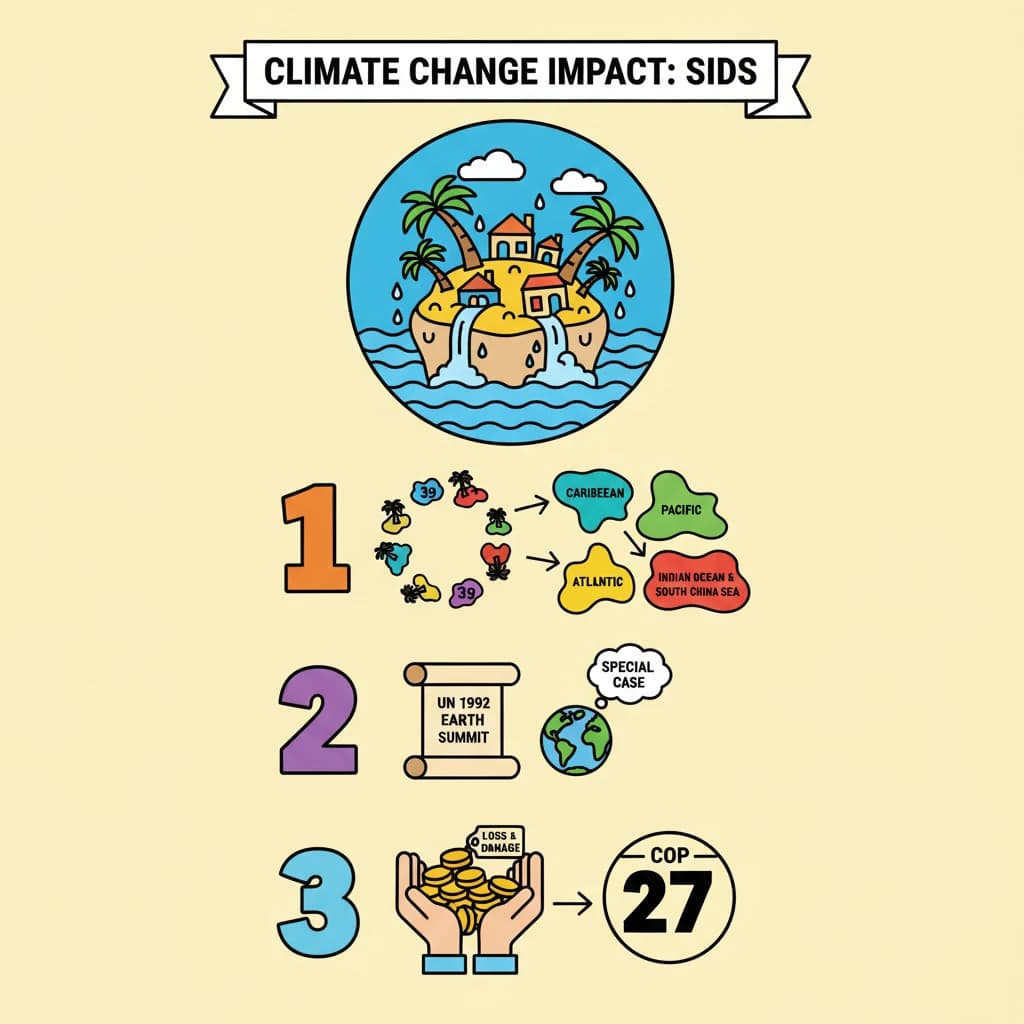
- SIDS are 39 small island nations facing severe environmental, social, and economic vulnerabilities, particularly to climate change.
- They are located primarily in the Caribbean, Pacific, and Atlantic, Indian Ocean & South China Sea regions.
- SIDS were formally recognized as a 'special case' at the 1992 UN Conference on Environment and Development.
- UNFCCC COP27 (2022) established a 'Loss and Damage Fund' to aid climate-vulnerable nations, especially SIDS.
- The Alliance of Small Island States (AOSIS) is a key intergovernmental organization advocating for SIDS' interests in climate policy.
- Wealthier nations' failure to fulfill financial commitments remains a major hurdle for SIDS' adaptation and mitigation efforts.
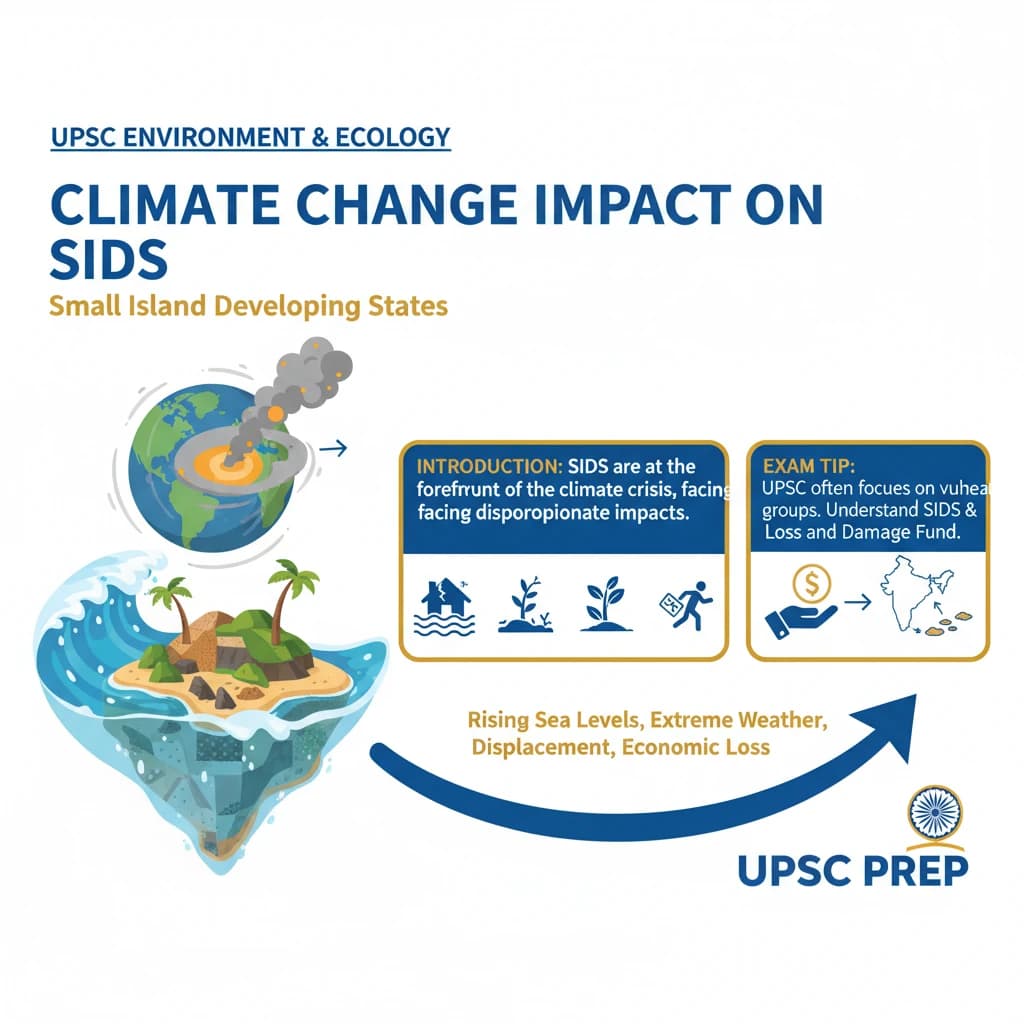
Climate Change Impact on Small Island Developing States
Medium⏱️ 7 min read
environment and ecology
📖 Introduction
Introduction to Climate Change Impact on SIDS
The **Small Island Developing States (SIDS)** are at the forefront of the climate crisis, facing disproportionate impacts despite their minimal contribution to global emissions. Their unique geographical and economic characteristics make them extremely vulnerable.
UPSC often focuses on vulnerable groups and international efforts. Understanding **SIDS** and initiatives like the **Loss and Damage Fund** is crucial for **GS-I Geography**, **GS-II International Relations**, and **GS-III Environment**.
UNFCCC COP27 and the Loss and Damage Fund
At the **UNFCCC COP27** in **Sharm El Sheikh (2022)**, a significant breakthrough occurred with the creation of a new **Loss and Damage Fund**. This fund aims to provide financial assistance to climate-vulnerable nations, particularly **SIDS**, for unavoidable climate impacts.
Despite this agreement, a persistent challenge remains: wealthier nations, historically the largest carbon emitters, have often failed to fulfill their financial commitments. This leaves many vulnerable countries, including **SIDS**, without the necessary support to address climate-induced losses.
Defining Small Island Developing States (SIDS)
Small Island Developing States (SIDS) are a distinct group of small island nations and territories. They share common characteristics that lead to significant vulnerabilities in their pursuit of sustainable development.
These vulnerabilities encompass social, economic, and environmental dimensions. They often include small landmasses, remote locations, limited resources, and high exposure to natural disasters.
Geographical Distribution of SIDS
Approximately **39 SIDS** are recognized globally. These states are primarily concentrated in three major geographical regions, highlighting their shared regional challenges and specific climate threats.
- The Caribbean: Home to many SIDS facing hurricane risks and sea-level rise.
- The Pacific: Features numerous low-lying atoll nations highly susceptible to rising sea levels and ocean acidification.
- The Atlantic, Indian Ocean & South China Sea (AIS) regions: Includes diverse island nations with varying climate vulnerabilities.
Examples of SIDS include: Maldives, Seychelles, Marshall Islands, Solomon Islands, Suriname, Mauritius, Papua New Guinea, Vanuatu, Guyana, and Singapore.
International Recognition of SIDS
The unique plight of **SIDS** received formal international recognition at the **United Nations Conference on Environment and Development (UNCED)** in **1992**. This landmark event designated them as a 'special case' due to their distinct environmental and developmental challenges.
The 'special case' recognition underscored the need for tailored international support and policies to address the specific vulnerabilities of **SIDS**.
💡 Key Takeaways
- •SIDS are 39 small island nations facing severe environmental, social, and economic vulnerabilities, particularly to climate change.
- •They are located primarily in the Caribbean, Pacific, and Atlantic, Indian Ocean & South China Sea regions.
- •SIDS were formally recognized as a 'special case' at the 1992 UN Conference on Environment and Development.
- •UNFCCC COP27 (2022) established a 'Loss and Damage Fund' to aid climate-vulnerable nations, especially SIDS.
- •The Alliance of Small Island States (AOSIS) is a key intergovernmental organization advocating for SIDS' interests in climate policy.
- •Wealthier nations' failure to fulfill financial commitments remains a major hurdle for SIDS' adaptation and mitigation efforts.
🧠 Memory Techniques
95% Verified Content
📚 Reference Sources
•UNFCCC Official Website (COP27 outcomes, Loss and Damage Fund)
•United Nations Office of the High Representative for the Least Developed Countries, Landlocked Developing Countries and Small Island Developing States (UN-OHRLLS)
•Alliance of Small Island States (AOSIS) Official Website