Loading page, please wait…
Coral Bleaching in Great Barrier Reef - UPSC Environment And Ecology
What is Coral Bleaching in Great Barrier Reef in UPSC Environment And Ecology?
Coral Bleaching in Great Barrier Reef is a key topic under Environment And Ecology for UPSC Civil Services Examination. Key points include: Coral bleaching is the expulsion of symbiotic algae (zooxanthellae) by corals due to stress, primarily rising ocean temperatures.. The Great Barrier Reef (GBR) has experienced widespread bleaching, with recent surveys confirming impact across two-thirds of the reef.. Bleached corals are not dead but are severely weakened and can die if stress persists, leading to reef degradation.. Understanding this topic is essential for both UPSC Prelims and Mains preparation.
Why is Coral Bleaching in Great Barrier Reef important for UPSC exam?
Coral Bleaching in Great Barrier Reef is a Medium-level topic in UPSC Environment And Ecology. It is tested in both Prelims (factual MCQs) and Mains (analytical answer writing). Previous year UPSC questions have frequently covered aspects of Coral Bleaching in Great Barrier Reef, making it essential for comprehensive IAS preparation.
How to prepare Coral Bleaching in Great Barrier Reef for UPSC?
To prepare Coral Bleaching in Great Barrier Reef for UPSC: (1) Study the comprehensive notes covering all key concepts on Vaidra. (2) Practice previous year questions on this topic. (3) Connect it with current affairs using daily updates. (4) Revise using key takeaways and mind maps available for Environment And Ecology. (5) Write practice answers linking Coral Bleaching in Great Barrier Reef to related GS Paper topics.
Key takeaways of Coral Bleaching in Great Barrier Reef for UPSC
- Coral bleaching is the expulsion of symbiotic algae (zooxanthellae) by corals due to stress, primarily rising ocean temperatures.
- The Great Barrier Reef (GBR) has experienced widespread bleaching, with recent surveys confirming impact across two-thirds of the reef.
- Bleached corals are not dead but are severely weakened and can die if stress persists, leading to reef degradation.
- Climate change, particularly global warming and ocean acidification, is the primary driver of mass bleaching events globally.
- Coral reefs are vital biodiversity hotspots, supporting marine life and coastal economies; their degradation has severe ecological and economic consequences.
- Urgent global and local actions are required to mitigate climate change and enhance reef resilience to prevent further irreversible damage.
Coral Bleaching in Great Barrier Reef
Medium⏱️ 8 min read
environment and ecology
📖 Introduction
Recent Bleaching Event in Great Barrier Reef
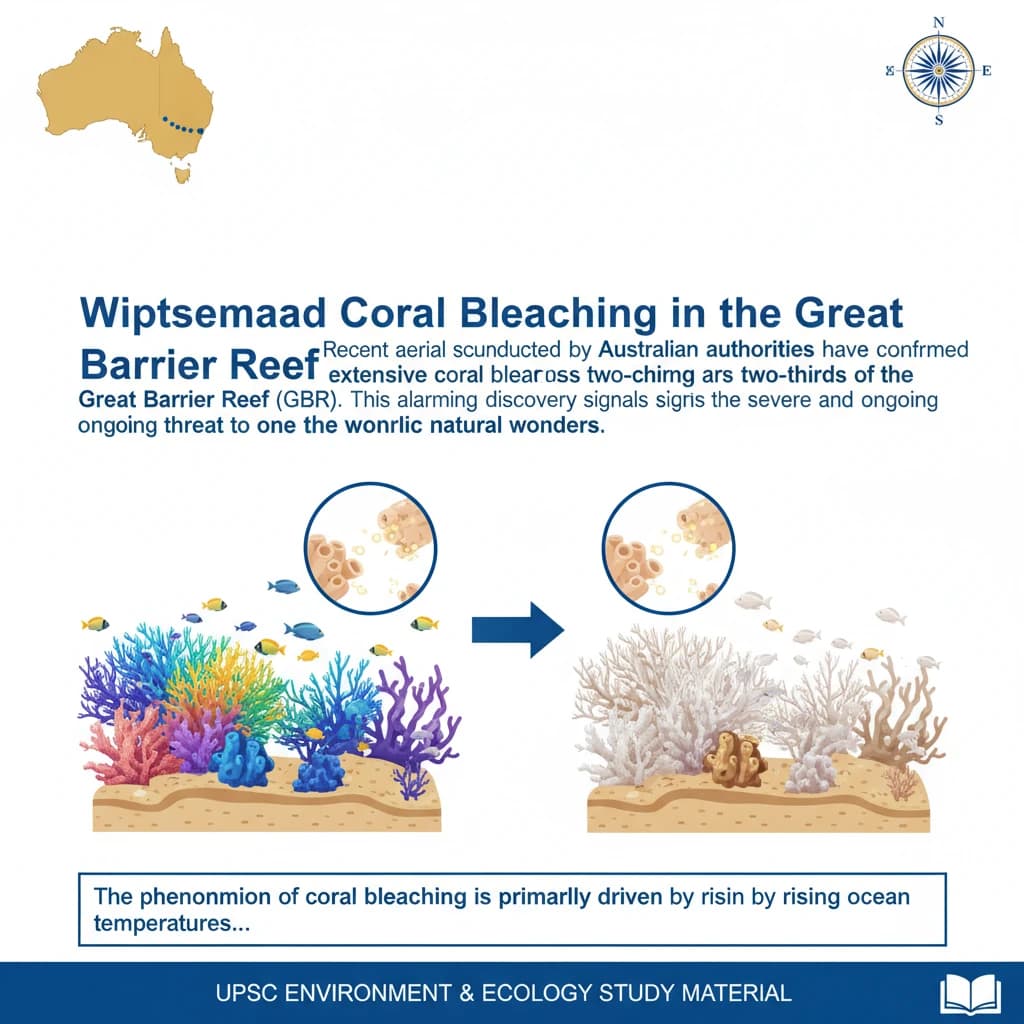
Recent aerial surveys conducted by Australian authorities have confirmed widespread coral bleaching across two-thirds of the Great Barrier Reef (GBR). This alarming discovery signals a dire threat, largely exacerbated by ongoing climate change.
The surveys highlight the urgent need for action to protect this iconic natural wonder. Such extensive bleaching events underscore the severe impact of rising global temperatures on marine ecosystems worldwide.
Understanding Coral Bleaching
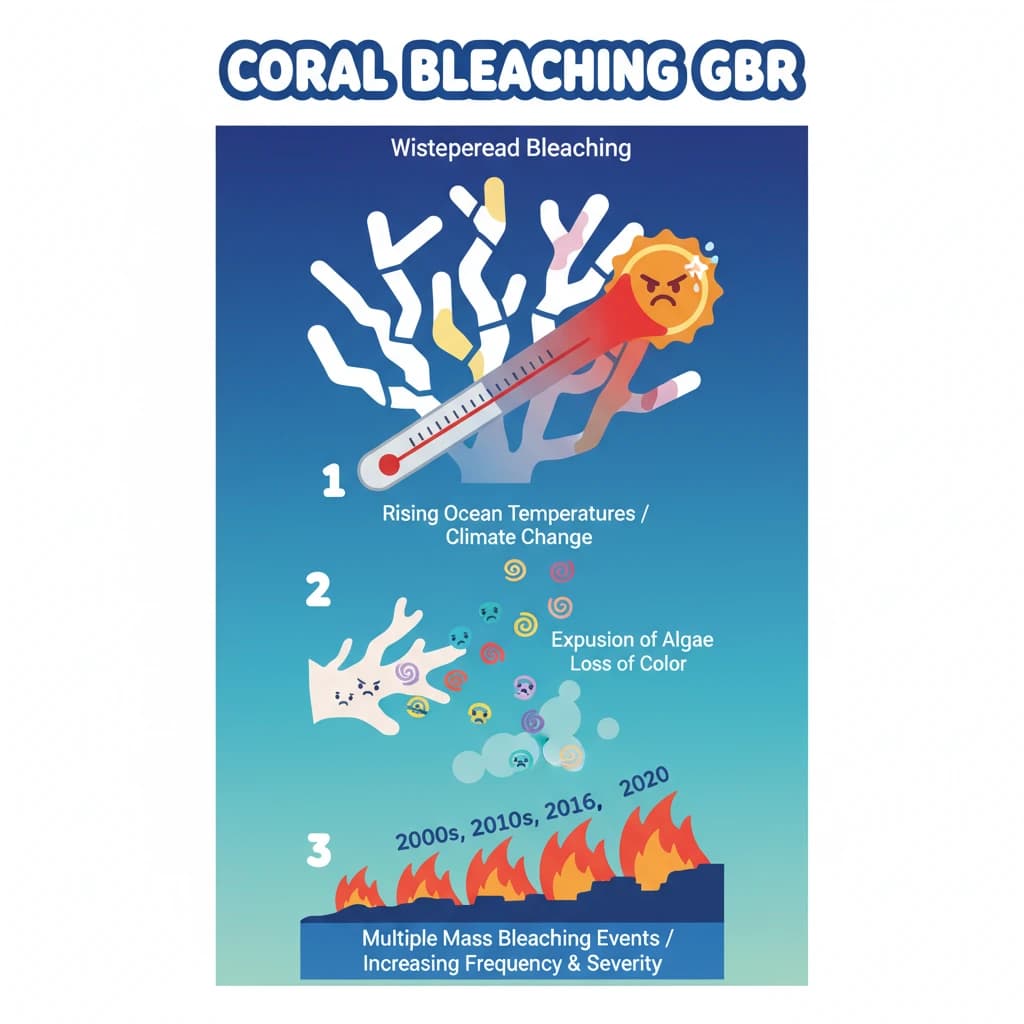
Coral bleaching is a process where corals expel the algae (zooxanthellae) living in their tissues, causing them to turn completely white. These algae provide corals with most of their food through photosynthesis and give them their vibrant colours.
Key Fact: Corals are animals that form large underwater structures called reefs. They have a symbiotic relationship with zooxanthellae, which are single-celled algae.
Causes of Coral Bleaching
The primary cause of coral bleaching is increased ocean temperatures, often linked to global warming. When water temperatures rise above a certain threshold, corals become stressed.
Other stressors include ocean acidification, pollution, increased sedimentation, and extreme low tides. However, sustained high temperatures are the most significant driver of mass bleaching events.
Impact on the Great Barrier Reef
The Great Barrier Reef (GBR), a UNESCO World Heritage site, is the world's largest coral reef system. It stretches over 2,300 kilometres off the coast of Queensland, Australia.
The GBR is a critical habitat for thousands of marine species, supporting immense biodiversity. Repeated bleaching events severely compromise its ecological integrity and ability to recover.
Consequences of Bleaching
While bleached corals are not immediately dead, prolonged bleaching can lead to coral mortality. Dead corals disrupt the entire reef ecosystem, impacting fish populations and other marine life that rely on the reef for shelter and food.
UPSC Insight: Understanding the causes, impacts, and solutions for coral bleaching is crucial for GS-III Environment and Ecology. Be prepared to discuss its link to climate change and its implications for biodiversity and coastal economies.
💡 Key Takeaways
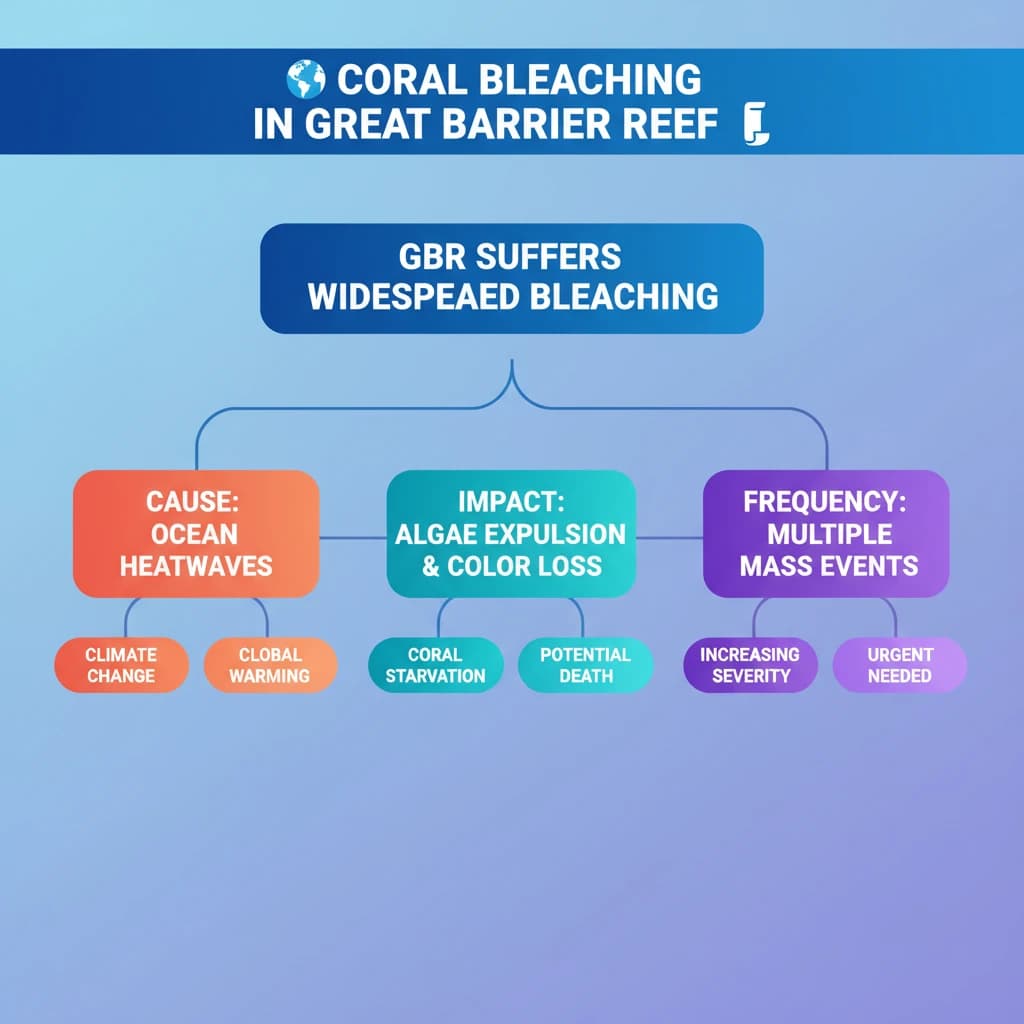
- •Coral bleaching is the expulsion of symbiotic algae (zooxanthellae) by corals due to stress, primarily rising ocean temperatures.
- •The Great Barrier Reef (GBR) has experienced widespread bleaching, with recent surveys confirming impact across two-thirds of the reef.
- •Bleached corals are not dead but are severely weakened and can die if stress persists, leading to reef degradation.
- •Climate change, particularly global warming and ocean acidification, is the primary driver of mass bleaching events globally.
- •Coral reefs are vital biodiversity hotspots, supporting marine life and coastal economies; their degradation has severe ecological and economic consequences.
- •Urgent global and local actions are required to mitigate climate change and enhance reef resilience to prevent further irreversible damage.
🧠 Memory Techniques
95% Verified Content
📚 Reference Sources
•Australian Institute of Marine Science (AIMS)
•Great Barrier Reef Marine Park Authority (GBRMPA)
•National Oceanic and Atmospheric Administration (NOAA) Coral Reef Watch
•United Nations Environment Programme (UNEP)