Loading page, please wait…
Critical Threats Facing the Aravallis - UPSC Environment And Ecology
What is Critical Threats Facing the Aravallis in UPSC Environment And Ecology?
Critical Threats Facing the Aravallis is a key topic under Environment And Ecology for UPSC Civil Services Examination. Key points include: Aravallis are rapidly degrading: 8% vanished, 19% converted to settlements (1975-2019).. Degradation accelerates Thar Desert expansion towards NCR, worsening pollution and erratic weather.. Unchecked urbanization (settlements up from 4.5% to 13.3%) is a primary cause.. Understanding this topic is essential for both UPSC Prelims and Mains preparation.
Why is Critical Threats Facing the Aravallis important for UPSC exam?
Critical Threats Facing the Aravallis is a Medium-level topic in UPSC Environment And Ecology. It is tested in both Prelims (factual MCQs) and Mains (analytical answer writing). Previous year UPSC questions have frequently covered aspects of Critical Threats Facing the Aravallis, making it essential for comprehensive IAS preparation.
How to prepare Critical Threats Facing the Aravallis for UPSC?
To prepare Critical Threats Facing the Aravallis for UPSC: (1) Study the comprehensive notes covering all key concepts on Vaidra. (2) Practice previous year questions on this topic. (3) Connect it with current affairs using daily updates. (4) Revise using key takeaways and mind maps available for Environment And Ecology. (5) Write practice answers linking Critical Threats Facing the Aravallis to related GS Paper topics.
Key takeaways of Critical Threats Facing the Aravallis for UPSC
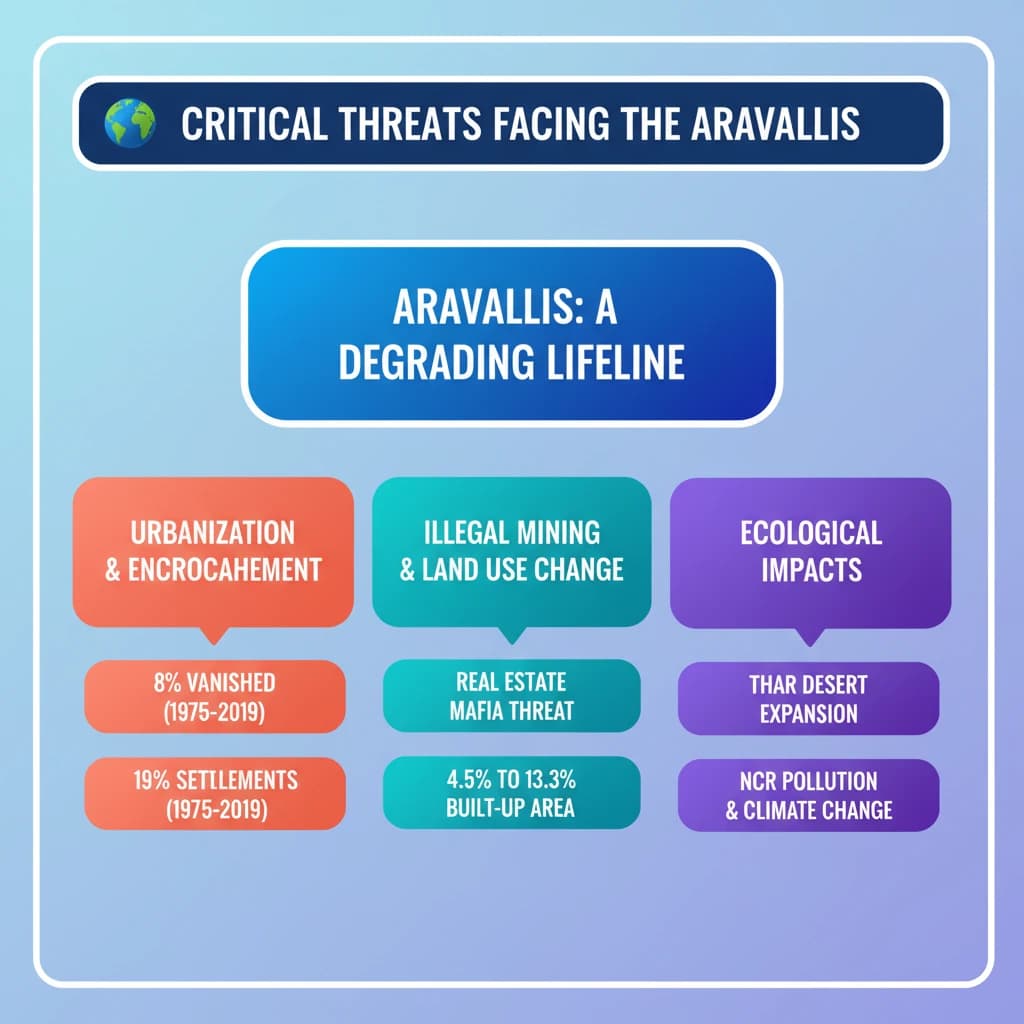
- Aravallis are rapidly degrading: 8% vanished, 19% converted to settlements (1975-2019).
- Degradation accelerates Thar Desert expansion towards NCR, worsening pollution and erratic weather.
- Unchecked urbanization (settlements up from 4.5% to 13.3%) is a primary cause.
- Aravallis are critical for NCR's air quality, water security, and biodiversity.
- Illegal mining and real estate encroachment are major threats to this ancient mountain range.
Critical Threats Facing the Aravallis
Medium⏱️ 8 min read
environment and ecology
📖 Introduction
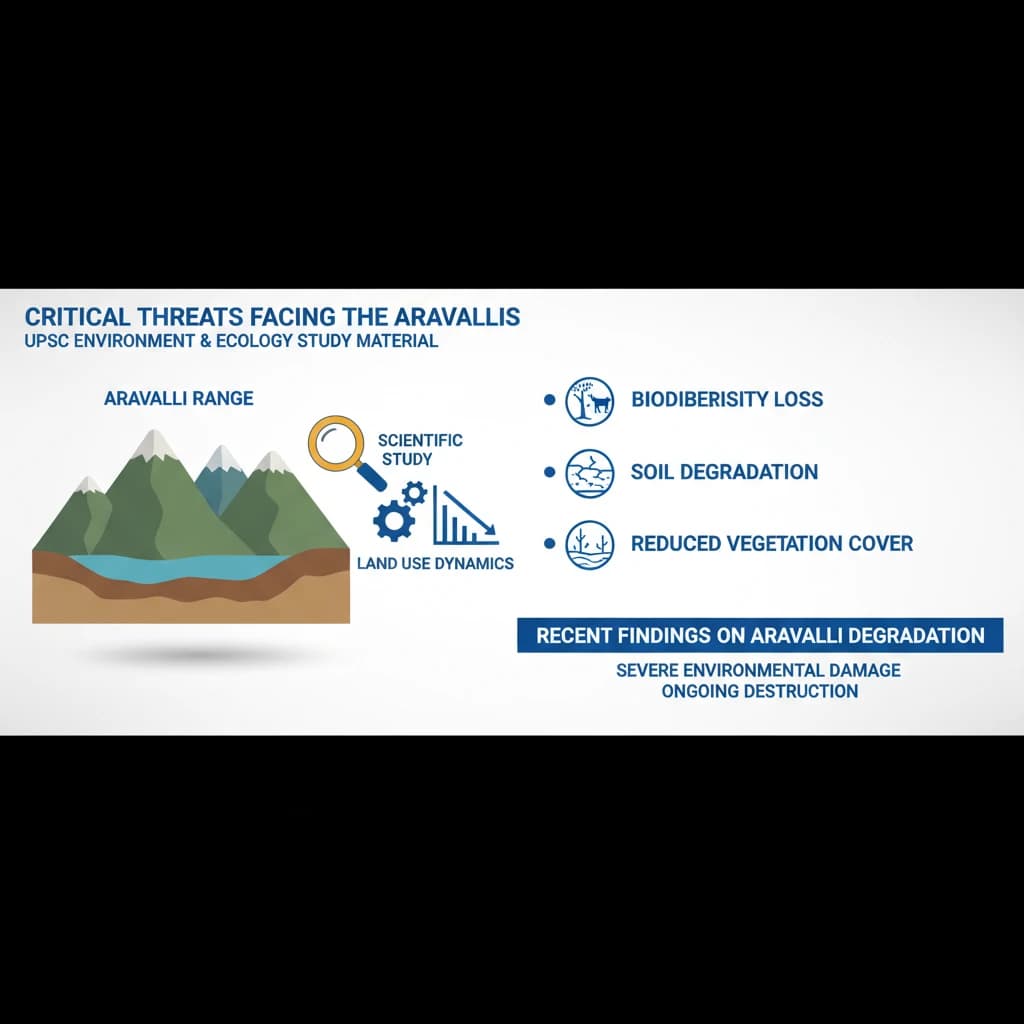
Recent Findings on Aravalli Degradation
A recent scientific study on land use dynamics in the Aravallis has brought to light the severe threats facing this ancient mountain range. The study highlights significant environmental damage.
The ongoing destruction has led to considerable biodiversity loss, widespread soil degradation, and a marked reduction in vegetation cover across the region.
UPSC Prelims/Mains: Understanding such studies is crucial for questions on environmental degradation, biodiversity conservation, and sustainable development in India.
Quantifying the Decline of the Aravallis
The study provides stark figures illustrating the physical disappearance of the Aravalli hills between 1975 and 2019. This period saw substantial changes in the landscape.
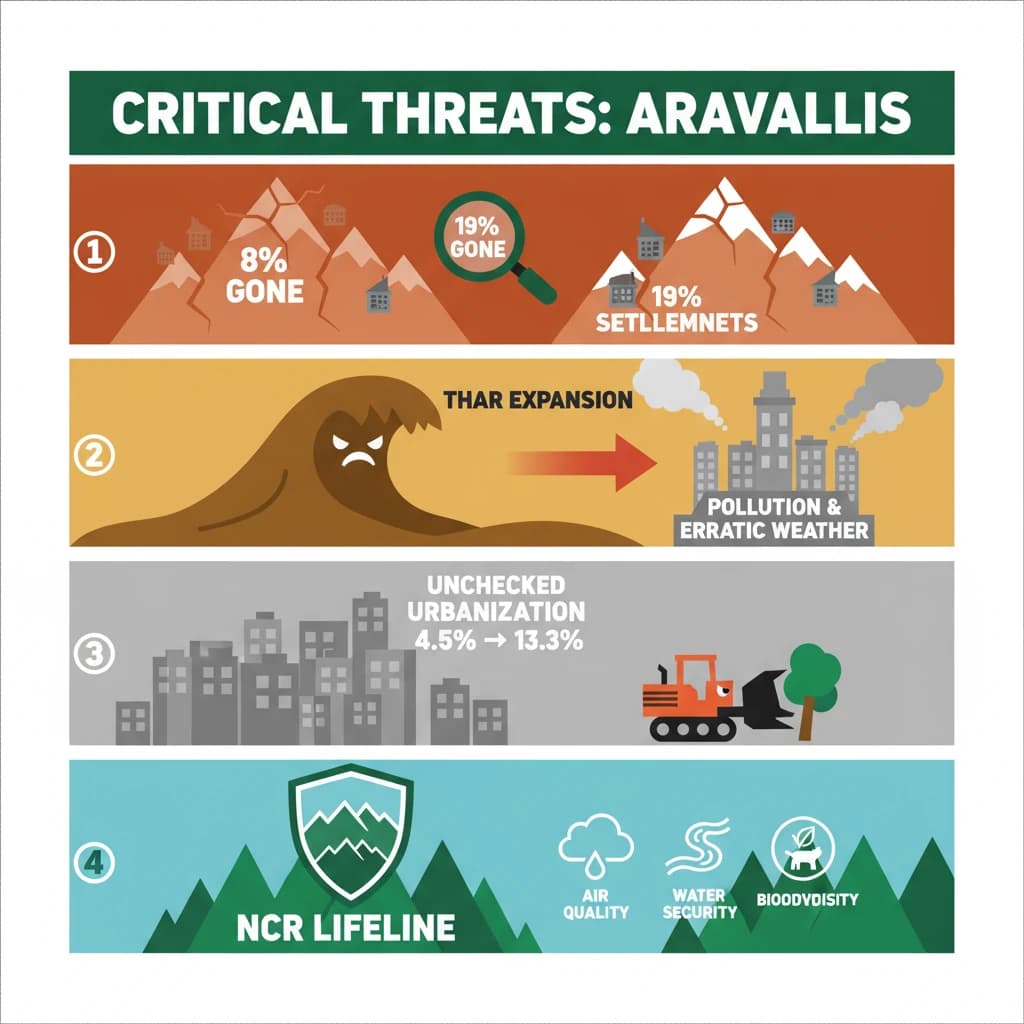
- 8% (approximately 5,772.7 sq km) of the entire Aravalli range has completely vanished.
- Much of this lost area has transformed from rock to barren land.
- An additional 19% of the range has been converted into human settlements.
This rapid transformation underscores the intense anthropogenic pressure on the fragile ecosystem of the Aravallis.
Rising Desertification Risk
The degradation of the Aravallis poses a critical threat, particularly concerning the expansion of the Thar Desert. The mountain range acts as a natural barrier against desertification.
With the weakening of this natural barrier, the Thar Desert is increasingly expanding towards the National Capital Region (NCR). This has severe environmental consequences.
The expansion exacerbates existing problems such as air pollution, accelerates desertification processes, and contributes to more erratic weather patterns in the region.
Primary Cause: Unchecked Urbanization
One of the most significant drivers of Aravalli degradation is the relentless surge in urbanization. The demand for land and resources from growing cities is immense.
- In 1975, settlements accounted for only 4.5% of the Aravalli region.
- By 2019, this figure dramatically increased to 13.3%.
This substantial increase is primarily driven by unchecked urban expansion, leading to encroachment, construction, and resource extraction within the ecologically sensitive Aravalli range.
💡 Key Takeaways
- •Aravallis are rapidly degrading: 8% vanished, 19% converted to settlements (1975-2019).
- •Degradation accelerates Thar Desert expansion towards NCR, worsening pollution and erratic weather.
- •Unchecked urbanization (settlements up from 4.5% to 13.3%) is a primary cause.
- •Aravallis are critical for NCR's air quality, water security, and biodiversity.
- •Illegal mining and real estate encroachment are major threats to this ancient mountain range.
🧠 Memory Techniques
95% Verified Content
📚 Reference Sources
•Scientific studies on Aravalli land use dynamics (general reference)
•Government reports on environmental degradation
•Environmental Protection Agency data
•Academic research papers on desertification