Loading page, please wait…
Vaidra Logo
Vaidra

Top 4 items + smart groups

UPSC GPT
New
Current Affairs
Daily Solutions
Daily Puzzle
Mains Evaluator

Version 2.0.0 • Built with ❤️ for UPSC aspirants

Loading...
Loading...
Loading...
Loading...
Loading...
Loading...
Loading...
Loading...
Loading...
Loading...
Loading...
Loading...
Loading...
What Has the Recent Study Revealed? - UPSC Environment And Ecology
Back
All Subjects

Topics

0 topics • 0 completed

Loading topics...
Loading...
Loading...
Loading...
Loading...
Loading...
Overall Progress0%

What Has the Recent Study Revealed? - UPSC Environment And Ecology

What is What Has the Recent Study Revealed? in UPSC Environment And Ecology?

What Has the Recent Study Revealed? is a key topic under Environment And Ecology for UPSC Civil Services Examination. Key points include: Eocene era (54 MYA) with >1000 ppmv CO2 serves as an analogue for future warming.. High CO2 in Eocene led to decreased equatorial rainfall and increased deciduous forests.. Deep-time hyperthermal events provide insights into Earth's response to extreme warming.. Understanding this topic is essential for both UPSC Prelims and Mains preparation.

Why is What Has the Recent Study Revealed? important for UPSC exam?

What Has the Recent Study Revealed? is a Medium-level topic in UPSC Environment And Ecology. It is tested in both Prelims (factual MCQs) and Mains (analytical answer writing). Previous year UPSC questions have frequently covered aspects of What Has the Recent Study Revealed?, making it essential for comprehensive IAS preparation.

How to prepare What Has the Recent Study Revealed? for UPSC?

To prepare What Has the Recent Study Revealed? for UPSC: (1) Study the comprehensive notes covering all key concepts on Vaidra. (2) Practice previous year questions on this topic. (3) Connect it with current affairs using daily updates. (4) Revise using key takeaways and mind maps available for Environment And Ecology. (5) Write practice answers linking What Has the Recent Study Revealed? to related GS Paper topics.

Key takeaways of What Has the Recent Study Revealed? for UPSC

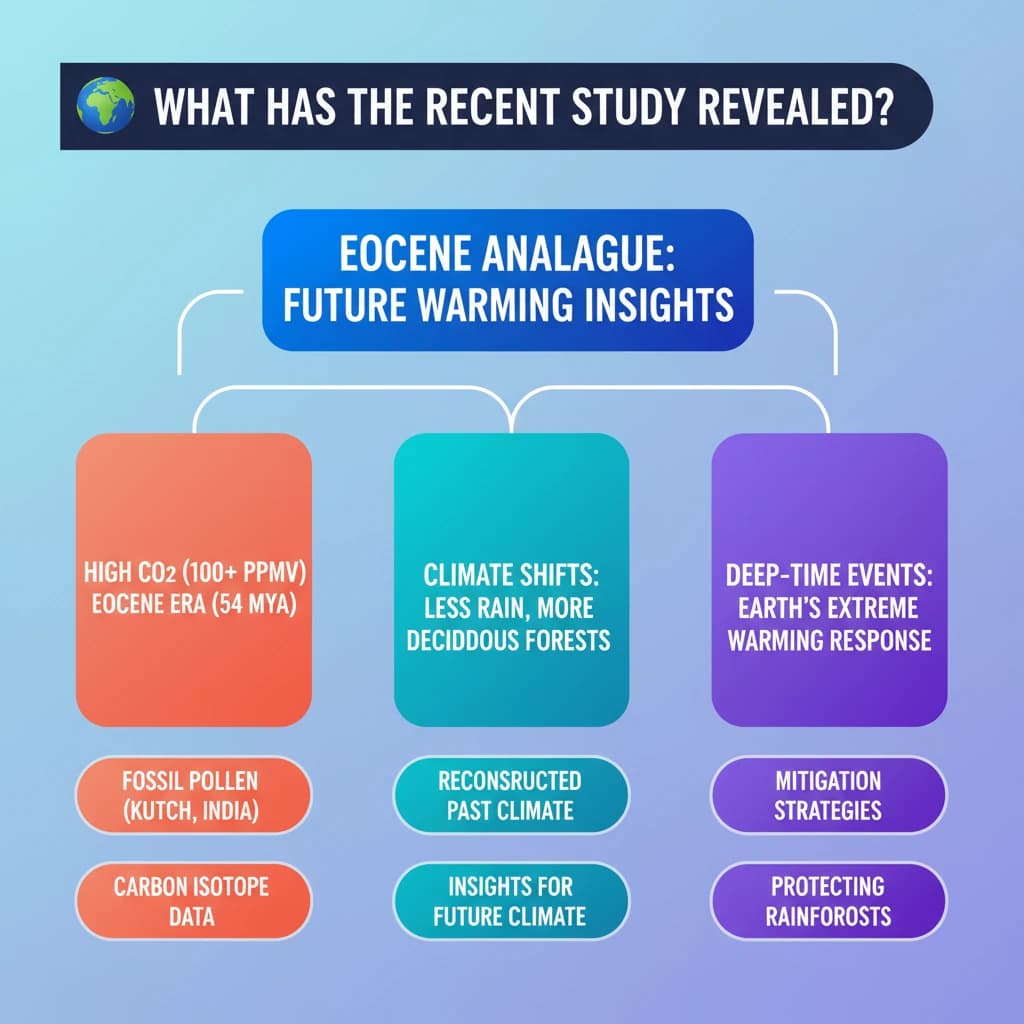
  • Eocene era (54 MYA) with >1000 ppmv CO2 serves as an analogue for future warming.
  • High CO2 in Eocene led to decreased equatorial rainfall and increased deciduous forests.
  • Deep-time hyperthermal events provide insights into Earth's response to extreme warming.
  • Study used fossil pollen from Kutch and carbon isotope data to reconstruct past climate.
  • Findings inform strategies for mitigating climate change impacts on rainforests and sensitive ecosystems.
What Has the Recent Study Revealed?

What Has the Recent Study Revealed?

Medium⏱️ 5 min read✓ 95% Verified
environment and ecology

📖 Introduction

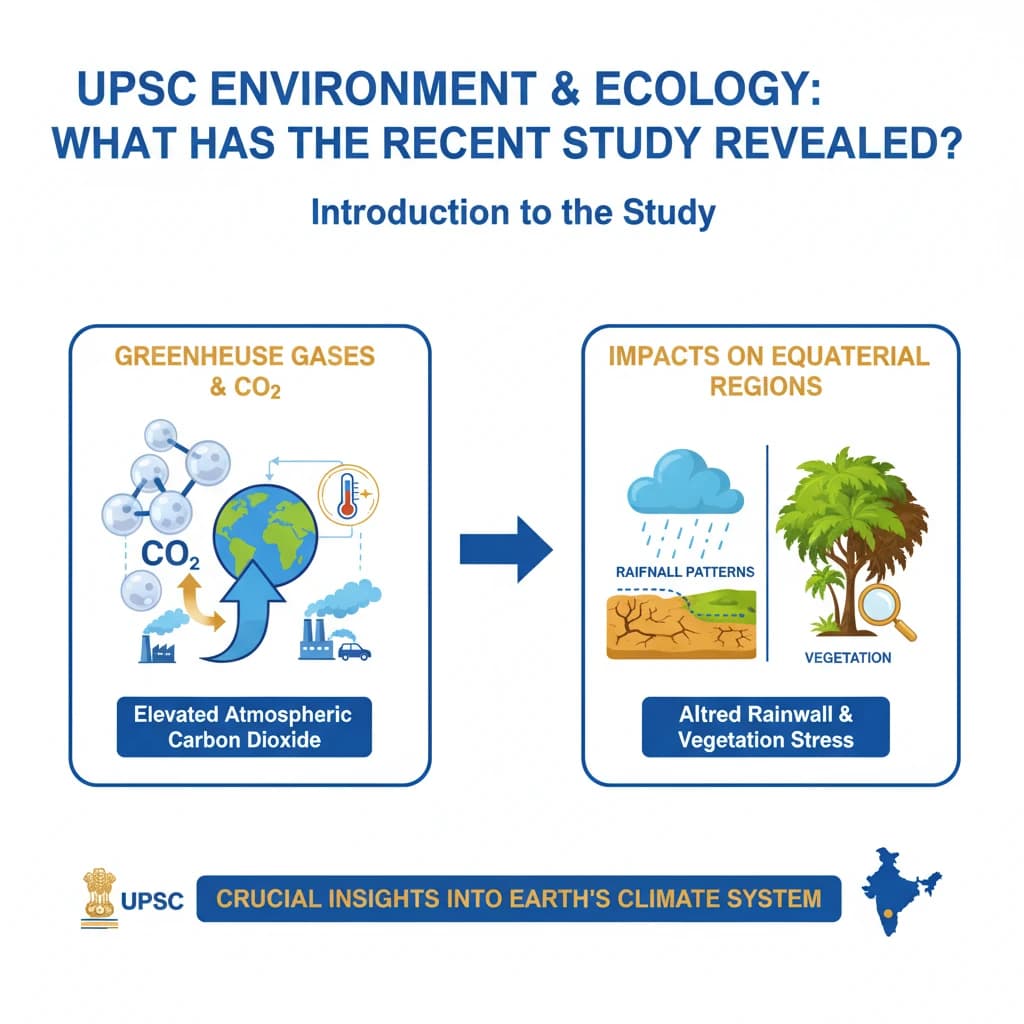
<h4>Introduction to the Study</h4><p>A recent study has shed light on the profound impacts of elevated <strong>greenhouse gases</strong>, particularly high levels of <strong>atmospheric carbon dioxide</strong>, on <strong>rainfall patterns</strong> and <strong>vegetation</strong> in <strong>equatorial regions</strong>.</p><p>This research offers crucial insights into how our planet's climate system responds to significant increases in atmospheric CO2, drawing parallels between past and potential future scenarios.</p><h4>Methodology and Data Sources</h4><p>The study meticulously utilized <strong>fossil pollen</strong> extracted from the <strong>Lignite Mine of Kutch</strong>, India. This paleobotanical data provides direct evidence of past vegetation types.</p><div class='info-box'><p>Additionally, <strong>carbon isotope data</strong> from the <strong>Eocene era</strong> was analyzed. The <strong>Eocene era</strong>, occurring approximately <strong>54 million years ago</strong>, was a geological period characterized by significant <strong>global warming</strong>.</p></div><p>A key aspect of the methodology involved using data from <strong>deep-time hyperthermal events</strong>. These are periods of extreme warmth in Earth's geological history.</p><div class='key-point-box'><p>Such events are considered valuable <strong>potential analogs</strong> for future <strong>climate predictions</strong>, offering a natural laboratory to understand Earth's response to present-day <strong>greenhouse gas emissions</strong>.</p></div><h4>Key Findings from the Eocene Era</h4><p>During the <strong>Eocene era</strong>, when atmospheric <strong>CO2 concentrations</strong> near the equator were exceptionally high, exceeding <strong>1000 parts per million by volume (ppmv)</strong>, a significant climatic shift occurred.</p><p>The study revealed a substantial <strong>decrease in rainfall</strong> across these <strong>equatorial regions</strong>. This reduction in precipitation had a direct and profound impact on the prevalent vegetation.</p><div class='info-box'><p>The decreased rainfall led to a notable <strong>increase in deciduous forests</strong>, replacing what would typically be more moisture-dependent vegetation types.</p></div><h4>Relevance to Present-Day Climate Change</h4><p>The findings of this study are highly relevant to our current understanding of <strong>climate change</strong>. It directly draws parallels between the climatic conditions of the <strong>Eocene era</strong> and potential future scenarios under increased <strong>greenhouse gas emissions</strong>.</p><div class='exam-tip-box'><p>Insights gained from this research are instrumental in formulating effective strategies for <strong>mitigating the impacts of climate change</strong>. Specifically, it can help protect vulnerable ecosystems such as <strong>rainforests</strong> and other <strong>sensitive ecosystems</strong> from adverse climatic shifts.</p></div>
Concept Diagram

💡 Key Takeaways

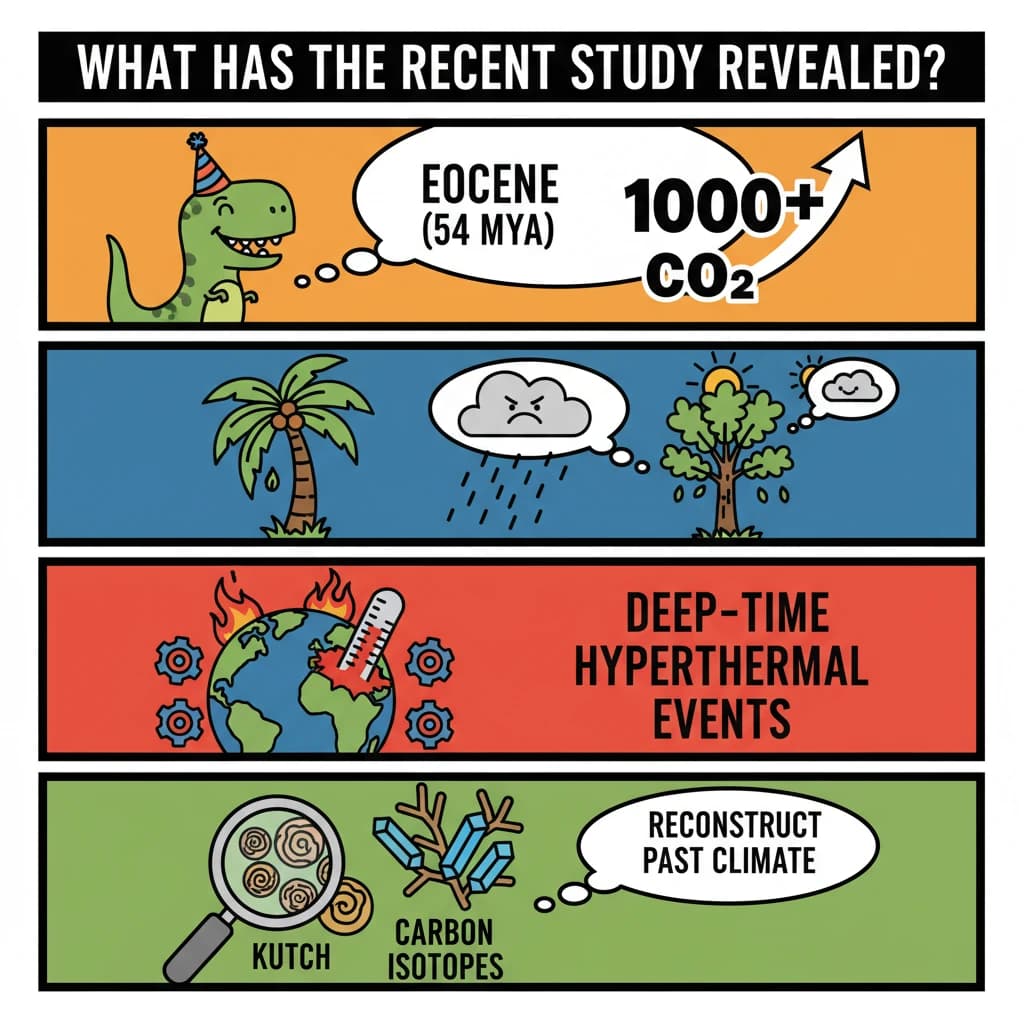
  • •Eocene era (54 MYA) with >1000 ppmv CO2 serves as an analogue for future warming.
  • •High CO2 in Eocene led to decreased equatorial rainfall and increased deciduous forests.
  • •Deep-time hyperthermal events provide insights into Earth's response to extreme warming.
  • •Study used fossil pollen from Kutch and carbon isotope data to reconstruct past climate.
  • •Findings inform strategies for mitigating climate change impacts on rainforests and sensitive ecosystems.

🧠 Memory Techniques
Memory Aid
95% Verified Content

📚 Reference Sources

•Scientific literature on Eocene Climate Optimum and hyperthermal events
•IPCC Assessment Reports (Working Group I: The Physical Science Basis - Paleoclimate chapter)

Related Topics

Loading related topics...
Explore:Environment And Ecology Topics·All Subjects·Daily Current Affairs·Editorial Analysis·Previous Year Questions·UPSC GPT