Loading page, please wait…
Vaidra Logo
Vaidra

Top 4 items + smart groups

UPSC GPT
New
Current Affairs
Daily Solutions
Daily Puzzle
Mains Evaluator

Version 2.0.0 • Built with ❤️ for UPSC aspirants

Loading...
Loading...
Loading...
Loading...
Loading...
Loading...
Loading...
Loading...
Loading...
Loading...
Loading...
Loading...
Loading...
Back
All Subjects

Topics

0 topics • 0 completed

Loading topics...
Loading...
Loading...
Loading...
Loading...
Loading...
Overall Progress0%

Disaster Management - UPSC Environment And Ecology

What is Disaster Management in UPSC Environment And Ecology?

Disaster Management is a key topic under Environment And Ecology for UPSC Civil Services Examination. Key points include: Sendai Framework (2015-2030) is a UN-backed global blueprint for Disaster Risk Reduction (DRR).. It succeeded the Hyogo Framework for Action (2005-2015).. Focuses on preparedness, disaster risk financing, and sustainable development.. Understanding this topic is essential for both UPSC Prelims and Mains preparation.

Why is Disaster Management important for UPSC exam?

Disaster Management is a Medium-level topic in UPSC Environment And Ecology. It is tested in both Prelims (factual MCQs) and Mains (analytical answer writing). Previous year UPSC questions have frequently covered aspects of Disaster Management, making it essential for comprehensive IAS preparation.

How to prepare Disaster Management for UPSC?

To prepare Disaster Management for UPSC: (1) Study the comprehensive notes covering all key concepts on Vaidra. (2) Practice previous year questions on this topic. (3) Connect it with current affairs using daily updates. (4) Revise using key takeaways and mind maps available for Environment And Ecology. (5) Write practice answers linking Disaster Management to related GS Paper topics.

Key takeaways of Disaster Management for UPSC

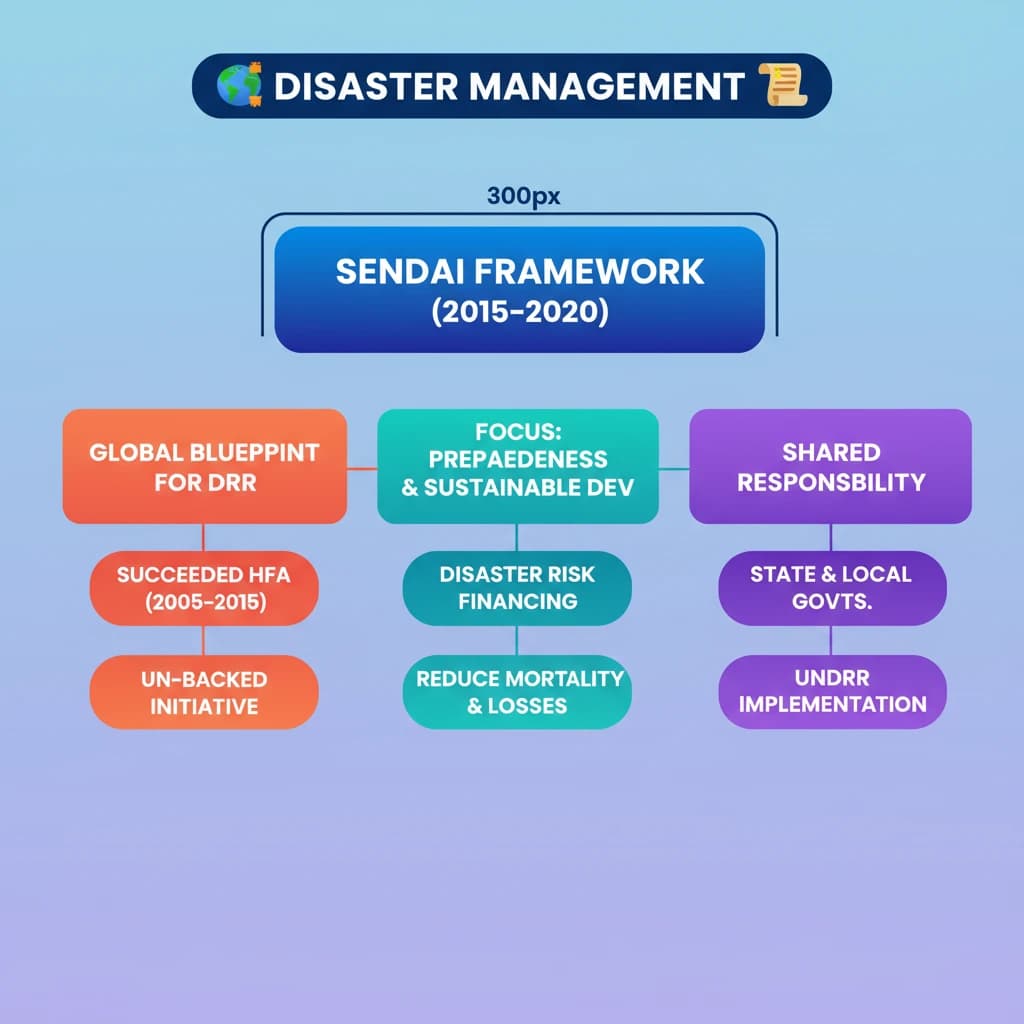
  • Sendai Framework (2015-2030) is a UN-backed global blueprint for Disaster Risk Reduction (DRR).
  • It succeeded the Hyogo Framework for Action (2005-2015).
  • Focuses on preparedness, disaster risk financing, and sustainable development.
  • Recognizes shared responsibility between the State, local governments, and other stakeholders.
  • UNDRR supports its implementation, follow-up, and review.
  • Works hand-in-hand with the Paris Agreement, Addis Ababa Action Agenda, and SDGs.
  • India shows steadfast commitment to Sendai, as seen in G-20 DRR Working Group meetings and national initiatives like NDMP and CDRI.
Disaster Management

Disaster Management

Medium⏱️ 8 min read✓ 95% Verified
environment and ecology

📖 Introduction

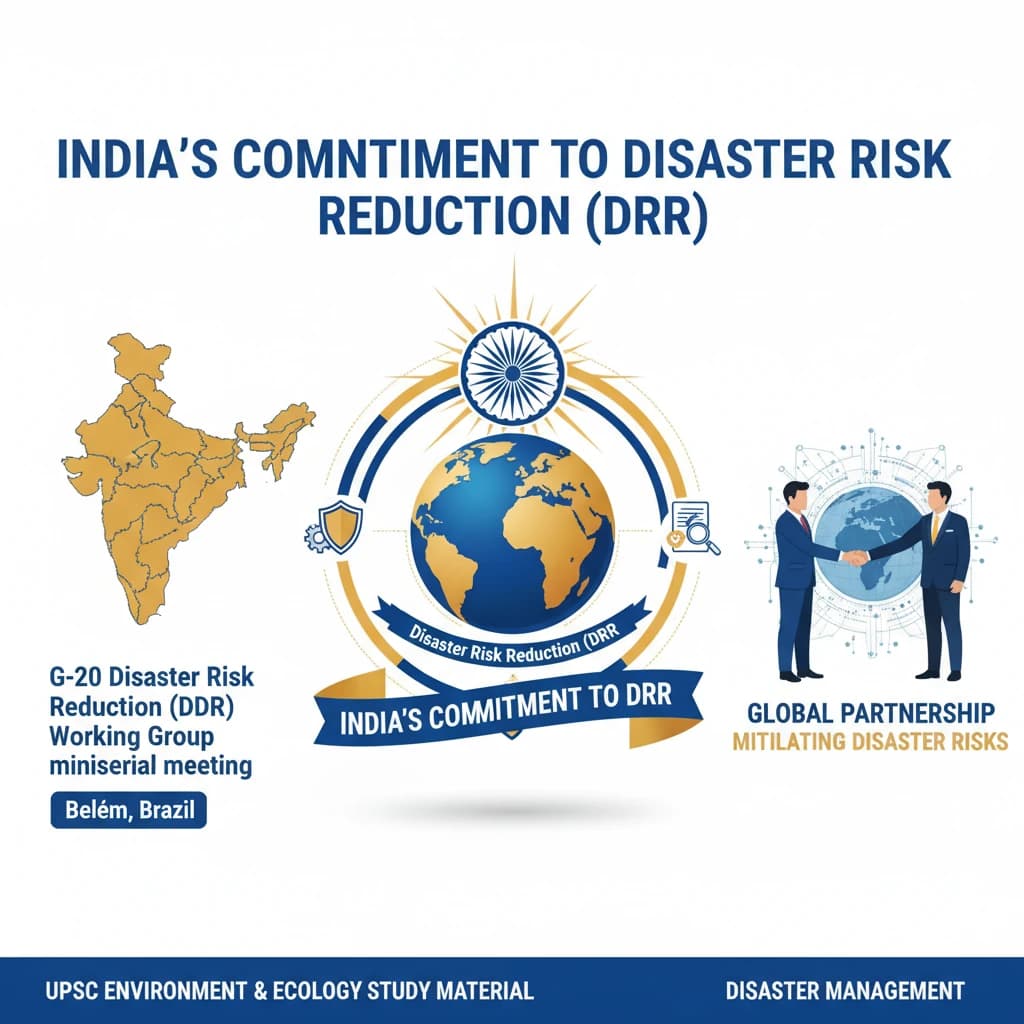
<h4>India's Commitment to Disaster Risk Reduction (DRR)</h4><p><strong>India</strong> has consistently demonstrated a strong commitment to global <strong>Disaster Risk Reduction (DRR)</strong> efforts. This commitment was recently highlighted during the <strong>G-20 Disaster Risk Reduction (DRR) Working Group ministerial meeting</strong>.</p><p>The meeting took place in <strong>Belem, Brazil</strong>, emphasizing India's dedication to international frameworks aimed at mitigating disaster risks and losses.</p><div class='info-box'><p>The <strong>G-20 Disaster Risk Reduction (DRR) Working Group</strong> was established by <strong>G20 countries</strong>. Its primary goal is to integrate risk reduction measures into both public and private sector investment decisions and policy-making.</p><p>This integration aims to reduce existing risks, prevent the creation of new risks, and ultimately build more <strong>resilient economies, societies, and natural systems</strong>.</p></div><h4>Understanding the Sendai Framework (2015-2030)</h4><p>The <strong>Sendai Framework for Disaster Risk Reduction (2015-2030)</strong> is a landmark <strong>UN-backed framework</strong>. It provides Member States with concrete actions to protect development gains from the risk of disaster.</p><div class='key-point-box'><p>The framework focuses on reducing disaster risks through key measures such as <strong>better preparedness</strong>, robust <strong>disaster risk financing</strong>, and fostering <strong>sustainable development practices</strong>.</p></div><h4>Adoption and Predecessor</h4><p>This crucial framework was adopted in <strong>2015</strong> at the <strong>Third United Nations World Conference on Disaster Risk Reduction</strong>. The conference was held in <strong>Sendai, Miyagi, Japan</strong>.</p><p>The <strong>Sendai Framework</strong> serves as the successor instrument to the earlier <strong>Hyogo Framework for Action (HFA) 2005-2015</strong>. The HFA was titled: "Building the Resilience of Nations and Communities to Disasters."</p><h4>Shared Responsibility in DRR</h4><p>A fundamental principle of the <strong>Sendai Framework</strong> is the recognition of the <strong>State's primary role</strong> in reducing disaster risk. However, it also strongly emphasizes that this responsibility must be shared.</p><p>This shared responsibility extends to various other stakeholders, including <strong>local governments, the private sector, and other community-level actors</strong>, ensuring a holistic approach to DRR.</p><h4>Implementing Organization</h4><p>The <strong>United Nations Office for Disaster Risk Reduction (UNDRR)</strong> is the designated organization tasked with supporting the implementation of the <strong>Sendai Framework</strong>. It also oversees its follow-up and review processes.</p><h4>Synergy with 2030 Agenda Agreements</h4><p>The <strong>Sendai Framework</strong> is designed to work in close conjunction with other critical agreements under the <strong>2030 Agenda for Sustainable Development</strong>. These agreements collectively aim for a more sustainable and resilient future.</p><div class='exam-tip-box'><p>The <strong>Sendai Framework</strong> is interconnected with the <strong>Paris Agreement (2015)</strong> on climate change, the <strong>Addis Ababa Action Agenda on Financing for Development (2015)</strong>, and the <strong>New Urban Agenda</strong>. Ultimately, it contributes directly to achieving the <strong>Sustainable Development Goals (SDGs)</strong>.</p></div>
Concept Diagram

💡 Key Takeaways

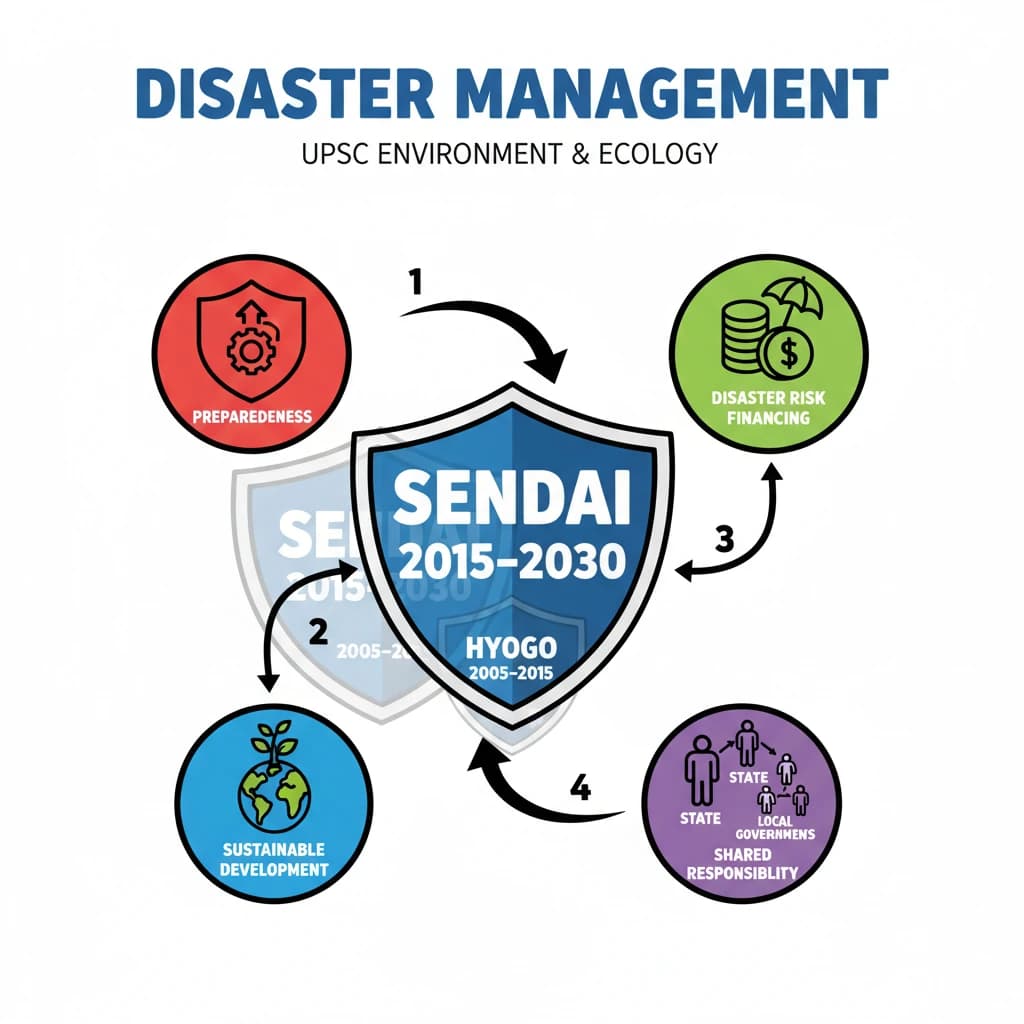
  • •Sendai Framework (2015-2030) is a UN-backed global blueprint for Disaster Risk Reduction (DRR).
  • •It succeeded the Hyogo Framework for Action (2005-2015).
  • •Focuses on preparedness, disaster risk financing, and sustainable development.
  • •Recognizes shared responsibility between the State, local governments, and other stakeholders.
  • •UNDRR supports its implementation, follow-up, and review.
  • •Works hand-in-hand with the Paris Agreement, Addis Ababa Action Agenda, and SDGs.
  • •India shows steadfast commitment to Sendai, as seen in G-20 DRR Working Group meetings and national initiatives like NDMP and CDRI.

🧠 Memory Techniques
Memory Aid
95% Verified Content

Related Topics

Loading related topics...
Explore:Environment And Ecology Topics·All Subjects·Daily Current Affairs·Editorial Analysis·Previous Year Questions·UPSC GPT
Disaster Management - UPSC Environment And Ecology