Loading page, please wait…
Vaidra Logo
Vaidra

Top 4 items + smart groups

UPSC GPT
New
Current Affairs
Daily Solutions
Daily Puzzle
Mains Evaluator

Version 2.0.0 • Built with ❤️ for UPSC aspirants

Loading...
Loading...
Loading...
Loading...
Loading...
Loading...
Loading...
Loading...
Loading...
Loading...
Loading...
Loading...
Loading...
Back
All Subjects

Topics

0 topics • 0 completed

Loading topics...
Loading...
Loading...
Loading...
Loading...
Loading...
Overall Progress0%

Brazilian Velvet Ant - UPSC Environment And Ecology

What is Brazilian Velvet Ant in UPSC Environment And Ecology?

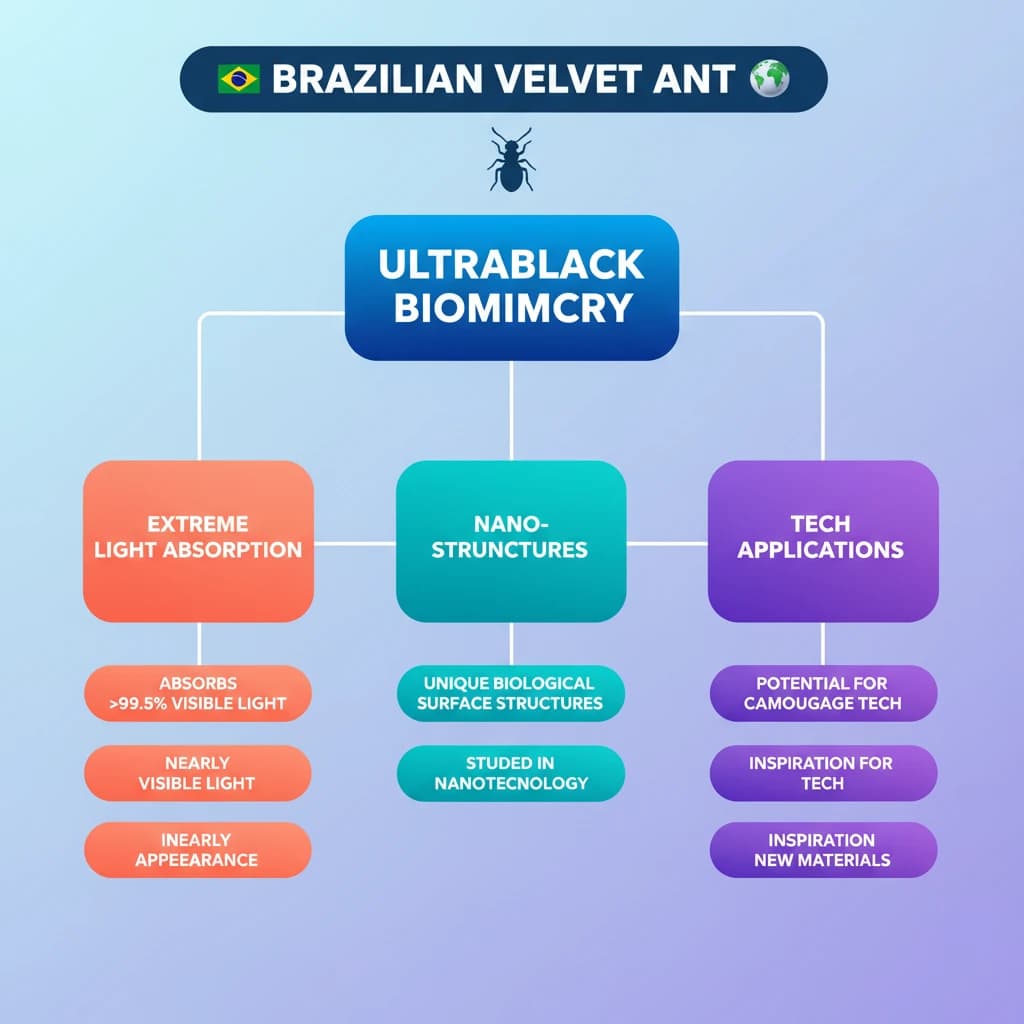
Brazilian Velvet Ant is a key topic under Environment And Ecology for UPSC Civil Services Examination. Key points include: Brazilian velvet ant (Traumatotilla bifulca) has "ultrablack" body parts.. These parts absorb over 99.5% of visible light, making them nearly invisible.. The ultrablackness is due to unique biological nanostructures.. Understanding this topic is essential for both UPSC Prelims and Mains preparation.

Why is Brazilian Velvet Ant important for UPSC exam?

Brazilian Velvet Ant is a Medium-level topic in UPSC Environment And Ecology. It is tested in both Prelims (factual MCQs) and Mains (analytical answer writing). Previous year UPSC questions have frequently covered aspects of Brazilian Velvet Ant, making it essential for comprehensive IAS preparation.

How to prepare Brazilian Velvet Ant for UPSC?

To prepare Brazilian Velvet Ant for UPSC: (1) Study the comprehensive notes covering all key concepts on Vaidra. (2) Practice previous year questions on this topic. (3) Connect it with current affairs using daily updates. (4) Revise using key takeaways and mind maps available for Environment And Ecology. (5) Write practice answers linking Brazilian Velvet Ant to related GS Paper topics.

Key takeaways of Brazilian Velvet Ant for UPSC

  • Brazilian velvet ant (Traumatotilla bifulca) has "ultrablack" body parts.
  • These parts absorb over 99.5% of visible light, making them nearly invisible.
  • The ultrablackness is due to unique biological nanostructures.
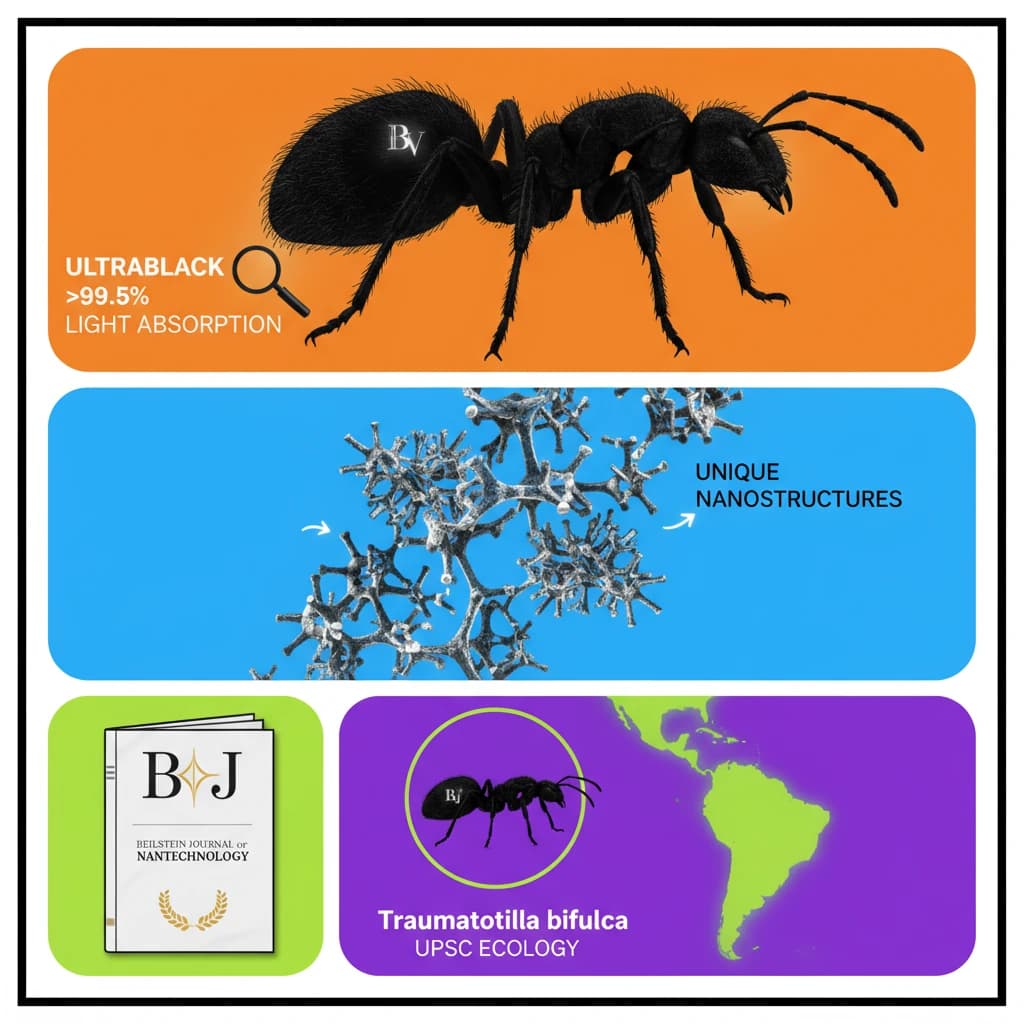
  • Discovery published in Beilstein Journal of Nanotechnology.
  • Holds significant potential for technological applications, especially in biomimicry.
  • Examples include advanced camouflage, optical instruments, and solar energy.
Brazilian Velvet Ant

Brazilian Velvet Ant

Medium⏱️ 5 min read✓ 95% Verified
environment and ecology

📖 Introduction

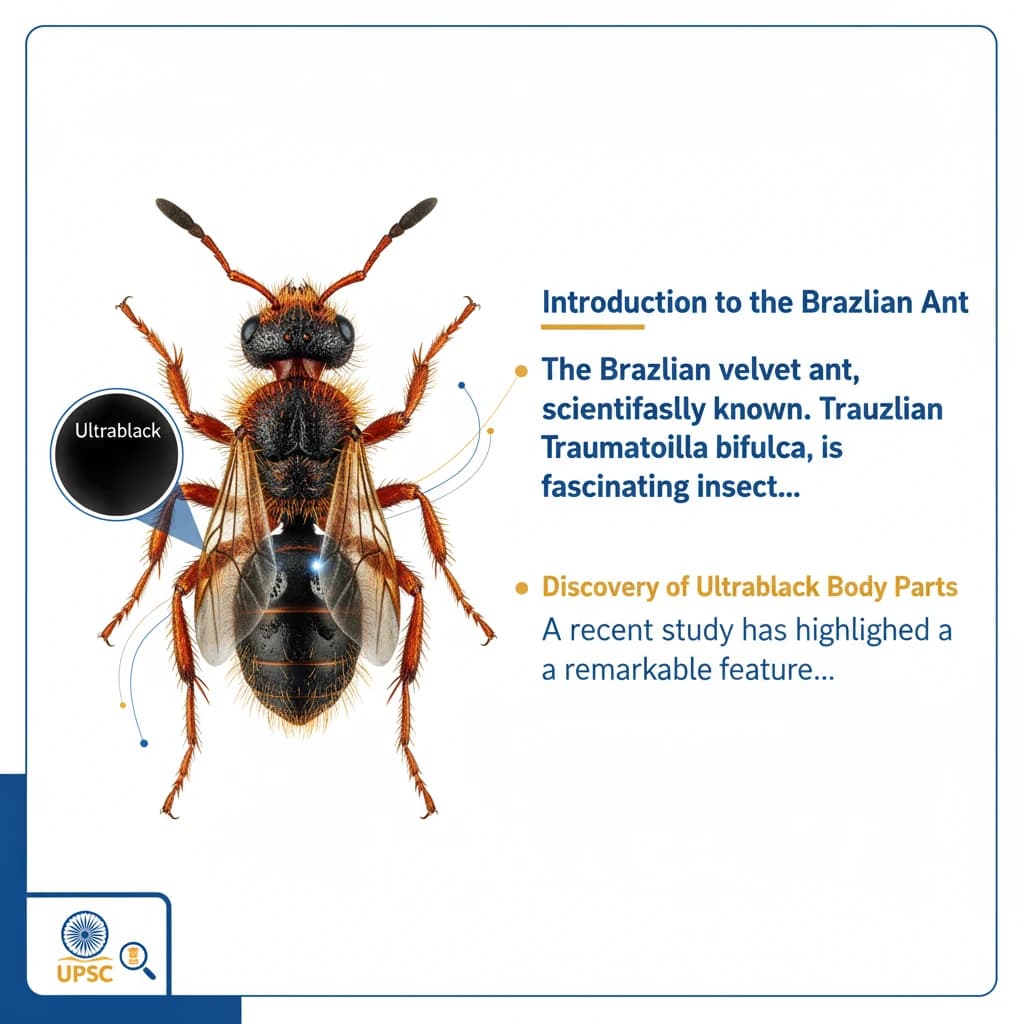
<h4>Introduction to the Brazilian Velvet Ant</h4><p>The <strong>Brazilian velvet ant</strong>, scientifically known as <strong>Traumatotilla bifulca</strong>, is a fascinating insect that has recently garnered scientific attention. It is a species of wingless wasp, often mistaken for an ant due to its appearance.</p><p>A recent study has highlighted a remarkable feature of this creature, revealing unique adaptations related to light absorption.</p><h4>Discovery of Ultrablack Body Parts</h4><p>A significant study published in the <strong>Beilstein Journal of Nanotechnology</strong> brought the <strong>Brazilian velvet ant</strong> into the limelight. The research focused on specific body parts of this insect.</p><div class='info-box'><p>The study revealed that certain body parts of the <strong>Brazilian velvet ant</strong> possess <strong>"ultrablack"</strong> properties. These parts are capable of absorbing <strong>over 99.5% of visible light</strong>.</p></div><p>This exceptional light absorption makes these parts appear almost entirely without reflection, rendering them nearly <strong>invisible</strong> to the naked eye under certain conditions.</p><h4>Biological Nanostructures and Technological Potential</h4><p>The secret behind the <strong>Brazilian velvet ant's</strong> ultrablackness lies in its <strong>unique biological nanostructures</strong>. These microscopic structures on the surface of its exoskeleton are precisely arranged to trap light.</p><div class='key-point-box'><p>The discovery of these natural <strong>nanostructures</strong> and their light-absorbing capabilities is not merely a biological curiosity. It holds significant <strong>potential applications in technology</strong>, particularly in fields like material science and optics.</p></div><div class='exam-tip-box'><p>For <strong>UPSC Prelims</strong>, remember the species name <strong>Traumatotilla bifulca</strong> and the journal <strong>Beilstein Journal of Nanotechnology</strong>. The concept of <strong>"ultrablack"</strong> and its percentage absorption (<strong>&gt;99.5%</strong>) are also crucial. For <strong>Mains (GS-III)</strong>, focus on the implications for <strong>biomimicry</strong> and <strong>nanotechnology</strong>.</p></div>
Concept Diagram

💡 Key Takeaways

  • •Brazilian velvet ant (Traumatotilla bifulca) has "ultrablack" body parts.
  • •These parts absorb over 99.5% of visible light, making them nearly invisible.
  • •The ultrablackness is due to unique biological nanostructures.
  • •Discovery published in Beilstein Journal of Nanotechnology.
  • •Holds significant potential for technological applications, especially in biomimicry.
  • •Examples include advanced camouflage, optical instruments, and solar energy.

🧠 Memory Techniques
Memory Aid
95% Verified Content

📚 Reference Sources

•Beilstein Journal of Nanotechnology (implied source of the study)
•General scientific literature on ultrablack materials and biomimicry

Related Topics

Loading related topics...
Explore:Environment And Ecology Topics·All Subjects·Daily Current Affairs·Editorial Analysis·Previous Year Questions·UPSC GPT
Brazilian Velvet Ant - UPSC Environment And Ecology