Loading page, please wait…
Vaidra Logo
Vaidra

Top 4 items + smart groups

UPSC GPT
New
Current Affairs
Daily Solutions
Daily Puzzle
Mains Evaluator

Version 2.0.0 • Built with ❤️ for UPSC aspirants

Loading...
Loading...
Loading...
Loading...
Loading...
Loading...
Loading...
Loading...
Loading...
Loading...
Loading...
Loading...
Loading...

Registration of Exotic Animals - UPSC Environment And Ecology

What is Registration of Exotic Animals in UPSC Environment And Ecology?

Registration of Exotic Animals is a key topic under Environment And Ecology for UPSC Civil Services Examination. Key points include: MoEFCC mandates electronic registration of exotic animals under WLPA Schedule IV.. Registration is done via the PARIVESH 2.0 portal to the Chief Wildlife Warden.. Aims to combat illegal wildlife trade and manage potential invasive species.. Understanding this topic is essential for both UPSC Prelims and Mains preparation.

Why is Registration of Exotic Animals important for UPSC exam?

Registration of Exotic Animals is a Medium-level topic in UPSC Environment And Ecology. It is tested in both Prelims (factual MCQs) and Mains (analytical answer writing). Previous year UPSC questions have frequently covered aspects of Registration of Exotic Animals, making it essential for comprehensive IAS preparation.

How to prepare Registration of Exotic Animals for UPSC?

To prepare Registration of Exotic Animals for UPSC: (1) Study the comprehensive notes covering all key concepts on Vaidra. (2) Practice previous year questions on this topic. (3) Connect it with current affairs using daily updates. (4) Revise using key takeaways and mind maps available for Environment And Ecology. (5) Write practice answers linking Registration of Exotic Animals to related GS Paper topics.

Key takeaways of Registration of Exotic Animals for UPSC

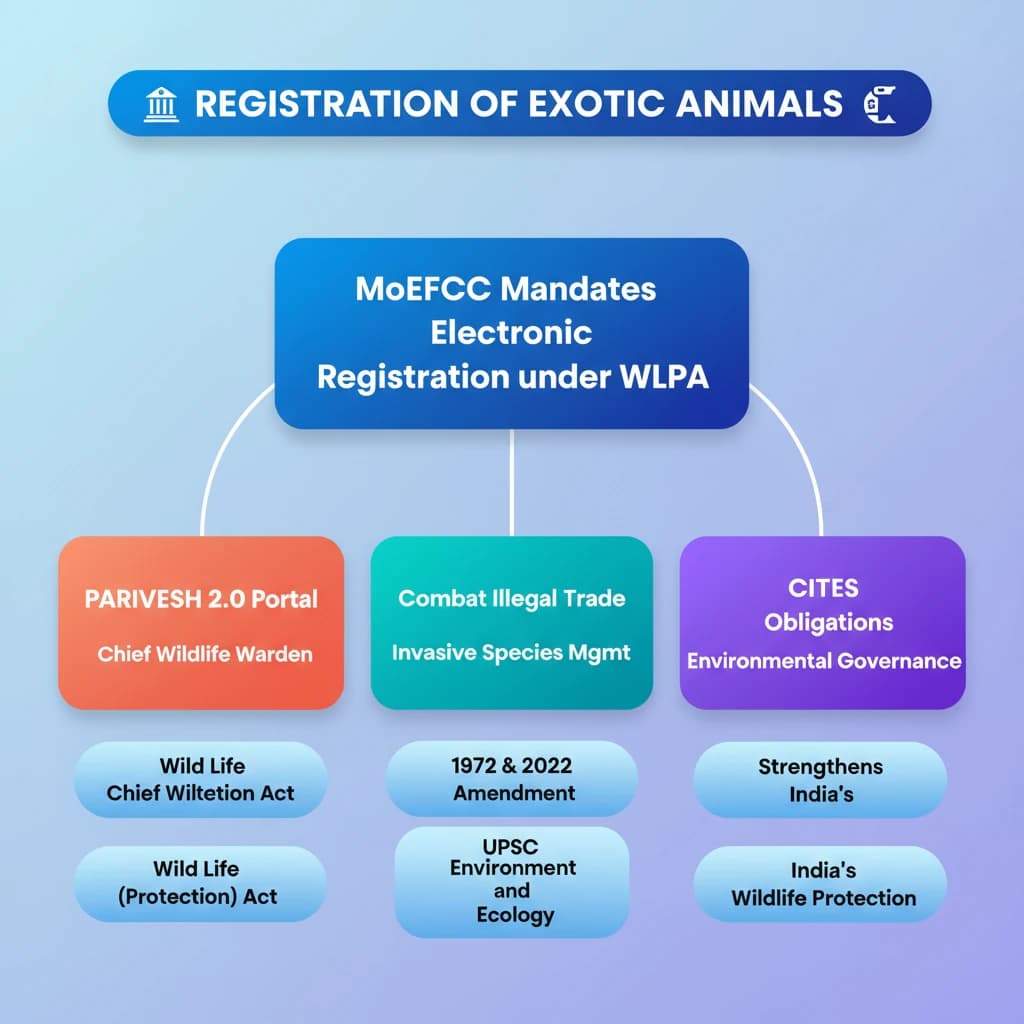
  • MoEFCC mandates electronic registration of exotic animals under WLPA Schedule IV.
  • Registration is done via the PARIVESH 2.0 portal to the Chief Wildlife Warden.
  • Aims to combat illegal wildlife trade and manage potential invasive species.
  • Strengthens India's environmental governance and aligns with CITES obligations.
  • Based on the Wild Life (Protection) Act, 1972, and its 2022 Amendment Act.

Registration of Exotic Animals

Registration of Exotic Animals

Medium⏱️ 5 min read✓ 95% Verified
environment and ecology

📖 Introduction

<h4>Introduction to Exotic Animal Registration</h4><p>The <strong>Ministry of Environment, Forest and Climate Change (MoEFCC)</strong> recently issued a significant directive concerning the registration of <strong>exotic animals</strong>.</p><p>This initiative aims to enhance oversight and management of non-native species within the country.</p><h4>Directive for Registration</h4><div class='key-point-box'><p>The <strong>MoEFCC</strong> has mandated that individuals, organizations, and zoos must register any <strong>exotic animals</strong> they possess.</p><p>This registration is a crucial step towards better regulation and tracking.</p></div><h4>Scope of Animals Covered</h4><p>The directive specifically applies to <strong>exotic animals</strong> that are listed under <strong>Schedule IV</strong> of the <strong>Wild Life (Protection) Act, 1972</strong>.</p><p>This includes species as updated by the <strong>Amendment Act, 2022</strong>, reflecting contemporary conservation needs.</p><div class='info-box'><p><strong>Schedule IV</strong> of the <strong>WLPA</strong> typically encompasses species that require protection but are not classified as highly endangered, often necessitating permits for their possession or trade.</p></div><h4>Registration Procedure</h4><p>The entire registration process is conducted <strong>electronically</strong>, utilizing the dedicated <strong>PARIVESH 2.0 portal</strong>.</p><p>Once completed, the registration details must be submitted to the <strong>Chief Wildlife Warden</strong> of the respective State where the animals are kept.</p><div class='exam-tip-box'><p>This directive is highly relevant for <strong>UPSC GS Paper III</strong>, particularly for topics on <strong>environmental governance</strong>, <strong>biodiversity conservation</strong>, and <strong>wildlife protection laws</strong>.</p></div>
Concept Diagram

💡 Key Takeaways

  • •MoEFCC mandates electronic registration of exotic animals under WLPA Schedule IV.
  • •Registration is done via the PARIVESH 2.0 portal to the Chief Wildlife Warden.
  • •Aims to combat illegal wildlife trade and manage potential invasive species.
  • •Strengthens India's environmental governance and aligns with CITES obligations.
  • •Based on the Wild Life (Protection) Act, 1972, and its 2022 Amendment Act.

🧠 Memory Techniques

Memory Aid
95% Verified Content

📚 Reference Sources

•Ministry of Environment, Forest and Climate Change (MoEFCC) official notifications/press releases
•The Wild Life (Protection) Act, 1972 (as amended up to 2022)

Related Topics

Loading related topics...
Explore:Environment And Ecology Topics·All Subjects·Daily Current Affairs·Editorial Analysis·Previous Year Questions·UPSC GPT
Back
All Subjects

Topics

0 topics • 0 completed

Loading topics...
Loading...
Loading...
Loading...
Loading...
Loading...
Overall Progress0%
Registration of Exotic Animals - UPSC Environment And Ecology