Loading page, please wait…
Vaidra Logo
Vaidra

Top 4 items + smart groups

UPSC GPT
New
Current Affairs
Daily Solutions
Daily Puzzle
Mains Evaluator

Version 2.0.0 • Built with ❤️ for UPSC aspirants

Loading...
Loading...
Loading...
Loading...
Loading...
Loading...
Loading...
Loading...
Loading...
Loading...
Loading...
Loading...
Loading...

What are Big Cats? - UPSC Environment And Ecology

What is What are Big Cats? in UPSC Environment And Ecology?

What are Big Cats? is a key topic under Environment And Ecology for UPSC Civil Services Examination. Key points include: Big cats are large wild felines, mostly from the Panthera genus, serving as keystone species.. Seven key species are targeted for conservation: Tiger, Lion, Leopard, Snow Leopard, Cheetah, Jaguar, Puma.. Five of these seven big cat species are found in India (excluding Puma and Jaguar).. Understanding this topic is essential for both UPSC Prelims and Mains preparation.

Why is What are Big Cats? important for UPSC exam?

What are Big Cats? is a Medium-level topic in UPSC Environment And Ecology. It is tested in both Prelims (factual MCQs) and Mains (analytical answer writing). Previous year UPSC questions have frequently covered aspects of What are Big Cats?, making it essential for comprehensive IAS preparation.

How to prepare What are Big Cats? for UPSC?

To prepare What are Big Cats? for UPSC: (1) Study the comprehensive notes covering all key concepts on Vaidra. (2) Practice previous year questions on this topic. (3) Connect it with current affairs using daily updates. (4) Revise using key takeaways and mind maps available for Environment And Ecology. (5) Write practice answers linking What are Big Cats? to related GS Paper topics.

Key takeaways of What are Big Cats? for UPSC

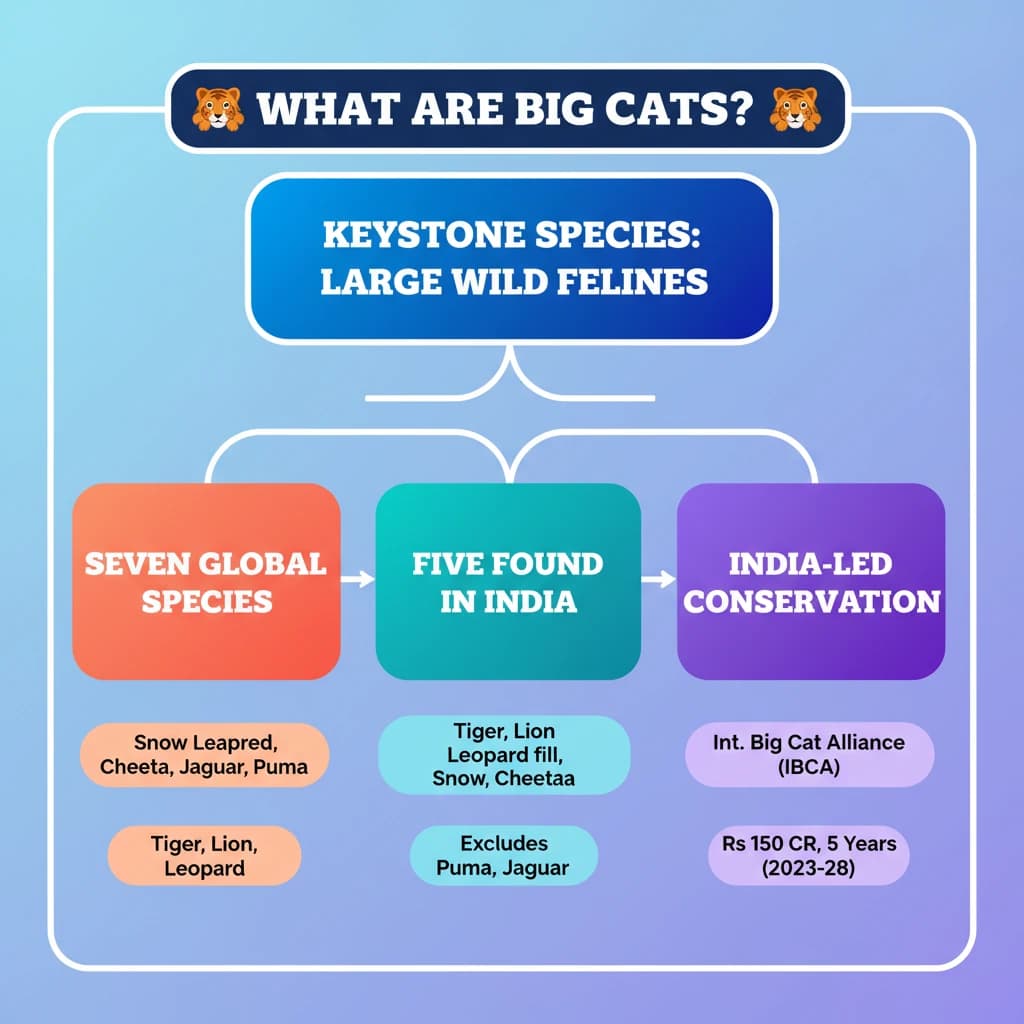
  • Big cats are large wild felines, mostly from the Panthera genus, serving as keystone species.
  • Seven key species are targeted for conservation: Tiger, Lion, Leopard, Snow Leopard, Cheetah, Jaguar, Puma.
  • Five of these seven big cat species are found in India (excluding Puma and Jaguar).
  • The International Big Cat Alliance (IBCA) is an India-led initiative for global big cat conservation.
  • IBCA, modeled after ISA, has a budget of Rs 150 crore for 5 years (2023-28) and aims to align conservation with SDGs.
  • Lions are the only social big cats; Siberian tiger is the largest and endangered.
  • Major threats include poaching, illegal trade, and habitat loss.
What are Big Cats?

What are Big Cats?

Medium⏱️ 7 min read✓ 98% Verified
environment and ecology

📖 Introduction

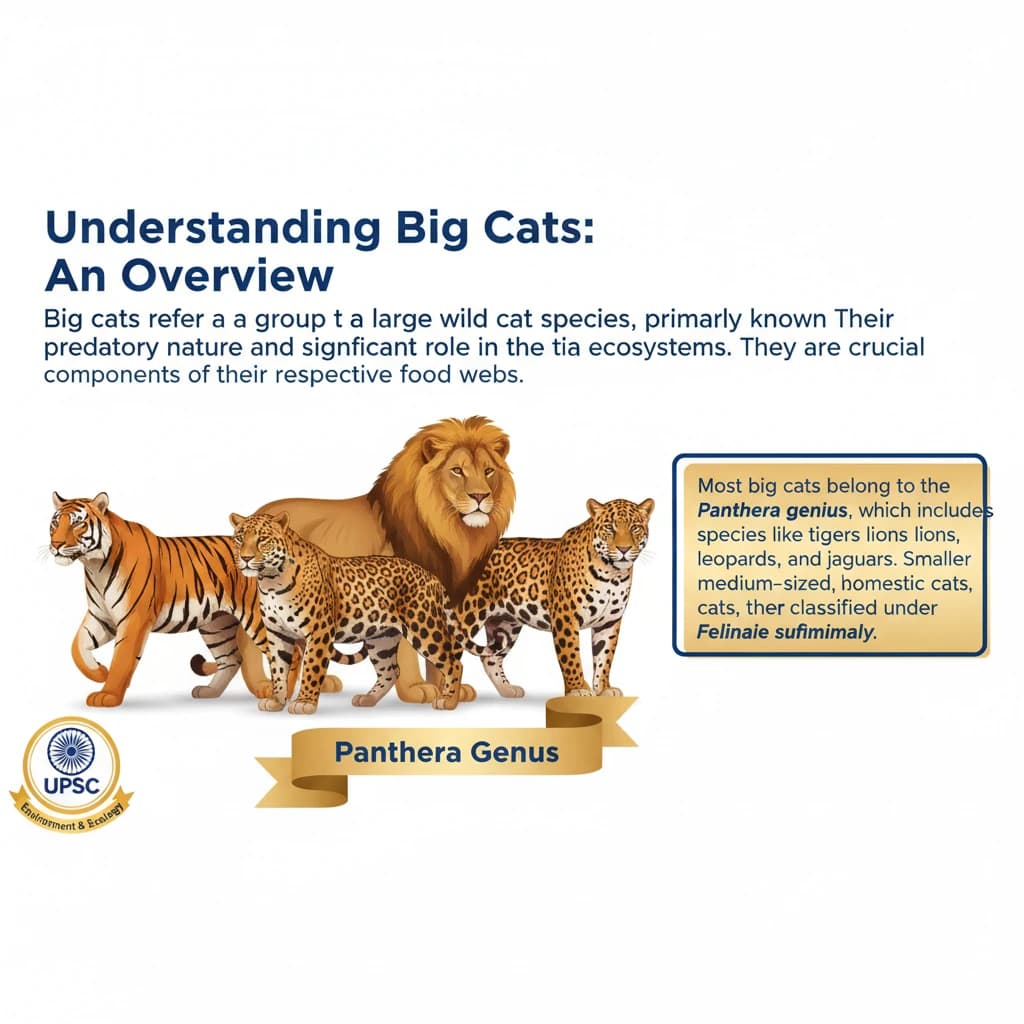
<h4>Understanding Big Cats: An Overview</h4><p><strong>Big cats</strong> refer to a group of large wild cat species, primarily known for their predatory nature and significant role in ecosystems. They are crucial components of their respective food webs.</p><div class='info-box'><p>Most big cats belong to the <strong>Panthera genus</strong>, which includes species like tigers, lions, leopards, and jaguars. Smaller and medium-sized cats, including domestic cats, are classified under the <strong>Felis genus</strong>.</p></div><div class='key-point-box'><p>Big cats are considered <strong>keystone species</strong>. Their presence is a critical indicator of the overall health and balance of an ecosystem, reflecting biodiversity and habitat integrity.</p></div><h4>Focus Species of Big Cat Conservation</h4><p>The global conservation initiative, the <strong>International Big Cat Alliance (IBCA)</strong>, focuses on the conservation of seven specific big cat species worldwide.</p><ul><li><strong>Tigers</strong> (Panthera tigris)</li><li><strong>Lions</strong> (Panthera leo)</li><li><strong>Leopards</strong> (Panthera pardus)</li><li><strong>Snow Leopards</strong> (Panthera uncia)</li><li><strong>Cheetahs</strong> (Acinonyx jubatus)</li><li><strong>Jaguars</strong> (Panthera onca)</li><li><strong>Pumas</strong> (Puma concolor), also known as cougars or mountain lions</li></ul><div class='info-box'><p>Out of these seven, <strong>five species are found in India</strong>: the <strong>tiger</strong>, <strong>lion</strong>, <strong>leopard</strong>, <strong>snow leopard</strong>, and <strong>cheetah</strong>. The <strong>puma</strong> and <strong>jaguar</strong> are not native to India.</p></div><h4>The International Big Cat Alliance (IBCA)</h4><p>The <strong>International Big Cat Alliance (IBCA)</strong> is a significant global initiative launched by India to conserve the world's big cat species. It represents a collaborative effort to protect these endangered animals.</p><div class='key-point-box'><p>Its primary objective is to advocate for policy initiatives that align <strong>biodiversity conservation efforts</strong> with local needs. This also contributes towards the attainment of <strong>United Nations-mandated Sustainable Development Goals (SDGs)</strong> within member countries.</p></div><h4>IBCA: Governance and Funding</h4><p>The IBCA's governance structure is robust, designed to ensure effective global coordination for big cat conservation and resource management.</p><ul><li>It comprises an <strong>Assembly of Members</strong>, a <strong>Standing Committee</strong>, and a <strong>Secretariat</strong>.</li><li>The Secretariat is based in <strong>India</strong>, highlighting India's leadership role in this global environmental endeavor.</li><li>The framework is modelled after the successful <strong>International Solar Alliance (ISA)</strong>, indicating a proven organizational blueprint.</li><li>A <strong>Director-General (DG)</strong> is appointed by the <strong>Ministry of Environment, Forest and Climate Change (MoEFCC)</strong>, Government of India.</li></ul><div class='info-box'><p>The Union Cabinet allocated a one-time budgetary support of <strong>Rs 150 crore</strong> for the IBCA. This funding is designated for a period of <strong>five years</strong>, from the financial year <strong>2023-24 to 2027-28</strong>.</p></div><p>Currently, <strong>four countries</strong> are members of the IBCA: <strong>India</strong>, <strong>Nicaragua</strong>, <strong>Eswatini</strong>, and <strong>Somalia</strong>. More countries are expected to join this crucial alliance.</p><h4>Unique Characteristics and Threats</h4><p>Big cats exhibit diverse behaviors and face various threats globally, necessitating targeted conservation strategies.</p><div class='key-point-box'><p><strong>Lions</strong> are unique among big cats as they are the only species that live in <strong>social groups</strong>, known as <strong>prides</strong>. They are also known for cooperative hunting. Most other big cats are solitary, except for mothers with cubs.</p></div><div class='info-box'><p>The <strong>Siberian tiger</strong> is recognized as the <strong>largest of all big cats</strong>. It is currently endangered due to significant threats such as <strong>trophy hunting</strong> and its extensive use in <strong>traditional Chinese medicine</strong>.</p></div><div class='exam-tip-box'><p>All big cat species are increasingly threatened by factors like <strong>poaching</strong>, <strong>illegal wildlife trade</strong>, and severe <strong>habitat loss</strong> and fragmentation. Understanding these interconnected threats is crucial for UPSC answers on environmental conservation and policy.</p></div>
Concept Diagram

💡 Key Takeaways

  • •Big cats are large wild felines, mostly from the Panthera genus, serving as keystone species.
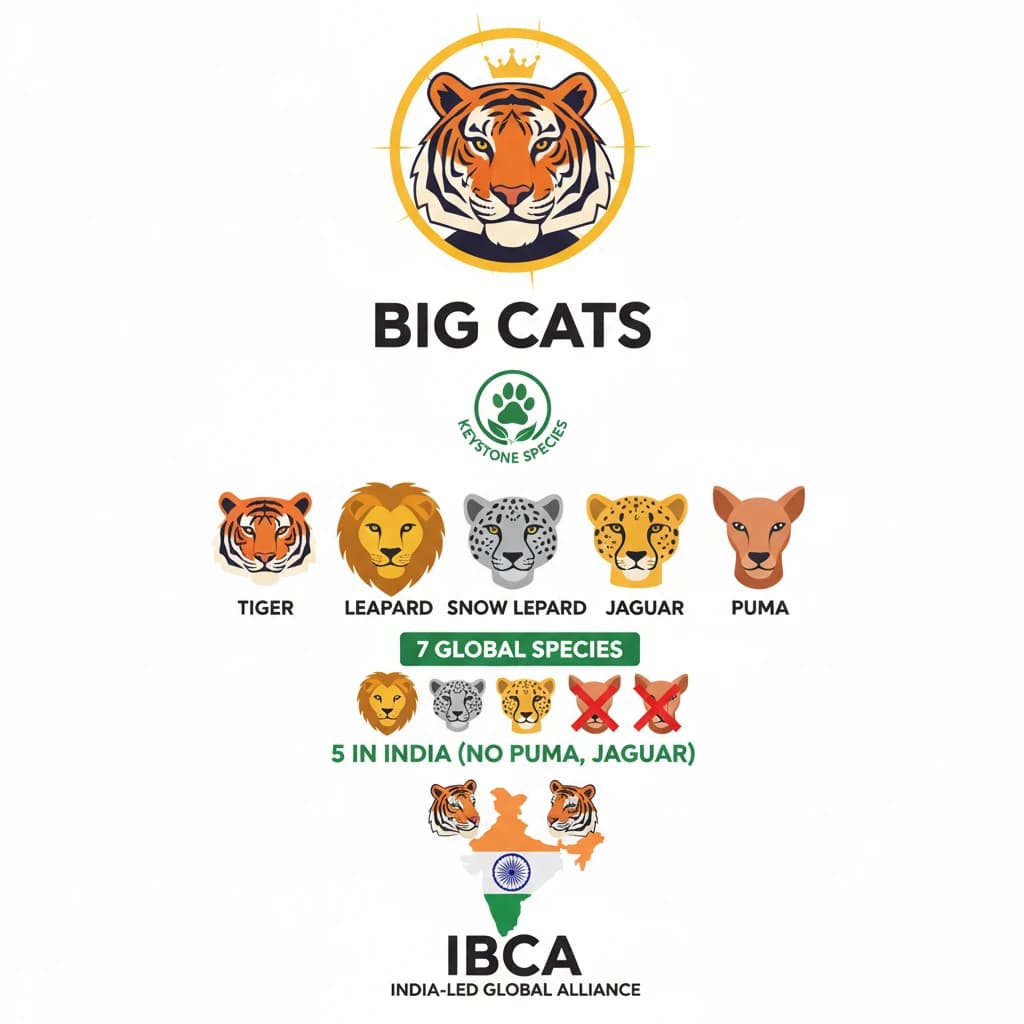
  • •Seven key species are targeted for conservation: Tiger, Lion, Leopard, Snow Leopard, Cheetah, Jaguar, Puma.
  • •Five of these seven big cat species are found in India (excluding Puma and Jaguar).
  • •The International Big Cat Alliance (IBCA) is an India-led initiative for global big cat conservation.
  • •IBCA, modeled after ISA, has a budget of Rs 150 crore for 5 years (2023-28) and aims to align conservation with SDGs.
  • •Lions are the only social big cats; Siberian tiger is the largest and endangered.
  • •Major threats include poaching, illegal trade, and habitat loss.

🧠 Memory Techniques
Memory Aid
98% Verified Content

📚 Reference Sources

•Ministry of Environment, Forest and Climate Change (MoEFCC), Government of India - Press Releases on IBCA
•National Tiger Conservation Authority (NTCA) - Project Tiger reports
•IUCN Red List of Threatened Species
•United Nations Sustainable Development Goals official website

Related Topics

Loading related topics...
Explore:Environment And Ecology Topics·All Subjects·Daily Current Affairs·Editorial Analysis·Previous Year Questions·UPSC GPT
Back
All Subjects

Topics

0 topics • 0 completed

Loading topics...
Loading...
Loading...
Loading...
Loading...
Loading...
Overall Progress0%
What are Big Cats? - UPSC Environment And Ecology