Loading page, please wait…
Vaidra Logo
Vaidra

Top 4 items + smart groups

UPSC GPT
New
Current Affairs
Daily Solutions
Daily Puzzle
Mains Evaluator

Version 2.0.0 • Built with ❤️ for UPSC aspirants

Loading...
Loading...
Loading...
Loading...
Loading...
Loading...
Loading...
Loading...
Loading...
Loading...
Loading...
Loading...
Loading...
Back
All Subjects

Topics

0 topics • 0 completed

Loading topics...
Loading...
Loading...
Loading...
Loading...
Loading...
Overall Progress0%

Biodiversity Credits for Environment Conservation - UPSC Environment And Ecology

What is Biodiversity Credits for Environment Conservation in UPSC Environment And Ecology?

Biodiversity Credits for Environment Conservation is a key topic under Environment And Ecology for UPSC Civil Services Examination. Key points include: Biodiversity credits are verifiable, quantifiable, and tradable financial instruments rewarding positive nature outcomes.. Their mechanism is similar to carbon credits, aiming to offset biodiversity loss by attracting private funding for conservation.. The World Economic Forum (WEF) and the Kunming-Montreal Global Biodiversity Framework 2022 support their development as key financing tools.. Understanding this topic is essential for both UPSC Prelims and Mains preparation.

Why is Biodiversity Credits for Environment Conservation important for UPSC exam?

Biodiversity Credits for Environment Conservation is a Medium-level topic in UPSC Environment And Ecology. It is tested in both Prelims (factual MCQs) and Mains (analytical answer writing). Previous year UPSC questions have frequently covered aspects of Biodiversity Credits for Environment Conservation, making it essential for comprehensive IAS preparation.

How to prepare Biodiversity Credits for Environment Conservation for UPSC?

To prepare Biodiversity Credits for Environment Conservation for UPSC: (1) Study the comprehensive notes covering all key concepts on Vaidra. (2) Practice previous year questions on this topic. (3) Connect it with current affairs using daily updates. (4) Revise using key takeaways and mind maps available for Environment And Ecology. (5) Write practice answers linking Biodiversity Credits for Environment Conservation to related GS Paper topics.

Key takeaways of Biodiversity Credits for Environment Conservation for UPSC

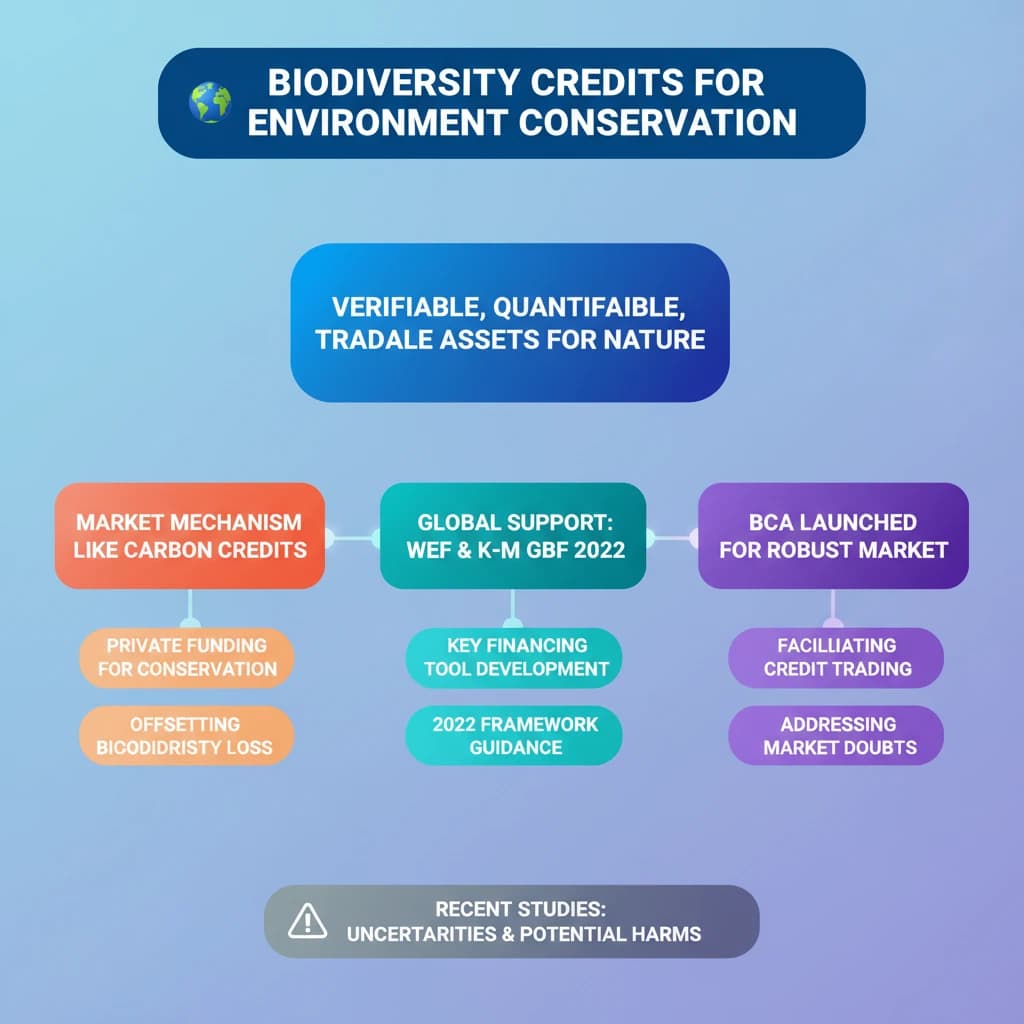
  • Biodiversity credits are verifiable, quantifiable, and tradable financial instruments rewarding positive nature outcomes.
  • Their mechanism is similar to carbon credits, aiming to offset biodiversity loss by attracting private funding for conservation.
  • The World Economic Forum (WEF) and the Kunming-Montreal Global Biodiversity Framework 2022 support their development as key financing tools.
  • The Biodiversity Credit Alliance (BCA) was launched to facilitate a robust market for these credits.
  • Recent studies, however, cast doubt on their effectiveness, highlighting deep uncertainties and questioning if benefits truly outweigh potential harms.
Biodiversity Credits for Environment Conservation

Biodiversity Credits for Environment Conservation

Medium⏱️ 7 min read✓ 95% Verified
environment and ecology

📖 Introduction

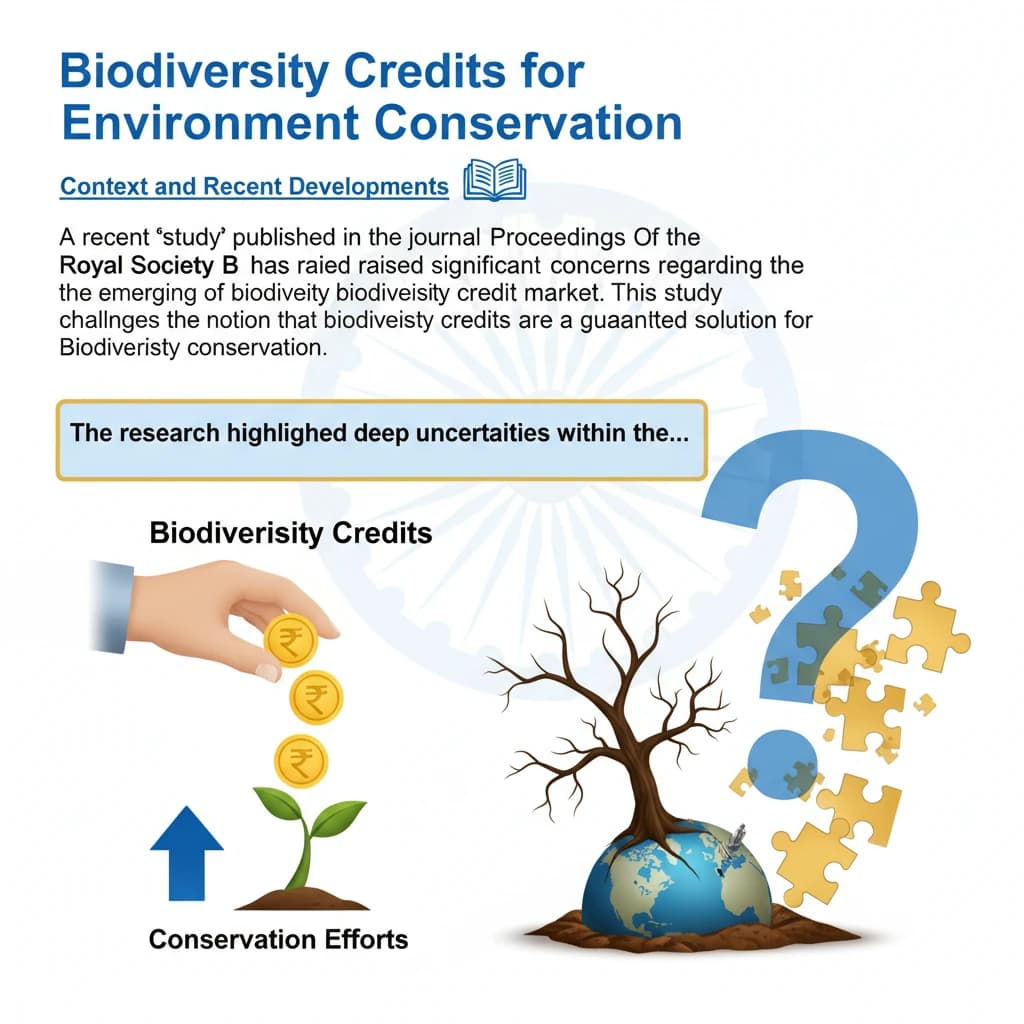
<h4>Context and Recent Developments</h4><p>A recent <strong>study</strong> published in the journal <strong>Proceedings of the Royal Society B</strong> has raised significant concerns regarding the effectiveness of the emerging <strong>biodiversity credit market</strong>.</p><p>This study challenges the notion that biodiversity credits are a guaranteed solution for <strong>biodiversity conservation</strong>.</p><div class='key-point-box'><p>The research highlighted deep uncertainties within the market and questioned whether the benefits designed to offset biodiversity loss truly outweigh the potential harms.</p></div><h4>Understanding Biodiversity Credits</h4><p><strong>Biodiversity credits</strong> are a novel financial instrument designed to incentivize and fund positive outcomes for nature and biodiversity.</p><p>They are <strong>verifiable, quantifiable</strong>, and <strong>tradable</strong>, allowing for market-based approaches to conservation.</p><div class='info-box'><p><strong>Definition:</strong> A <strong>biodiversity credit</strong> represents a unit of positive impact on nature, such as the conservation of a specific species, restoration of an ecosystem, or protection of natural habitats, created and sold over a fixed period.</p><ul><li>Can be <strong>land-based</strong> or <strong>ocean-based</strong>.</li><li>Aims to reward positive nature and biodiversity outcomes.</li></ul></div><h4>Mechanism of Biodiversity Credits</h4><p>The operational mechanism of biodiversity credits draws parallels with the well-established system of <strong>carbon credits</strong>.</p><p>When an entity, such as a <strong>company</strong> or a <strong>government</strong>, causes harm or degradation to biodiversity, they can utilize biodiversity credits to offset this damage.</p><p>This offset is achieved by <strong>paying for conservation efforts</strong> undertaken elsewhere, effectively balancing the ecological impact.</p><div class='key-point-box'><p>The core idea is to achieve an overall net-zero or net-positive impact on biodiversity by compensating for losses through targeted conservation and restoration activities, while also attracting vital <strong>private funding for conservation</strong>.</p></div><h4>Global Initiatives and Future Potential</h4><p>The <strong>World Economic Forum (WEF)</strong> has actively promoted this concept by launching the <strong>Biodiversity Credits Initiative</strong>.</p><p>This initiative aims to unlock new financial streams to support measurable positive outcomes for nature globally.</p><div class='info-box'><p><strong>Market Projections:</strong></p><ul><li>Current estimated worth (WEF): <strong>USD 8 billion</strong>.</li><li>Projected worth by <strong>2030</strong>: <strong>USD 2 billion</strong>.</li><li>Projected worth by <strong>2050</strong>: <strong>USD 69 billion</strong>.</li></ul></div><p>The landmark <strong>Kunming-Montreal Global Biodiversity Framework 2022</strong> explicitly advocates for diverse financing mechanisms.</p><p>These mechanisms include <strong>ecosystem service payments, green bonds</strong>, and <strong>biodiversity credits</strong>, aiming to mobilize <strong>USD 200 billion annually by 2030</strong> for global biodiversity goals.</p><p>In alignment with these ambitious targets, the <strong>Biodiversity Credit Alliance (BCA)</strong> was subsequently launched to further develop and promote the market.</p><div class='exam-tip-box'><p><strong>UPSC Mains:</strong> Understanding the <strong>Kunming-Montreal Global Biodiversity Framework</strong> and its financing mechanisms like <strong>biodiversity credits</strong> is crucial for questions on global environmental governance and sustainable development (<strong>GS Paper 3</strong>).</p></div>
Concept Diagram

💡 Key Takeaways

  • •Biodiversity credits are verifiable, quantifiable, and tradable financial instruments rewarding positive nature outcomes.
  • •Their mechanism is similar to carbon credits, aiming to offset biodiversity loss by attracting private funding for conservation.
  • •The World Economic Forum (WEF) and the Kunming-Montreal Global Biodiversity Framework 2022 support their development as key financing tools.
  • •The Biodiversity Credit Alliance (BCA) was launched to facilitate a robust market for these credits.
  • •Recent studies, however, cast doubt on their effectiveness, highlighting deep uncertainties and questioning if benefits truly outweigh potential harms.

🧠 Memory Techniques

Memory Aid
95% Verified Content

📚 Reference Sources

•Proceedings of the Royal Society B (general journal reference)
•World Economic Forum reports (general reference)
•Kunming-Montreal Global Biodiversity Framework 2022 (general reference)

Related Topics

Loading related topics...
Explore:Environment And Ecology Topics·All Subjects·Daily Current Affairs·Editorial Analysis·Previous Year Questions·UPSC GPT
Biodiversity Credits for Environment Conservation - UPSC Environment And Ecology