Loading page, please wait…
Environmental Impacts: Ocean Warming, MHWs, and Coral Bleaching - UPSC Environment And Ecology
What is Environmental Impacts: Ocean Warming, MHWs, and Coral Bleaching in UPSC Environment And Ecology?
Environmental Impacts: Ocean Warming, MHWs, and Coral Bleaching is a key topic under Environment And Ecology for UPSC Civil Services Examination. Key points include: Marine Heatwaves (MHWs) are periods of unusually warm ocean temperatures with catastrophic impacts.. MHWs cause devastating fish kills and destroy vital habitats like kelp forests, altering marine ecosystems.. Coral bleaching, where corals expel symbiotic algae due to warm water, is a major MHW impact.. Understanding this topic is essential for both UPSC Prelims and Mains preparation.
Why is Environmental Impacts: Ocean Warming, MHWs, and Coral Bleaching important for UPSC exam?
Environmental Impacts: Ocean Warming, MHWs, and Coral Bleaching is a Medium-level topic in UPSC Environment And Ecology. It is tested in both Prelims (factual MCQs) and Mains (analytical answer writing). Previous year UPSC questions have frequently covered aspects of Environmental Impacts: Ocean Warming, MHWs, and Coral Bleaching, making it essential for comprehensive IAS preparation.
How to prepare Environmental Impacts: Ocean Warming, MHWs, and Coral Bleaching for UPSC?
To prepare Environmental Impacts: Ocean Warming, MHWs, and Coral Bleaching for UPSC: (1) Study the comprehensive notes covering all key concepts on Vaidra. (2) Practice previous year questions on this topic. (3) Connect it with current affairs using daily updates. (4) Revise using key takeaways and mind maps available for Environment And Ecology. (5) Write practice answers linking Environmental Impacts: Ocean Warming, MHWs, and Coral Bleaching to related GS Paper topics.
Key takeaways of Environmental Impacts: Ocean Warming, MHWs, and Coral Bleaching for UPSC
- Marine Heatwaves (MHWs) are periods of unusually warm ocean temperatures with catastrophic impacts.
- MHWs cause devastating fish kills and destroy vital habitats like kelp forests, altering marine ecosystems.
- Coral bleaching, where corals expel symbiotic algae due to warm water, is a major MHW impact.
- MHWs intensify tropical storms (hurricanes, cyclones) by increasing evaporation and heat transfer.
- Stronger storms lead to more powerful winds, heavier rainfall, and increased flooding, devastating human communities.
Environmental Impacts: Ocean Warming, MHWs, and Coral Bleaching
Medium⏱️ 8 min read
environment and ecology
📖 Introduction
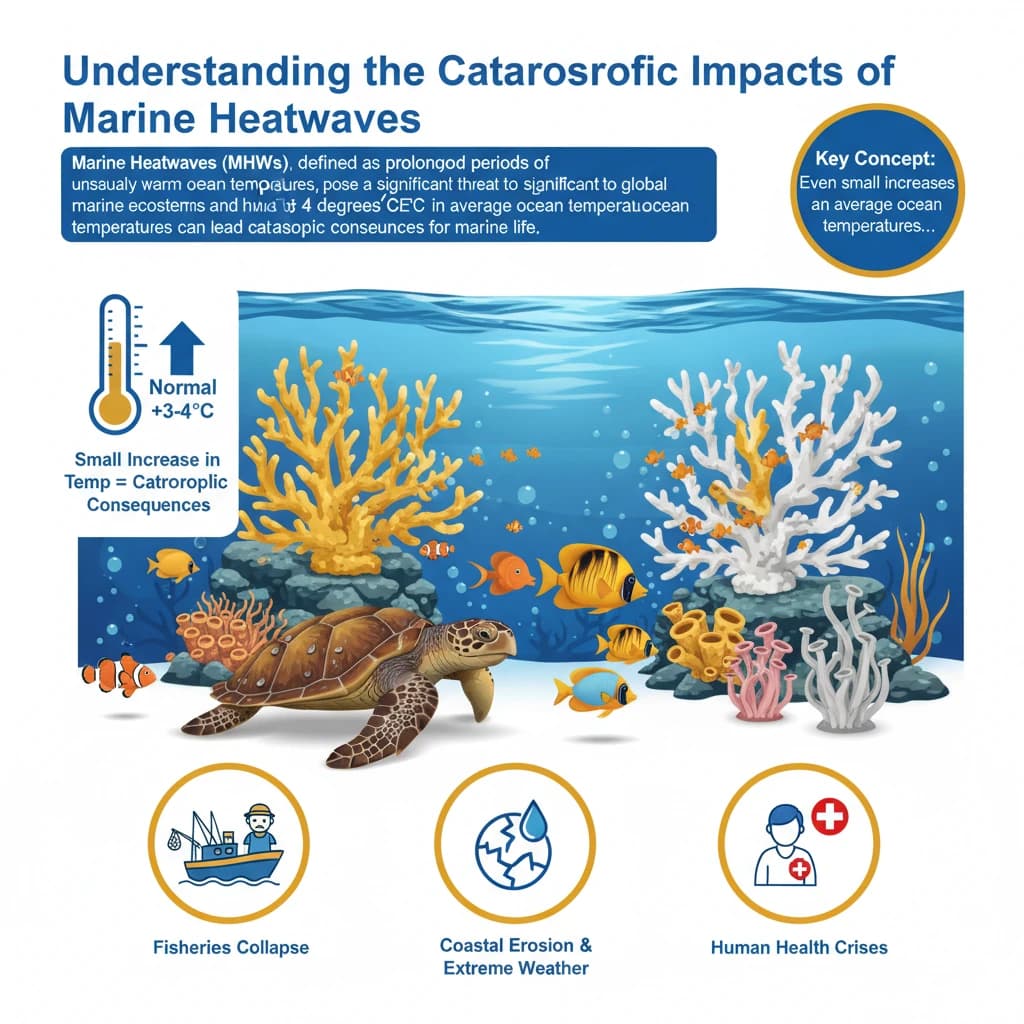
Understanding the Catastrophic Impacts of Marine Heatwaves
Marine Heatwaves (MHWs), defined as prolonged periods of unusually warm ocean temperatures, pose a significant threat to global marine ecosystems and human populations. An increase of just 3 or 4 degrees Celsius in average ocean temperatures can lead to catastrophic consequences for marine life.
Key Concept: Even small increases in average ocean temperatures can trigger severe and widespread ecological damage, highlighting the fragility of marine environments to thermal stress.
Impacts on Ocean Ecosystems
Marine Heatwaves have direct and devastating effects on the delicate balance of ocean ecosystems, leading to widespread mortality and habitat destruction.
Fish Kills and Ecosystem Alteration
During the 2010 and 2011 MHWs along the Western Australian coast, there were significant instances of “devastating” fish kills. These events refer to the sudden and unexpected death of numerous fish or other aquatic animals within a short period and a specific area.
Case Study: Western Australia MHWs (2010-2011)
- Impact: Caused massive fish mortality.
- Ecosystem Change: Destroyed kelp forests, fundamentally altering coastal ecosystems.
Kelp forests, which typically thrive in cooler waters, are crucial habitats and food sources for a diverse range of marine animals. Their destruction removes vital shelter and sustenance, leading to cascading effects throughout the food web.
Coral Bleaching Events
Elevated ocean temperatures, a hallmark of MHWs, are a primary driver of coral bleaching. In 2005, high ocean temperatures across the tropical Atlantic and Caribbean triggered a massive coral bleaching event, demonstrating the widespread vulnerability of coral reefs.
What is Coral Bleaching?
Corals are highly sensitive to water temperature. When temperatures become excessively warm, corals expel the symbiotic algae, known as zooxanthellae, that live within their tissues. This expulsion causes the corals to lose their vibrant color and turn entirely white, a phenomenon termed coral bleaching. Bleached corals are not dead but are under severe stress and are more susceptible to disease and mortality if temperatures remain high.
Impacts on Human Populations
The consequences of Marine Heatwaves extend beyond marine ecosystems, directly affecting human societies through intensified weather events.
Stronger Storms and Increased Devastation
Higher ocean temperatures, directly linked to MHWs, provide more energy for atmospheric disturbances, making storms like hurricanes and tropical cyclones significantly stronger and more destructive.
Warmer ocean waters lead to an escalated rate of evaporation and an increased transfer of heat from the oceans to the air. As storms traverse these hot ocean surfaces, they absorb more water vapor and heat.
This increased energy results in more powerful winds, heavier rainfall, and consequently, more severe flooding when these storms make landfall. Such intensified weather events lead to heightened devastation for human communities, impacting infrastructure, livelihoods, and lives.
UPSC Insight: When discussing climate change impacts, remember to link ocean warming and MHWs to the intensification of extreme weather events. This demonstrates a comprehensive understanding of interconnected environmental phenomena relevant for GS Paper 1 (Geography) and GS Paper 3 (Environment & Disaster Management).
💡 Key Takeaways
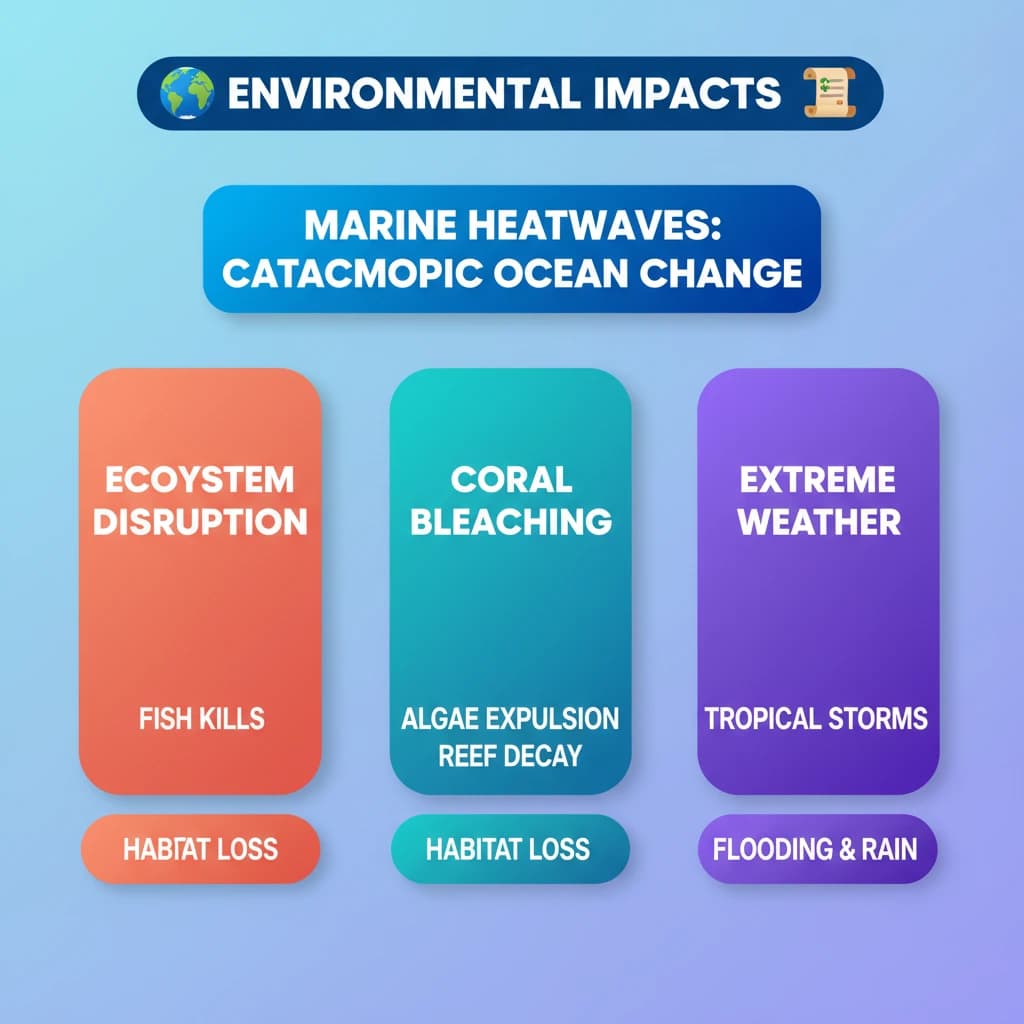
- •Marine Heatwaves (MHWs) are periods of unusually warm ocean temperatures with catastrophic impacts.
- •MHWs cause devastating fish kills and destroy vital habitats like kelp forests, altering marine ecosystems.
- •Coral bleaching, where corals expel symbiotic algae due to warm water, is a major MHW impact.
- •MHWs intensify tropical storms (hurricanes, cyclones) by increasing evaporation and heat transfer.
- •Stronger storms lead to more powerful winds, heavier rainfall, and increased flooding, devastating human communities.
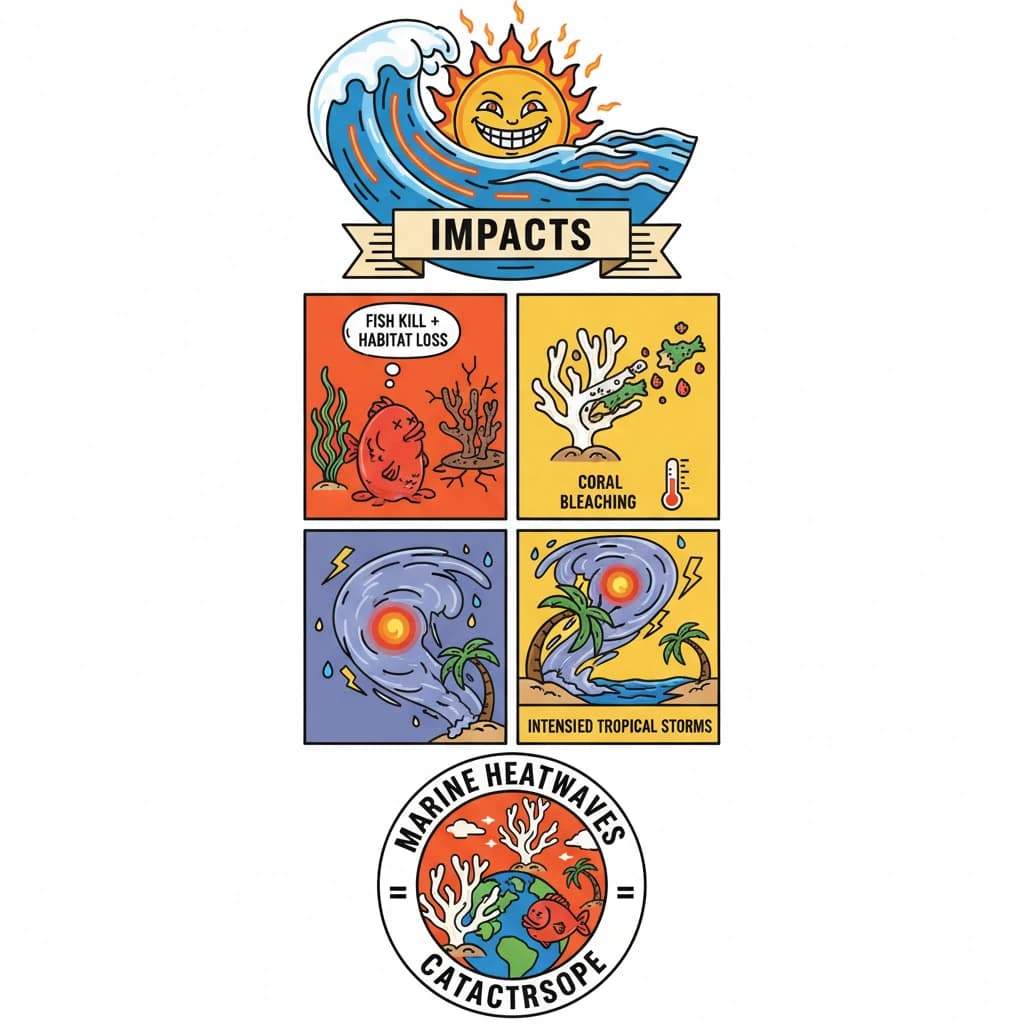
🧠 Memory Techniques
95% Verified Content
📚 Reference Sources
•Intergovernmental Panel on Climate Change (IPCC) Reports on Oceans and Cryosphere
•Scientific literature on Marine Heatwaves and Coral Bleaching