Loading page, please wait…
Vaidra Logo
Vaidra

Top 4 items + smart groups

UPSC GPT
New
Current Affairs
Daily Solutions
Daily Puzzle
Mains Evaluator

Version 2.0.0 • Built with ❤️ for UPSC aspirants

Loading...
Loading...
Loading...
Loading...
Loading...
Loading...
Loading...
Loading...
Loading...
Loading...
Loading...
Loading...
Loading...
Back
All Subjects

Topics

0 topics • 0 completed

Loading topics...
Loading...
Loading...
Loading...
Loading...
Loading...
Overall Progress0%

Salt-water Crocodiles - UPSC Environment And Ecology

What is Salt-water Crocodiles in UPSC Environment And Ecology?

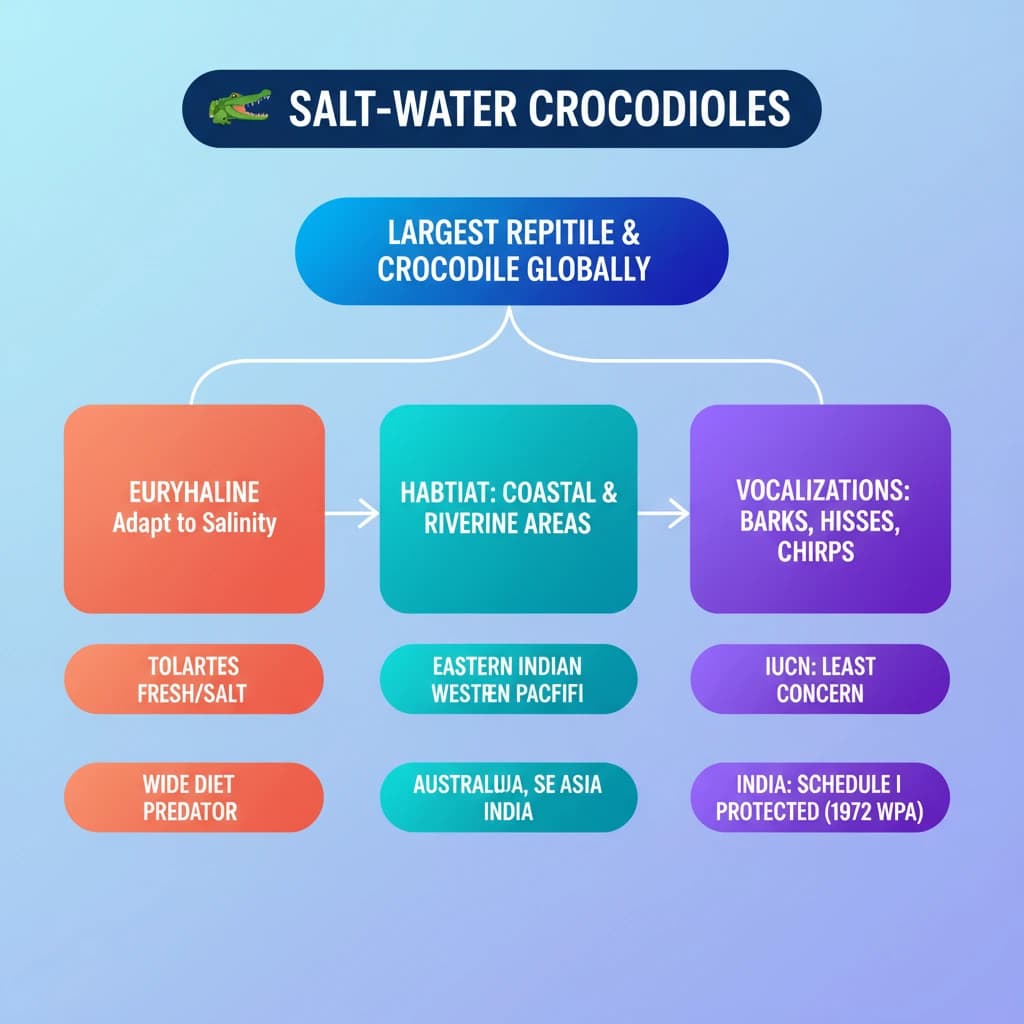
Salt-water Crocodiles is a key topic under Environment And Ecology for UPSC Civil Services Examination. Key points include: Salt-water Crocodile is the largest reptile and largest crocodile globally.. They are euryhaline, tolerating both fresh and saltwater environments.. Found in coastal and riverine areas of the eastern Indian and western Pacific oceans.. Understanding this topic is essential for both UPSC Prelims and Mains preparation.

Why is Salt-water Crocodiles important for UPSC exam?

Salt-water Crocodiles is a Medium-level topic in UPSC Environment And Ecology. It is tested in both Prelims (factual MCQs) and Mains (analytical answer writing). Previous year UPSC questions have frequently covered aspects of Salt-water Crocodiles, making it essential for comprehensive IAS preparation.

How to prepare Salt-water Crocodiles for UPSC?

To prepare Salt-water Crocodiles for UPSC: (1) Study the comprehensive notes covering all key concepts on Vaidra. (2) Practice previous year questions on this topic. (3) Connect it with current affairs using daily updates. (4) Revise using key takeaways and mind maps available for Environment And Ecology. (5) Write practice answers linking Salt-water Crocodiles to related GS Paper topics.

Key takeaways of Salt-water Crocodiles for UPSC

  • Salt-water Crocodile is the largest reptile and largest crocodile globally.
  • They are euryhaline, tolerating both fresh and saltwater environments.
  • Found in coastal and riverine areas of the eastern Indian and western Pacific oceans.
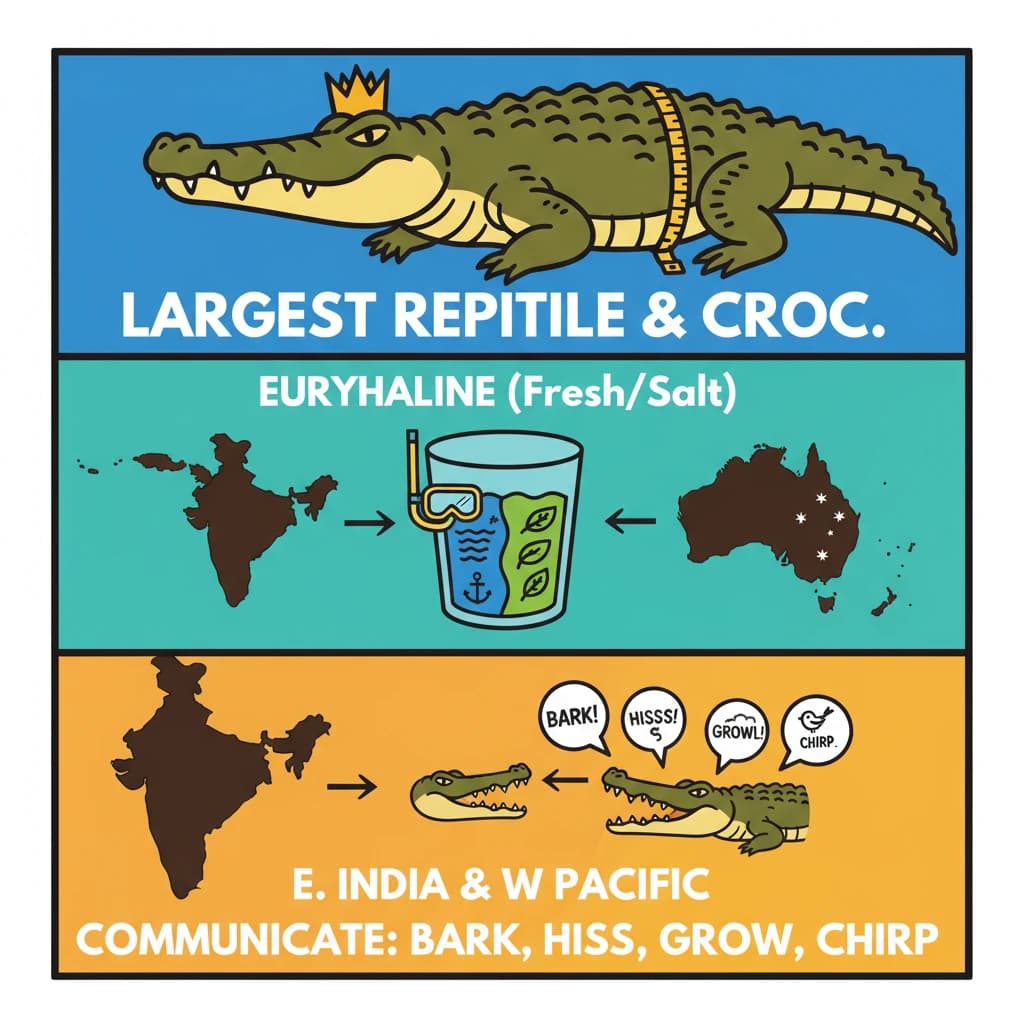
  • Communicate through barking, hissing, growling, and chirps.
  • Globally 'Least Concern' (IUCN), but Schedule I protected in India (Wildlife Protection Act, 1972).
  • Apex predators crucial for ecosystem balance in mangrove and estuarine habitats.
Salt-water Crocodiles

Salt-water Crocodiles

Medium⏱️ 6 min read✓ 98% Verified
environment and ecology

📖 Introduction

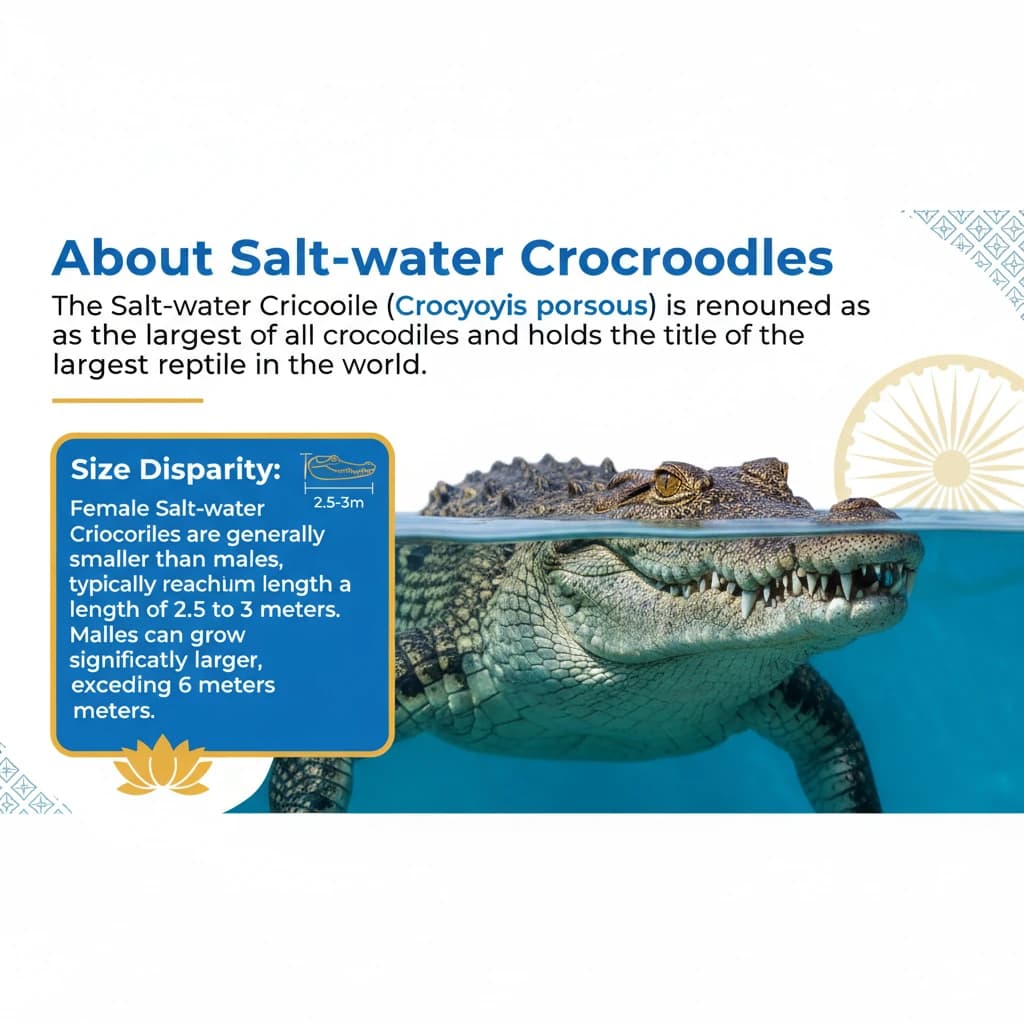
<h4>About Salt-water Crocodiles</h4><p>The <strong>Salt-water Crocodile</strong> (<em>Crocodylus porosus</em>) is renowned as the <strong>largest of all crocodiles</strong> and holds the title of the <strong>largest reptile in the world</strong>.</p><div class='info-box'><p><strong>Size Disparity:</strong> Female <strong>Salt-water Crocodiles</strong> are generally smaller than males, typically reaching a maximum length of <strong>2.5 to 3 meters</strong>. Males can grow significantly larger, often exceeding 6 meters.</p></div><h4>Habitat and Salinity Tolerance</h4><p>A defining characteristic of <strong>Salt-water Crocodiles</strong> is their remarkable tolerance to varying salinity levels. This allows them to thrive in diverse aquatic environments.</p><p>They are predominantly found in <strong>coastal waters</strong>, estuaries, and near river mouths. However, their adaptability also sees them inhabiting <strong>freshwater areas</strong> adjacent to rivers and swamps.</p><h4>Communication Methods</h4><p><strong>Salt-water Crocodiles</strong> employ a range of vocalizations for communication within their species. These sounds are crucial for territorial defense, mating, and warning.</p><ul><li><strong>Barking:</strong> Often used for territorial displays or warnings.</li><li><strong>Hissing:</strong> A common sound indicating aggression or discomfort.</li><li><strong>Growling:</strong> Employed during disputes or as a threat.</li><li><strong>Chirps:</strong> Frequently used by hatchlings and juveniles to communicate with their mother.</li></ul><h4>Geographical Distribution</h4><p>The distribution of <strong>Salt-water Crocodiles</strong> spans across tropical to warm temperate latitudes. Their range primarily covers the regions of the <strong>eastern Indian Ocean</strong> and the <strong>western Pacific Ocean</strong>.</p><div class='info-box'><p><strong>Key Regions:</strong> This includes parts of India, Southeast Asia, Northern Australia, and various Pacific islands.</p></div>
Concept Diagram

💡 Key Takeaways

  • •Salt-water Crocodile is the largest reptile and largest crocodile globally.
  • •They are euryhaline, tolerating both fresh and saltwater environments.
  • •Found in coastal and riverine areas of the eastern Indian and western Pacific oceans.
  • •Communicate through barking, hissing, growling, and chirps.
  • •Globally 'Least Concern' (IUCN), but Schedule I protected in India (Wildlife Protection Act, 1972).
  • •Apex predators crucial for ecosystem balance in mangrove and estuarine habitats.

🧠 Memory Techniques
Memory Aid
98% Verified Content

📚 Reference Sources

•IUCN Red List of Threatened Species
•Wildlife Protection Act, 1972 (India)
•National Geographic
•Australian Government Department of Environment and Energy

Related Topics

Loading related topics...
Explore:Environment And Ecology Topics·All Subjects·Daily Current Affairs·Editorial Analysis·Previous Year Questions·UPSC GPT
Salt-water Crocodiles - UPSC Environment And Ecology