Loading page, please wait…
Vaidra Logo
Vaidra

Top 4 items + smart groups

UPSC GPT
New
Current Affairs
Daily Solutions
Daily Puzzle
Mains Evaluator

Version 2.0.0 • Built with ❤️ for UPSC aspirants

Loading...
Loading...
Loading...
Loading...
Loading...
Loading...
Loading...
Loading...
Loading...
Loading...
Loading...
Loading...
Loading...
Back
All Subjects

Topics

0 topics • 0 completed

Loading topics...
Loading...
Loading...
Loading...
Loading...
Loading...
Overall Progress0%

What are the Key Facts About the Golden Tiger? - UPSC Environment And Ecology

What is What are the Key Facts About the Golden Tiger? in UPSC Environment And Ecology?

What are the Key Facts About the Golden Tiger? is a key topic under Environment And Ecology for UPSC Civil Services Examination. Key points include: Golden tigers are a 'color form,' not a separate subspecies, like white and black tigers.. Their unique coloration is caused by a recessive 'wideband' gene.. The wideband gene reduces melanin production, leading to blond/golden skin, while orange stripes are due to a 'tabby mutation'.. Understanding this topic is essential for both UPSC Prelims and Mains preparation.

Why is What are the Key Facts About the Golden Tiger? important for UPSC exam?

What are the Key Facts About the Golden Tiger? is a Medium-level topic in UPSC Environment And Ecology. It is tested in both Prelims (factual MCQs) and Mains (analytical answer writing). Previous year UPSC questions have frequently covered aspects of What are the Key Facts About the Golden Tiger?, making it essential for comprehensive IAS preparation.

How to prepare What are the Key Facts About the Golden Tiger? for UPSC?

To prepare What are the Key Facts About the Golden Tiger? for UPSC: (1) Study the comprehensive notes covering all key concepts on Vaidra. (2) Practice previous year questions on this topic. (3) Connect it with current affairs using daily updates. (4) Revise using key takeaways and mind maps available for Environment And Ecology. (5) Write practice answers linking What are the Key Facts About the Golden Tiger? to related GS Paper topics.

Key takeaways of What are the Key Facts About the Golden Tiger? for UPSC

  • Golden tigers are a 'color form,' not a separate subspecies, like white and black tigers.
  • Their unique coloration is caused by a recessive 'wideband' gene.
  • The wideband gene reduces melanin production, leading to blond/golden skin, while orange stripes are due to a 'tabby mutation'.
  • They are exceptionally rare because the recessive gene must be inherited from both parents to be expressed.
  • A Golden Tiger was notably spotted in Kaziranga National Park (KNP).
  • Understanding these genetic variations is important for biodiversity conservation and genetic research.
What are the Key Facts About the Golden Tiger?

What are the Key Facts About the Golden Tiger?

Medium⏱️ 6 min read✓ 95% Verified
environment and ecology

📖 Introduction

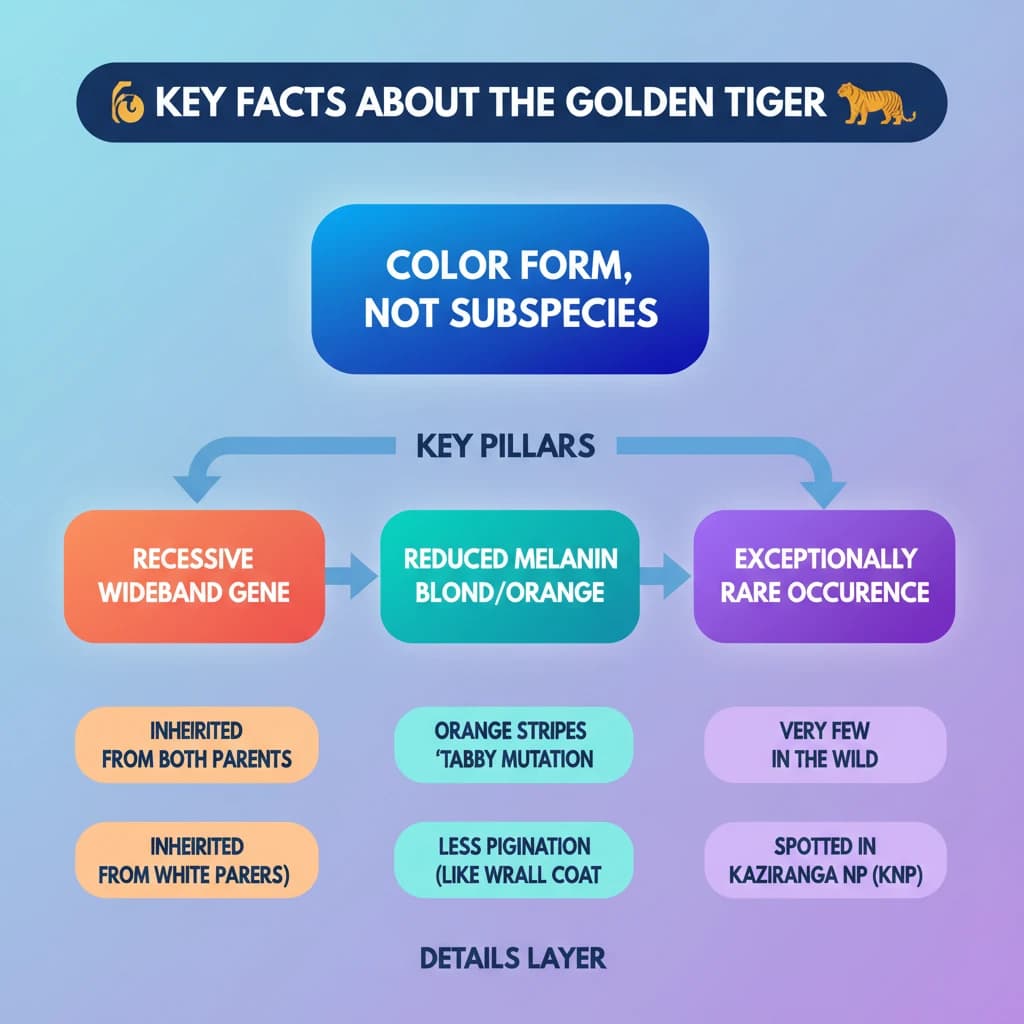
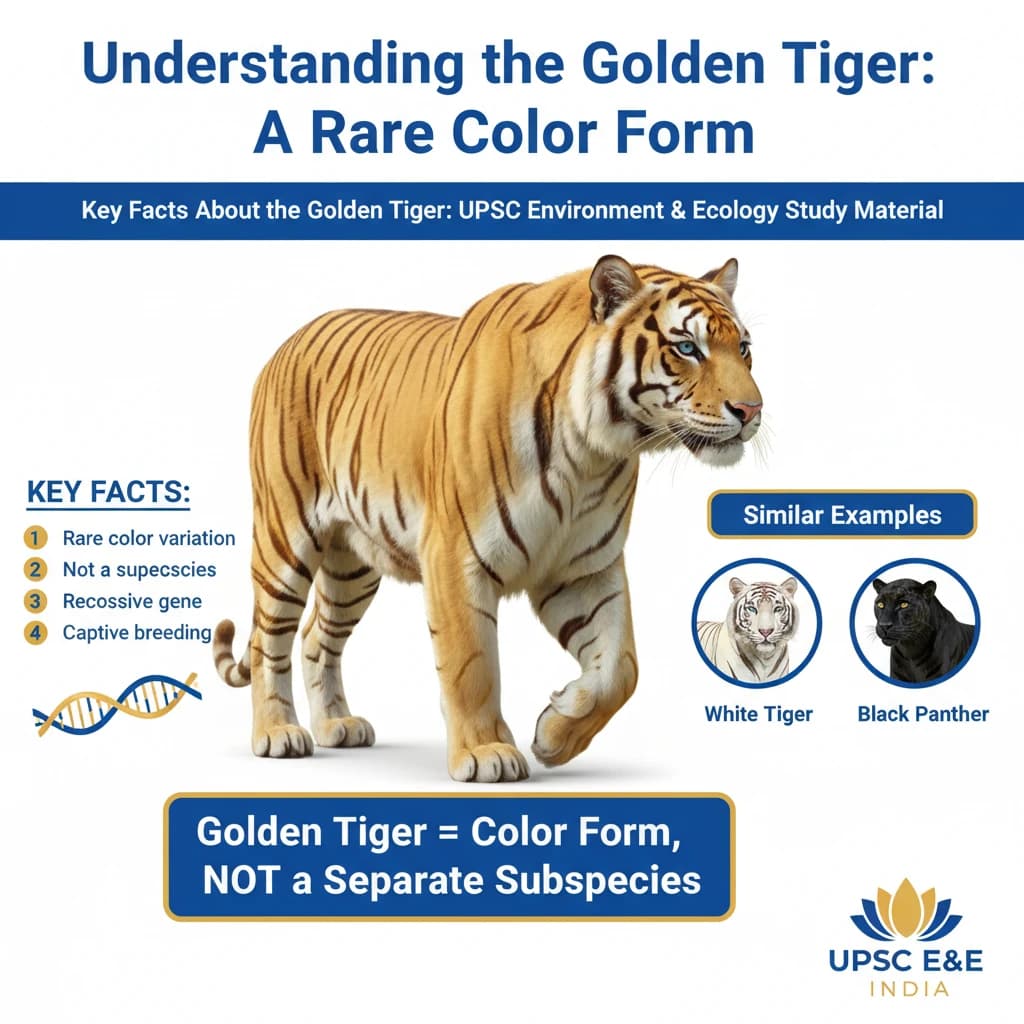
<h4>Understanding the Golden Tiger: A Rare Color Form</h4><p>The <strong>Golden Tiger</strong>, also known as the <strong>golden tabby tiger</strong>, is a unique color variation of the tiger. It is crucial to understand that it is a <strong>color form</strong> and not a distinct <strong>subspecies</strong>, similar to how white and black tigers are categorized.</p><div class='key-point-box'><p><strong>Key Point:</strong> Golden tigers are a <strong>color form</strong>, not a separate <strong>subspecies</strong>. This distinction is vital for understanding their biological classification.</p></div><p>These majestic animals are exceptionally <strong>rare in the wild</strong> and even more uncommon in captivity. Their scarcity highlights the specific genetic conditions required for their appearance.</p><h4>Genetic Basis of the Golden Tiger's Coloration</h4><p>The distinctive golden coloration observed in tigers, such as those spotted in <strong>Kaziranga National Park (KNP)</strong>, is attributed to the presence of a <strong>recessive gene</strong>. This specific gene is known as the <strong>“wideband” gene</strong>.</p><div class='info-box'><p><strong>Wideband Gene:</strong> This recessive gene plays a critical role by reducing the production of <strong>melanin</strong>, the pigment responsible for dark coloration, during the hair growth cycle.</p></div><p>The reduced melanin production leads to the expression of the <strong>agouti mutation</strong>. This mutation is responsible for producing a protein typically expressed in the skin, resulting in the characteristic <strong>blond or golden skin</strong> of these tigers.</p><p>While the agouti mutation gives the golden hue, the distinct <strong>orange stripes</strong> are a result of the <strong>“tabby mutation”</strong>. This tabby gene is also responsible for various coat patterns seen in domestic cats, indicating a shared genetic mechanism across feline species.</p><h4>Recessive Gene Expression and Rarity</h4><p>The existence of both golden and black tigers is fundamentally linked to the concept of <strong>recessive genes</strong>. These genes are only expressed when a dominant gene, which would typically suppress their trait, is absent.</p><p>When two individuals carrying <strong>dominant traits</strong> breed, the recessive genes they might carry are usually masked. However, if two individuals both possess and pass on the <strong>recessive gene</strong>, the recessive trait becomes expressed.</p><div class='exam-tip-box'><p><strong>UPSC Insight:</strong> Understanding the difference between <strong>dominant and recessive genes</strong> is crucial for topics related to biodiversity, evolution, and conservation genetics in <strong>GS Paper III</strong>. Questions might involve genetic variations in endangered species.</p></div><p>This mechanism explains the rarity of golden and black tigers: the specific combination of recessive genes needed for their coloration to manifest is uncommon in the general tiger population.</p>
Concept Diagram

💡 Key Takeaways

  • •Golden tigers are a 'color form,' not a separate subspecies, like white and black tigers.
  • •Their unique coloration is caused by a recessive 'wideband' gene.
  • •The wideband gene reduces melanin production, leading to blond/golden skin, while orange stripes are due to a 'tabby mutation'.
  • •They are exceptionally rare because the recessive gene must be inherited from both parents to be expressed.
  • •A Golden Tiger was notably spotted in Kaziranga National Park (KNP).
  • •Understanding these genetic variations is important for biodiversity conservation and genetic research.

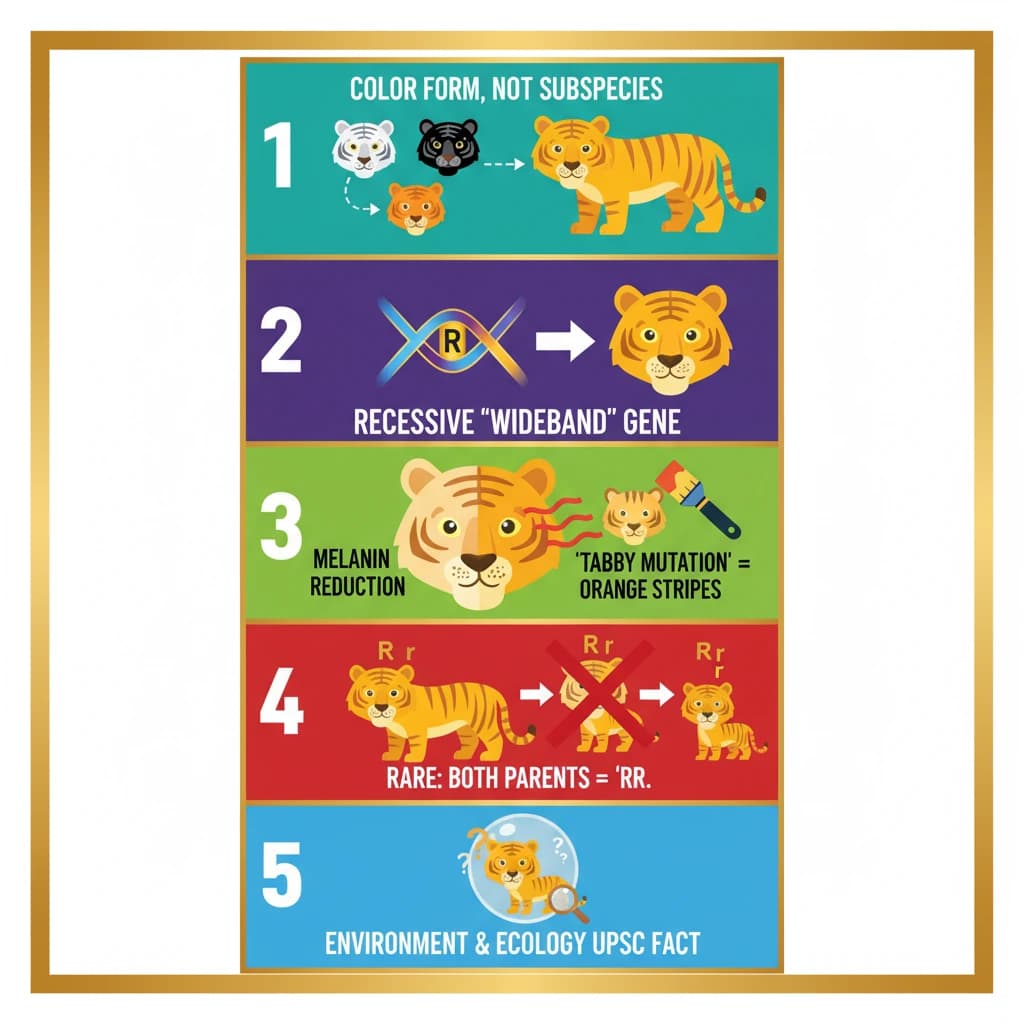
🧠 Memory Techniques
Memory Aid
95% Verified Content

📚 Reference Sources

•General knowledge on tiger genetics and conservation biology.

Related Topics

Loading related topics...
Explore:Environment And Ecology Topics·All Subjects·Daily Current Affairs·Editorial Analysis·Previous Year Questions·UPSC GPT
What are the Key Facts About the Golden Tiger? - UPSC Environment And Ecology