Loading page, please wait…
Vaidra Logo
Vaidra

Top 4 items + smart groups

UPSC GPT
New
Current Affairs
Daily Solutions
Daily Puzzle
Mains Evaluator

Version 2.0.0 • Built with ❤️ for UPSC aspirants

Loading...
Loading...
Loading...
Loading...
Loading...
Loading...
Loading...
Loading...
Loading...
Loading...
Loading...
Loading...
Loading...
New Species of Plants and Animals Discovered - UPSC Environment And Ecology
Back
All Subjects

Topics

0 topics • 0 completed

Loading topics...
Loading...
Loading...
Loading...
Loading...
Loading...
Overall Progress0%

New Species of Plants and Animals Discovered - UPSC Environment And Ecology

What is New Species of Plants and Animals Discovered in UPSC Environment And Ecology?

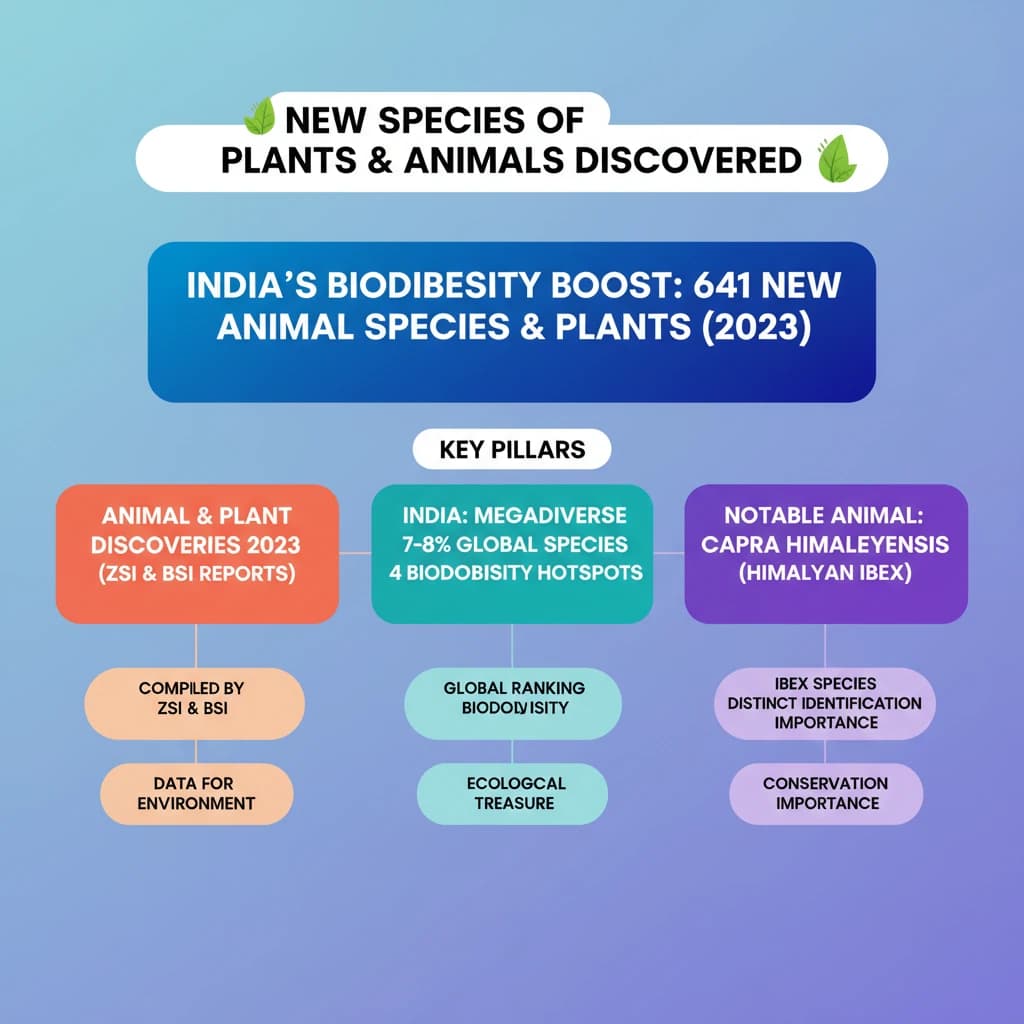
New Species of Plants and Animals Discovered is a key topic under Environment And Ecology for UPSC Civil Services Examination. Key points include: India added 641 new animal species and numerous plant species in 2023, enhancing its biodiversity database.. Discoveries were compiled in 'Animal Discoveries 2023' (ZSI) and 'Plant Discoveries 2023' (BSI).. India is a megadiverse nation, hosting 7-8% of global species and 4 biodiversity hotspots.. Understanding this topic is essential for both UPSC Prelims and Mains preparation.

Why is New Species of Plants and Animals Discovered important for UPSC exam?

New Species of Plants and Animals Discovered is a Medium-level topic in UPSC Environment And Ecology. It is tested in both Prelims (factual MCQs) and Mains (analytical answer writing). Previous year UPSC questions have frequently covered aspects of New Species of Plants and Animals Discovered, making it essential for comprehensive IAS preparation.

How to prepare New Species of Plants and Animals Discovered for UPSC?

To prepare New Species of Plants and Animals Discovered for UPSC: (1) Study the comprehensive notes covering all key concepts on Vaidra. (2) Practice previous year questions on this topic. (3) Connect it with current affairs using daily updates. (4) Revise using key takeaways and mind maps available for Environment And Ecology. (5) Write practice answers linking New Species of Plants and Animals Discovered to related GS Paper topics.

Key takeaways of New Species of Plants and Animals Discovered for UPSC

  • India added 641 new animal species and numerous plant species in 2023, enhancing its biodiversity database.
  • Discoveries were compiled in 'Animal Discoveries 2023' (ZSI) and 'Plant Discoveries 2023' (BSI).
  • India is a megadiverse nation, hosting 7-8% of global species and 4 biodiversity hotspots.
  • A significant animal discovery was Capra Himalayensis, confirming the Himalayan Ibex as distinct from Siberian Ibex.
  • New species discoveries are vital for conservation, ecosystem health monitoring, and bioprospecting.
New Species of Plants and Animals Discovered

New Species of Plants and Animals Discovered

Medium⏱️ 8 min read✓ 95% Verified
environment and ecology

📖 Introduction

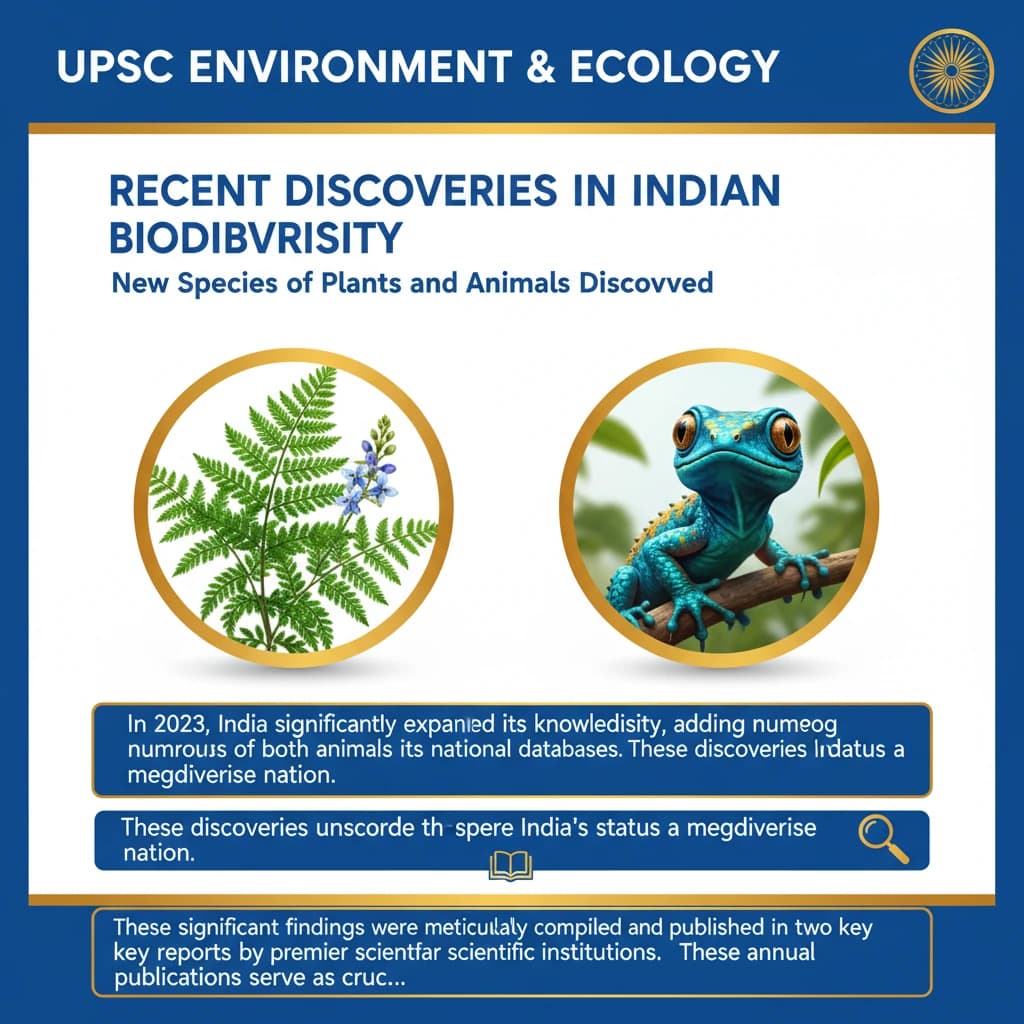
<h4>Recent Discoveries in Indian Biodiversity</h4><p>In <strong>2023</strong>, India significantly expanded its knowledge of <strong>biodiversity</strong>, adding numerous new species of both animals and plants to its national databases. These discoveries underscore India's status as a <strong>megadiverse nation</strong>.</p><p>These significant findings were meticulously compiled and published in two key reports by India's premier scientific institutions. These annual publications serve as crucial records of the country's natural heritage.</p><div class='info-box'><p>The two primary publications detailing these discoveries are:</p><ul><li><strong>“Animal Discoveries 2023”</strong> by the <strong>Zoological Survey of India (ZSI)</strong>.</li><li><strong>“Plant Discoveries 2023”</strong> by the <strong>Botanical Survey of India (BSI)</strong>.</li></ul></div><h4>India's Megadiverse Status</h4><p>India is recognized globally as a <strong>megadiverse nation</strong>, boasting an exceptional variety of life forms. This rich biodiversity is a cornerstone of its ecological and cultural landscape.</p><div class='key-point-box'><p>India accounts for approximately <strong>7-8%</strong> of the world’s documented species. It is also home to <strong>4 of the 34 globally recognized biodiversity hotspots</strong>, highlighting its critical role in global conservation efforts.</p></div><h4>Major Additions to Faunal Database</h4><p>The year <strong>2023</strong> saw a substantial increase in India's faunal database. A total of <strong>641 new species</strong> were added, reflecting ongoing efforts in wildlife exploration and documentation.</p><div class='info-box'><p>Out of the <strong>641 new faunal additions</strong>:</p><ul><li><strong>442 species</strong> were entirely <strong>new to science</strong>, meaning they had never been formally described before.</li><li><strong>199 species</strong> were <strong>newly recorded</strong> in India, indicating their first documented presence within the country's geographical boundaries.</li></ul></div><h4>Significant Animal Discovery: Capra Himalayensis</h4><p>One of the most notable animal discoveries was the recognition of <strong>Capra Himalayensis</strong>. This finding has significant implications for understanding the taxonomy and distribution of mountain ungulates in the Himalayas.</p><div class='key-point-box'><p>The discovery of <strong>Capra Himalayensis</strong> confirms that the <strong>Himalayan Ibex</strong> is a distinct species. Previously, it was often considered a subspecies of the <strong>Siberian Ibex</strong>.</p></div><p>The <strong>Himalayan Ibex</strong> is primarily distributed across the trans-Himalayan ranges. Its habitats include regions of <strong>Jammu and Kashmir</strong>, <strong>Ladakh</strong>, and <strong>Himachal Pradesh</strong>.</p><div class='exam-tip-box'><p><strong>UPSC Insight:</strong> Questions on <strong>endemic species</strong>, <strong>biodiversity hotspots</strong>, and the role of scientific institutions like <strong>ZSI</strong> and <strong>BSI</strong> are common in <strong>GS Paper III (Environment & Ecology)</strong>. Understanding the distinction between a 'new species' and a 'new record' is also important.</p></div>
Concept Diagram

💡 Key Takeaways

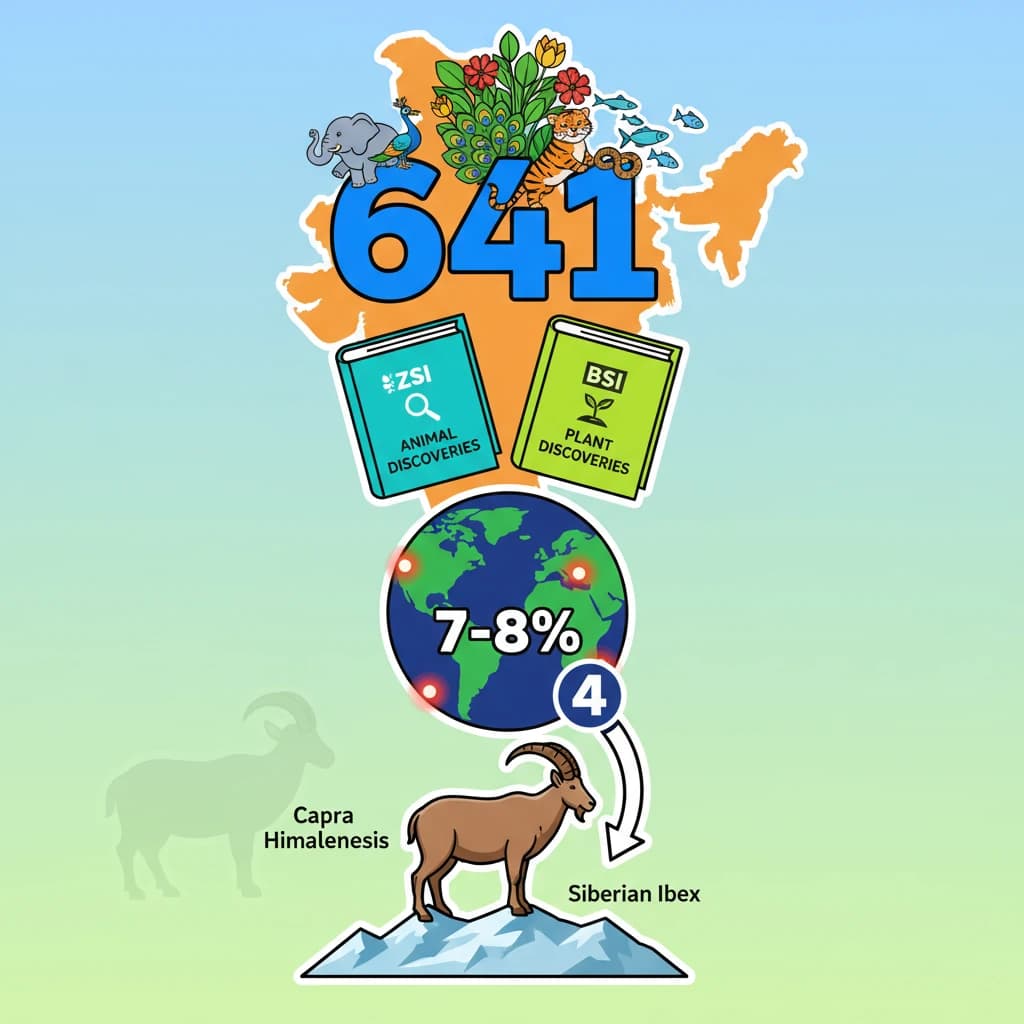
  • •India added 641 new animal species and numerous plant species in 2023, enhancing its biodiversity database.
  • •Discoveries were compiled in 'Animal Discoveries 2023' (ZSI) and 'Plant Discoveries 2023' (BSI).
  • •India is a megadiverse nation, hosting 7-8% of global species and 4 biodiversity hotspots.
  • •A significant animal discovery was Capra Himalayensis, confirming the Himalayan Ibex as distinct from Siberian Ibex.
  • •New species discoveries are vital for conservation, ecosystem health monitoring, and bioprospecting.

🧠 Memory Techniques
Memory Aid
95% Verified Content

📚 Reference Sources

•Botanical Survey of India (BSI) publication: “Plant Discoveries 2023”
•Drishti IAS Summary (provided source content)

Related Topics

Loading related topics...
Explore:Environment And Ecology Topics·All Subjects·Daily Current Affairs·Editorial Analysis·Previous Year Questions·UPSC GPT