Loading page, please wait…
Vaidra Logo
Vaidra

Top 4 items + smart groups

UPSC GPT
New
Current Affairs
Daily Solutions
Daily Puzzle
Mains Evaluator

Version 2.0.0 • Built with ❤️ for UPSC aspirants

Loading...
Loading...
Loading...
Loading...
Loading...
Loading...
Loading...
Loading...
Loading...
Loading...
Loading...
Loading...
Loading...
Back
All Subjects

Topics

0 topics • 0 completed

Loading topics...
Loading...
Loading...
Loading...
Loading...
Loading...
Overall Progress0%

What is Bio mining? - UPSC Environment And Ecology

What is What is Bio mining? in UPSC Environment And Ecology?

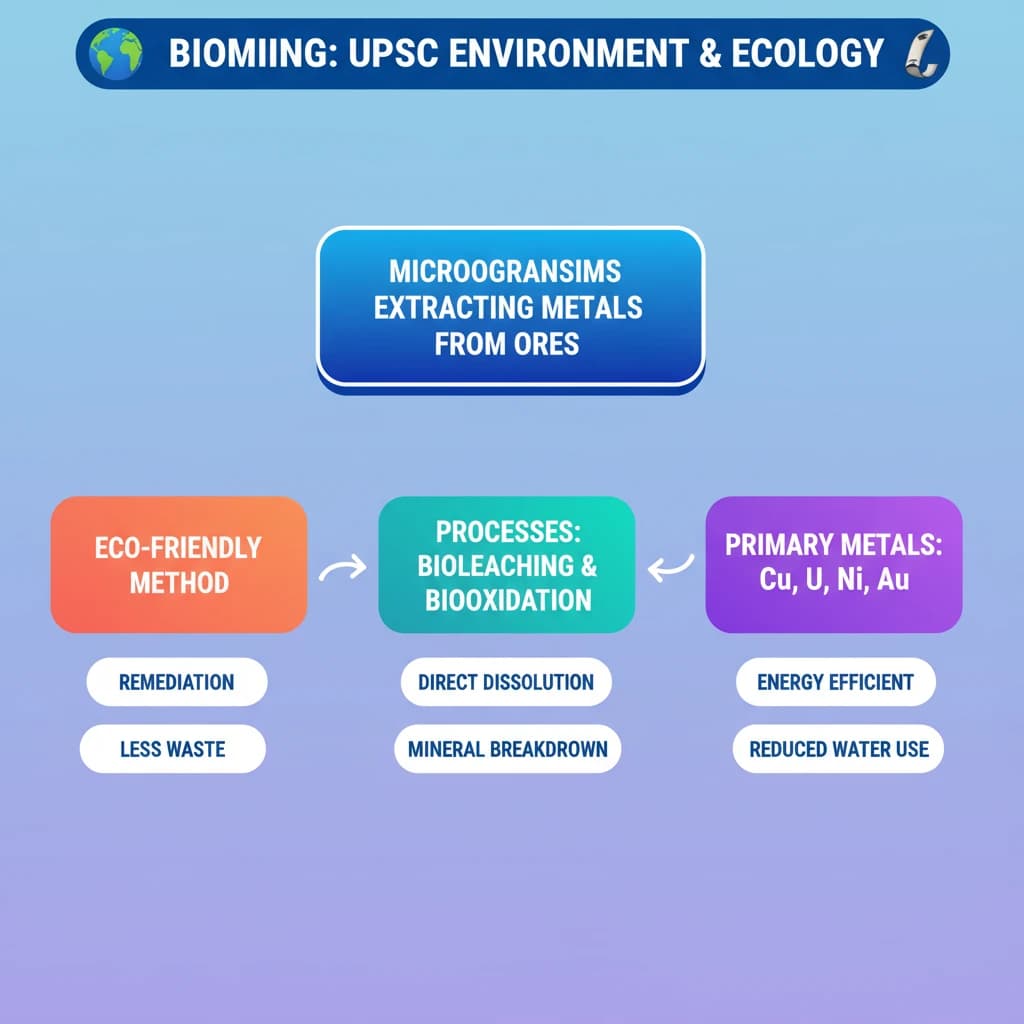
What is Bio mining? is a key topic under Environment And Ecology for UPSC Civil Services Examination. Key points include: Biomining uses microorganisms (bacteria, archaea, fungi, plants) to extract metals from ores and solid materials.. It's an eco-friendly method, also used for remediating metal-polluted sites.. Processes include Bioleaching (direct dissolution) and Biooxidation (breaking down surrounding minerals).. Understanding this topic is essential for both UPSC Prelims and Mains preparation.

Why is What is Bio mining? important for UPSC exam?

What is Bio mining? is a Medium-level topic in UPSC Environment And Ecology. It is tested in both Prelims (factual MCQs) and Mains (analytical answer writing). Previous year UPSC questions have frequently covered aspects of What is Bio mining?, making it essential for comprehensive IAS preparation.

How to prepare What is Bio mining? for UPSC?

To prepare What is Bio mining? for UPSC: (1) Study the comprehensive notes covering all key concepts on Vaidra. (2) Practice previous year questions on this topic. (3) Connect it with current affairs using daily updates. (4) Revise using key takeaways and mind maps available for Environment And Ecology. (5) Write practice answers linking What is Bio mining? to related GS Paper topics.

Key takeaways of What is Bio mining? for UPSC

  • Biomining uses microorganisms (bacteria, archaea, fungi, plants) to extract metals from ores and solid materials.
  • It's an eco-friendly method, also used for remediating metal-polluted sites.
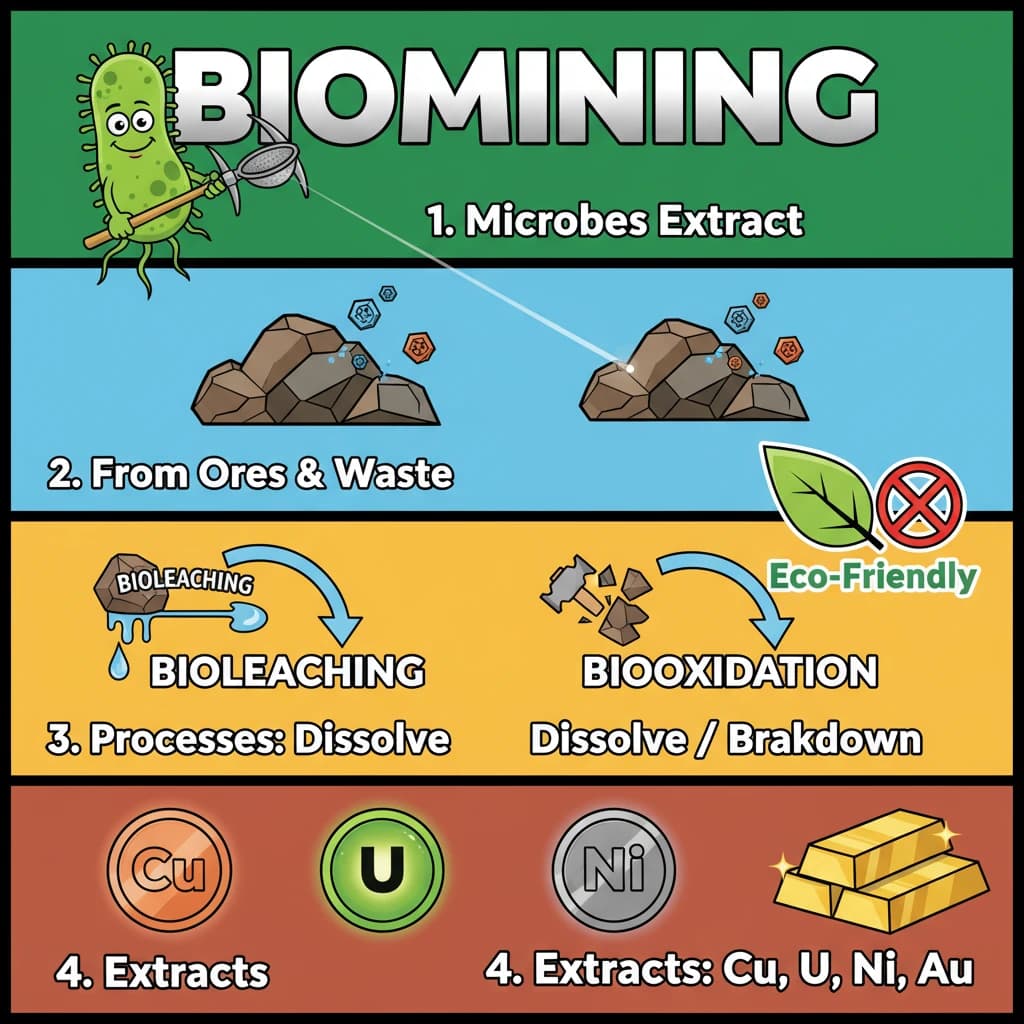
  • Processes include Bioleaching (direct dissolution) and Biooxidation (breaking down surrounding minerals).
  • Primarily extracts copper, uranium, nickel, and gold from sulfidic minerals.
  • Offers advantages: environmental sustainability (less waste, lower carbon footprint), energy efficiency, and reduced water usage.
What is Bio mining?

What is Bio mining?

Medium⏱️ 8 min read✓ 95% Verified
environment and ecology

📖 Introduction

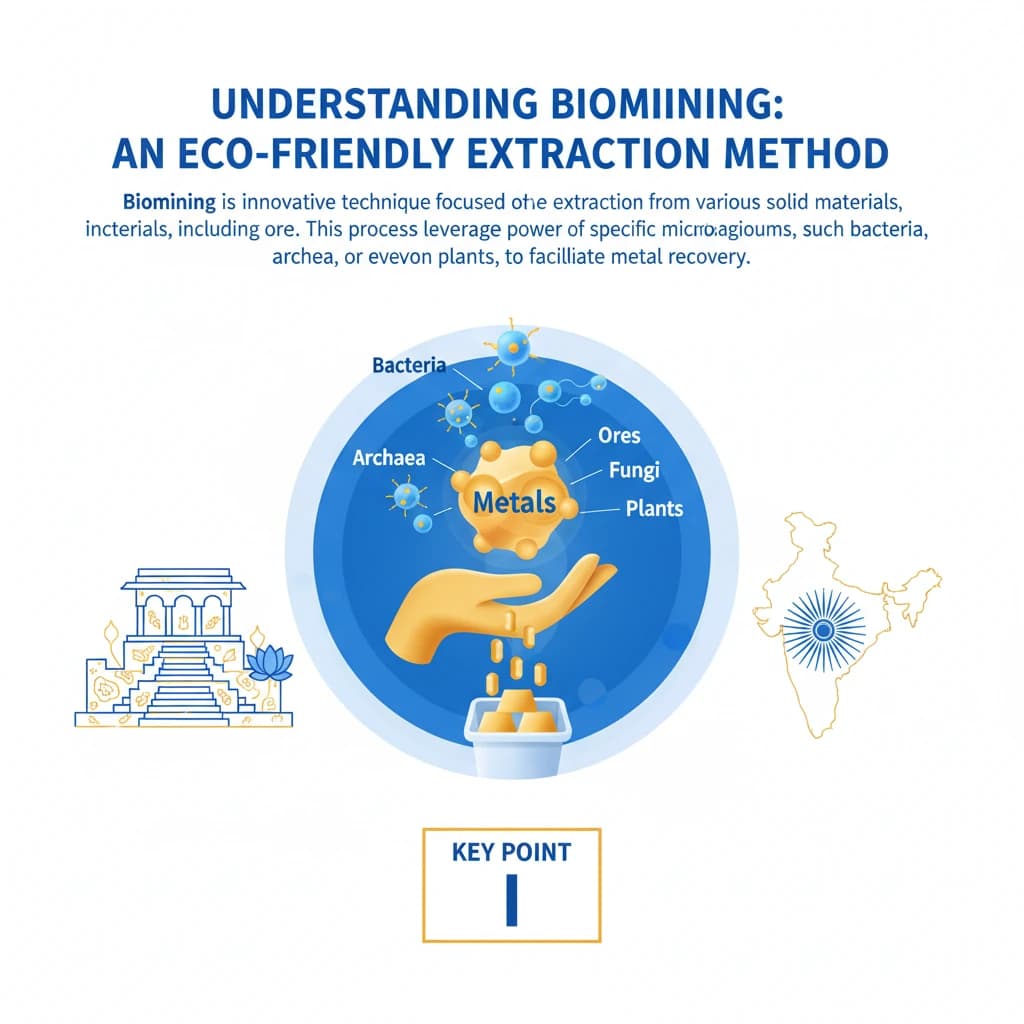
<h4>Understanding Biomining: An Eco-Friendly Extraction Method</h4><p><strong>Biomining</strong> is an innovative technique focused on the extraction of <strong>metals</strong> from various solid materials, including <strong>ores</strong>. This process leverages the power of specific <strong>microorganisms</strong>, such as <strong>bacteria</strong>, <strong>archaea</strong>, <strong>fungi</strong>, or even <strong>plants</strong>, to facilitate metal recovery.</p><div class='key-point-box'><p>It represents a significant shift towards more sustainable practices in the mining industry, offering an alternative to conventional, often environmentally intensive, methods.</p></div><p>Beyond metal extraction, biomining also serves as an effective <strong>eco-friendly technique</strong> for <strong>remediating sites</strong> contaminated by various <strong>metal pollutants</strong>. This dual application highlights its environmental benefits.</p><h4>Mechanism of Metal Extraction</h4><p>The core principle behind biomining involves the microorganisms oxidizing the target metals. This oxidation process increases the <strong>solubility</strong> of the metals, making them much easier to recover from the ore or contaminated material.</p><div class='info-box'><p><strong>Key Mechanism:</strong> Microorganisms induce <strong>oxidation</strong>, which enhances <strong>metal solubility</strong> and simplifies their subsequent extraction.</p></div><h4>Primary Processes in Biomining</h4><p>Biomining primarily employs two distinct but related processes to achieve metal extraction:</p><ul><li><strong>Bioleaching:</strong> In this process, <strong>microorganisms directly dissolve</strong> the desired <strong>target metal</strong> from its surrounding ore. This makes the metal readily available for easier and more efficient extraction.</li><li><strong>Biooxidation:</strong> Here, microbes are utilized to <strong>break down the surrounding minerals</strong> that encapsulate the target metal. By doing so, they effectively <strong>enrich the concentration</strong> of the target metal, thereby facilitating its subsequent extraction.</li></ul><h4>Metals Extracted via Biomining</h4><p>Biomining is particularly effective for extracting certain types of metals, especially those commonly found within <strong>sulfidic minerals</strong>. These include economically important elements.</p><div class='info-box'><p><strong>Commonly Extracted Metals:</strong></p><ul><li><strong>Copper</strong></li><li><strong>Uranium</strong></li><li><strong>Nickel</strong></li><li><strong>Gold</strong></li></ul></div><h4>Advantages of Biomining</h4><p>The adoption of biomining offers several significant advantages over traditional mining techniques, particularly in terms of environmental impact and operational efficiency:</p><ul><li><strong>Environmental Sustainability:</strong> It generates <strong>minimal hazardous waste</strong> and significantly <strong>reduces the carbon footprint</strong> associated with metal extraction, making it a much greener option.</li><li><strong>Energy Efficiency:</strong> Biomining processes generally require <strong>less energy</strong> compared to conventional methods. This directly translates to lower operational costs and a reduction in overall <strong>greenhouse gas emissions</strong>.</li><li><strong>Reduced Water Usage:</strong> This technique employs water more efficiently, making it particularly beneficial and sustainable in regions facing <strong>water scarcity</strong>.</li></ul><div class='exam-tip-box'><p><strong>UPSC Insight:</strong> Understanding the advantages of <strong>biomining</strong> is crucial for questions on <strong>sustainable development</strong>, <strong>environmental technology</strong>, and <strong>resource management</strong>. Focus on its eco-friendly nature and efficiency benefits.</p></div>
Concept Diagram

💡 Key Takeaways

  • •Biomining uses microorganisms (bacteria, archaea, fungi, plants) to extract metals from ores and solid materials.
  • •It's an eco-friendly method, also used for remediating metal-polluted sites.
  • •Processes include Bioleaching (direct dissolution) and Biooxidation (breaking down surrounding minerals).
  • •Primarily extracts copper, uranium, nickel, and gold from sulfidic minerals.
  • •Offers advantages: environmental sustainability (less waste, lower carbon footprint), energy efficiency, and reduced water usage.

🧠 Memory Techniques
Memory Aid
95% Verified Content

Related Topics

Loading related topics...
Explore:Environment And Ecology Topics·All Subjects·Daily Current Affairs·Editorial Analysis·Previous Year Questions·UPSC GPT
What is Bio mining? - UPSC Environment And Ecology