Loading page, please wait…
Vaidra Logo
Vaidra

Top 4 items + smart groups

UPSC GPT
New
Current Affairs
Daily Solutions
Daily Puzzle
Mains Evaluator

Version 2.0.0 • Built with ❤️ for UPSC aspirants

Loading...
Loading...
Loading...
Loading...
Loading...
Loading...
Loading...
Loading...
Loading...
Loading...
Loading...
Loading...
Loading...

Solid Waste Management Rules 2016 - UPSC Environment And Ecology

What is Solid Waste Management Rules 2016 in UPSC Environment And Ecology?

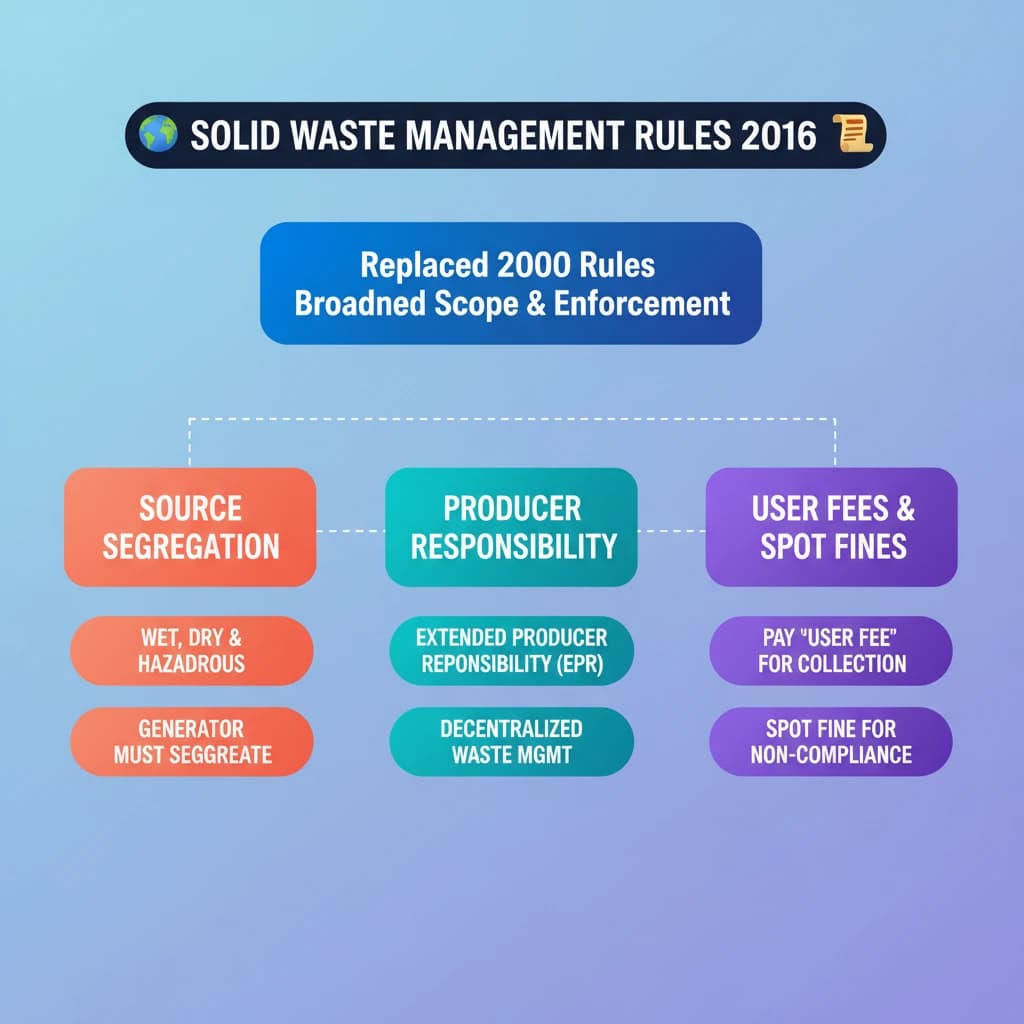
Solid Waste Management Rules 2016 is a key topic under Environment And Ecology for UPSC Civil Services Examination. Key points include: SWM Rules 2016 replaced the 2000 rules, broadening scope and strengthening enforcement.. Key focus: Source segregation, manufacturer responsibility, and user fees.. Waste generators must segregate into wet, dry, and domestic hazardous streams.. Understanding this topic is essential for both UPSC Prelims and Mains preparation.

Why is Solid Waste Management Rules 2016 important for UPSC exam?

Solid Waste Management Rules 2016 is a Medium-level topic in UPSC Environment And Ecology. It is tested in both Prelims (factual MCQs) and Mains (analytical answer writing). Previous year UPSC questions have frequently covered aspects of Solid Waste Management Rules 2016, making it essential for comprehensive IAS preparation.

How to prepare Solid Waste Management Rules 2016 for UPSC?

To prepare Solid Waste Management Rules 2016 for UPSC: (1) Study the comprehensive notes covering all key concepts on Vaidra. (2) Practice previous year questions on this topic. (3) Connect it with current affairs using daily updates. (4) Revise using key takeaways and mind maps available for Environment And Ecology. (5) Write practice answers linking Solid Waste Management Rules 2016 to related GS Paper topics.

Key takeaways of Solid Waste Management Rules 2016 for UPSC

  • SWM Rules 2016 replaced the 2000 rules, broadening scope and strengthening enforcement.
  • Key focus: Source segregation, manufacturer responsibility, and user fees.
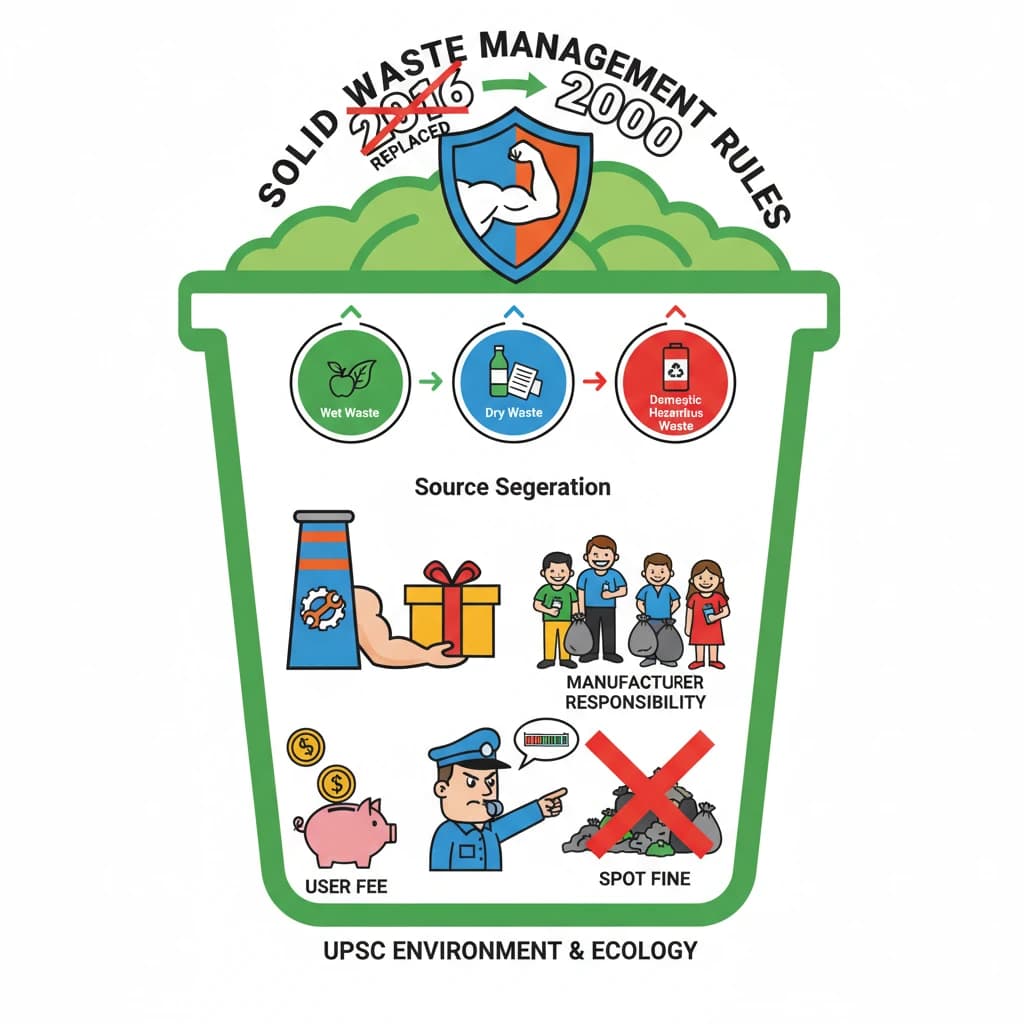
  • Waste generators must segregate into wet, dry, and domestic hazardous streams.
  • Generators pay 'User Fee' and face 'Spot Fine' for non-compliance.
  • Rules promote Extended Producer Responsibility and decentralized waste management.
Solid Waste Management Rules 2016

Solid Waste Management Rules 2016

Medium⏱️ 7 min read✓ 95% Verified
environment and ecology

📖 Introduction

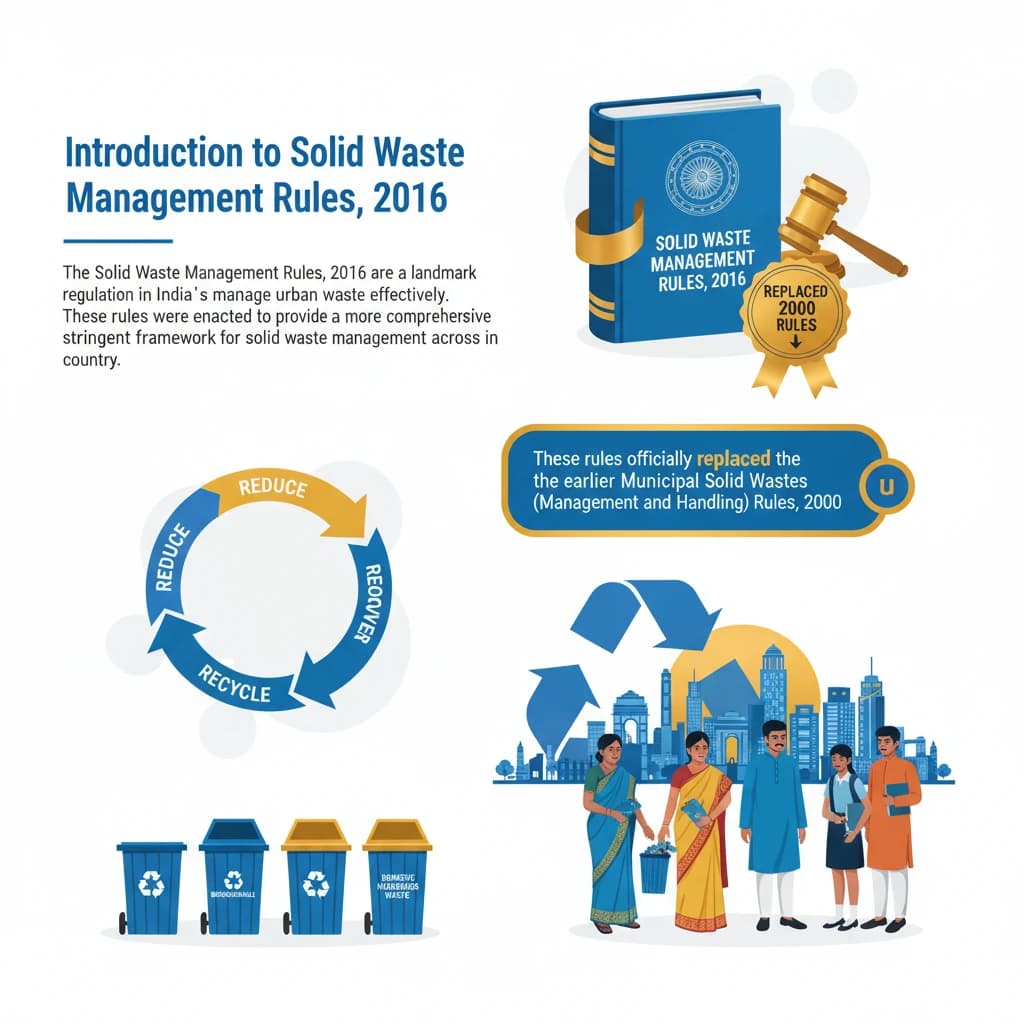
<h4>Introduction to Solid Waste Management Rules, 2016</h4><p>The <strong>Solid Waste Management Rules, 2016</strong> are a landmark regulation in India's efforts to manage urban waste effectively. These rules were enacted to provide a more comprehensive and stringent framework for solid waste management across the country.</p><div class='info-box'><p>These rules officially <strong>replaced</strong> the earlier <strong>Municipal Solid Wastes (Management and Handling) Rules, 2000</strong>. This update reflected a shift towards more proactive and decentralized waste management practices.</p></div><h4>Core Focus Areas of the 2016 Rules</h4><p>The <strong>Solid Waste Management Rules, 2016</strong> introduced several critical areas of focus to enhance waste management efficiency and accountability.</p><ul><li><strong>Segregation of Waste at Source:</strong> A primary emphasis is placed on the separation of waste at the point of generation, which is crucial for effective processing and recycling.</li><li><strong>Manufacturer's Responsibility:</strong> The rules assign specific duties to manufacturers regarding the disposal of certain types of waste, particularly <strong>sanitary and packaging wastes</strong>.</li><li><strong>User Fees for Generators:</strong> A system of user fees was introduced for the collection, disposal, and processing of waste, particularly targeting <strong>bulk generators</strong>.</li></ul><h4>Key Features and Generator Responsibilities</h4><p>The 2016 Rules significantly expanded the responsibilities of <strong>waste generators</strong>, making them active participants in the waste management cycle from the very beginning.</p><div class='key-point-box'><p><strong>Mandatory Waste Segregation:</strong> Generators are now mandated to segregate their waste into <strong>three distinct streams</strong> at the source itself. This is a fundamental shift from previous practices.</p></div><ul><li><strong>Wet Waste (Biodegradable):</strong> This stream includes organic materials like food waste, vegetable peels, and garden waste, suitable for composting.</li><li><strong>Dry Waste:</strong> Comprises non-biodegradable materials such as <strong>plastic, paper, metal, wood, and glass</strong>, which can often be recycled.</li><li><strong>Domestic Hazardous Wastes:</strong> This category includes items like <strong>diapers, sanitary pads, mosquito repellents, discarded medicines, and electronic waste</strong>, requiring special handling.</li></ul><p>Once segregated, generators are responsible for handing over these wastes to <strong>authorised rag-pickers</strong>, designated <strong>waste collectors</strong>, or directly to the <strong>local bodies</strong> responsible for waste management.</p><h4>Financial Obligations of Waste Generators</h4><p>To ensure financial sustainability and compliance, the rules introduced specific monetary obligations for waste generators.</p><ul><li><strong>'User Fee':</strong> Generators are required to pay a '<strong>User Fee</strong>' to the waste collectors for the services rendered in collecting, transporting, and processing their segregated waste.</li><li><strong>'Spot Fine':</strong> A provision for '<strong>Spot Fine</strong>' was introduced to deter non-compliance. Generators can be fined for acts such as <strong>littering</strong> or failing to perform <strong>waste segregation</strong> at source.</li></ul><div class='exam-tip-box'><p>Understanding the <strong>three-stream segregation</strong> and the concept of <strong>generator responsibility</strong> is crucial for UPSC Mains questions on urban governance and environmental policy. Note the shift from municipal responsibility to shared responsibility.</p></div>
Concept Diagram

💡 Key Takeaways

  • •SWM Rules 2016 replaced the 2000 rules, broadening scope and strengthening enforcement.
  • •Key focus: Source segregation, manufacturer responsibility, and user fees.
  • •Waste generators must segregate into wet, dry, and domestic hazardous streams.
  • •Generators pay 'User Fee' and face 'Spot Fine' for non-compliance.
  • •Rules promote Extended Producer Responsibility and decentralized waste management.

🧠 Memory Techniques
Memory Aid
95% Verified Content

📚 Reference Sources

•Ministry of Environment, Forest and Climate Change (MoEFCC) website (for official rules confirmation)

Related Topics

Loading related topics...
Explore:Environment And Ecology Topics·All Subjects·Daily Current Affairs·Editorial Analysis·Previous Year Questions·UPSC GPT
Back
All Subjects

Topics

0 topics • 0 completed

Loading topics...
Loading...
Loading...
Loading...
Loading...
Loading...
Overall Progress0%
Solid Waste Management Rules 2016 - UPSC Environment And Ecology