Loading page, please wait…
Vaidra Logo
Vaidra

Top 4 items + smart groups

UPSC GPT
New
Current Affairs
Daily Solutions
Daily Puzzle
Mains Evaluator

Version 2.0.0 • Built with ❤️ for UPSC aspirants

Loading...
Loading...
Loading...
Loading...
Loading...
Loading...
Loading...
Loading...
Loading...
Loading...
Loading...
Loading...
Loading...
Back
All Subjects

Topics

0 topics • 0 completed

Loading topics...
Loading...
Loading...
Loading...
Loading...
Loading...
Overall Progress0%
UNESCO Designates 11 New Biosphere Reserves - UPSC Environment And Ecology

UNESCO Designates 11 New Biosphere Reserves - UPSC Environment And Ecology

What is UNESCO Designates 11 New Biosphere Reserves in UPSC Environment And Ecology?

UNESCO Designates 11 New Biosphere Reserves is a key topic under Environment And Ecology for UPSC Civil Services Examination. Key points include: UNESCO designated 11 new Biosphere Reserves (BRs) in 11 countries.. Biosphere Reserves are sites under UNESCO's Man and the Biosphere (MAB) Programme.. BRs aim to reconcile biodiversity conservation with sustainable development.. Understanding this topic is essential for both UPSC Prelims and Mains preparation.

Why is UNESCO Designates 11 New Biosphere Reserves important for UPSC exam?

UNESCO Designates 11 New Biosphere Reserves is a Medium-level topic in UPSC Environment And Ecology. It is tested in both Prelims (factual MCQs) and Mains (analytical answer writing). Previous year UPSC questions have frequently covered aspects of UNESCO Designates 11 New Biosphere Reserves, making it essential for comprehensive IAS preparation.

How to prepare UNESCO Designates 11 New Biosphere Reserves for UPSC?

To prepare UNESCO Designates 11 New Biosphere Reserves for UPSC: (1) Study the comprehensive notes covering all key concepts on Vaidra. (2) Practice previous year questions on this topic. (3) Connect it with current affairs using daily updates. (4) Revise using key takeaways and mind maps available for Environment And Ecology. (5) Write practice answers linking UNESCO Designates 11 New Biosphere Reserves to related GS Paper topics.

Key takeaways of UNESCO Designates 11 New Biosphere Reserves for UPSC

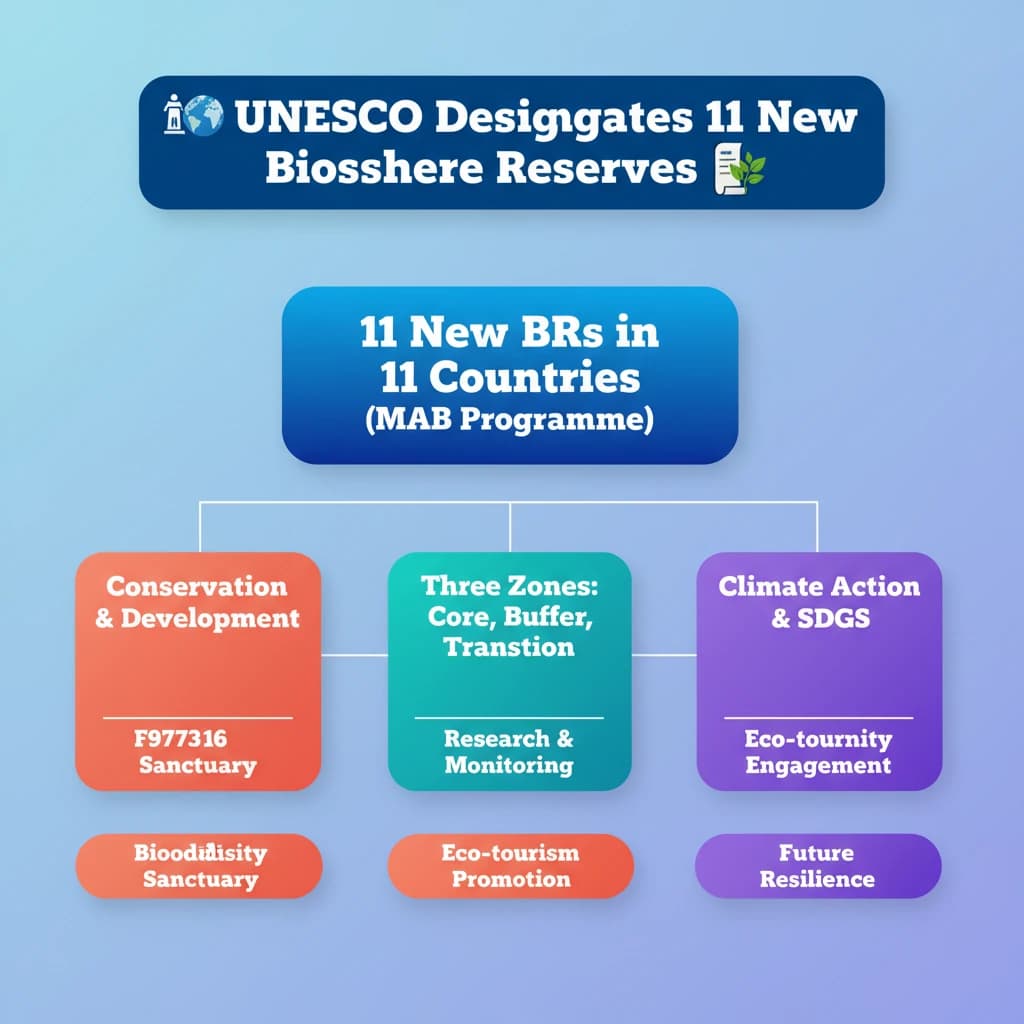
  • UNESCO designated 11 new Biosphere Reserves (BRs) in 11 countries.
  • Biosphere Reserves are sites under UNESCO's Man and the Biosphere (MAB) Programme.
  • BRs aim to reconcile biodiversity conservation with sustainable development.
  • They have three zones: core, buffer, and transition, each with specific functions.
  • BRs are crucial for climate change adaptation, achieving SDGs, and promoting eco-tourism.
UNESCO Designates 11 New Biosphere Reserves

UNESCO Designates 11 New Biosphere Reserves

Medium⏱️ 7 min read✓ 98% Verified
environment and ecology

📖 Introduction

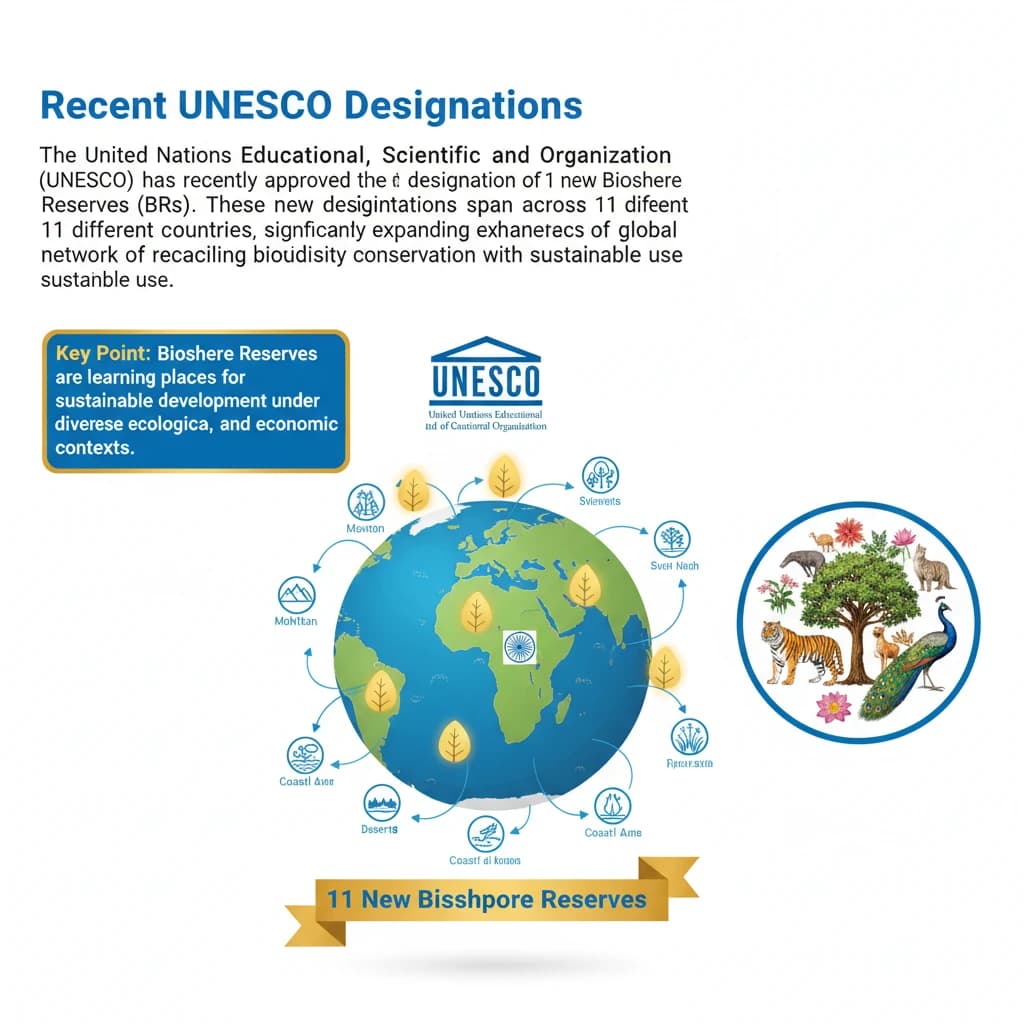
<h4>Recent UNESCO Designations</h4><p>The <strong>United Nations Educational, Scientific and Cultural Organization (UNESCO)</strong> has recently approved the designation of <strong>11 new Biosphere Reserves (BRs)</strong>.</p><p>These new designations span across <strong>11 different countries</strong>, significantly expanding the global network of sites dedicated to reconciling biodiversity conservation with sustainable use.</p><div class='key-point-box'><p><strong>Key Point:</strong> Biosphere Reserves are sites established by countries and recognized under <strong>UNESCO's Man and the Biosphere (MAB) Programme</strong> to promote sustainable development based on local community efforts and sound science.</p></div><h4>Understanding Biosphere Reserves (BRs)</h4><p>A <strong>Biosphere Reserve</strong> is an international designation by UNESCO for representative parts of natural and cultural landscapes extending over large areas of terrestrial or coastal/marine ecosystems or a combination thereof.</p><p>They are intended to conserve <strong>biodiversity</strong> and promote <strong>sustainable development</strong>, fostering a balanced relationship between humans and nature.</p><div class='exam-tip-box'><p><strong>UPSC Insight:</strong> Questions on <strong>international environmental conventions</strong> and <strong>conservation initiatives</strong>, like UNESCO's MAB programme and Biosphere Reserves, are frequent in <strong>GS Paper III (Environment)</strong>. Be prepared to discuss their objectives and significance.</p></div><h4>Objectives of Biosphere Reserves</h4><ul><li><strong>Conservation:</strong> Protecting landscapes, ecosystems, species, and genetic variation.</li><li><strong>Development:</strong> Fostering economic and human development that is socio-culturally and ecologically sustainable.</li><li><strong>Logistic Support:</strong> Providing support for research, monitoring, education, and information exchange related to local, national, and global issues of conservation and sustainable development.</li></ul>
Concept Diagram

💡 Key Takeaways

  • •UNESCO designated 11 new Biosphere Reserves (BRs) in 11 countries.
  • •Biosphere Reserves are sites under UNESCO's Man and the Biosphere (MAB) Programme.
  • •BRs aim to reconcile biodiversity conservation with sustainable development.
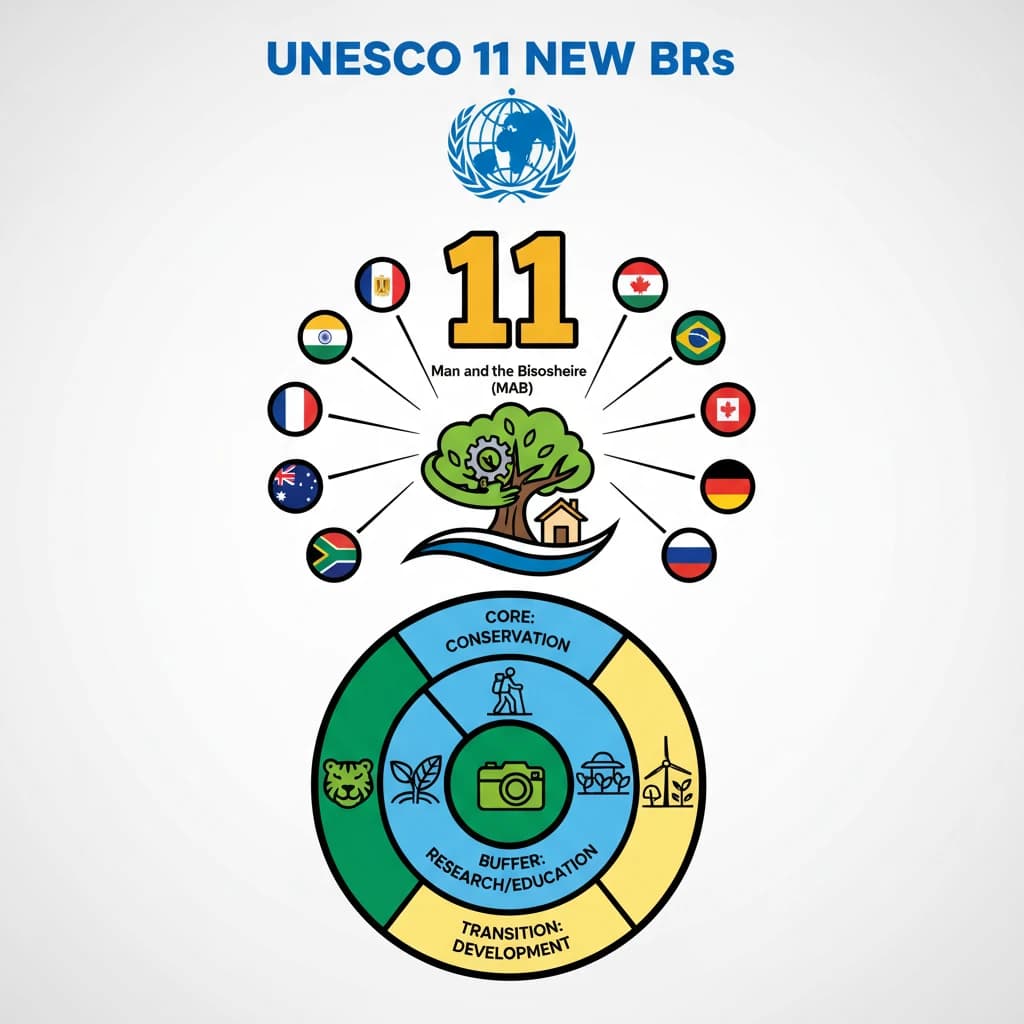
  • •They have three zones: core, buffer, and transition, each with specific functions.
  • •BRs are crucial for climate change adaptation, achieving SDGs, and promoting eco-tourism.

🧠 Memory Techniques
Memory Aid
98% Verified Content

📚 Reference Sources

•UNESCO official website (Man and the Biosphere Programme)
•Ministry of Environment, Forest and Climate Change (MoEFCC), Government of India

Related Topics

Loading related topics...
Explore:Environment And Ecology Topics·All Subjects·Daily Current Affairs·Editorial Analysis·Previous Year Questions·UPSC GPT