Loading page, please wait…
Forest Advisory Committee (FAC) - UPSC Environment And Ecology
What is Forest Advisory Committee (FAC) in UPSC Environment And Ecology?
Forest Advisory Committee (FAC) is a key topic under Environment And Ecology for UPSC Civil Services Examination. Key points include: FAC is a statutory body under MoEF&CC, established by the Forest (Conservation) Act, 1980.. Its primary role is to evaluate and approve proposals for diverting forest land for non-forest purposes.. The Forest (Conservation) Act, 1980, mandates prior Central Government approval for such diversions.. Understanding this topic is essential for both UPSC Prelims and Mains preparation.
Why is Forest Advisory Committee (FAC) important for UPSC exam?
Forest Advisory Committee (FAC) is a Medium-level topic in UPSC Environment And Ecology. It is tested in both Prelims (factual MCQs) and Mains (analytical answer writing). Previous year UPSC questions have frequently covered aspects of Forest Advisory Committee (FAC), making it essential for comprehensive IAS preparation.
How to prepare Forest Advisory Committee (FAC) for UPSC?
To prepare Forest Advisory Committee (FAC) for UPSC: (1) Study the comprehensive notes covering all key concepts on Vaidra. (2) Practice previous year questions on this topic. (3) Connect it with current affairs using daily updates. (4) Revise using key takeaways and mind maps available for Environment And Ecology. (5) Write practice answers linking Forest Advisory Committee (FAC) to related GS Paper topics.
Key takeaways of Forest Advisory Committee (FAC) for UPSC
- FAC is a statutory body under MoEF&CC, established by the Forest (Conservation) Act, 1980.
- Its primary role is to evaluate and approve proposals for diverting forest land for non-forest purposes.
- The Forest (Conservation) Act, 1980, mandates prior Central Government approval for such diversions.
- The Godavarman Judgement (1996) significantly expanded the definition of 'forest' to include all areas resembling forests, regardless of classification.
- FAC acts as a critical check and balance in development projects impacting forest ecosystems, as seen in the Odisha airport case.
Forest Advisory Committee (FAC)
Medium⏱️ 7 min read
environment and ecology
📖 Introduction
Why in News?
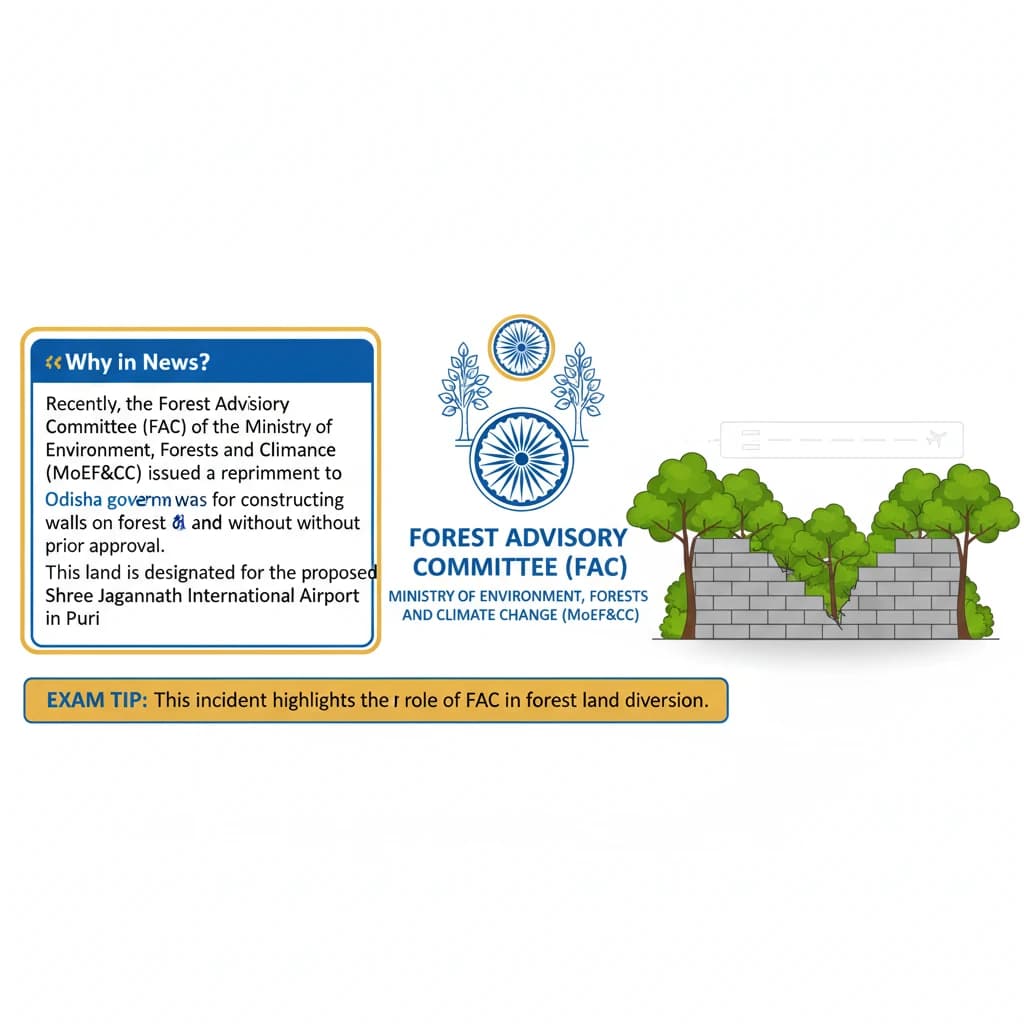
Recently, the Forest Advisory Committee (FAC) of the Ministry of Environment, Forests and Climate Change (MoEF&CC) issued a reprimand to the Odisha government.
The reprimand was for constructing walls on forest land without prior approval. This land is designated for the proposed Shree Jagannath International Airport in Puri.
This incident highlights the critical role of the FAC in ensuring compliance with environmental regulations, particularly the Forest (Conservation) Act, 1980.
What is the Forest Advisory Committee (FAC)?
The Forest Advisory Committee (FAC) is a statutory body established under the provisions of the Forest (Conservation) Act, 1980.
It operates under the administrative control of the Ministry of Environment, Forests & Climate Change (MoEF&CC).
- Nature: Statutory body
- Parent Act: Forest (Conservation) Act, 1980
- Ministry: Ministry of Environment, Forests & Climate Change (MoEF&CC)
The primary function of the FAC is to evaluate industrial or developmental projects that necessitate the diversion of forest land for non-forest activities.
The committee holds the authority to either approve or reject such projects. It can also grant approval with specific conditions attached to mitigate environmental impact.
In the recent Odisha case, satellite imagery revealed that the agency involved had already commenced wall construction without awaiting the necessary approval from the FAC, demonstrating a clear violation of protocol.
The FAC's approval is mandatory for any project involving the diversion of forest land, underscoring its role as a gatekeeper for forest conservation.
What is the Forest Conservation Act, 1980?
The Forest Conservation Act (FCA) of 1980 was enacted with the objective of streamlining forest-related laws and regulating various activities impacting forest ecosystems.
Its key aims include controlling deforestation, overseeing the transportation of forest products, and levying duties on timber and other forest produce.
- Enactment Year: 1980
- Primary Goal: Regulate deforestation and forest land diversion.
- Key Requirement: Prior Central Government approval for non-forest use of forest land.
A crucial provision of this Act mandates that prior approval from the Central Government is essential before any forest land can be diverted for non-forest purposes.
Initially, the FCA 1980 primarily applied to lands recognized as forests under the Indian Forest Act, 1927, or those recorded as forest land in State records since 1980.
Supreme Court's Interpretation: Godavarman Judgement, 1996
A landmark ruling by the Supreme Court in the T.N. Godavarman Thirumulpad vs Union of India case in 1996 significantly broadened the scope of forest protection.
This judgement, often referred to as the Godavarman judgement, mandated the protection of all forests, irrespective of their official classification or ownership status.
The Godavarman judgement is a pivotal legal precedent for environmental law in India, extending the protective ambit of the FCA 1980 to 'deemed forests' and unrecorded forest areas.
This ruling ensured that the definition of "forest" for the purpose of the FCA 1980 is not limited to legally notified forests but includes any area that fits the dictionary meaning of a forest.
💡 Key Takeaways
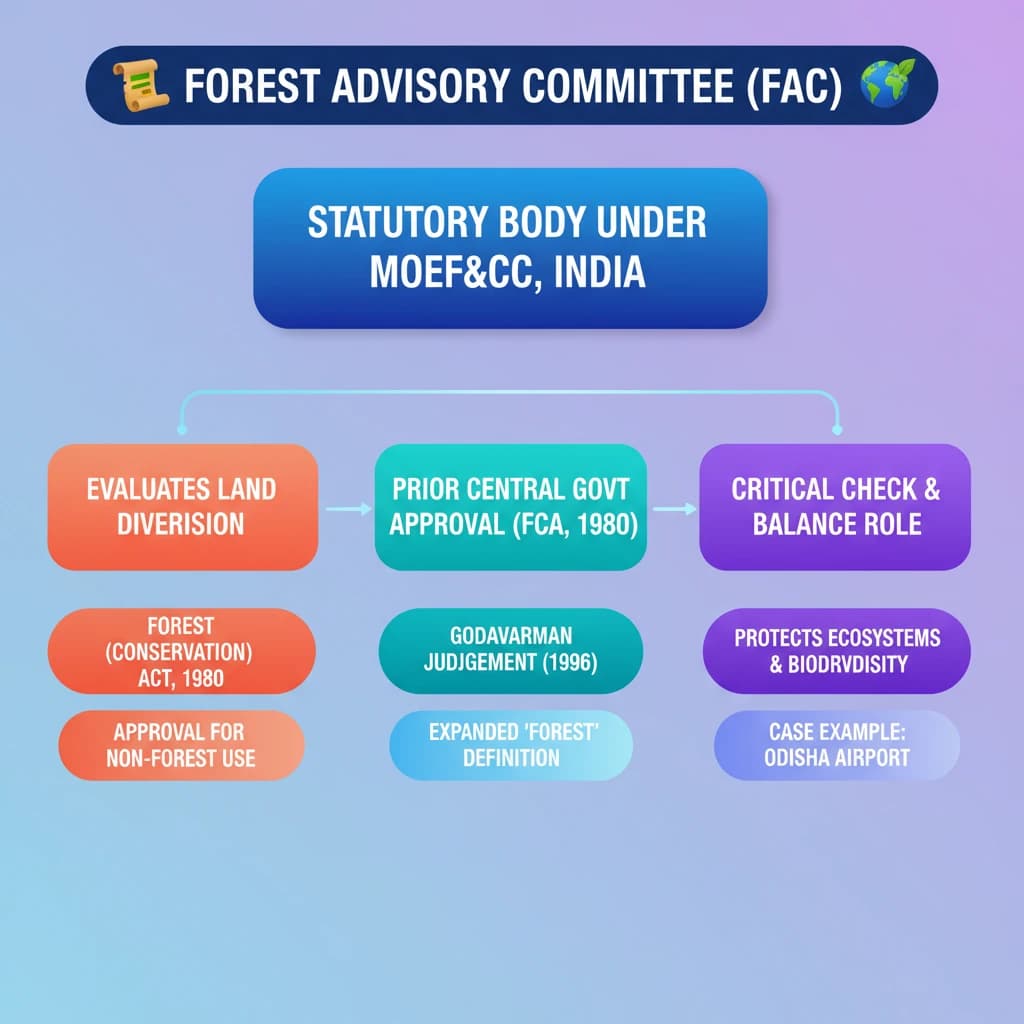
- •FAC is a statutory body under MoEF&CC, established by the Forest (Conservation) Act, 1980.
- •Its primary role is to evaluate and approve proposals for diverting forest land for non-forest purposes.
- •The Forest (Conservation) Act, 1980, mandates prior Central Government approval for such diversions.
- •The Godavarman Judgement (1996) significantly expanded the definition of 'forest' to include all areas resembling forests, regardless of classification.
- •FAC acts as a critical check and balance in development projects impacting forest ecosystems, as seen in the Odisha airport case.
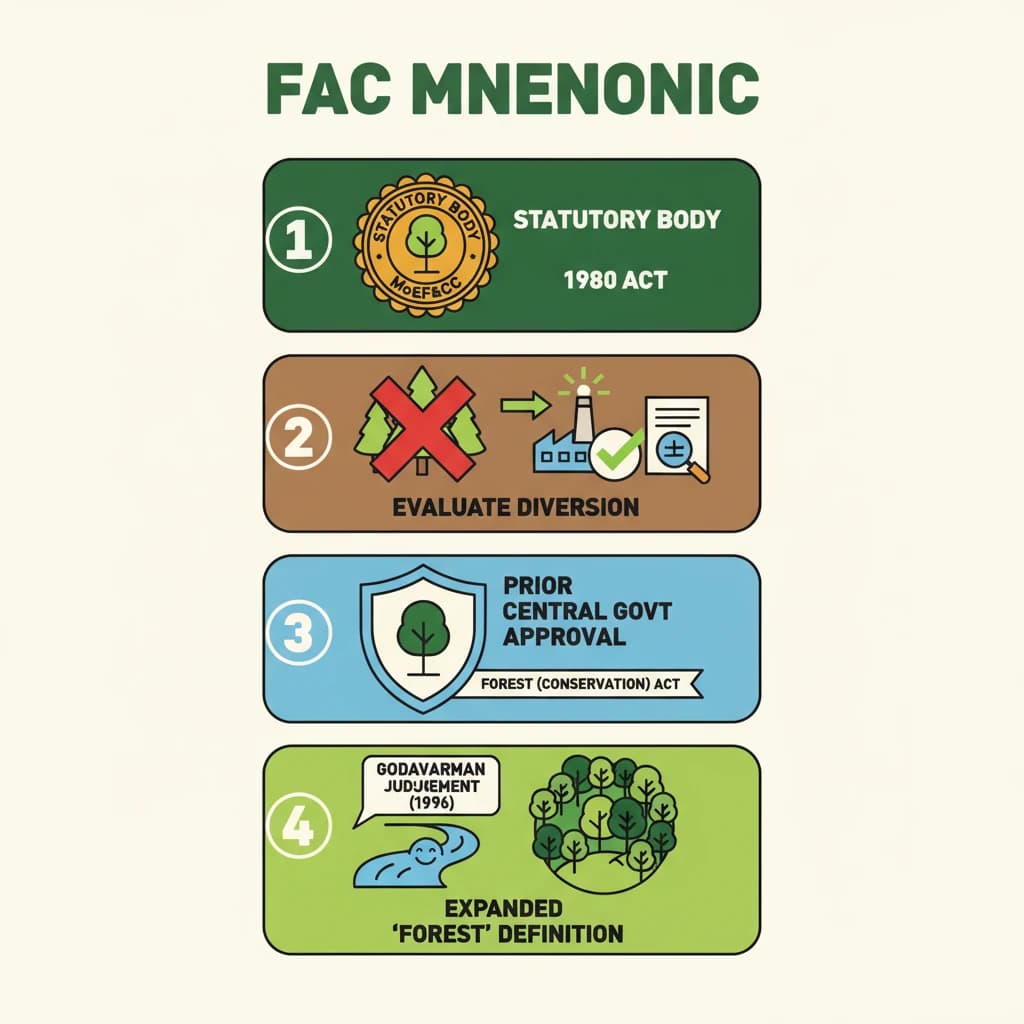
🧠 Memory Techniques
95% Verified Content