Loading page, please wait…
Increase in Coastal Erosion - UPSC Environment And Ecology
What is Increase in Coastal Erosion in UPSC Environment And Ecology?
Increase in Coastal Erosion is a key topic under Environment And Ecology for UPSC Civil Services Examination. Key points include: Coastal erosion is the loss of land due to sea action, significantly impacting areas like Tamil Nadu.. Nearly 43% of Tamil Nadu's coast is eroding, with annual land loss rates up to 3 meters.. Anthropogenic structures (ports, breakwaters) disrupt natural sand movement, accelerating erosion.. Understanding this topic is essential for both UPSC Prelims and Mains preparation.
Why is Increase in Coastal Erosion important for UPSC exam?
Increase in Coastal Erosion is a Medium-level topic in UPSC Environment And Ecology. It is tested in both Prelims (factual MCQs) and Mains (analytical answer writing). Previous year UPSC questions have frequently covered aspects of Increase in Coastal Erosion, making it essential for comprehensive IAS preparation.
How to prepare Increase in Coastal Erosion for UPSC?
To prepare Increase in Coastal Erosion for UPSC: (1) Study the comprehensive notes covering all key concepts on Vaidra. (2) Practice previous year questions on this topic. (3) Connect it with current affairs using daily updates. (4) Revise using key takeaways and mind maps available for Environment And Ecology. (5) Write practice answers linking Increase in Coastal Erosion to related GS Paper topics.
Key takeaways of Increase in Coastal Erosion for UPSC
- Coastal erosion is the loss of land due to sea action, significantly impacting areas like Tamil Nadu.
- Nearly 43% of Tamil Nadu's coast is eroding, with annual land loss rates up to 3 meters.
- Anthropogenic structures (ports, breakwaters) disrupt natural sand movement, accelerating erosion.
- Natural factors like wind and sea current patterns, especially during monsoons, influence coastal dynamics.
- Beyond direct coastal impact, environmental changes like increased CO2 can impact other ecosystems (e.g., grasslands).
- Sustainable coastal management and Integrated Coastal Zone Management (ICZM) are crucial to mitigate the effects.
Increase in Coastal Erosion
Medium⏱️ 8 min read
environment and ecology
📖 Introduction
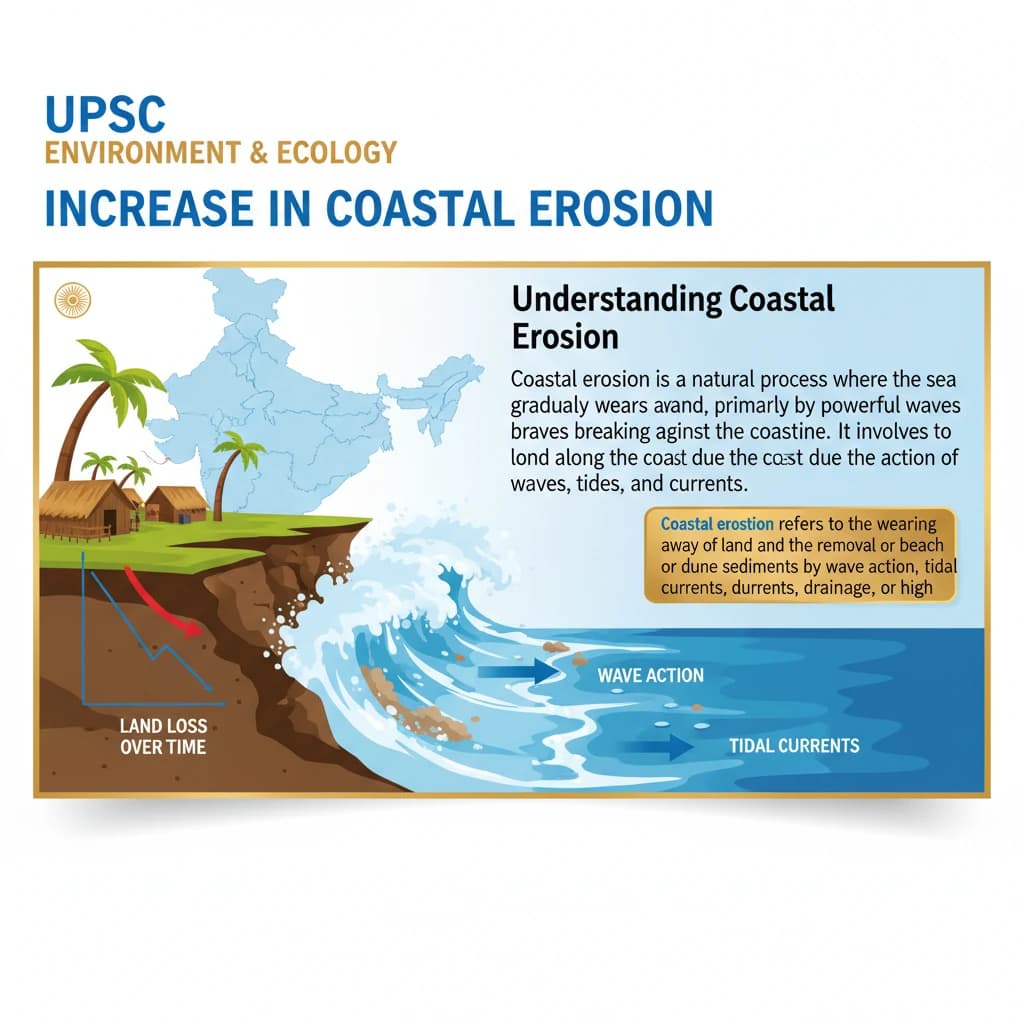
Understanding Coastal Erosion
Coastal erosion is a natural process where the sea gradually wears away land, primarily driven by powerful waves breaking against the coastline. It involves the loss of land along the coast due to the action of waves, tides, and currents.
Coastal erosion refers to the wearing away of land and the removal of beach or dune sediments by wave action, tidal currents, wave currents, drainage, or high winds.
Coastal Erosion in Tamil Nadu: A Critical Concern
A recent study has highlighted the severe threat posed by coastal erosion to the livelihoods of fishers and other inhabitants along the coast of Tamil Nadu.
The study reveals alarming statistics regarding land loss in the state.
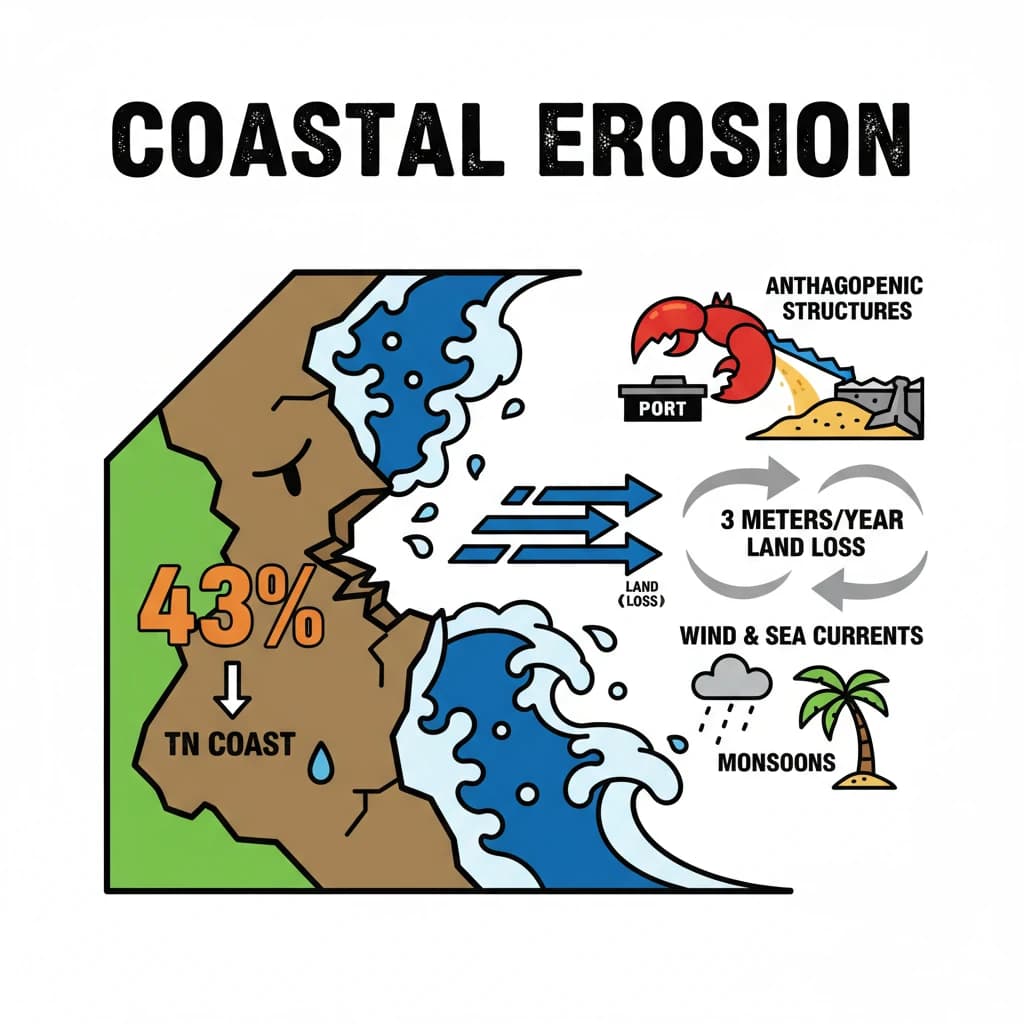
- Approximately 43% of Tamil Nadu's coast is currently facing erosion.
- This erosion has resulted in a significant loss of over 4,450 acres of land.
- The rate of erosion is increasing by 3 metres per year on the east coast.
- On the west coast, the erosion rate is approximately 2.5 metres per year.
Ironically, some development projects, initially intended to boost economic growth and prevent sea erosion, are exacerbating the problem by altering the natural shoreline dynamics.
Mechanism of Erosion on the Tamil Nadu Coast
The study provides specific insights into the mechanics of erosion along the Tamil Nadu coast, primarily influenced by natural wind and sea current patterns.
- For about eight months of the year, wind and sea currents predominantly flow from south to north, carrying sand along the coast.
- During the northeast monsoon period (approximately four months), these currents reverse direction, flowing from north to south.
The construction of artificial structures significantly disrupts this natural sediment transport.
When structures such as ports, breakwaters, or groynes are built extending into the sea, they act as barriers. These barriers block the natural, seasonal movement of sand along the coast.
This blockage causes sand to accumulate excessively on one side of the structure, while simultaneously leading to a severe loss of sand and subsequent erosion on the other side.
This artificial imbalance accelerates coastal erosion, causing waves to penetrate further inland and intensifying the risk to vulnerable coastal communities and ecosystems.
Broader Ecological Implications: Grassland Ecosystems
Beyond direct coastal impacts, the increase in certain environmental factors can have wider ecological consequences, such as those observed in grassland ecosystems.
Higher atmospheric CO2 levels can promote the growth of deep-rooted woody plants. These woody plants can then overshadow and suppress the growth of native grasses.
This shift in vegetation composition fundamentally alters soil conditions and the associated faunal communities.
Such changes lead to a decline in typical grassland species and disrupt the overall ecological balance of these vital habitats.
While the primary topic is coastal erosion, UPSC often interlinks environmental issues. Understanding how factors like CO2 levels can impact different ecosystems (e.g., grasslands) shows a holistic grasp of environmental science for GS Paper III.
💡 Key Takeaways
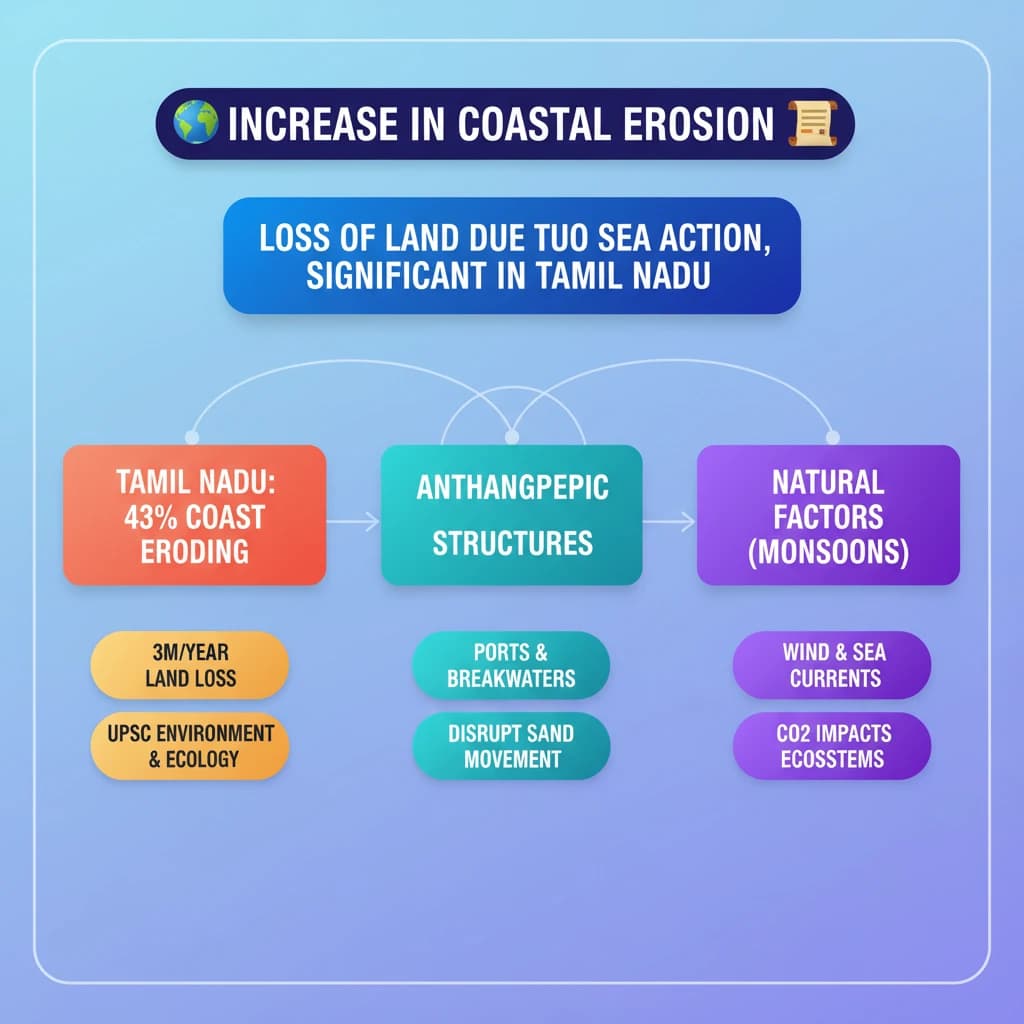
- •Coastal erosion is the loss of land due to sea action, significantly impacting areas like Tamil Nadu.
- •Nearly 43% of Tamil Nadu's coast is eroding, with annual land loss rates up to 3 meters.
- •Anthropogenic structures (ports, breakwaters) disrupt natural sand movement, accelerating erosion.
- •Natural factors like wind and sea current patterns, especially during monsoons, influence coastal dynamics.
- •Beyond direct coastal impact, environmental changes like increased CO2 can impact other ecosystems (e.g., grasslands).
- •Sustainable coastal management and Integrated Coastal Zone Management (ICZM) are crucial to mitigate the effects.
🧠 Memory Techniques
95% Verified Content
📚 Reference Sources
•General knowledge on coastal geomorphology and environmental policy in India