Loading page, please wait…
Increase in Forest and Tree Cover - UPSC Environment And Ecology
What is Increase in Forest and Tree Cover in UPSC Environment And Ecology?
Increase in Forest and Tree Cover is a key topic under Environment And Ecology for UPSC Civil Services Examination. Key points include: India's forest and tree cover increased by 1,445.81 km² since 2021, showing a positive trend.. Madhya Pradesh has the largest forest area, while Lakshadweep and Mizoram lead in percentage of forest cover.. India's forest carbon stock increased by 81.5 million tonnes, contributing significantly to climate targets.. Understanding this topic is essential for both UPSC Prelims and Mains preparation.
Why is Increase in Forest and Tree Cover important for UPSC exam?
Increase in Forest and Tree Cover is a Medium-level topic in UPSC Environment And Ecology. It is tested in both Prelims (factual MCQs) and Mains (analytical answer writing). Previous year UPSC questions have frequently covered aspects of Increase in Forest and Tree Cover, making it essential for comprehensive IAS preparation.
How to prepare Increase in Forest and Tree Cover for UPSC?
To prepare Increase in Forest and Tree Cover for UPSC: (1) Study the comprehensive notes covering all key concepts on Vaidra. (2) Practice previous year questions on this topic. (3) Connect it with current affairs using daily updates. (4) Revise using key takeaways and mind maps available for Environment And Ecology. (5) Write practice answers linking Increase in Forest and Tree Cover to related GS Paper topics.
Key takeaways of Increase in Forest and Tree Cover for UPSC
- India's forest and tree cover increased by 1,445.81 km² since 2021, showing a positive trend.
- Madhya Pradesh has the largest forest area, while Lakshadweep and Mizoram lead in percentage of forest cover.
- India's forest carbon stock increased by 81.5 million tonnes, contributing significantly to climate targets.
- Mangrove cover experienced a net decrease of 7.43 km², with regional variations (e.g., Gujarat's decrease vs. Andhra Pradesh/Maharashtra's increase).
- The Forest Survey of India (FSI), established in 1981, is the key national agency for monitoring forest resources.
- India's efforts in forest expansion align with international commitments like the Paris Agreement and Bonn Challenge, bolstering its global standing.
Increase in Forest and Tree Cover
Medium⏱️ 8 min read
environment and ecology
📖 Introduction
Overall Increase in Forest and Tree Cover
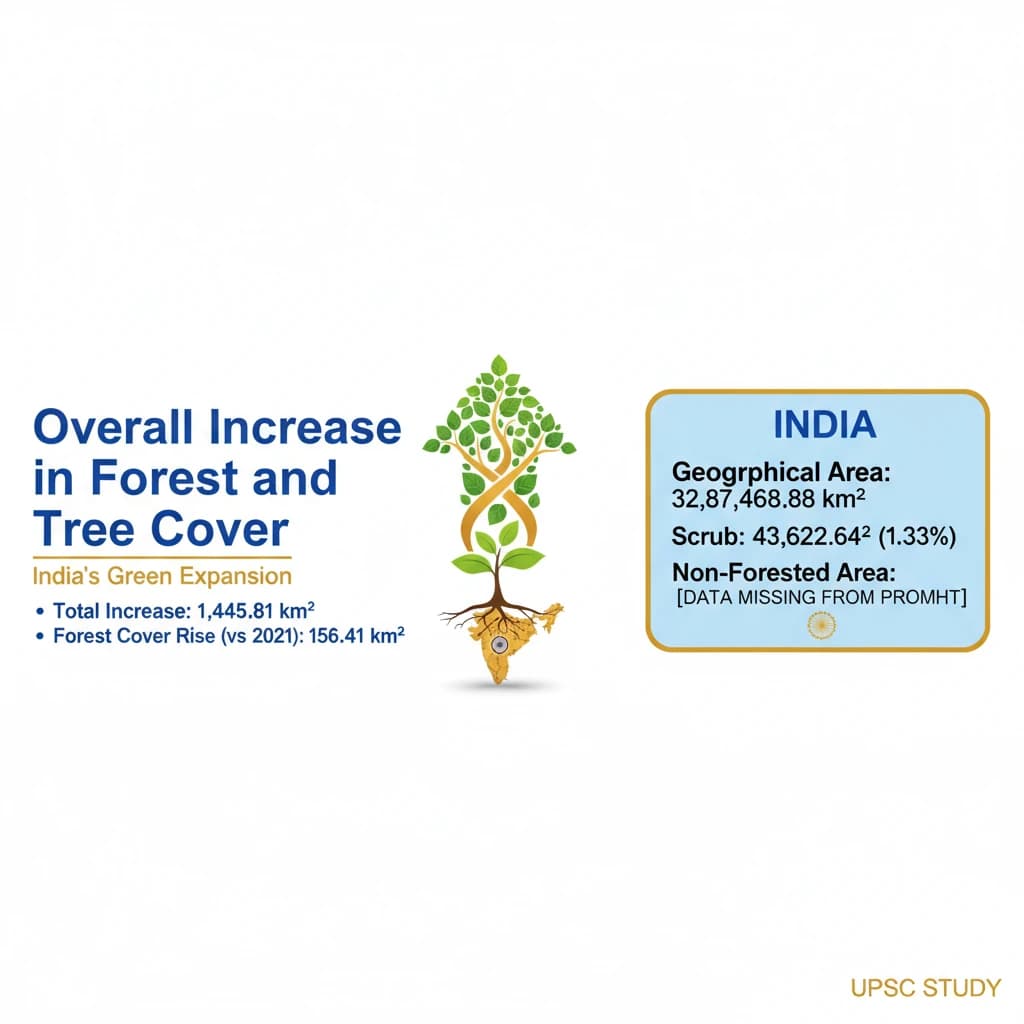
India has shown a positive trend in its forest and tree cover. The total increase is 1,445.81 km², with a specific rise of 156.41 km² in forest cover compared to 2021.
The geographical area of India is 32,87,468.88 km². Scrub constitutes 43,622.64 km² (1.33%), while Non-Forest land is 24,16,489.29 km² (73.50%).
States with Maximum Increase in Forest and Tree Cover
Several states have contributed significantly to the overall increase in forest and tree cover. Chhattisgarh led with an increase of 684 sq km.
It was closely followed by Uttar Pradesh and Odisha, both recording an increase of 559 sq km. Rajasthan also showed a notable rise of 394 sq km.
States with Maximum Increase in Forest Cover (Specifically)
When considering only forest cover, Mizoram registered the highest increase of 242 sq km. Gujarat followed with an increase of 180 sq km.
Odisha also contributed significantly with a rise of 152 sq km in its forest cover.
States with Largest Decrease in Forest Cover
Despite the overall increase, some states experienced a decrease in their forest cover. Madhya Pradesh saw the largest reduction of 612.41 km².
Other states with significant decreases included Karnataka (439.36 km²), Ladakh (159.26 km²), and Telangana (125.32 km²).
Top States by Forest Area
In terms of the absolute geographical area covered by forests, certain states stand out. Madhya Pradesh holds the largest forest cover with 77,073 sq km.
It is followed by Arunachal Pradesh (65,882 sq km) and Chhattisgarh (55,812 sq km).
Top States by Percentage of Forest Cover
When considering the percentage of forest cover relative to the total geographical area, the picture changes. Lakshadweep has the highest percentage at 91.33%.
Mizoram (85.34%) and Andaman & Nicobar Island (81.62%) also have very high percentages.
19 states/UTs have more than 33% of their geographical area under forest cover, a crucial ecological benchmark.
Eight of these states/UTs—Mizoram, Lakshadweep, A & N Island, Arunachal Pradesh, Nagaland, Meghalaya, Tripura, and Manipur—boast forest cover above 75%.
Forest Carbon Stock
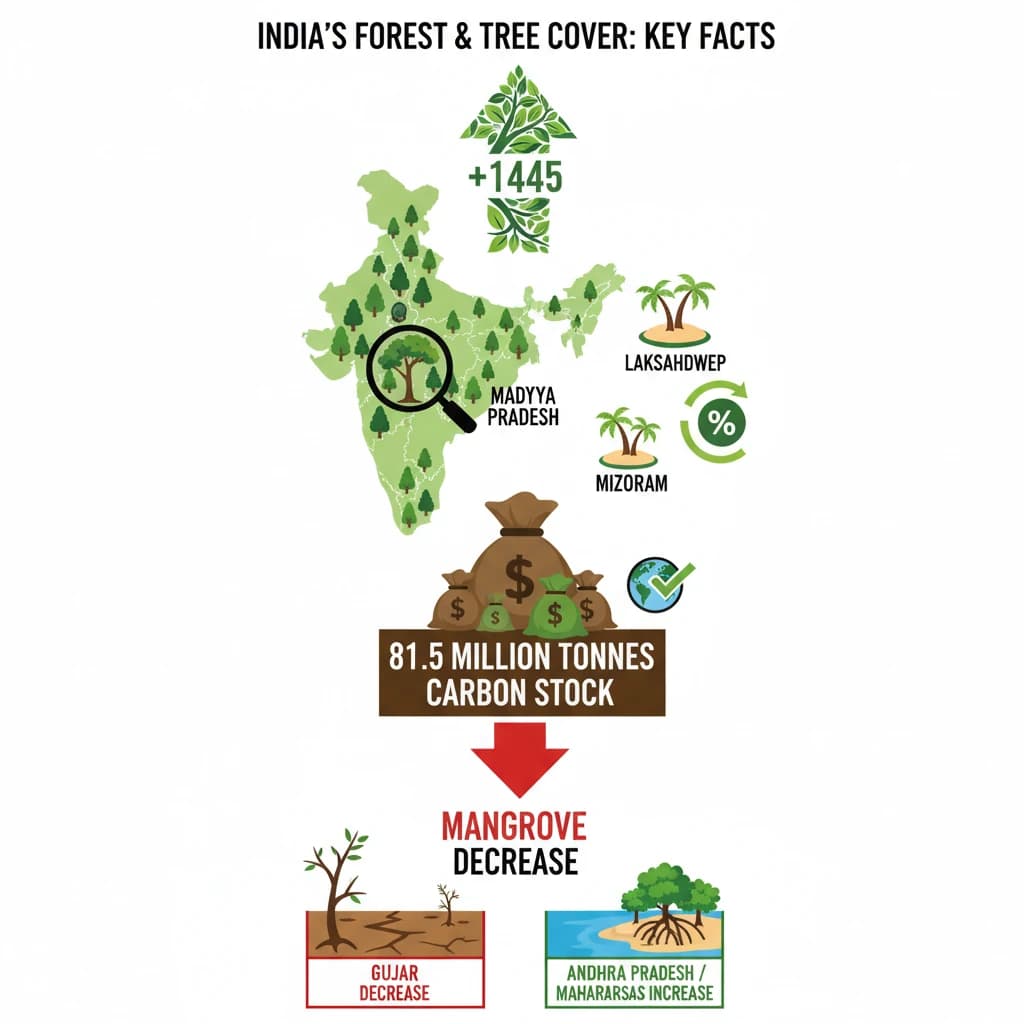
Forests play a vital role as carbon sinks, absorbing atmospheric carbon dioxide. India's forest carbon stock is estimated at 7,285.5 million tonnes, showing an increase of 81.5 million tonnes since 2021.
The country's total carbon stock has reached 30.42 billion tonnes of CO₂ equivalent. This exceeds the 2005 base year by 2.29 billion tonnes, bringing India closer to its 2030 target of 2.5–3.0 billion tonnes.
Top contributors to carbon stock include Arunachal Pradesh (1,021 Mt), Madhya Pradesh (926 Mt), Chhattisgarh (505 Mt), and Maharashtra (465 Mt).
Regional Performance
Specific ecological regions demonstrate unique forest cover characteristics. The Western Ghats Eco-Sensitive Areas (WGESA) span 60,285.61 km², with 73% (44,043.99 km²) under forest cover.
The Northeastern region has a total forest and tree cover of 1,74,394.70 km², which accounts for 67% of its geographical area.
Mangrove Cover
Mangroves are crucial coastal ecosystems. India's mangrove cover is 4,991.68 km², representing 0.15% of the total geographical area.
There was a net decrease of 7.43 km² in mangrove cover since 2021. Gujarat saw a decrease of 36.39 km².
However, Andhra Pradesh and Maharashtra experienced increases of 13.01 km² and 12.39 km² respectively.
Forest Fire Incidents
Forest fires pose a significant threat to forest ecosystems. In the 2023-24 season, the states with the most fire incidents were Uttarakhand, Odisha, and Chhattisgarh.
Understanding the trends in forest fires is crucial for disaster management and environmental policy questions in UPSC Mains GS-III.
💡 Key Takeaways
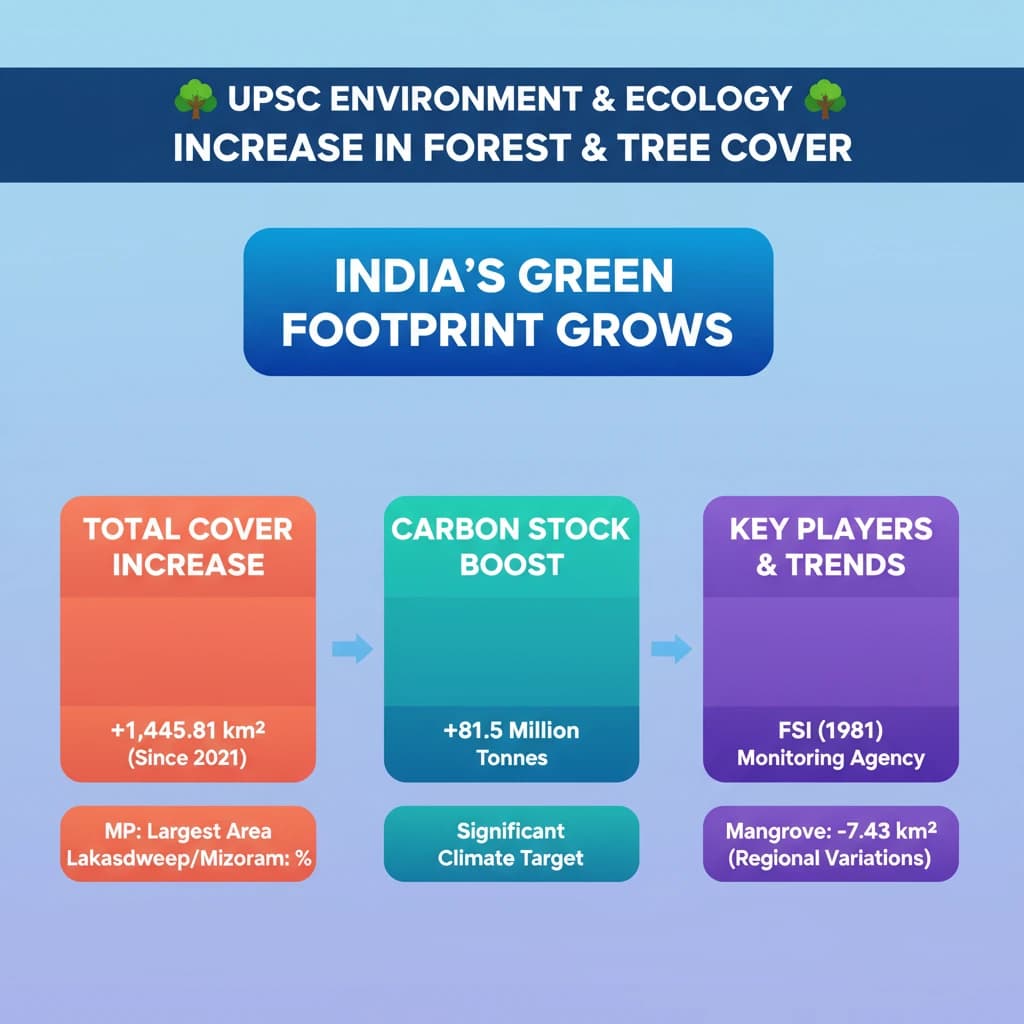
- •India's forest and tree cover increased by 1,445.81 km² since 2021, showing a positive trend.
- •Madhya Pradesh has the largest forest area, while Lakshadweep and Mizoram lead in percentage of forest cover.
- •India's forest carbon stock increased by 81.5 million tonnes, contributing significantly to climate targets.
- •Mangrove cover experienced a net decrease of 7.43 km², with regional variations (e.g., Gujarat's decrease vs. Andhra Pradesh/Maharashtra's increase).
- •The Forest Survey of India (FSI), established in 1981, is the key national agency for monitoring forest resources.
- •India's efforts in forest expansion align with international commitments like the Paris Agreement and Bonn Challenge, bolstering its global standing.
🧠 Memory Techniques
95% Verified Content