Loading page, please wait…
International Big Cat Alliance - UPSC Environment And Ecology
What is International Big Cat Alliance in UPSC Environment And Ecology?
International Big Cat Alliance is a key topic under Environment And Ecology for UPSC Civil Services Examination. Key points include: IBCA is an India-led global alliance launched in 2023 to conserve 7 big cat species and their habitats.. Focuses on Tigers, Lions, Leopards, Snow Leopards, Cheetah, Jaguar, and Puma; five of these are found in India.. Objectives include preventing illegal trade, habitat conservation, resource mobilization, and climate change mitigation.. Understanding this topic is essential for both UPSC Prelims and Mains preparation.
Why is International Big Cat Alliance important for UPSC exam?
International Big Cat Alliance is a Medium-level topic in UPSC Environment And Ecology. It is tested in both Prelims (factual MCQs) and Mains (analytical answer writing). Previous year UPSC questions have frequently covered aspects of International Big Cat Alliance, making it essential for comprehensive IAS preparation.
How to prepare International Big Cat Alliance for UPSC?
To prepare International Big Cat Alliance for UPSC: (1) Study the comprehensive notes covering all key concepts on Vaidra. (2) Practice previous year questions on this topic. (3) Connect it with current affairs using daily updates. (4) Revise using key takeaways and mind maps available for Environment And Ecology. (5) Write practice answers linking International Big Cat Alliance to related GS Paper topics.
Key takeaways of International Big Cat Alliance for UPSC
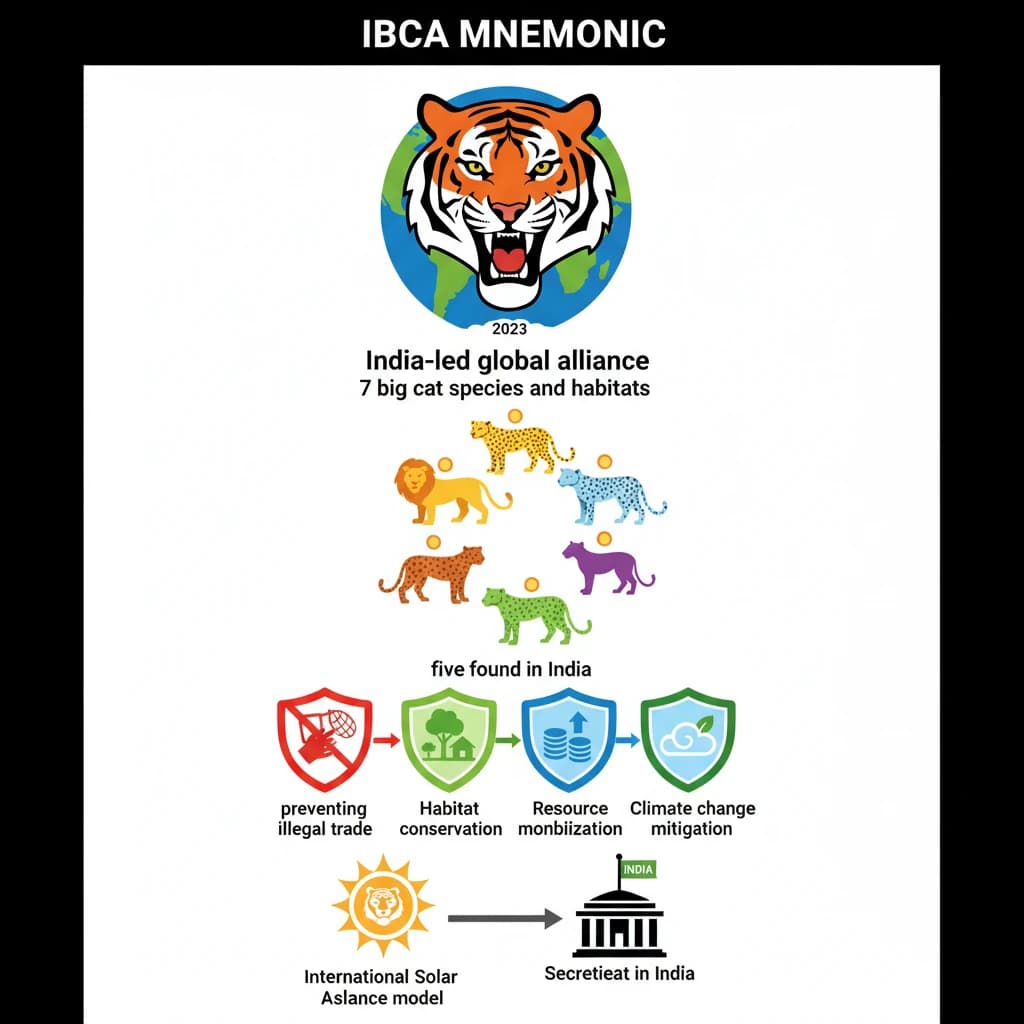
- IBCA is an India-led global alliance launched in 2023 to conserve 7 big cat species and their habitats.
- Focuses on Tigers, Lions, Leopards, Snow Leopards, Cheetah, Jaguar, and Puma; five of these are found in India.
- Objectives include preventing illegal trade, habitat conservation, resource mobilization, and climate change mitigation.
- Governance structure is modelled after the International Solar Alliance (ISA), with a Secretariat in India.
- India has committed Rs 150 crore for five years as budgetary support.
- Big cats are keystone species and indicators of ecosystem health, facing threats from poaching, trade, and habitat loss.
International Big Cat Alliance
Medium⏱️ 7 min read
environment and ecology
📖 Introduction
Introduction to the International Big Cat Alliance (IBCA)
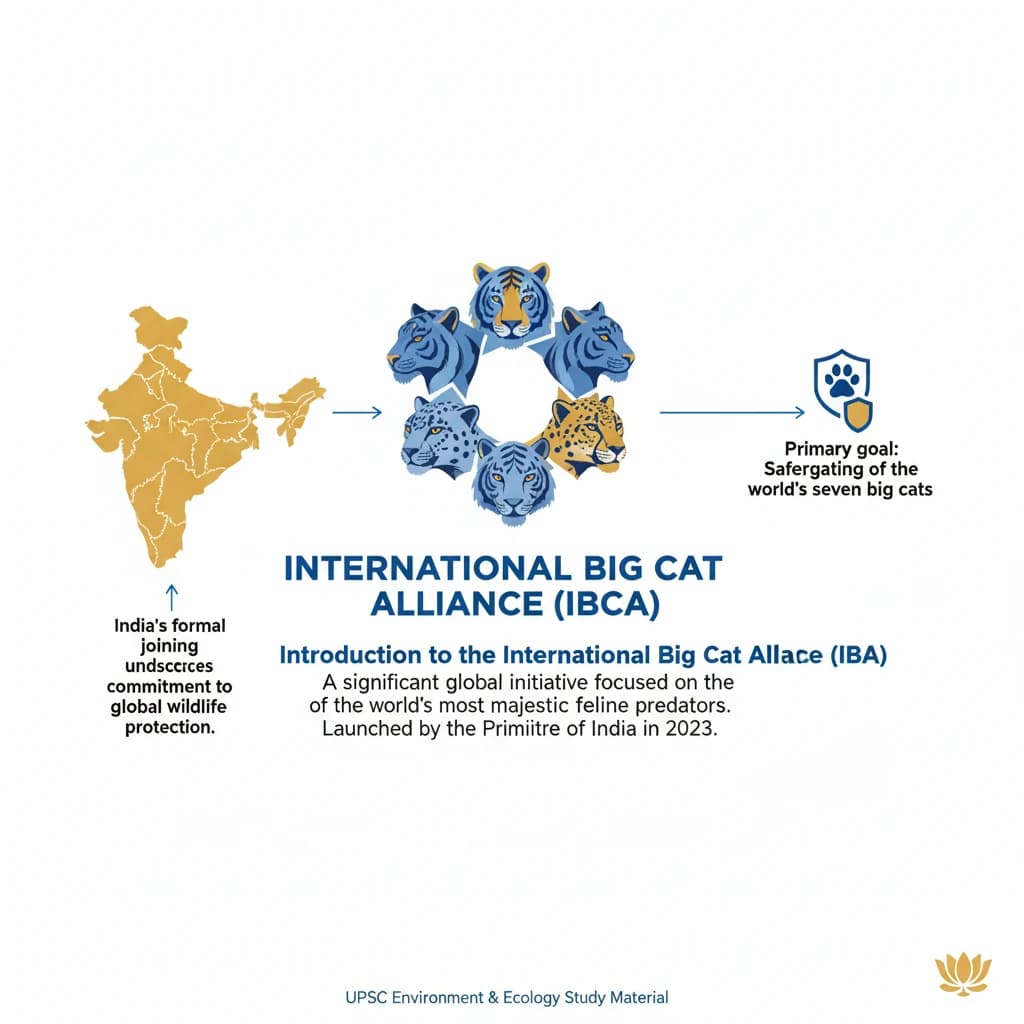
The International Big Cat Alliance (IBCA) is a significant global initiative focused on the conservation of the world's most majestic feline predators. It was officially launched by the Prime Minister of India in 2023.
India's formal joining of the IBCA underscores its commitment to global wildlife protection efforts. The alliance's primary goal is to safeguard big cats and their vital habitats across the globe.
While India initiated and launched the IBCA as a global institution, it is crucial to remember that India must still sign and ratify its Framework Agreement. This process is similar to how India approaches other major international agreements and bodies, such as the Paris Agreement, the Convention on Biological Diversity (CBD), and the Shanghai Cooperation Organization (SCO).
Coordination and Structure of IBCA
The IBCA operates as a multi-country, multi-agency coalition. It brings together 96 big cat range countries and non-range countries under a common umbrella for conservation.
The International Big Cat Alliance (IBCA) is coordinated by several key international organizations:
- Conservation International (CI)
- International Union for Conservation of Nature (IUCN)
- Intergovernmental Oceanographic Commission-UNESCO (IOC-UNESCO)
Governance Framework
The governance structure of the IBCA is designed for effective global coordination and implementation. It mirrors the successful model of the International Solar Alliance (ISA).
Key components of the IBCA's governance structure include:
- An Assembly of Members for overall strategic direction.
- A Standing Committee for ongoing oversight and decision-making.
- A Secretariat, which is strategically based in India.
A Director-General (DG) for the Secretariat is appointed by the Ministry of Environment, Forest and Climate Change (MoEFCC).
Core Objectives of the IBCA
The IBCA is driven by a comprehensive set of objectives aimed at holistic big cat conservation:
- To actively prevent the illegal wildlife trade involving the seven designated big cat species.
- To vigorously promote the conservation of natural habitats essential for these seven big cats.
- To effectively mobilise financial and technical resources to bolster conservation and protection efforts globally.
- To proactively work towards mitigating the adverse effects of climate change on big cat populations and their ecosystems.
- To strongly advocate for policy initiatives that seamlessly integrate biodiversity conservation with local community needs, contributing to United Nations-mandated Sustainable Development Goals (SDGs) within member countries.
Focus Species of the Alliance
The IBCA concentrates its conservation efforts on seven iconic big cat species, recognizing their ecological importance and vulnerability.
The seven big cat species at the heart of the IBCA's mission are:
- Tigers
- Lions
- Leopards
- Snow Leopards
- Cheetahs
- Jaguars
- Pumas
Out of these seven, five species—the tiger, lion, leopard, snow leopard, and cheetah—are naturally found in India. The puma and jaguar are not native to India.
Member Countries and Financial Support
The alliance is growing, with several nations formally committing to its cause. Early members play a crucial role in establishing its operational framework.
Currently, the IBCA counts four countries as its members:
- India
- Nicaragua
- Eswatini
- Somalia
To ensure the operational viability of the alliance, significant financial backing has been pledged by the Indian government.
The Union Cabinet has approved a substantial one-time budgetary support of Rs 150 crore for the IBCA. This allocation will cover a period of five years, from the fiscal year 2023-24 to 2027-28.
Ecological Significance of Big Cats
Big cats are not just magnificent creatures; they are vital components of their ecosystems, playing critical roles in maintaining ecological balance.
Key Ecological Roles:
- Keystone Species: Big cats are often keystone species, meaning their presence or absence significantly impacts the entire ecosystem structure and function.
- Ecosystem Health Indicators: They serve as critical indicators of ecosystem health. A decline in big cat populations often signals broader environmental degradation.
- Apex Predators: As apex predators, they regulate prey populations, preventing overgrazing and maintaining biodiversity within their habitats.
Despite their importance, big cat populations face severe threats globally, jeopardizing their survival and the health of the ecosystems they inhabit.
Major threats to big cat survival include:
- Poaching: Illegal hunting for their body parts, often for traditional medicine or trophies.
- Illegal Wildlife Trade: A lucrative black market driven by demand for exotic pets and animal products.
- Habitat Loss and Fragmentation: Due to human encroachment, agriculture, and infrastructure development.
- Human-Wildlife Conflict: Retaliatory killings due to livestock depredation.
Unique Characteristics of Big Cats
While often grouped, big cats exhibit diverse behaviors and social structures.
Distinctive Traits:
- Social Structure: Lions are the only big cats that live in complex social groups called prides and exhibit cooperative hunting behaviors. Most other big cats are largely solitary, except for mothers raising cubs.
- Size and Status: The Siberian tiger is renowned as the largest of all big cats. Unfortunately, it is currently listed as endangered, primarily due to threats like trophy hunting and its use in traditional Chinese medicine.
💡 Key Takeaways
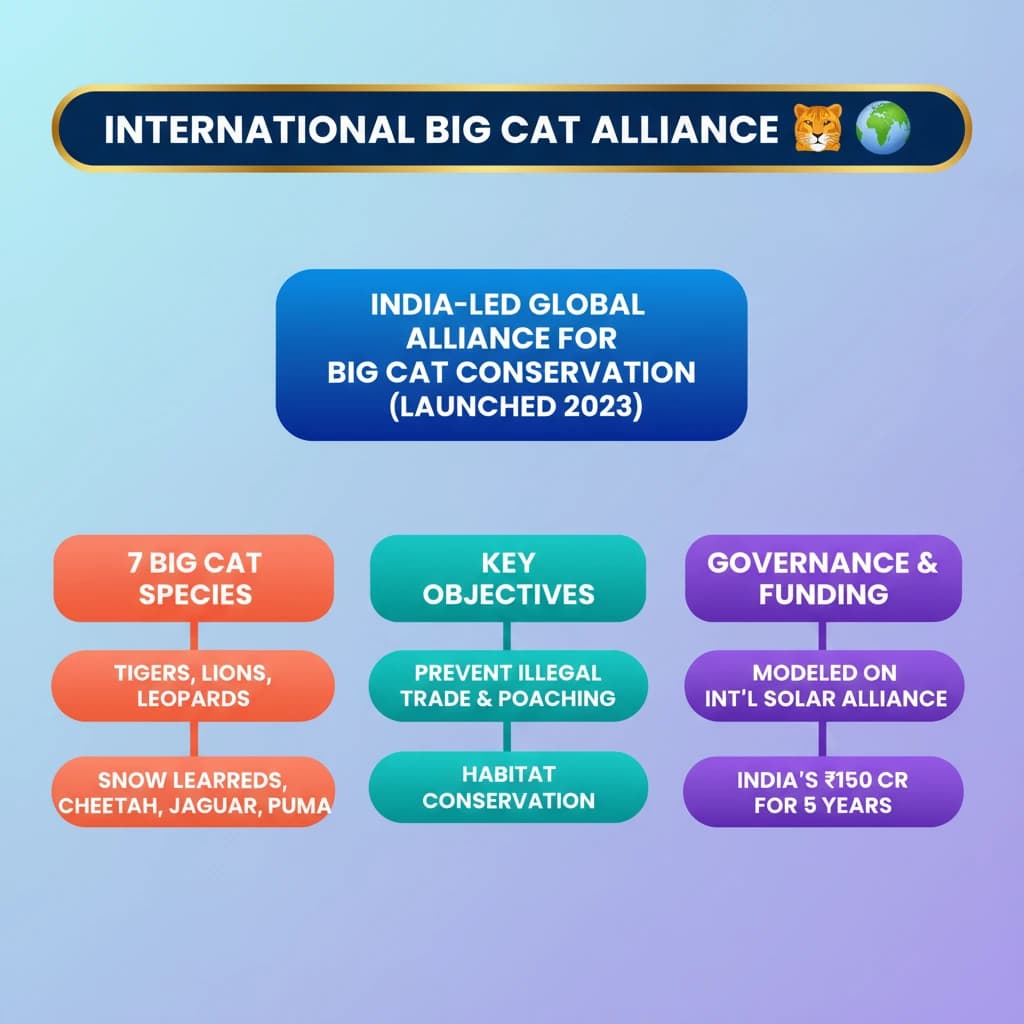
- •IBCA is an India-led global alliance launched in 2023 to conserve 7 big cat species and their habitats.
- •Focuses on Tigers, Lions, Leopards, Snow Leopards, Cheetah, Jaguar, and Puma; five of these are found in India.
- •Objectives include preventing illegal trade, habitat conservation, resource mobilization, and climate change mitigation.
- •Governance structure is modelled after the International Solar Alliance (ISA), with a Secretariat in India.
- •India has committed Rs 150 crore for five years as budgetary support.
- •Big cats are keystone species and indicators of ecosystem health, facing threats from poaching, trade, and habitat loss.
🧠 Memory Techniques
95% Verified Content