Loading page, please wait…
Mass Nesting of Olive Ridley Turtles - UPSC Environment And Ecology
What is Mass Nesting of Olive Ridley Turtles in UPSC Environment And Ecology?
Mass Nesting of Olive Ridley Turtles is a key topic under Environment And Ecology for UPSC Civil Services Examination. Key points include: <strong>Olive Ridley turtles</strong> are known for <strong>arribada</strong>, a unique mass nesting behavior.. Major Indian nesting sites include <strong>Rushikulya</strong> and <strong>Gahirmatha</strong> (world's largest rookery) in <strong>Odisha</strong>.. They are classified as <strong>Vulnerable</strong> (IUCN), <strong>Schedule I</strong> (WPA, 1972), and <strong>Appendix I</strong> (CITES).. Understanding this topic is essential for both UPSC Prelims and Mains preparation.
Why is Mass Nesting of Olive Ridley Turtles important for UPSC exam?
Mass Nesting of Olive Ridley Turtles is a Medium-level topic in UPSC Environment And Ecology. It is tested in both Prelims (factual MCQs) and Mains (analytical answer writing). Previous year UPSC questions have frequently covered aspects of Mass Nesting of Olive Ridley Turtles, making it essential for comprehensive IAS preparation.
How to prepare Mass Nesting of Olive Ridley Turtles for UPSC?
To prepare Mass Nesting of Olive Ridley Turtles for UPSC: (1) Study the comprehensive notes covering all key concepts on Vaidra. (2) Practice previous year questions on this topic. (3) Connect it with current affairs using daily updates. (4) Revise using key takeaways and mind maps available for Environment And Ecology. (5) Write practice answers linking Mass Nesting of Olive Ridley Turtles to related GS Paper topics.
Key takeaways of Mass Nesting of Olive Ridley Turtles for UPSC
- <strong>Olive Ridley turtles</strong> are known for <strong>arribada</strong>, a unique mass nesting behavior.
- Major Indian nesting sites include <strong>Rushikulya</strong> and <strong>Gahirmatha</strong> (world's largest rookery) in <strong>Odisha</strong>.
- They are classified as <strong>Vulnerable</strong> (IUCN), <strong>Schedule I</strong> (WPA, 1972), and <strong>Appendix I</strong> (CITES).
- <strong>Sex determination</strong> in hatchlings is <strong>temperature-dependent</strong>, making them vulnerable to climate change.
- Key threats include <strong>bycatch</strong>, <strong>habitat loss</strong>, and <strong>coastal pollution</strong>.
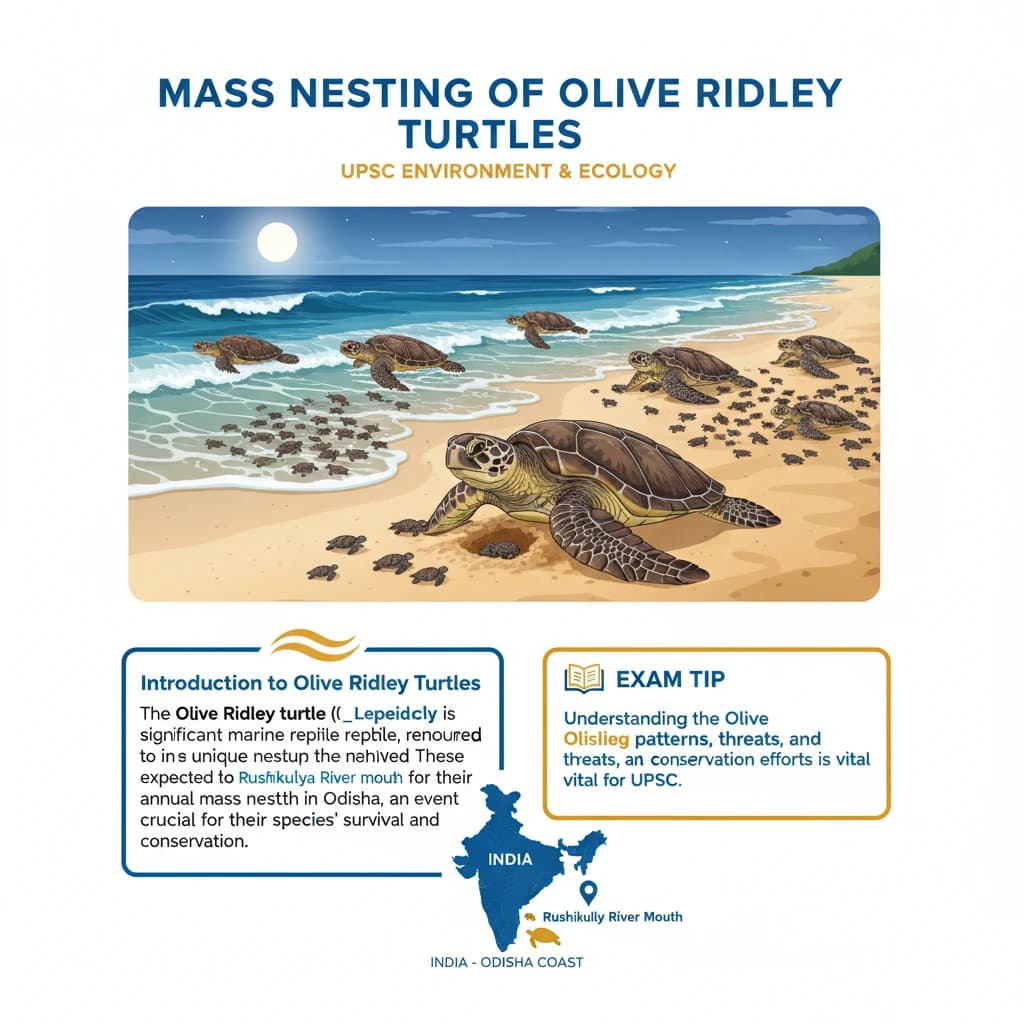
Mass Nesting of Olive Ridley Turtles
Medium⏱️ 8 min read
environment and ecology
📖 Introduction
Introduction to Olive Ridley Turtles
The Olive Ridley turtle (Lepidochelys olivacea) is a globally significant marine reptile, renowned for its unique mass nesting behavior. These turtles are expected to return to the Rushikulya River mouth in Odisha for their annual mass nesting, an event crucial for their species' survival and conservation.
Understanding the Olive Ridley turtle's lifecycle and conservation status is vital for UPSC Prelims (Environment & Ecology) and Mains GS-III (Biodiversity & Conservation).
Scientific Classification and Appearance
The Olive Ridley turtle belongs to the class Reptilia and the family Cheloniidae. Its scientific name is Lepidochelys olivacea.
Scientific Classification:
- Scientific Name: Lepidochelys olivacea
- Class: Reptilia
- Family: Cheloniidae
These turtles are characterized by their distinctive appearance. They typically have an olive or grayish-green coloration and a heart-shaped carapace (top shell). They closely resemble Kemp's ridleys (primarily found in the Gulf of Mexico) and are the smallest sea turtles globally, though their size and shape can vary by region, with the largest specimens found in West Africa.
Habitat and Distribution
Olive Ridley turtles are widely distributed across the tropical regions of the Pacific, Indian, and Atlantic Oceans. They inhabit both pelagic (open ocean) and coastal waters, demonstrating adaptability to different marine environments.
Major Nesting Sites in India:
- Rushikulya River mouth, Odisha
- Gahirmatha Marine Sanctuary, Odisha
- Devi River mouth, Odisha
- Andaman Islands
Gahirmatha Marine Sanctuary holds particular importance as it is recognized as the largest known mass nesting rookery for Olive Ridley sea turtles in the world.
Reproduction: The Arribada Phenomenon
The Olive Ridley turtles are most famous for their unique mass nesting behavior, known as arribada (a Spanish term meaning “arrival”). During an arribada, thousands of female turtles emerge simultaneously to nest on specific beaches.
Arribada: This term describes the synchronized mass nesting event where thousands of female Olive Ridley turtles gather and lay eggs together on a single stretch of beach. This behavior is rare among sea turtle species.
Their migratory journey is extensive; from September, they travel approximately 9,000 km from the Pacific to the Indian seas. After mating, the males typically retreat, while the females prepare for nesting, which occurs between December and March.
A female Olive Ridley can nest 1-3 times per season, laying around 100 eggs per clutch. A fascinating aspect of their reproduction is that the sex of the hatchlings is determined by the nest temperature, a phenomenon known as Temperature-Dependent Sex Determination (TSD).
Diet and Behavior
Like all sea turtle species, except the herbivorous Green Turtle, the Olive Ridley is primarily a carnivore. Their diet consists of a variety of marine organisms, ensuring their role in the marine food web.
Diet of Olive Ridley Turtles:
- Jellyfish
- Snails
- Crabs
- Prawns
- Algae
- Small fish
They undertake significant long-distance migrations between their feeding grounds and nesting sites, highlighting the need for protection across vast marine territories.
Conservation Status
The Olive Ridley turtle is afforded high levels of protection both nationally and internationally due to its vulnerable status.
Protection Status:
- Wildlife Protection Act, 1972: Schedule I (Highest protection)
- IUCN Red List: Vulnerable
- CITES (Convention on International Trade in Endangered Species of Wild Fauna and Flora): Appendix I (Prohibits international commercial trade)
Memorizing the conservation status (WPA, IUCN, CITES) for key species like the Olive Ridley is crucial for UPSC Prelims, as direct questions on these classifications are common.
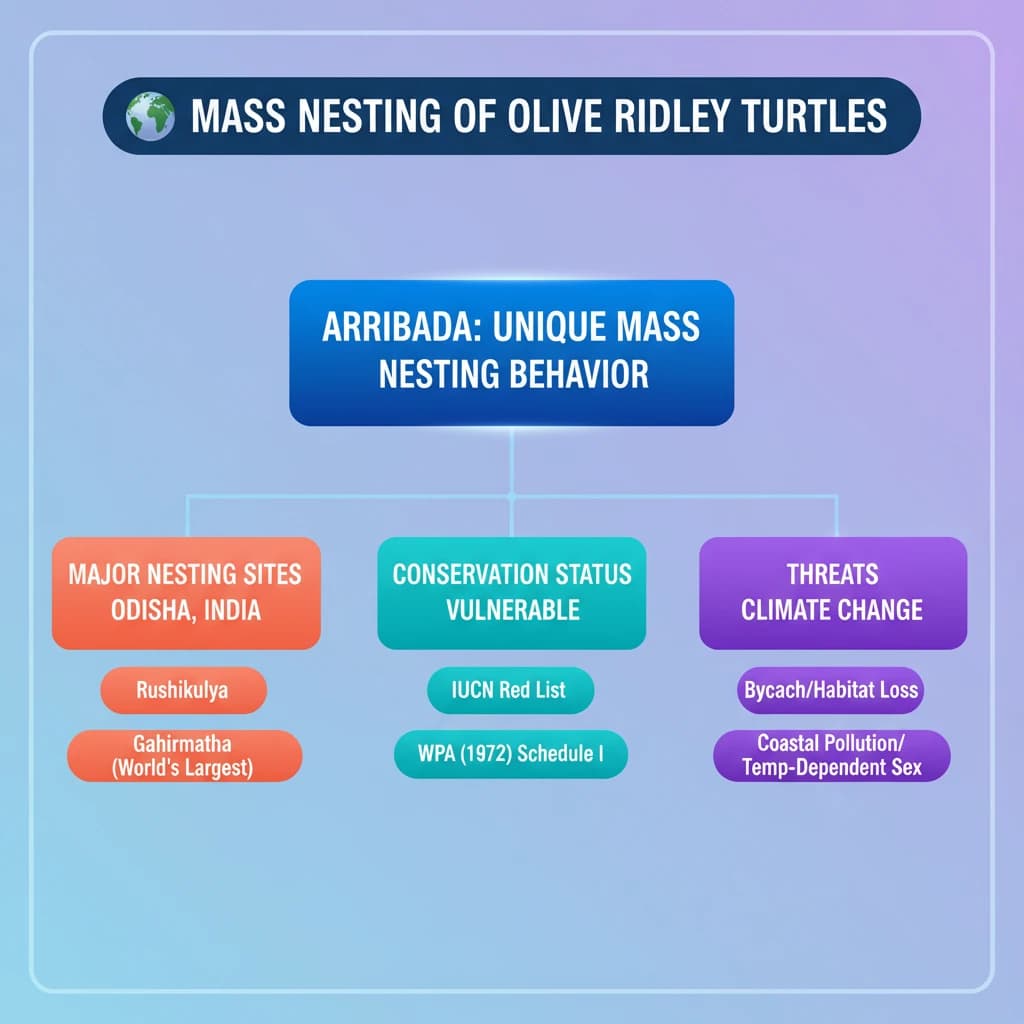
💡 Key Takeaways
- •<strong>Olive Ridley turtles</strong> are known for <strong>arribada</strong>, a unique mass nesting behavior.
- •Major Indian nesting sites include <strong>Rushikulya</strong> and <strong>Gahirmatha</strong> (world's largest rookery) in <strong>Odisha</strong>.
- •They are classified as <strong>Vulnerable</strong> (IUCN), <strong>Schedule I</strong> (WPA, 1972), and <strong>Appendix I</strong> (CITES).
- •<strong>Sex determination</strong> in hatchlings is <strong>temperature-dependent</strong>, making them vulnerable to climate change.
- •Key threats include <strong>bycatch</strong>, <strong>habitat loss</strong>, and <strong>coastal pollution</strong>.
🧠 Memory Techniques
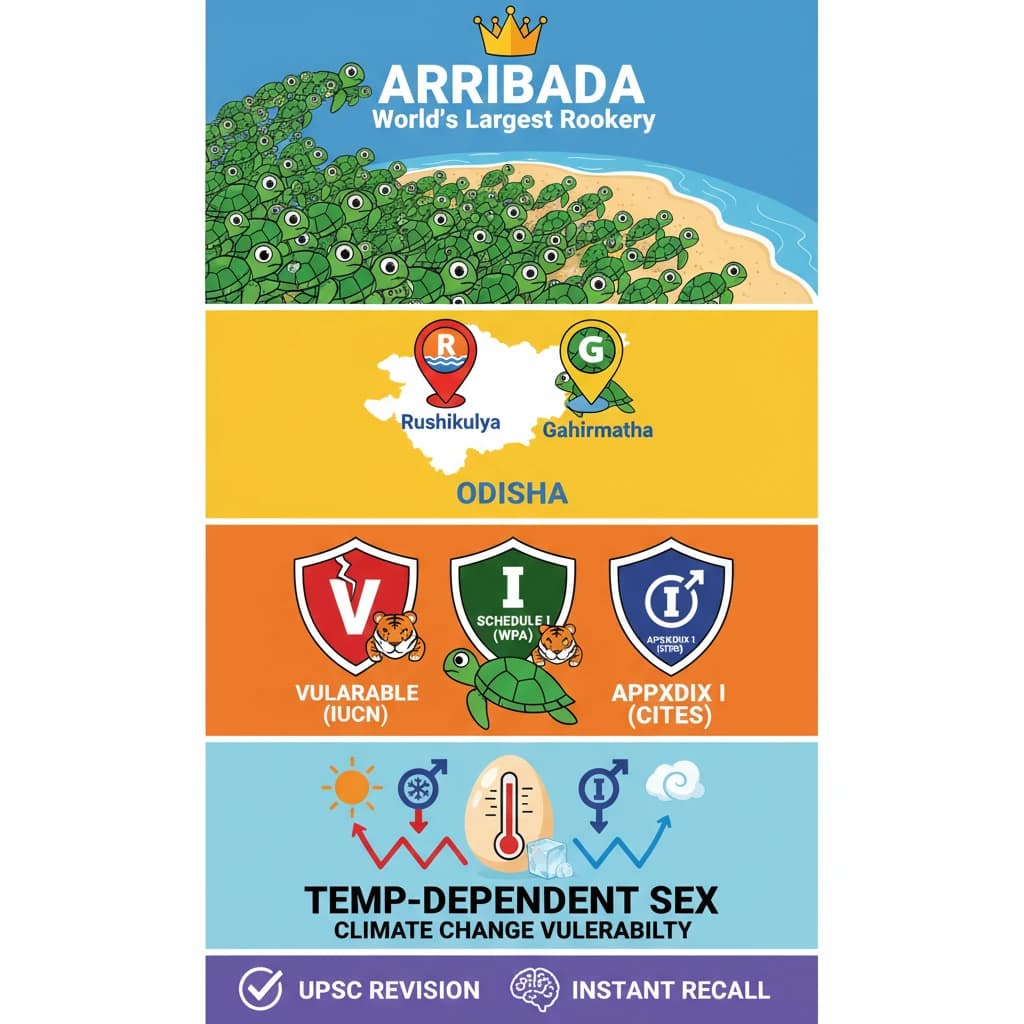
98% Verified Content
📚 Reference Sources
•Wildlife Protection Act, 1972 (Schedule I)
•IUCN Red List of Threatened Species (Vulnerable)
•CITES (Appendix I)
•General knowledge on Olive Ridley turtles and marine conservation