Loading page, please wait…
National Disaster Management Framework: Act, NDMA & NDRF - UPSC Environment And Ecology
What is National Disaster Management Framework: Act, NDMA & NDRF in UPSC Environment And Ecology?
National Disaster Management Framework: Act, NDMA & NDRF is a key topic under Environment And Ecology for UPSC Civil Services Examination. Key points include: DM Act 2005 is the legal foundation for disaster management in India.. NDMA (chaired by PM) is the apex body for policy and coordination, formed Sept 2006.. NDRF (formed 2006) is the world's largest rapid reaction force for disaster response.. Understanding this topic is essential for both UPSC Prelims and Mains preparation.
Why is National Disaster Management Framework: Act, NDMA & NDRF important for UPSC exam?
National Disaster Management Framework: Act, NDMA & NDRF is a Medium-level topic in UPSC Environment And Ecology. It is tested in both Prelims (factual MCQs) and Mains (analytical answer writing). Previous year UPSC questions have frequently covered aspects of National Disaster Management Framework: Act, NDMA & NDRF, making it essential for comprehensive IAS preparation.
How to prepare National Disaster Management Framework: Act, NDMA & NDRF for UPSC?
To prepare National Disaster Management Framework: Act, NDMA & NDRF for UPSC: (1) Study the comprehensive notes covering all key concepts on Vaidra. (2) Practice previous year questions on this topic. (3) Connect it with current affairs using daily updates. (4) Revise using key takeaways and mind maps available for Environment And Ecology. (5) Write practice answers linking National Disaster Management Framework: Act, NDMA & NDRF to related GS Paper topics.
Key takeaways of National Disaster Management Framework: Act, NDMA & NDRF for UPSC
- DM Act 2005 is the legal foundation for disaster management in India.
- NDMA (chaired by PM) is the apex body for policy and coordination, formed Sept 2006.
- NDRF (formed 2006) is the world's largest rapid reaction force for disaster response.
- NDMP defines roles for all government levels, NDMP 2016 was first aligned with Sendai Framework, revised in 2019.
- India chairs ADPC for 2024-25, highlighting regional leadership.
- National-level mechanisms ensure a comprehensive, multi-stakeholder approach to disaster risk reduction.
National Disaster Management Framework: Act, NDMA & NDRF
Medium⏱️ 8 min read
environment and ecology
📖 Introduction
Asian Disaster Preparedness Centre (ADPC)
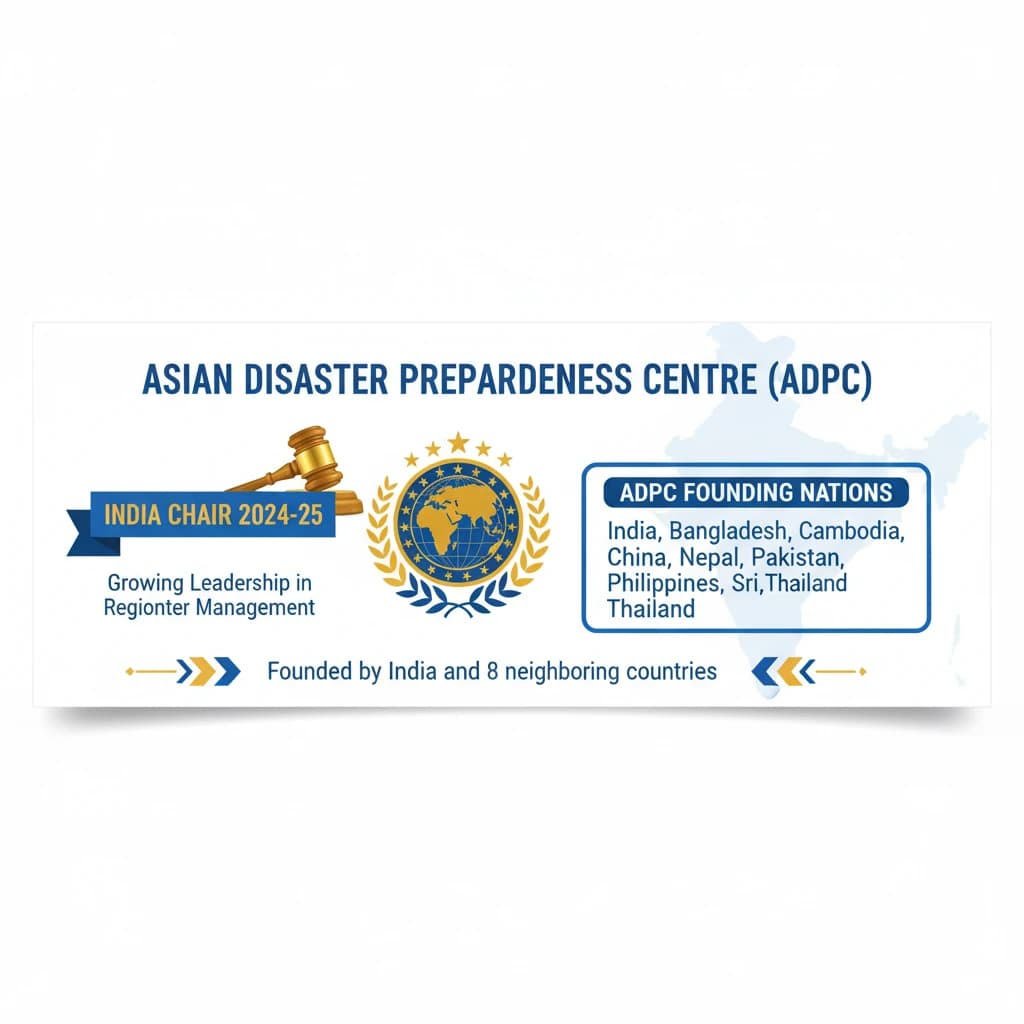
India holds the prestigious position of Chair of the Asian Disaster Preparedness Centre (ADPC) for the 2024-25 term. This highlights India's growing leadership in regional disaster management initiatives.
The ADPC was founded by India and eight of its neighboring countries. These include Bangladesh, Cambodia, China, Nepal, Pakistan, Philippines, Sri Lanka, and Thailand. Its establishment signifies a collaborative regional approach to disaster resilience.
Disaster Management Act of 2005
The Disaster Management Act (DM Act) was enacted by the Government of India in 2005. This landmark legislation provides the legal and institutional framework for disaster management in the country.
The primary purpose of the DM Act, 2005, is to ensure the efficient management of disasters. It also covers all other matters connected to, or incidental to, disaster management, from preparedness to response and recovery.
National Disaster Management Authority (NDMA)
The National Disaster Management Authority (NDMA) was formally constituted on 27th September 2006. Its formation was a direct outcome and mandate of the Disaster Management Act, 2005.
The Prime Minister of India serves as the ex-officio Chairperson of the NDMA. The authority comprises nine other members, with one among them designated as the Vice-Chairperson, ensuring high-level oversight and strategic direction.
National Disaster Response Force (NDRF)
The National Disaster Response Force (NDRF) is globally recognized as the world’s largest rapid reaction force dedicated solely to disaster response operations. It represents a critical component of India's disaster management machinery.
The NDRF was established in 2006 under the provisions of the DM Act, 2005. Its core mission is to provide a specialized response to both natural and man-made disasters, ensuring swift and effective relief operations.
National Disaster Management Plan (NDMP)
The National Disaster Management Plan (NDMP) is a comprehensive document that delineates the roles and responsibilities of various stakeholders involved in disaster management across India.
The NDMP defines the specific functions of Central Ministries/Departments, State Governments, Union Territory Administrations, District Authorities, and Local Self-Governments. This ensures a coordinated and multi-tiered approach to disaster preparedness and response.
The NDMP of 2016 was a significant milestone, being the world’s first ever national plan explicitly aligned with the Sendai Framework for Disaster Risk Reduction. This alignment underscores India's commitment to global best practices. A revised NDMP was subsequently introduced in 2019, reflecting evolving needs and strategies.
💡 Key Takeaways
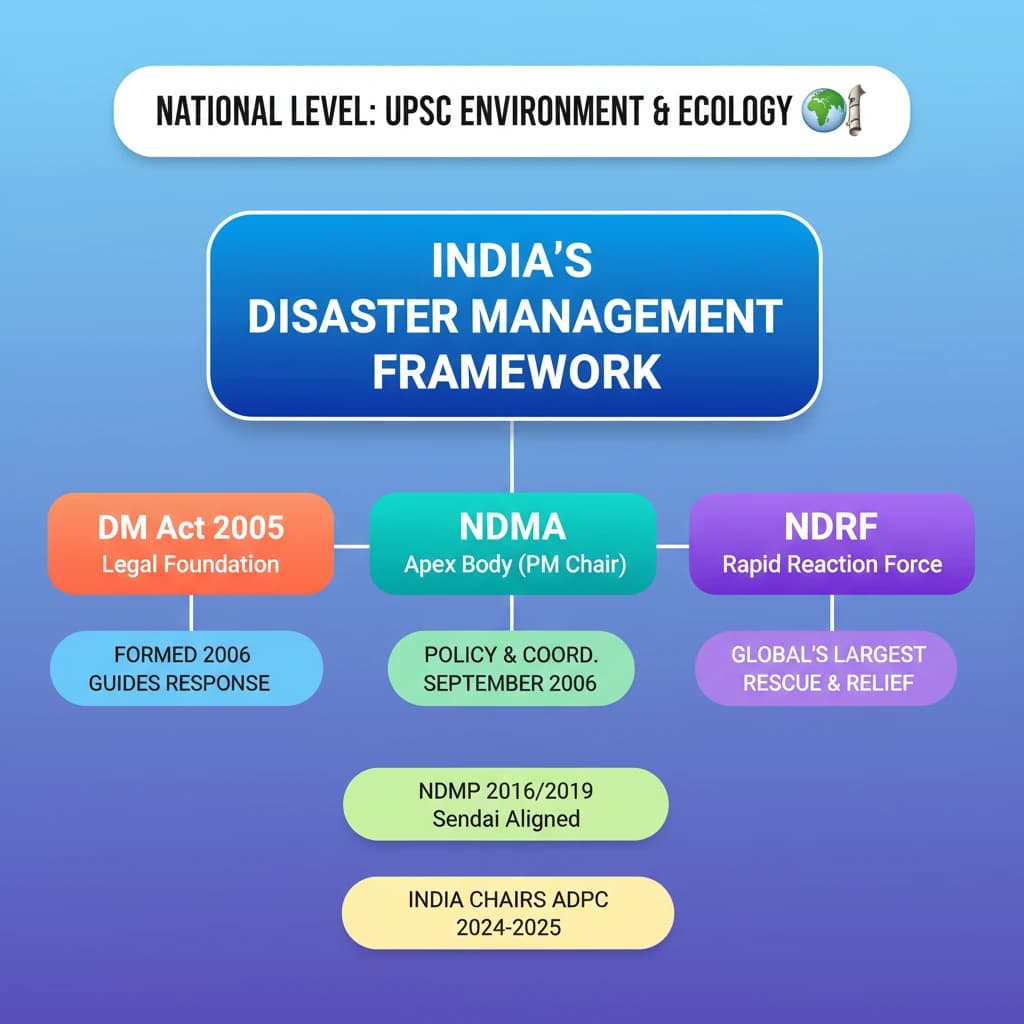
- •DM Act 2005 is the legal foundation for disaster management in India.
- •NDMA (chaired by PM) is the apex body for policy and coordination, formed Sept 2006.
- •NDRF (formed 2006) is the world's largest rapid reaction force for disaster response.
- •NDMP defines roles for all government levels, NDMP 2016 was first aligned with Sendai Framework, revised in 2019.
- •India chairs ADPC for 2024-25, highlighting regional leadership.
- •National-level mechanisms ensure a comprehensive, multi-stakeholder approach to disaster risk reduction.
🧠 Memory Techniques

98% Verified Content
📚 Reference Sources
•Disaster Management Act, 2005 (official document)
•National Disaster Management Authority (NDMA) website
•National Disaster Response Force (NDRF) website
•National Disaster Management Plan (NDMP) 2019 (official document)
•Asian Disaster Preparedness Centre (ADPC) official website