Loading page, please wait…
New Plant Discoveries - UPSC Environment And Ecology
What is New Plant Discoveries in UPSC Environment And Ecology?
New Plant Discoveries is a key topic under Environment And Ecology for UPSC Civil Services Examination. Key points include: India added 339 new plant taxa in 2023, with 171 entirely new species and 168 new distributional records.. West Bengal led in new plant discoveries, followed by Kerala and Uttarakhand.. Western Ghats and North Eastern Regions are key biodiversity hotspots for discoveries.. Understanding this topic is essential for both UPSC Prelims and Mains preparation.
Why is New Plant Discoveries important for UPSC exam?
New Plant Discoveries is a Medium-level topic in UPSC Environment And Ecology. It is tested in both Prelims (factual MCQs) and Mains (analytical answer writing). Previous year UPSC questions have frequently covered aspects of New Plant Discoveries, making it essential for comprehensive IAS preparation.
How to prepare New Plant Discoveries for UPSC?
To prepare New Plant Discoveries for UPSC: (1) Study the comprehensive notes covering all key concepts on Vaidra. (2) Practice previous year questions on this topic. (3) Connect it with current affairs using daily updates. (4) Revise using key takeaways and mind maps available for Environment And Ecology. (5) Write practice answers linking New Plant Discoveries to related GS Paper topics.
Key takeaways of New Plant Discoveries for UPSC
- India added 339 new plant taxa in 2023, with 171 entirely new species and 168 new distributional records.
- West Bengal led in new plant discoveries, followed by Kerala and Uttarakhand.
- Western Ghats and North Eastern Regions are key biodiversity hotspots for discoveries.
- Curcuma kachinense, a new turmeric species from Manipur, is 'Data Deficient' on the IUCN Red List.
- Curcuma species are known for significant antioxidant, anti-inflammatory, and other pharmacological properties.
- New discoveries underscore India's rich biodiversity and the ongoing need for extensive botanical exploration and conservation efforts.
New Plant Discoveries
Medium⏱️ 4 min read
environment and ecology
📖 Introduction
Faunal Discoveries Overview
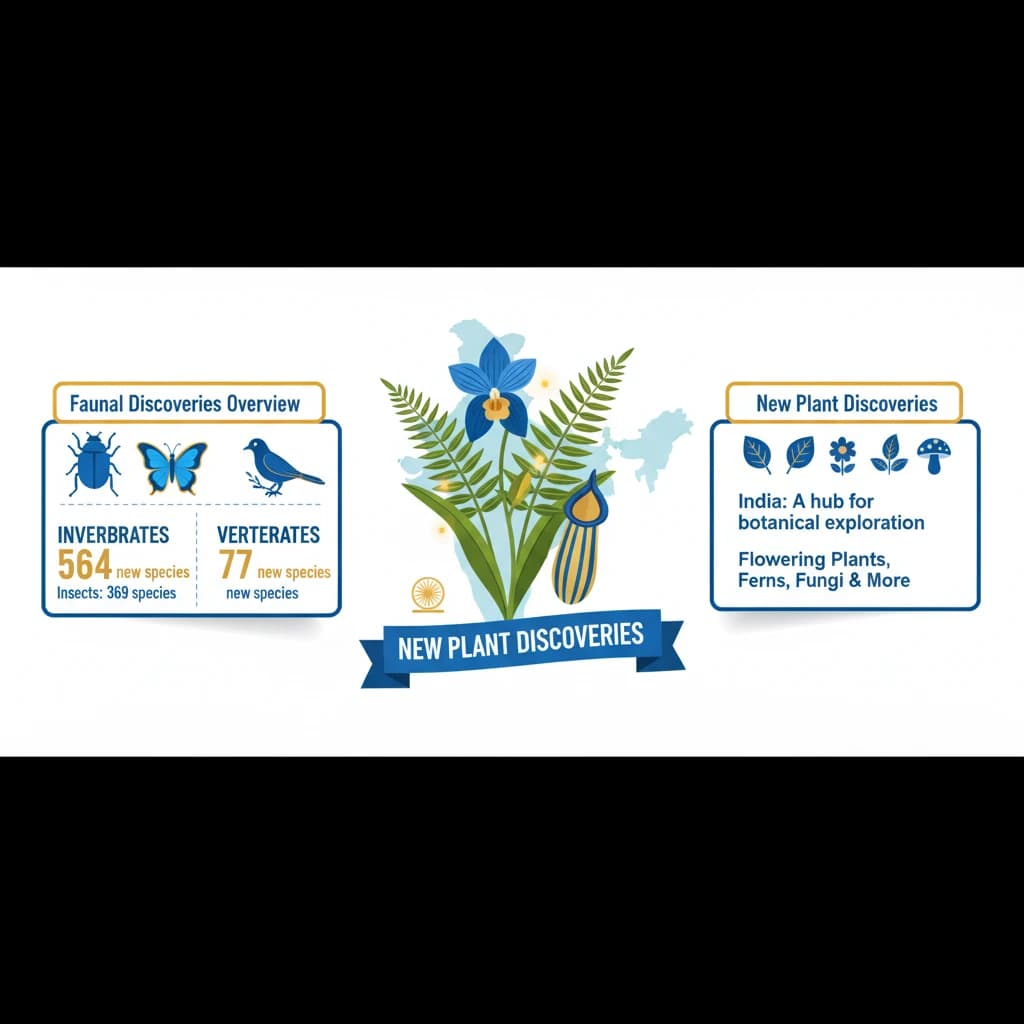
In the recent period, invertebrates accounted for the majority of new faunal discoveries in India, with a total of 564 new species identified. In contrast, vertebrates constituted a smaller number, with 77 new species discovered.
Among invertebrates, insects were the largest group, comprising 369 species. For vertebrates, fish dominated the discoveries with 47 species.
Following fish, the new vertebrate discoveries included reptiles, amphibians, and mammals. Aves (birds) recorded the least number of new species among vertebrates.
Floral Discoveries in India (2023)
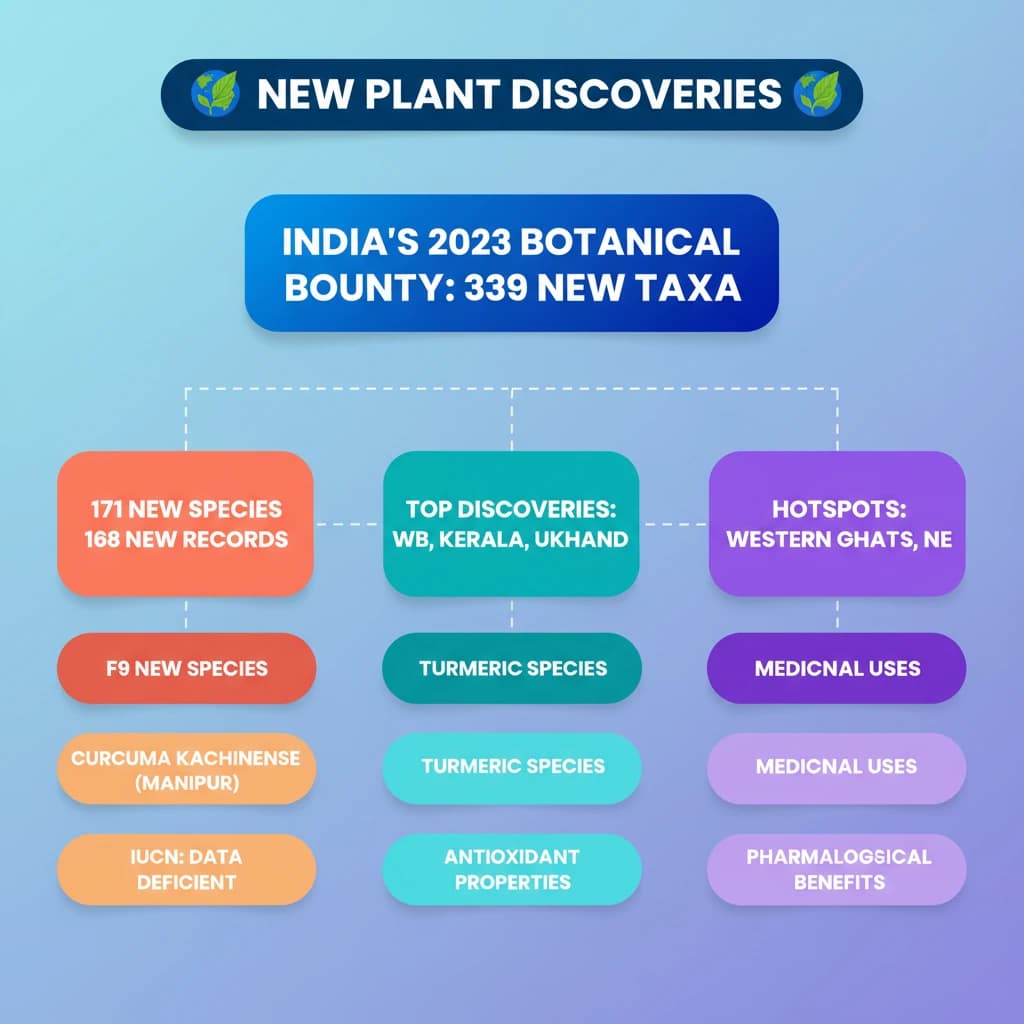
In 2023, India significantly expanded its plant database by adding 339 new taxa. This includes 326 new species and 13 infraspecific taxa, highlighting the rich botanical diversity of the country.
Of these 339 taxa, 171 taxa were entirely new to science. The remaining 168 taxa represent new distributional records, meaning they were found for the first time in India, though known elsewhere.
West Bengal emerged as the leading state for new plant discoveries, recording the highest number with 52 taxa. It was closely followed by Kerala and Uttarakhand, indicating significant botanical exploration in these regions.
The discoveries encompassed a wide range of plant groups. These included 106 angiosperms, 2 pteridophytes, 16 bryophytes, 44 lichens, 111 fungi, 50 algae, and 10 microbes, showcasing diverse life forms.
These new discoveries often include wild relatives of important horticultural, agricultural, medicinal, and ornamental plants. Examples include new species of begonias, impatiens, legumes, zingibers, and orchids, which can be crucial for genetic research and breeding programs.
The Western Ghats and the North Eastern Regions were identified as biodiversity hotspots, contributing to 14% of the total new discoveries. These regions are known for their endemic and diverse flora.
Curcuma kachinense: A New Turmeric Species
A significant floral discovery is Curcuma kachinense, a new species of turmeric found in Manipur’s Kakching district. This discovery was made by three researchers in the region.
Characteristics of Curcuma kachinense
- It is a new flowering plant species belonging to the ginger family (Zingiberaceae).
- It closely resembles well-known plants such as turmeric, ginger, galangal, and cardamom.
- This plant can grow quite tall, reaching up to eight feet, and features large terminal inflorescences.
- It was specifically found thriving along the banks of the stream of Silver Falls in the Kakching district of Manipur.
- It bears a striking resemblance to Curcuma longa, locally known as yaiying.
- A distinguished appearance is noted by its vibrant rhizomes, which possess a very bitter taste.
Curcuma kachinense has been classified as “Data Deficient” under the guidelines of the IUCN Red List category. This classification indicates insufficient information to assess its risk of extinction.
Medicinal Properties of Curcuma Species
Several Curcuma species, including the common turmeric (Curcuma longa), have been utilized for centuries. Their applications span traditional medicines, spices, dyes, perfumes, cosmetics, and as ornamental plants.
The rhizomes of turmeric contain active compounds like curcumin and several curcuminoids. These compounds are known for their significant antioxidant and anti-inflammatory properties.
The essential oil derived from Curcuma species exhibits a broad spectrum of pharmacological activities. These include anti-inflammatory, anti-cancerous, anti-diabetic, anti-microbial, anti-malarial, anti-venom, anti-oxidant, anti-rheumatic, hypotensive, anti-viral, and anti-parasitic effects.
Asystasia Venui: Another Notable Discovery
Another recent discovery is Asystasia Venui, a new flowering plant. It was found in the Acharya Jagadish Chandra Bose Indian Botanic Garden at Howrah, West Bengal, underscoring the importance of botanical gardens in conservation and discovery efforts.
💡 Key Takeaways
- •India added 339 new plant taxa in 2023, with 171 entirely new species and 168 new distributional records.
- •West Bengal led in new plant discoveries, followed by Kerala and Uttarakhand.
- •Western Ghats and North Eastern Regions are key biodiversity hotspots for discoveries.
- •Curcuma kachinense, a new turmeric species from Manipur, is 'Data Deficient' on the IUCN Red List.
- •Curcuma species are known for significant antioxidant, anti-inflammatory, and other pharmacological properties.
- •New discoveries underscore India's rich biodiversity and the ongoing need for extensive botanical exploration and conservation efforts.
🧠 Memory Techniques

95% Verified Content